


The Gulf of Thailand stretches from the coconut palms of Koh Samui to the mangrove-fringed bays of Trat province, taking in everything from luxe private-pool villas to bamboo bungalows. It is not one single destination. Weather patterns, transport, nightlife and hotel styles vary sharply between the southern "Lower Gulf" islands around Samui and the eastern Trat group near Koh Chang and Koh Kood, as well as the mainland towns of Hua Hin, Pattaya and low-key Khanom. Choosing the right base is the single most important decision you will make for a Gulf holiday. This guide breaks down the main islands and beach towns, where to stay in each, and which suits families, honeymooners, divers, solo travellers and digital nomads.
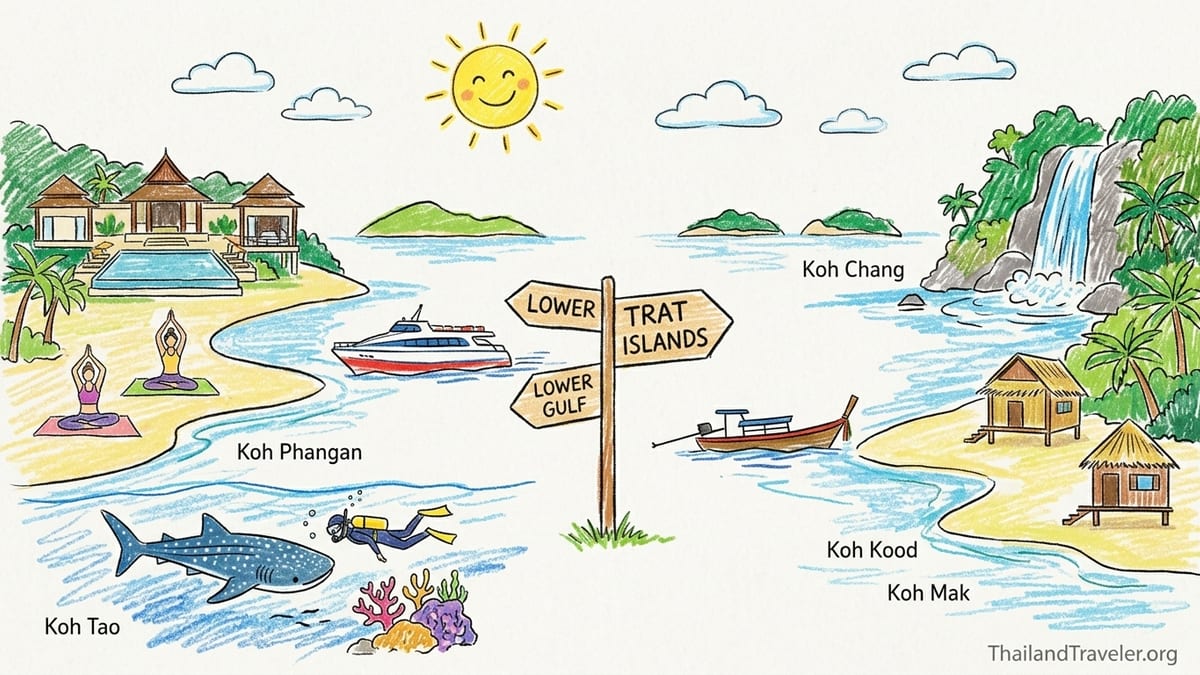
Lower Gulf vs Trat Islands: How the Gulf of Thailand Really Fits Together
Most maps colour the Gulf of Thailand in a single shade of blue, but travellers experience it as two quite separate playgrounds. The Lower Gulf consists of Koh Samui, Koh Phangan, Koh Tao and the nearby mainland coast around Surat Thani and Nakhon Si Thammarat, including the quiet beaches of Khanom. These islands are linked by frequent high-speed ferries and a busy regional airport on Samui, which makes them easy to combine on one itinerary. North and east, off the coast of Trat province, a second island arc includes Koh Chang, Koh Kood and Koh Mak. These are reached from piers around Laem Ngop and Laem Sok in eastern Thailand and are generally combined with Bangkok or Cambodia rather than with Samui.
Weather is another key difference. The Samui – Phangan – Tao trio is sheltered from the southwest monsoon that soaks Phuket and Krabi in mid-year. Samui and its neighbours tend to be relatively dry from January to September, with their heaviest rain between October and December when the northeast monsoon pushes rain onto the east side of the peninsula. By contrast, the Trat islands follow the same pattern as much of mainland eastern Thailand, with a wetter period roughly from May to October and a drier season from November to April, though showers can still appear. When you see "Gulf of Thailand" on a brochure, do not assume the weather will be the same on Koh Samui and Koh Chang in a given month.
Logistics also separate the two regions. There is no practical ferry network linking the Lower Gulf islands to Koh Chang, Koh Kood or Koh Mak. Travellers who want to visit both clusters in a single trip usually route via Bangkok and combine a domestic flight with a long overland transfer. For most holidays of two weeks or less, it makes far more sense to choose either the Lower Gulf or the Trat islands and then add a mainland beach town or Bangkok rather than trying to link all of them.
Finally, the style of accommodation and atmosphere differ. Samui has polished international brands such as Four Seasons Resort Koh Samui and Anantara Bophut alongside midrange beach hotels and simple guesthouses. Koh Phangan and Koh Tao feel smaller and more independent, with everything from yoga retreats and boutique pool villas to budget dive dorms. Koh Chang and Koh Kood have more low-rise resorts and bungalow-style properties, with fewer big-name chains and a stronger "castaway" feel once you leave the west coast of Koh Chang. Understanding this split is the starting point for deciding where to stay.
Koh Samui: Luxury Resorts, Family Beaches and Easy Access
Koh Samui is the main gateway to the Lower Gulf and still the best choice if you want direct flights, polished service and a broad range of hotel categories. Its compact size makes it easy to sample several different coasts while basing yourself in one or two areas. Samui Airport is served by domestic flights from Bangkok and regional routes from hubs such as Singapore, and onward ferries fan out to Koh Phangan and Koh Tao. For most visitors, Samui works well as a three to seven night stay, either as a standalone holiday or in combination with a neighbouring island.
For luxury, the quiet northwest and northern cap of the island stand out. Four Seasons Resort Koh Samui spreads villas with private plunge pools across a hillside in Laem Yai Bay, looking over the Ang Thong Marine Park. It is a top-tier choice for honeymooners and families who want space and privacy, with recent entry-level villas often priced in the region of 1,000 to 1,500 US dollars per night in high season, including breakfast, and lower shoulder-season offers at certain times of year. On the north coast in Bophut, Anantara Bophut Koh Samui Resort fronts a long curve of sand near Fisherman’s Village, putting guests within walking distance of dozens of restaurants and cafes. Nightly rates there tend to range from roughly 250 to 450 US dollars for standard rooms in high season, with suites and pool categories higher.
Families often favour Bophut and Choeng Mon for a blend of calm water, easy dining and short transfers. Bophut’s Fisherman’s Village has a family-friendly evening market and many midrange hotels in the 100 to 200 US dollar per night bracket, some with kids’ pools and interconnecting rooms. Choeng Mon, near the airport but well insulated from flight noise, offers smaller coves with soft sand and a handful of resorts that feel self-contained. Chaweng, once the island’s nightlife hub, still has the longest beach and a full spread of accommodation from basic guesthouses under 60 US dollars per night to four-star resorts, but the main drag is busy and suits those who want bars and late-opening restaurants more than those craving quiet.
Samui is also convenient without a rental car. Airport and pier transfers are easy to arrange through hotels or private operators, and songthaew pick-up trucks circle the island. However, the hilly interior and limited pavements mean families with small children often choose resorts with good on-site facilities instead of planning to explore extensively on foot. As a rule of thumb, budget travellers can still find simple fan rooms and older bungalows in pockets of Lamai or Maenam from around 25 to 40 US dollars per night, while midrange beachfront hotels in Lamai, Bophut and Maenam sit mostly between 80 and 200 US dollars. Most visitors are comfortable with three to five nights on Samui before moving on to Phangan or Tao.
Koh Phangan: Beach Retreats, Wellness and Targeted Nightlife
Koh Phangan is no longer just the home of the Full Moon Party. While Haad Rin on the southeast headland still hosts monthly beach parties and keeps a stock of budget guesthouses and party hostels, much of the rest of the island has evolved into a softer mix of yoga centres, boutique resorts and quiet bays. Regular ferries and speedboats link Phangan to Samui, the mainland and Koh Tao, with typical crossing times from Samui between 20 and 60 minutes depending on the operator and vessel.
The island’s most appealing accommodation areas are scattered around its west and north coasts. On the northeast peninsula, Thong Nai Pan Noi and Thong Nai Pan Yai are deep bays backed by headlands and jungle, with soft sand and relatively calm water in the main season. Santhiya Koh Phangan Resort & Spa occupies a large hillside and beachfront site here, with steeply stepped wooden villas and private pools that suit couples and honeymooners. Recent reports put many of its room categories in the approximate 180 to 350 US dollar per night range in high season, with more competitive rates outside peak dates, particularly in the shoulder months. Smaller boutique resorts and simple bungalows in the same bays can dip under 100 US dollars per night.
Along the west coast, Sri Thanu and Haad Yao have become hubs for longer-stay visitors, yoga enthusiasts and digital nomads. Expect a mix of modest beach resorts with monthly rates, plant-based cafes and co-working spaces set just back from the sand. Beachfront bungalows with air-con here can be found from around 40 to 80 US dollars per night depending on season, while more polished midrange resorts edge into the 100 to 200 US dollar bracket. Food options are excellent for Thailand’s smaller islands, from beachfront Thai seafood restaurants to European bakeries and coffee shops, which makes these bays well suited to travellers without a vehicle.
Koh Phangan does have hills and a partly rugged road network, so if you are not comfortable on a scooter, concentrating your stay in a self-contained bay makes sense. For party-focused trips, Haad Rin still offers dozens of cheap rooms and hostels below 40 US dollars, but noise and late nights are part of the bargain. For quiet beach retreats and wellness stays, Thong Nai Pan and the west coast beaches usually appeal more. Many travellers split their time, spending two or three nights near Haad Rin for a party, then moving to the north or west coasts for three to five quieter nights.
Koh Tao: Diving, Snorkelling and Compact Island Life
Koh Tao is the smallest of the three main Lower Gulf islands and the region’s main diving centre. High-speed ferries and catamarans connect it to Samui, Phangan and mainland piers in Chumphon and Surat Thani, with travel times from Samui often around two and a half hours. The island’s hilly terrain means most development is squeezed around a few key bays. Sairee Beach is the social and accommodation heart, with dive centres, bars and guesthouses lining a long sandy shore, while Mae Haad town wraps around the main pier.
Dive-oriented accommodation dominates the local market. Many dive schools operate their own rooms or partner guesthouses, sometimes offering discounted stays when you book courses. Shared rooms in basic dive hostels can cost in the region of 15 to 25 US dollars per night, while private fan rooms and older bungalows may start around 30 to 50 US dollars. Midrange hotels with air-con, pools and beach frontage on Sairee or smaller bays such as Chalok Baan Kao often cluster between 80 and 150 US dollars per night. High-end boutique villas with sea views, some with private plunge pools, have emerged on the hillsides and can command rates above 200 US dollars in peak seasons.
Koh Tao works especially well for travellers who want to focus on activities rather than resort facilities. The island has dozens of dive sites within short boat rides, and snorkelling opportunities around Shark Bay and the Japanese Gardens near neighbouring Nang Yuan. Restaurants, bars and nightspots line the beachfront in Sairee, so it is easy to eat out every night if you stay nearby. The flip side is that quiet is harder to find directly in the busiest stretches; couples and families seeking peace often look to smaller bays and boutique resorts that provide shuttles to the main town.
Because ferry schedules and sea conditions can sometimes be disrupted by weather, especially in the heavier-rain months from October onwards in the Lower Gulf, it is wise to allow at least three nights on Koh Tao if diving is a priority and not plan tight flight connections immediately after your stay. For a classic Gulf itinerary, many divers and younger backpackers opt for two or three nights on Samui, three to four on Phangan and four or more on Tao, but even a simple three-night stay on Koh Tao gives time for a short course or several fun dives.
Koh Chang: Larger Island Exploration in Trat Province
Koh Chang sits closer to Cambodia than to the Samui archipelago and is reached from piers in Trat province, with ferries departing the mainland near Ao Thammachat and Centrepoint and crossing to the island in less than an hour. Travellers typically reach Trat by bus or private transfer from Bangkok or by a short domestic flight followed by a road journey to the pier. Koh Chang is Thailand’s third largest island, with a hilly, jungle-clad interior and a string of beaches and small communities along its west coast. It suits visitors who like to move around and explore different bays rather than staying in a single compact resort area.
Most accommodation is concentrated along White Sand Beach, Klong Prao, Kai Bae and Lonely Beach on the west side. White Sand Beach has the best-developed tourist infrastructure, with midrange resorts at the northern end and a busier strip of bars and shops. Room rates here can range from around 40 to 80 US dollars for older hotels across the road from the sea, up to 150 to 250 US dollars for newer beachfront properties in high season. Moving south, Klong Prao offers wider, flatter sands and more family-friendly resorts that feel quieter and more spacious, with many four-star hotels priced between roughly 100 and 200 US dollars, including pools and kids’ facilities.
Kai Bae and Lonely Beach attract younger and more budget-conscious travellers. Simple huts, hostels and low-key resorts appear down side lanes, with some fan rooms under 30 US dollars and air-conditioned bungalows from around 40 to 70 US dollars. These areas also have some of the liveliest backpacker nightlife on the island, though on a far smaller scale than mainland Pattaya. The east coast of Koh Chang is much less developed, with a scattering of homestays, small resorts and boutique hideaways overlooking mangroves and fishing communities. This side suits those with their own transport who value peace more than direct beach access.
Koh Chang’s size makes it a good candidate for longer stays of five to seven nights, especially for travellers who want to mix beach days with waterfall hikes, boat trips and scooter exploration. It is not as practical for visitors who dislike riding motorbikes or using taxis, since public transport is limited. While many travellers do not book major international brands here, the range of independent resorts and guesthouses is broad. Because Koh Chang shares the wetter May to October pattern of the Trat region, some simpler beach bungalows close during the heaviest rains, and ferry schedules can be more weather dependent than in the dry months between November and April.
Koh Kood and Koh Mak: Quiet Castaway Islands with Low-impact Resorts
South of Koh Chang, Koh Kood and Koh Mak appeal to travellers who want space, subdued nightlife and a closer connection to nature. Both are accessed from piers in Trat province, such as Laem Sok for Koh Kood, using speedboats and ferries that usually run more frequently in the dry season. There is no bridge to either island, and there are no direct ferries linking them to the Samui archipelago, so they are best approached as a separate itinerary from Bangkok or the eastern mainland.
Koh Kood is one of Thailand’s larger but least developed islands, with scattered villages, plantations and a handful of small bays. Accommodation collects mainly along the west coast beaches such as Klong Chao, Ao Phrao and Bang Bao. At the ultra-luxury end of the market, Soneva Kiri occupies a vast private headland and adjacent beach with large pool villas, some reached by private buggy or boat. Package materials and traveller reports suggest nightly villa rates often well into four figures in US dollars during peak periods, reflecting its position in the very top tier of Asian beach resorts. Elsewhere on Koh Kood, midrange and upper-midrange resorts in Klong Chao and nearby bays tend to run from about 120 to 300 US dollars per night in high season, with a mix of beachfront bungalows and rooms in low-rise blocks.
Koh Mak is much smaller and lower in elevation, and markets itself as a quiet, low-impact island with an emphasis on family-run resorts, coconut plantations and simple pleasures. Its main accommodation strips sit around Ao Kao and Ao Suan Yai, where rustic-chic bungalows and small resorts line the sand. Rates are generally lower than Koh Kood’s, with sea-facing bungalows in many properties falling roughly between 60 and 150 US dollars per night in the busier months. Lighting is low, nightlife is almost non-existent and many visitors get around by bicycle or on foot rather than by motorbike or car. This makes Koh Mak particularly appealing to couples and families seeking a low-key stay with a lighter environmental footprint.
Both islands reward slower travel. Three nights can feel short once you factor in boat transfers and the relaxed pace of island life, so many visitors plan four to seven nights on Koh Kood or split a week between Koh Kood and Koh Mak. While restaurants are fewer than on Samui or Phangan, most midrange and above resorts have their own dining rooms, and small independent beach eateries dot the main bays. Because public transport is limited, visitors without their own vehicle tend to stay in or near the main beach clusters where walking to dinner is simple.
Koh Samet, Hua Hin, Pattaya and Khanom: Mainland Beach Bases
Not every Gulf holiday needs an island. Several mainland beach towns provide easier access from Bangkok or the southern transport hubs and can be good choices if you want to avoid multiple ferries. Each has a distinct accommodation pattern and atmosphere. Koh Samet, although an island, is often treated like a near-mainland extension of Bangkok because it sits just offshore from Rayong and is reached in a short boat ride after a road transfer from the capital. Hua Hin and nearby Cha-am stretch along the western side of the upper Gulf, while Pattaya and Jomtien are on the eastern side. Further south in the Lower Gulf, Khanom in Nakhon Si Thammarat province offers long, quiet beaches backed by simple resorts and small hotels.
Koh Samet is a classic short escape from Bangkok, popular with Thais and expatriates on two or three night breaks. Ferries and speedboats run from piers near Ban Phe in Rayong, making it realistic to leave Bangkok in the morning and be on the beach before lunch. Most accommodation clusters around Sai Kaew Beach and a handful of smaller bays to the south and east. Sai Kaew has the liveliest strip, with midrange beachfront hotels in the region of 80 to 180 US dollars per night and simpler guesthouses inland starting below 60 US dollars. Quieter bays such as Ao Phai and Ao Wong Duean hold a blend of small resorts and bungalows, with some romantic options for couples and reasonable choices for families who want swimmable water and easy restaurant access.
Hua Hin, about three hours by road from Bangkok, developed as a royal seaside retreat and today offers a long run of mostly midrange and upper-midrange resorts. The main core of Hua Hin town has city-style hotels just back from the beach, while family-focused resorts with pools and kids’ clubs stretch along the coast road both north towards Cha-am and south towards Khao Takiab. Nightly prices for four-star beachfront properties commonly sit between about 120 and 250 US dollars in busier periods, with occasional deals outside holidays. The area is especially practical for families and older travellers, thanks to good medical facilities, golf courses, shopping malls and an array of Thai and international restaurants.
Pattaya and Jomtien, a similar road distance from Bangkok, deliver the Gulf’s most urban beach experience. Central Pattaya is dense with high-rise hotels, bars and nightlife, with a heavy focus on entertainment. Accommodation ranges from inexpensive city hotels and guesthouses under 50 US dollars per night to high-rise international brands priced from around 120 to 250 US dollars or more. Jomtien, slightly south, feels more residential and subdued, with many condominiums and midrange hotels on or near the beach that appeal to longer-stay visitors and families who still want access to the region’s theme parks, water parks and excursions.
Khanom, by contrast, sits on a curve of the Lower Gulf coast between Surat Thani and Nakhon Si Thammarat. Its long Nadan Beach and nearby bays remain relatively quiet, with a handful of low-rise resorts and small hotels opening directly onto wide, often sparsely populated sand. Travellers come here for calm, pink-dolphin watching tours and a slower pace rather than for nightlife. Beachfront midrange hotels might run from roughly 60 to 150 US dollars per night, with some more upscale, design-led resorts modestly above that, but the choice is still limited compared with Samui or Hua Hin. Khanom is best seen as a quieter mainland alternative for those who want empty beaches and are happy with a modest selection of restaurants rather than as a major resort hub.
Who Should Stay Where: A Practical Decision Guide
Families are usually happiest where beach access, medical care and varied dining are all straightforward. Koh Samui’s Bophut and Choeng Mon areas, Hua Hin’s chain of family resorts and, to a lesser extent, Klong Prao on Koh Chang all answer that brief. They combine midrange to upper-midrange hotels with kids’ pools and kids’ clubs, shallow beachfronts and a choice of restaurants within walking or short taxi distance. For example, a family of four might book a midrange beachfront room in Bophut at around 180 to 250 US dollars per night in high season and have easy access to Fisherman’s Village for dinners without needing a car.
Honeymooners and couples who prioritise privacy and atmosphere gravitate towards the quieter corners of the Gulf. Four Seasons Resort Koh Samui, Santhiya Koh Phangan on Thong Nai Pan, boutique villas on Koh Tao’s lesser-known bays and Soneva Kiri on Koh Kood all offer private-pool or villa accommodation at price points from the high hundreds to several thousand US dollars per night at the very top end. Those on more modest budgets can still find romantic, low-rise resorts on Koh Mak, Khanom or Koh Samet’s smaller bays, where sea-view bungalows might cost between about 80 and 200 US dollars yet still deliver sunset views and easy beach walks.
Divers unsurprisingly focus on Koh Tao, but Koh Phangan and Koh Chang also have active dive centres. A diver without a vehicle can stay in or just behind Sairee Beach on Koh Tao, in Mae Haad for closer pier access, or near centrally located beaches on Koh Chang’s west coast, booking fun dives and courses that include transfers. Solo travellers and backpackers tend to prefer more social destinations such as Koh Tao, Koh Phangan’s west coast and Lonely Beach on Koh Chang, where hostels, casual bars and budget bungalows keep costs down and make meeting people simple.
Digital nomads and longer-stay visitors look for good internet, cafes and accommodation that offers weekly or monthly rates. In the Gulf, they increasingly cluster in places such as Bophut and Lamai on Samui, Sri Thanu and Haad Yao on Koh Phangan and some corners of Koh Chang and Hua Hin. Budget-conscious nomads can often negotiate monthly deals for small apartments or bungalows in the 400 to 900 US dollar per month range depending on season and standard, then eat inexpensively at night markets and local eateries. Visitors who do not plan to rent a scooter or car should focus on compact, walkable areas like Bophut, central Chaweng, Sairee on Koh Tao, White Sand Beach on Koh Chang, Hua Hin town and central Pattaya or Jomtien, where public songthaews and taxis fill many gaps.
How Long to Stay and Sample Itineraries for 3, 5, 7 and 14 Nights
For a three-night Gulf holiday, the priority is easy access. From Bangkok, Koh Samet, Hua Hin and Pattaya are logical picks because you can be on the sand within three to four hours of leaving the city and avoid long boat rides. A three-night long-weekend might mean a midrange beachfront hotel in Hua Hin with time for one or two excursions inland, or a small resort on Koh Samet’s quieter bays with two full days of swimming and beach dining. From regional hubs with direct flights to Samui, three nights on Koh Samui itself is also realistic, ideally staying near the airport in Bophut or Choeng Mon to keep transfer times short.
With five nights, you can layer in more variety. One option is a split between Koh Samui and Koh Phangan, for example three nights in a family resort in Bophut and two nights in a boutique hotel on Thong Nai Pan or the west coast of Phangan. Another is to base entirely on Koh Chang or Koh Kood and use one or two days for boat trips and island exploration. Travellers who want to avoid internal flights can book five nights in Hua Hin or Jomtien, choosing a resort with a pool and direct beach access and using taxis or hotel shuttles to reach local markets and attractions.
A seven-night stay opens up classic combinations. Divers could spend three nights on Samui to recover from jet lag and enjoy larger-resort facilities, then cross to Koh Tao for four nights of diving and snorkelling. Families might choose four or five nights in a Hua Hin resort and two or three on Koh Samet for a change of scene. Those drawn to quieter islands could plan three nights on Koh Mak followed by four on Koh Kood, using speedboats between Laem Sok and the islands and accepting longer transfers at the start and end in exchange for low-key beaches and starry nights.
For a full two-week or fourteen-night Gulf itinerary, it makes sense to commit to either the Lower Gulf or the Trat islands rather than trying to cover both. One Lower Gulf example would be four nights on Koh Samui in a midrange or luxury resort, five nights on Koh Phangan split between a quieter bay and perhaps one night near Haad Rin for nightlife, and five nights on Koh Tao geared towards diving. Accommodation could span budget bungalows on Phangan’s west coast at around 40 to 80 US dollars per night and a splurge on Samui or in a Koh Tao hillside villa. In the Trat region, a balanced two-week trip might include five nights on Koh Chang exploring multiple beaches, four nights on Koh Mak in a family-run resort and five nights on Koh Kood with one or two nights in an upscale beachfront property. In each case, checking recent guest feedback for comments on maintenance, service and beach conditions helps refine hotel choices within your budget.
FAQ
Q1. What is the main difference between the Lower Gulf islands and the Trat island group?
The Lower Gulf islands of Koh Samui, Koh Phangan and Koh Tao cluster off southern Thailand and are linked by frequent ferries and flights via Samui Airport, while the Trat islands of Koh Chang, Koh Kood and Koh Mak lie off eastern Thailand near Cambodia, reached by road and boat from Trat province with no direct ferries connecting them to the Samui group.
Q2. When is the best time to visit Koh Samui, Koh Phangan and Koh Tao?
The Samui, Phangan and Tao group usually stay relatively dry from around January to September, with their heaviest rains tending to arrive from October to December, so many visitors favour the months from late December through August, checking forecasts carefully if travelling in late-year shoulder months.
Q3. When is the best time to visit Koh Chang, Koh Kood and Koh Mak?
The Trat islands generally share a wetter period from about May to October, with a drier season from November to April, so beach-focused holidays often work best between November and early April, accepting that some showers can still occur.
Q4. Are there direct ferries linking Koh Samui or Koh Phangan to Koh Chang or Koh Kood?
No, there are no practical direct ferries linking the Lower Gulf islands around Samui to the Trat island group. To combine them, you normally travel via Bangkok or another mainland hub using a mix of flights, buses and boat transfers.
Q5. Which Gulf destination is best for a family with young children?
Families with young children often do best in areas with calm beaches, short transfers and plenty of dining choices, such as Bophut or Choeng Mon on Koh Samui, Klong Prao on Koh Chang, Hua Hin’s family resorts or quieter bays on Koh Samet, where pushing a stroller and walking to restaurants are both straightforward.
Q6. Where should divers base themselves in the Gulf of Thailand?
Koh Tao is the main diving hub, with many dive schools, boats and accommodation options, but divers can also find good operators on Koh Phangan and Koh Chang, so your choice can reflect whether you prefer a compact dive-focused island like Tao or a bigger base with more varied beaches such as Koh Chang.
Q7. Is it possible to travel around the Gulf without renting a scooter or car?
Yes, if you choose compact and well-served areas such as Bophut and Chaweng on Koh Samui, Sairee Beach on Koh Tao, White Sand Beach on Koh Chang, central Hua Hin, Pattaya or Jomtien, where taxis, songthaews and hotel shuttles cover many journeys and restaurants are within walking distance.
Q8. Which island is best for a quiet, low-impact holiday with limited nightlife?
Travellers seeking quiet and a lighter footprint generally enjoy Koh Mak, Koh Kood outside peak Thai holidays, the west coast of Koh Phangan away from Haad Rin, or Khanom on the mainland, where beaches are long, nightlife is subdued and small-scale resorts dominate.
Q9. How much should I budget per night for accommodation on the Gulf coast?
As a broad guide, simple fan bungalows and hostels on islands such as Koh Tao or Koh Phangan can start from around 20 to 40 US dollars per night, comfortable midrange beachfront hotels on Samui, Koh Chang or in Hua Hin often cost between about 80 and 200 US dollars, and high-end pool villas or luxury resorts like Four Seasons Resort Koh Samui or Soneva Kiri on Koh Kood can run from several hundred to well over 1,000 US dollars per night.
Q10. For a one-week trip, should I stay on one island or combine several?
With seven nights, combining two destinations usually works well, such as Samui and Phangan, Samui and Tao, or Chang and Kood, but if you dislike frequent transfers you may be happier basing yourself on a single island like Koh Chang or Koh Samui and using day trips to vary the experience.