


On Koh Chang most visitors never leave the west coast, moving between White Sand, Klong Prao and Lonely Beach in a familiar loop of bars, sunset viewpoints and island-hopping booths. My favorite half-day on the island happened far from that scene, in the quiet mangrove bay of Salak Khok on the eastern side, where I traded reggae bars for rowing boats and spent a slow morning drifting past a working fishing village.
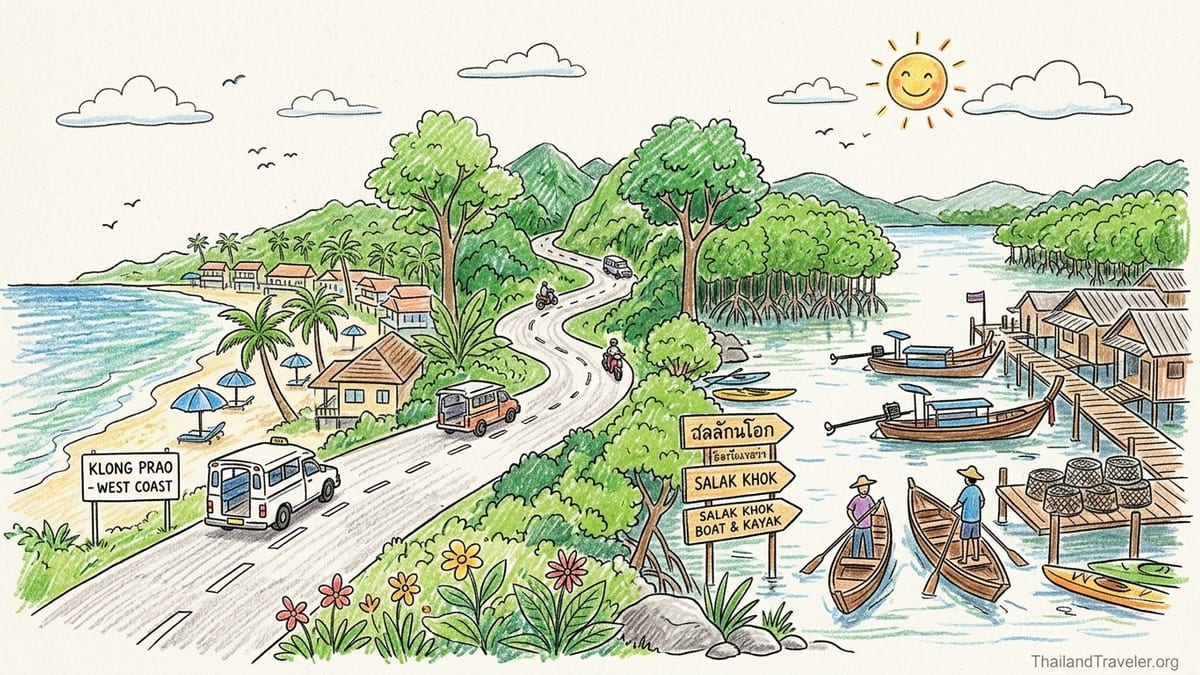
Getting From Koh Chang’s Beach Strip to Salak Khok
I based myself at Klong Prao Beach, one of Koh Chang’s relaxed west-coast stretches with low-rise resorts, 7‑Elevens every few hundred meters and songthaew taxis shuttling up and down the main road. From here Salak Khok lies across the spine of the island on the quieter eastern side, roughly 18 to 20 kilometers away depending on where you start in Klong Prao. The journey is part of the experience because it highlights just how different the two coasts feel.
I left after breakfast around 8:30 a.m., flagging down a white songthaew on the main road outside my guesthouse. Public songthaews on Koh Chang do not have meters; drivers quote fixed prices per person based on distance and how many people are already on board. Recent travelers, and my own bargaining, suggest that a shared ride from Klong Prao to the Salak Khok junction costs around 150 to 200 baht per person one way, and a private charter for two people in the same pickup-style taxi runs closer to 600 to 800 baht for the vehicle. I joined two Thai holidaymakers already inside and agreed on 180 baht each for the trip.
The road south from Klong Prao winds through jungle-covered hills, with short steep sections and tight bends. After Kai Bae and Lonely Beach, the resorts thin out and the views open to glimpses of the sea and inland mountains. At the southern junction near Salak Phet, my driver turned left onto the east-coast road, which immediately felt emptier: rubber trees, fruit orchards and small houses instead of beach bars and tour desks. From leaving Klong Prao to turning into Salak Khok Bay took about 40 minutes with a couple of quick roadside pick-ups.
If you start further north at White Sand Beach, allow roughly an hour to reach Salak Khok by songthaew and expect to pay slightly more, around 200 to 250 baht per person in a shared taxi or up to 900 baht if you charter the vehicle privately. The final stretch to the village runs along flat mangrove-lined water, already a strong contrast to the surf and sand of the west coast.
First Impressions of Salak Khok’s Fishing Village
Salak Khok itself is a compact community built around a sheltered bay enclosed by mangroves, with houses and restaurants on stilts above the water. Instead of beach umbrellas and smoothie stands, I found a simple concrete pier, wooden walkways and the smell of drying nets and diesel from longtail fishing boats. The village is a working fishing community first and a tourism destination second, which gives any visit a different tone from the resort beaches.
The songthaew dropped me at the side road to Salak Khok, from where it was a short walk to the water. Hand-painted signs pointed toward Salak Khok Seafood Restaurant and a separate Salak Khok Kayak Station, both hubs for arranging boat and kayak excursions run in cooperation with local families and a community tourism group that has been active for more than a decade. I chose to walk first through the village, passing stacks of crab pots, blue plastic barrels and a few small grocery shops serving locals heading out to sea.
On the timber walkways I met an older fisherman mending his nets who introduced himself simply as Nok. Through a mix of basic English and Thai he explained that before visitors ever came for boat trips, families here made their living from crab, squid and small fish in the bay. Tourism arrived gradually, encouraged by conservation-minded people on the island and supported by government agencies promoting community-based ecotourism. According to Nok, the mangroves around the bay were once under pressure from logging and land clearance, but the community realized that protecting the forest meant protecting their nursery grounds for fish and crabs.
Where the west coast of Koh Chang feels calibrated to visitor expectations, Salak Khok operates more on village time. Motorbikes pass with no rush, loud music is rare, and there are long pauses in conversation as people watch the tide. I checked the tide tables posted near the pier; mid to high tide is best for navigating the smaller mangrove channels, while at very low tide more mudflats are exposed and some side creeks become too shallow for rowing boats.
Organizing a Traditional Rowing Boat and Kayak
I walked to Salak Khok Seafood, a simple waterside restaurant that doubles as a pier for the community’s traditional rowing boats, often marketed as Koh Chang’s answer to a gondola. Staff there introduced me to a representative of the local tour club who keeps a handwritten list of bookings. Prices can change with fuel and demand, but as of October 2026 the community quoted 500 to 600 baht total for a one-hour rowing boat trip for up to four passengers, including a local guide who acts as boatman. For a solo traveler that means paying the full amount yourself; for couples or small groups it becomes very good value.
The traditional boat is a long, narrow wooden craft with a flat bottom designed to slide over shallow water and mudflats without damaging the mangrove roots. Instead of an engine it is propelled by a standing oarsman at the stern using a long wooden oar fixed to a simple pivot. He pushes against the water in a smooth, almost silent motion, steering by angling the oar. The lack of an engine keeps noise and wake to a minimum, which is important both for wildlife and for avoiding erosion on the muddy banks.
Next door, Salak Khok Kayak Station rented out sturdy sit-on-top plastic kayaks with backrests, paddles and life vests. Staff there quoted me 250 baht for a single kayak and 400 baht for a double for about two hours of paddling time within the marked mangrove channels and out into the bay. Kayaking is independent; you receive a simple map and basic orientation, but no guide paddles with you unless you arrange one separately and pay extra. I decided to start with the guided rowing boat to understand the maze of waterways before trying a kayak on my own.
Booking directly at the pier had two advantages. First, the money clearly went straight to the community group and boatmen rather than being split with outside tour resellers. Second, I could ask detailed questions about tides, weather and the particular loop we would take that morning. Several west-coast tour desks in Klong Prao and Kai Bae advertise “Salak Khok mangrove tours” bundled into island circuits or private taxi days; most quote around 1,500 to 2,500 baht per person including transport and lunch. For travelers short on time that can be convenient, but if you are already on Koh Chang and comfortable arranging your own transport, going direct saves a substantial amount and supports the village more transparently.
Gliding Through the Mangrove Waterways
Just after 10 a.m., with the tide halfway in and the sun already bright, I stepped carefully into the wooden boat from a low floating pontoon. My guide, a middle-aged man named Chai, wore a wide-brimmed hat and long sleeves against the sun. He pushed us away from the pier with one sure shove of the oar, and within seconds the village noises faded into the background.
We began in a broad channel lined on both sides with mangrove trees, their arching roots emerging from the water like a tangle of dark ribs. The water near the village was a green-brown mirror, disturbed only by the small bow wave from our boat and the occasional swirl from a fish near the surface. With no engine noise, the soundscape reduced to the creak of the oar, the squeak of the wooden pivot and bird calls from somewhere inside the foliage.
As we entered a narrower side canal, the air felt cooler. The mangroves formed a high green tunnel that filtered the sunlight into patches on the water. The mud banks showed the pockmarks of fiddler crabs, and several times I saw small crabs scuttle sideways into their holes as we passed. Wading birds, mostly egrets, hunted in the shallows, occasionally lifting off and gliding a few meters further along the edge of the creek. We did not see anything dramatic like monkeys or monitor lizards during my hour on the water, and I appreciated that Chai did not promise or invent wildlife sightings; his focus was on explaining how his neighbors depend on this habitat.
Chai pointed out areas where the community had replanted young mangroves after previous storms and where they had agreed not to set crab traps to allow stocks to replenish. He described how, in earlier years, some residents pushed to clear more of the mangroves for shrimp ponds or more houses, but a combination of outside conservation advice and the lived experience of declining fish catches convinced most families that intact mangroves were their insurance policy. Today, the community earns modest additional income from visitors while keeping fishing, not tourism, as its backbone.
Life on the Water: Fishing Boats, Houses and Human Stories
Toward the outer part of the bay the canal widened, and we passed clusters of wooden houses on stilts with small wooden landing stages. Many had colorful plastic tubs stacked high, ready for sorting fish and crabs when boats return. Brightly painted longtail boats were moored under the houses or in narrow side alleys, some rigged with small engines, others clearly reserved for hand-rowing in shallow creeks.
On one landing stage an elderly woman cleaned a basket of shellfish in a plastic tub, throwing the empty shells back into the water. Kids chased each other along the walkway, using upturned polystyrene boxes as improvised boats tied to the posts with rope. The scene underlined that although mangrove tours have become a recognized activity here, Salak Khok is still first and foremost a place where people live and work.
Chai explained that the community’s approach to tourism was shaped by two concerns. The first was environmental: they wanted any activity on the water to be low-impact, which meant avoiding engine-powered sightseeing within the narrow mangrove channels. The second was cultural: villagers were wary of outside operators buying or leasing land and running high-volume tours that might strain both the ecosystem and local life. The solution was a community enterprise that coordinates local boatmen, sets shared prices and reinvests part of the income into communal needs such as temple repairs and small conservation projects.
As we drifted slowly near the mouth of the bay, full ocean swells remained far away. Salak Khok’s mangroves act as a natural barrier, turning what might be an exposed coastline into a sheltered lagoon. At low tide broad mudflats appear, dotted with small stakes and markers used by crab fishermen. During my mid-tide visit, some of those flats were still underwater, but we saw narrow exposed strips where sandpipers and other small shorebirds fed. The combination of human activity and natural processes felt tightly interwoven, very different from the curated separation of resort front and service area on the west coast.
Is It Relaxing or Too Quiet for Thrill Seekers?
The traditional rowing boat moves slowly, even when the guide is strong and experienced. In one hour we covered only a small loop: from the village pier into one main canal, through two narrower side channels and back along the edge of the bay. At times our pace matched the drifting leaves on the surface. For me this slow rhythm was the main attraction. It offered space to notice crab tracks, shifting light on mangrove roots and distant calls from roosters in the village.
Visitors who equate water activities with adrenaline might find the excursion uneventful. There are no rapids, no fast sections and no jumping off the boat. Even kayaking here is about meandering exploration rather than speed or technical challenge. When I rented a single kayak after the rowing trip, I paddled gently along the same channels, occasionally grounding lightly on soft mud when I strayed too close to the banks. It was meditative rather than athletic.
Chai recognized this difference when I asked how guests react. He said that guests who come expecting something like Koh Chang’s island-hopping or snorkeling tours sometimes seem restless, asking how much further or when they will see “big animals.” People who arrive wanting quiet, photography or a glimpse of village life tend to leave more satisfied. His advice was simple: know what you want before you come. If you expect jet skis, party music or cliff jumps, Salak Khok is not your bay.
Personally I found that the slow pace suited the mangrove environment. The absence of engines meant we could hear the subtle sounds of the forest and talk without shouting. For families with small children or older travelers who prefer gentle outings over physical exertion, this trip offers a comfortable way to get on the water without needing to paddle or climb in and out of speedboats.
Practical Tips: Weather, Mosquitoes, Tides and Comfort
Spending a few hours in an open boat among mangroves requires a little more planning than a casual stroll along the beach road. The first concern most visitors have is mosquitoes. In my experience, and according to local guides, mosquitoes can be present in the shaded channels, especially in the late afternoon and on still, humid days. On my late-morning trip in the dry season I encountered only a few, but I still wore long, lightweight trousers and a long-sleeved shirt and applied insect repellent around my ankles and wrists before boarding.
Sun exposure is equally important. While sections of the canals are shaded by overhanging trees, other stretches are more open, and reflections off the water can intensify the sun. A wide-brimmed hat, sunglasses and high-SPF reef-safe sunscreen are sensible. There is no shade roof on the traditional wooden boats, and kayaks are completely open. Hydration is up to you; buy water at the village shop or restaurant before departure because there are no vendors once you are on the water.
Tides and rainfall affect both the route and comfort of the trip. At very low tide, more mudflats appear and some inner channels become too shallow for the boats, which means the tour might follow a more limited path. Mid to high tide offers more navigable options. During the rainy season, sudden showers can arrive with little warning, turning the air cooler but also making surfaces slippery. Salak Khok’s operators do run trips in light rain, but heavy rain or thunderstorms can postpone departures for safety. It is worth checking the forecast and avoiding the heaviest afternoon storm period if possible.
Footwear and facilities are straightforward but worth noting. Access to the boats is via simple wooden or floating piers that can be wet and uneven; sturdy sandals or shoes that you do not mind getting damp are better than flip-flops. Basic toilets are available at Salak Khok Seafood and at the kayak station, but there are none once you leave the pier. For photography, early morning and late afternoon provide softer light and more contrast in the mangrove roots, but midday can also produce dramatic reflections if clouds are present. My late-morning ride gave clear views yet also harsh light in the more open stretches, so I was glad to have a polarizing filter on my camera to tame glare from the water.
Do Sunset Cruises and Boat Meals Still Run?
Older promotional materials for Salak Khok often highlight sunset “Thai gondola” cruises with on-board seafood dinners. I asked both the community representative at Salak Khok Seafood and staff at the kayak station whether these are still operating in 2026. They confirmed that sunset trips are still offered, but mostly on a pre-booked basis rather than as daily scheduled departures. The availability of full meals on board has become more limited compared with the early days of the project, partly because of higher food costs and partly because many guests now prefer to eat in the restaurant before or after the boat ride.
As of this year, the community’s typical offer is an early evening rowing boat trip of around one hour starting about 60 to 90 minutes before sunset, at a slightly higher price than daytime outings, usually in the region of 700 to 800 baht per boat for up to four people. Simple snacks and drinks can be arranged, and some groups coordinate with the restaurant to have a set seafood dinner ready when they return to the pier, rather than trying to eat while on the water. Full “floating dinner” experiences are still possible but need to be arranged directly with the community or restaurant at least a day in advance and may depend on group size.
If you are staying on the west coast, consider carefully whether a sunset tour works logistically. After dark, songthaews are less frequent on the east side of Koh Chang, and drivers may charge significantly more for late-night returns. Some travelers arrange a private taxi for the round trip when booking a sunset boat, agreeing on a fixed price of around 1,000 to 1,200 baht from Klong Prao or Kai Bae that includes waiting time. Others rent a car or scooter for the day, but the winding island roads at night require confidence and caution, especially in wet weather.
During my visit I chose a morning excursion because afternoon storms were forecast later in the day and I wanted an easier return to Klong Prao. On a future trip I would plan a sunset tour with an early dinner in the village and a pre-arranged taxi back to the west coast, turning it into a full afternoon and evening away from the beach scene.
How It Compares to Snorkeling and Island-Hopping Trips
Koh Chang’s west coast is dotted with tour counters selling island-hopping and snorkeling packages. Popular day trips include speedboat or wooden boat excursions to nearby islands such as Koh Rang and Koh Wai, promising coral reefs, fish feeding and sandy beaches. These trips usually cost around 800 to 1,500 baht per person depending on the boat type and inclusions, with lunch and snorkeling gear typically provided.
Compared with those excursions, Salak Khok’s mangrove tour is smaller in scale and more focused on one ecosystem and community. There is no music on board, no buffet lunch and no stops for swimming in turquoise water. Instead, there is an hour or two of slow paddling through green tunnels, with time to ask questions about crab traps and mangrove roots, and to watch village life from a respectful distance. The cost structure is different as well: you pay per boat instead of per person, and most of your money stays in the village rather than being split among multiple operators.
From a purely visual standpoint, the mangroves might appear less spectacular than a bright snorkel reef. The water in the bay is murky, the mudflats are brown and the palette is dominated by greens and earth tones. Yet the experience filled a gap in my understanding of Koh Chang. Snorkeling trips show off the island’s marine side as a visitor playground. Salak Khok shows how local people interface with that environment day to day, relying on the same waters for livelihoods and protection from storms.
If you only have a couple of days on Koh Chang, you might prioritize a classic snorkeling trip for the postcard views. If your stay extends to four days or more, setting aside a half-day for Salak Khok brings welcome balance to the itinerary. For travelers already familiar with Thai islands and reefs, the mangrove excursion may feel fresher and more meaningful than yet another day of mask and fins.
The Takeaway: What I Learned and What I Would Do Differently
By the time I stepped back onto the pier at Salak Khok, the west coast of Koh Chang felt much further away than the 40-minute drive suggested. The morning on the water reframed the island in my mind from a chain of beaches and bars to a more layered place where fishing, conservation and low-key tourism intersect.
Practically, the outing filled a comfortable half-day. Leaving Klong Prao around 8:30 a.m., I reached the village before 10 a.m., arranged my boat at the pier, spent an hour on the rowing tour and another hour nosing around the canals by kayak, then had a simple seafood lunch before flagging a songthaew back to the west coast mid-afternoon. The total cost for the day came to roughly 500 baht for the rowing boat (shared with one other traveler I met at the pier), 250 baht for a single kayak, around 180 baht each way for transport and about 200 baht for lunch, or a little over 1,300 baht for a very different perspective on Koh Chang.
The main lesson was that life beyond the resort strip is both quieter and more fragile. In Salak Khok the mangroves are not scenery but infrastructure: a living seawall and fish nursery that underpins the village economy. The community’s decision to organize tourism on its own terms, favoring rowing boats and small-scale kayaking over loud engines, has kept the atmosphere calm and the channels surprisingly free of litter compared with some more visited coastal sites.
If I return to Koh Chang, I would plan two changes to my Salak Khok visit. First, I would aim for an even earlier morning boat to catch lower, softer light and perhaps more bird activity. Second, I would make time to stay longer in the village itself, perhaps with a night at a small homestay or simple guesthouse on the east coast, to experience the rhythms of fishing departures at dawn and returns at dusk rather than just dropping in between breakfast and lunch.
Salak Khok will not suit every traveler. Those looking for constant novelty, parties or high-energy sports will likely find it too quiet. For anyone curious about how communities live with mangroves, who is willing to travel beyond the ring of beach bars and to sit still long enough for the forest to reveal itself, this modest bay on Koh Chang’s eastern side offers one of the island’s most grounded and rewarding experiences.
FAQ
Q1. How long does it take to get from the west coast of Koh Chang to Salak Khok?
Most visitors coming from Klong Prao, Kai Bae or Lonely Beach reach Salak Khok in about 40 to 50 minutes by songthaew taxi, while the journey from White Sand Beach can take close to one hour depending on traffic, road works and how many stops the shared taxi makes along the way.
Q2. How much should I expect to pay for the Salak Khok mangrove boat tour?
The community typically charges a flat rate of roughly 500 to 600 baht per traditional rowing boat for about one hour on the water, which can usually seat up to four people, so solo travelers pay the full amount while couples or small groups can share the cost between them.
Q3. Is kayaking at Salak Khok suitable for beginners and children?
Kayaking here takes place on calm, sheltered water inside the bay and narrow channels, so confident beginners and older children can manage well in stable sit-on-top kayaks, but younger kids and non-swimmers should share a double kayak with an experienced adult and always wear life vests provided by the rental station.
Q4. Do I need to book the Salak Khok boat tour in advance?
Outside of peak holiday periods it is usually possible to show up at Salak Khok Seafood or the community pier in the morning and arrange a boat within 30 minutes, but during Thai public holidays, weekends and December to February it is wise to call ahead through your accommodation or a local contact, especially if you want a specific time or a sunset trip.
Q5. When is the best time of day to visit the mangroves for photography?
Early morning and late afternoon offer the most flattering light, with softer contrast on the mangrove roots and fewer harsh reflections on the water, while a mid-tide level helps your boat or kayak reach more of the side channels; midday can still work if there are some clouds, but expect stronger glare and deeper shadows.
Q6. Are there many mosquitoes in the mangroves?
Mosquito levels vary with season and time of day, but you should assume there will be at least some in shaded canals, especially in the late afternoon and during or after rain, so wearing light long sleeves and trousers and applying repellent to exposed skin is sensible protection.
Q7. What should I wear and bring for the trip?
Lightweight clothing that covers shoulders and legs, sturdy sandals or shoes that can get wet, a wide-brimmed hat, sunglasses, sunscreen, insect repellent, drinking water and a dry bag for cameras or phones are all useful, and if you plan to kayak you may also want a small towel and a change of clothes in case of splashes.
Q8. Are toilets and food available at Salak Khok?
Basic toilets are available at the community’s main restaurant and the kayak station near the pier, and you can find simple but fresh seafood meals, rice dishes and soft drinks in the village, although there are no facilities once you board the boat or enter the mangrove channels.
Q9. Is the Salak Khok trip suitable during the rainy season?
Boat and kayak tours usually still run in the rainy season on Koh Chang as long as conditions are safe, and light showers can actually make the mangroves feel cooler and more atmospheric, but heavy rain or thunderstorms may delay or cancel departures, so it is important to stay flexible and check forecasts with local operators.
Q10. How does visiting Salak Khok support the local community?
When you book directly with the community enterprise at Salak Khok, most of your payment goes to local boatmen, restaurant staff and conservation efforts, helping maintain traditional fishing livelihoods and mangrove protection, whereas booking through distant resellers can dilute the benefits that reach the village itself.