


When Bangkok starts to feel too intense, most residents and short-term visitors look in one direction: the Gulf of Thailand. For a quick weekend escape, two names always come up first in conversations and booking searches: Pattaya and Hua Hin. I recently spent two nights in each, staying in comparable mid-range hotels and tracking what I actually spent on transport, food, activities and beach time. This is a grounded, first-hand comparison for travelers choosing where to book that precious short break from Bangkok.
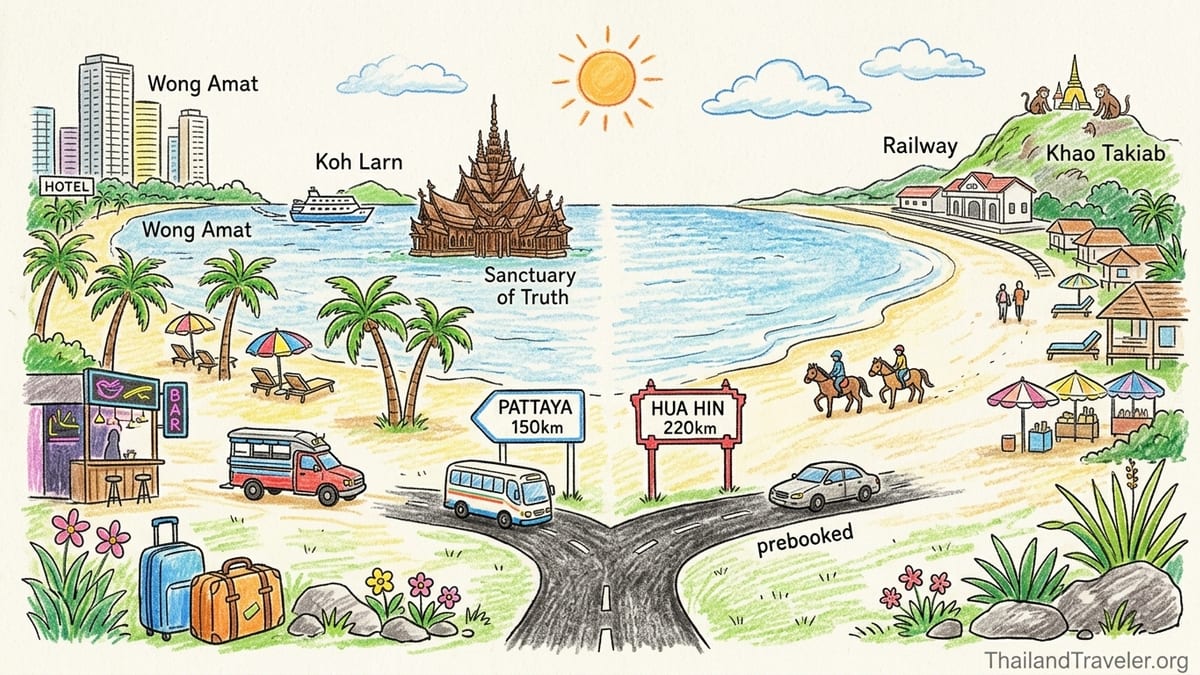
Getting There From Bangkok: Real Journeys, Times and Costs
For this comparison, I treated both destinations as classic Friday evening to Sunday night escapes. I started in central Bangkok around Asok and tried common transport options to see how they feel in real life, not just on paper. Pattaya is the closer choice in pure distance, with the main city roughly 150 kilometers southeast of Bangkok, while Hua Hin lies about 200 to 220 kilometers southwest, depending on the route and terminal. That gap matters when your Friday departure is fighting Bangkok’s rush-hour traffic.
For Pattaya, I tested the bus from Bangkok’s Eastern Bus Terminal at Ekkamai and a separate trip using a prebooked private car. The government-regulated buses from Ekkamai to Pattaya’s main bus terminals were advertising fares around 130 to 200 baht per person in October 2026, depending on operator and type of bus, with scheduled journey times of roughly 2.5 to 3 hours. In practice on a Friday early evening, my bus took just under 3 hours, including a slow crawl getting out of the city. Seats were reasonably spaced, air conditioning was strong and arrival was straightforward, with local songthaews and ride-hailing cars waiting outside.
The next time, I tried a private transfer, booked online, picking me up directly from my Sukhumvit hotel. Prices for a standard sedan for two people were widely quoted in the 1,300 to 1,800 baht range one way at the time of research, depending on exact pickup, time and operator. My journey door to door took about 2 hours and 10 minutes in evening traffic, saving roughly half an hour and a lot of hassle compared to public transport. For couples or small groups of friends, the cost difference against two bus tickets feels reasonable if convenience is a priority.
Reaching Hua Hin from Bangkok required more planning. Bus and minivan services from Bangkok’s Southern Bus Terminal (Sai Tai Mai) were showing fares commonly between about 200 and 300 baht per person to Hua Hin in late 2026 for standard air-conditioned services, with an expected journey time of about 3.5 to 4.5 hours. On my Friday departure, the minivan took roughly 4 hours including a short rest stop. The seating was tighter than my Pattaya bus, although air conditioning and safety felt adequate. I also tested the railway option on a separate weekend, departing from the new Krung Thep Aphiwat Central Terminal. Standard train fares in third and second class air-conditioned carriages to Hua Hin were often listed from around 150 to 450 baht depending on class and train type, with travel times typically listed between 3.5 and 5 hours. On my chosen express service, we arrived in just over 4 hours, and stepping off directly into central Hua Hin was one of the main advantages.
For anyone short on time, a private car from Bangkok to Hua Hin felt closer in cost to Pattaya, with recent quoted one-way prices per sedan or SUV generally between about 1,700 and 2,300 baht. My actual journey late on a Sunday morning took around 3 hours and 10 minutes door to door, including moderate traffic leaving Bangkok. The key takeaway: Pattaya almost always wins on sheer speed and spontaneity, while Hua Hin is still perfectly doable but better suited to travelers who can start early or do not mind a bit more time on the road or rails.
Staying in Comparable Hotels: Pattaya vs Hua Hin on the Same Budget
To make the comparison meaningful, I limited myself to mid-range properties that would appear in the same search filter: reputable three-and-a-half to four-star hotels with pools, breakfast included and locations close to the main beach areas. I checked typical nightly rates for October 2026 weekend dates through major booking engines and then booked directly where possible.
In Pattaya, I stayed first at a hotel just off Pattaya Beach Road, near Central Pattaya. Recent search results showed many such properties pricing standard double rooms with breakfast included between roughly 1,500 and 2,500 baht per night on a Friday to Sunday pattern outside peak holidays. My own two-night stay came in around 2,000 baht per night, including taxes and a sizeable buffet breakfast with Thai dishes, made-to-order eggs and fruit. From my room it took less than five minutes to walk to the sand.
For comparison, I booked a similar rating hotel in Jomtien, south of central Pattaya. Jomtien properties with pools and breakfast were often available on the same weekends in the 1,200 to 2,200 baht range per night. My actual Jomtien stay cost just under 1,700 baht per night, with a simpler but still satisfying breakfast and a short two-minute walk to the quieter beachfront. The rooms in both Pattaya hotels were comparable in size and comfort, although the central Pattaya property felt slightly more worn due to heavier year-round traffic.
In Hua Hin, I targeted central beachside options and then a family-oriented resort near Khao Takiab. For central Hua Hin Beach, mid-range hotels facing or close to the sea were often listed between about 1,800 and 2,800 baht per night with breakfast. My chosen hotel, a contemporary property a short walk from the sand and not far from the night markets, cost around 2,300 baht per night with a good buffet breakfast and an elegant pool area. The room felt more resort-like and spacious than my similarly priced central Pattaya option.
Near Khao Takiab, I selected a family-focused resort with a large pool and direct or near-direct beach access. Recent sample rates showed many such properties around 2,500 to 3,500 baht per night on weekends with breakfast and kids’ facilities. My booking landed close to 2,800 baht per night. The breakfast spread was broader, with more western items and bakery choices, and the grounds were greener and more open than any of the city hotels in Pattaya. Comparing like for like, I paid slightly more in Hua Hin for a noticeably calmer and resort-style feel, although Pattaya clearly offered more budget variety in every neighborhood.
Pattaya on the Ground: Beaches, Koh Larn, Attractions and Nightlife
I divided my Pattaya weekend between three beach areas: central Pattaya Beach, Jomtien Beach and Wong Amat, plus a day out to Koh Larn. Pattaya Beach sits directly in front of the busiest part of town. The sand is comparatively narrow and divided by rows of beach chairs and umbrellas. During my visit, chair rentals were quoted around 50 to 100 baht per person for a half or full day, with drink service from the adjacent vendors. The water was suitable for a quick dip, but the proximity to boat traffic, jet skis and the main road behind the beach meant it never felt like a tranquil swimming spot.
Jomtien, by contrast, offered a visibly more relaxed atmosphere. The beach is longer and slightly wider, and although chairs and umbrellas still dominate many stretches, there were clear gaps for those who want to sit on their own towels. Prices for chairs were similar to central Pattaya, generally 50 to 100 baht, but crowd levels were noticeably lower, especially in the morning. Families with young children were more common, and the water felt a bit more inviting, though conditions clearly depend on season, tides and recent weather.
Wong Amat, in the north, felt like a different world again. The beach is fronted by many high-rise condominiums and upscale hotels, yet the feel is quieter and more residential. The sand underfoot was soft enough for barefoot walks, and during my visit the sea here looked cleaner than central Pattaya, though it is important to be honest that water quality along the entire Gulf can fluctuate and no beach can be guaranteed pollution-free or perfectly clear every day. Wong Amat’s limitation is that public access feels more fragmented due to private developments, and food options immediately on the sand are fewer than Jomtien.
One of my key Pattaya experiences was the ferry trip to Koh Larn. Public ferries were operating from Bali Hai Pier to the island, with recent posted fares in the vicinity of 30 baht per person one way for the slower boat, and higher prices, usually several hundred baht, for speedboats. My slower ferry ride took about 40 to 45 minutes, landing at Tawaen Pier. Once on Koh Larn, I used local songthaews, paying in the approximate range of 30 to 50 baht per person per trip, to visit beaches such as Tawaen and Samae. Beach-chair rentals there mirrored Pattaya and Jomtien prices, around 50 to 100 baht, and food stalls sold simple Thai dishes between roughly 80 and 200 baht per plate. The water at Koh Larn during my visit looked significantly clearer than central Pattaya, and swimming felt more comfortable, but even here clarity varied between beaches and by time of day.
Back on the mainland, I visited the Sanctuary of Truth in north Pattaya, an intricately carved wooden temple-like structure facing the sea. Entry fees for foreign visitors were displayed in the high hundreds of baht, often around 500 to 600 baht per person, with guided tours included. The craftsmanship and scale justified the price for me, and it stands out as one of Pattaya’s most distinctive non-beach attractions. After dark, Pattaya’s central districts transformed. Walking Street and its surrounding sois filled quickly, with bars, go-go venues, live music pubs and street food. Drinks in simple bars started around 80 to 120 baht for a beer and went much higher in more upscale venues. The density of nightlife brought heavy traffic, loud music and crowds, especially on Saturday night. For visitors seeking entertainment and long nights, this is a clear advantage. For light sleepers or families, it is a significant drawback unless you choose a quieter area like Jomtien or Wong Amat and use taxis or ride-hailing to dip into the action.
Hua Hin in Practice: Beaches, Markets, Khao Takiab and Excursions
Hua Hin presented a different rhythm from the moment I arrived by train. Rather than a single intense strip of nightlife, the town is stretched along a long, gently curving beach that runs for several kilometers. I first explored the central Hua Hin Beach near the main town. Access is via lanes running between hotels or through beachfront properties that allow public passage, and the sand here is broad enough for walks, morning jogs and horse rides, which are a recognizable part of the scenery. I saw families paying for short horse rides at rates in the low hundreds of baht, negotiated with handlers on the sand.
For my two-night stay, I spent one night in central Hua Hin and one near Khao Takiab at the southern end of the beach. The central section of Hua Hin Beach felt busier in the late morning and afternoon, with sun loungers and umbrellas for hire. Prices for a pair of loungers with shade were commonly around 100 to 200 baht. The water was shallow with small waves, suitable for wading and light swimming on the days I visited, though again water clarity was not perfect and could shift with tides and wind. Compared with Pattaya Beach, the immediate beachfront road is set further back, which reduces traffic noise while you are on the sand.
Khao Takiab delivered a more low-key experience. The headland, also known as Chopsticks Hill, is topped by a temple and inhabited by monkeys, which attract local visitors and day-trippers. The beaches on either side are long and ideal for walking. From my resort, I could walk for more than 20 minutes along the sand without hitting a major obstruction. In the early morning, the beach was largely empty except for a handful of joggers and dog walkers. I found the overall environment more relaxing than any Pattaya mainland beach, especially for a quiet stroll. Like elsewhere on the Gulf, water cleanliness is variable, and visitors should not expect tropical-island clarity, but it felt pleasant for a cooling dip during my stay.
Evenings in Hua Hin centered for me on the Cicada Market and Tamarind Market, both near the Khao Takiab area and typically operating on selected nights, especially Friday to Sunday. At Cicada Market, I browsed art, crafts and clothing while snacking from stalls where single dishes were usually priced roughly between 60 and 150 baht. Tamarind Market next door had a more casual food-court feel, with live acoustic music and plenty of Thai families and Bangkok weekenders. A simple dinner of grilled seafood skewers, som tam and a beer came to about 250 to 350 baht per person depending on choices. Compared with central Pattaya’s bar streets, the atmosphere here was much quieter and more family-friendly.
For a daytime excursion, I joined a small-group trip from Hua Hin to a nearby national park area that included short hikes, a cave and viewpoints. Local tour desks were advertising such half-day to full-day trips in the approximate range of 800 to 1,800 baht per adult, depending on destination and inclusions. My chosen excursion cost a little over 1,200 baht including transport and park fees. The experience underlined one of Hua Hin’s strengths: access to more natural, low-key outings in surrounding provinces without the sheer party infrastructure of Pattaya.
Food, Local Transport and Three-Day Sample Budgets
During both weekends I kept notes on what I actually spent, to build sample budgets for two adults on a Friday to Sunday trip. These are not the cheapest possible itineraries, but realistic for travelers who want comfort without splurging on luxury resorts. For both destinations I used a mix of hotel breakfasts, local eateries and one or two nicer dinners.
In Pattaya, my two-night mid-range hotel with breakfast near the beach totaled close to 4,000 baht. Local meals at simple Thai restaurants or street stalls ranged roughly from 60 to 120 baht per dish. A seafood dinner on the beachfront for two, including a whole fish and a couple of side dishes with soft drinks, came to around 700 to 1,000 baht, depending on the restaurant and seafood selection. Beers in casual bars cost roughly 80 to 120 baht each. Over three days, including snacks and drinks, a realistic food and drink spend for two came in around 2,500 to 3,500 baht.
Transport within Pattaya relied on songthaews and ride-hailing. Typical shared songthaew rides along Beach Road or between central Pattaya and Jomtien were in the ballpark of 10 to 30 baht per person per ride, depending on route and whether you chartered the vehicle. Ride-hail or regular taxis across town or to Wong Amat typically cost between 100 and 250 baht per trip. My return ferry to Koh Larn and local transport there for two adults, plus beach chairs and simple lunch, added roughly 800 to 1,200 baht altogether. Including a visit to the Sanctuary of Truth for two at several hundred baht per person, a sample three-day Pattaya budget for two adults broke down into approximately 4,000 baht for hotel, 3,000 baht for food and drinks, 1,000 to 1,500 baht for local transport, and 2,000 to 2,500 baht for the Koh Larn outing and one major attraction. Adding a private transfer from Bangkok both ways could add another 2,600 to 3,600 baht. Choosing buses instead would reduce that significantly, closer to 600 to 800 baht round-trip for two.
In Hua Hin, my hotel costs were slightly higher. Two nights across central Hua Hin and a family resort near Khao Takiab totaled around 5,000 to 5,500 baht with breakfast. Eating out at simple Thai restaurants or food courts at the markets cost about 60 to 150 baht per dish. An evening at Tamarind Market, including shared plates and a couple of drinks for two, hovered around 500 to 700 baht. A slightly nicer sit-down seafood dinner near the beach was closer to 800 to 1,200 baht. Over three days, my food and drink bill for two came in near 3,000 to 4,000 baht.
Local transport in Hua Hin was a mix of tuk-tuks, songthaews and ride-hailing. Short rides within central Hua Hin often cost between 40 and 150 baht depending on distance and negotiation, while trips between central Hua Hin and Khao Takiab were typically in the 100 to 200 baht range. There is no nightlife district equivalent to Pattaya’s Walking Street, so evenings usually meant walking around the night markets or using short rides back to the hotel. My half-day excursion from Hua Hin for two adults added around 2,400 to 2,600 baht. A sample Hua Hin weekend budget for two adults would thus approximate 5,000 to 5,500 baht for hotels, 3,000 to 4,000 baht for food, about 1,000 to 1,800 baht for local transport, and 2,400 to 2,600 baht for a paid excursion. Transfer costs from Bangkok varied depending on choice, from about 800 to 1,000 baht for two on train or bus round-trip, up to over 3,000 or 4,000 baht for private car both ways.
Beaches and Atmosphere: What Actually Felt Better
Numbers tell part of the story, but the central question for many travelers is simple: which destination actually felt like a better beach break from Bangkok. On the mainland, Hua Hin’s strengths were clear. The long continuous coastline made it easier to find a stretch of sand that suited my mood, whether that was the slightly livelier central section or the quieter Khao Takiab area. Early morning and late afternoon walks along the surf were some of the most relaxing moments of the weekend, and the relative distance from the main road made the beach feel more separate from city noise. The sea, while not crystal clear, felt fine for regular dips and offered shallows that suited families with children.
Pattaya’s mainland beaches, particularly central Pattaya Beach, felt more urban and compressed, with louder surroundings and busier water traffic. Jomtien and Wong Amat improved things considerably, and in Jomtien I did enjoy relaxed hours under an umbrella watching the sea. However, there was rarely a sense of wide-open, crowd-free coastline. Where Pattaya shone was through its access to Koh Larn. On the days I visited, the island’s beaches provided a more appealing sea color, sand that felt less trampled and, once I walked beyond the busiest sections, genuine moments of tropical-island atmosphere.
When I look back at how I felt on each trip, I would say that Hua Hin’s long coastline delivered a more consistently pleasant environment for walking and relaxed beach time, particularly around sunrise and before sunset. Pattaya’s advantage was variety. If I grew bored on the mainland, I could hop to Koh Larn or shift between several different city beaches. That said, travelers should be aware that water clarity and perceived cleanliness at both destinations vary across locations and seasons. Neither place can be described honestly as having uniformly pristine or transparent water. The key is to choose your part of the coast carefully based on your expectations and to check recent local feedback on conditions.
Nightlife, Families and Traveler Types: Who Fits Where
Pattaya’s reputation for nightlife is well known, and a weekend there confirmed that its central districts are intense and concentrated. Walking Street and nearby sois are packed with neon-lit bars, adult entertainment venues, live music clubs and late-night eateries, particularly on Saturdays. Groups of friends, solo travelers and party-focused couples will find no shortage of places to stay out until dawn. At the same time, the very qualities that create that energy also bring downsides: heavy traffic on main roads, loud music that can carry to nearby hotels, and a general busyness that can feel overwhelming if you are seeking calm.
For families, Pattaya can still work, but it demands more planning. Jomtien and Wong Amat are significantly better choices for a quieter base, and many family-friendly hotels and condominiums cluster there. From these areas, it is easy enough to take a taxi or songthaew into central Pattaya for an evening meal or a stroll along the waterfront, then retreat back to quieter streets at night. Activities such as water parks, boat trips, shopping malls and the Sanctuary of Truth add variety beyond the beach itself. Budget-conscious travelers and groups of friends will also appreciate Pattaya’s vast accommodation range, including many affordable guesthouses and mid-range hotels.
Hua Hin, by contrast, offers a softer kind of evening life. There are bars around the town center and near the markets, but they are rarely as concentrated or intense as in Pattaya. After dinner, most people stroll through the Cicada and Tamarind markets, listen to live acoustic sets, have a drink and then return to their rooms before midnight. For some travelers, especially younger groups seeking a big night out, Hua Hin may feel limited. For others, including many families and couples, that same limitation becomes a major advantage. It was easy to walk around the markets with children, and I saw many multi-generation Thai families doing exactly that.
For solo travelers who enjoy a broad choice of social venues, Pattaya remains the more extroverted destination. For couples who prioritize long walks on the beach, lazy mornings by the pool and quiet dinners with a sea breeze, Hua Hin holds considerable appeal. Seniors and multi-generation groups may also find Hua Hin’s gentler atmosphere more comfortable. In both destinations, renting a car or using ride-hailing services gives you flexibility, but Hua Hin’s more spread-out attractions mean you are slightly more dependent on wheels to move between beach, markets and excursions.
The Takeaway
After two-night weekends in both Pattaya and Hua Hin, staying in similar hotel categories and logging real-world costs, my verdict is nuanced rather than one-sided. Pattaya wins on ease of access from Bangkok, sheer accommodation choice across all budgets and the breadth of entertainment on offer, from the Sanctuary of Truth to the night-time spectacle of Walking Street. Koh Larn genuinely lifted the overall beach experience, providing more attractive swimming and sand than any of the mainland stretches I visited. For an entertainment-focused weekend with friends, or a short break where nightlife and variety matter more than tranquility, I would choose Pattaya again, probably basing myself in Jomtien or Wong Amat and commuting into the center when desired.
Hua Hin, however, edged ahead on atmosphere and relaxation. The long, walkable coastline, the softer evening scene at Cicada and Tamarind markets and the resort-like feel of many beachfront hotels combined to create a calmer escape from Bangkok’s intensity. While hotel prices were slightly higher for comparable standards, and the journey from the capital took an extra hour or so, the payoff was a more restful environment that felt better suited to couples and families. For a family trip with children, or a romantic weekend that prioritizes early-morning walks on the sand over late-night bar hopping, I would pick Hua Hin again without hesitation.
Neither destination is perfect. Both live with fluctuating water quality and the broader environmental pressures of the Gulf of Thailand. Pattaya can disappoint those who imagine an untouched beach town and instead find a busy city by the sea. Hua Hin can disappoint party seekers who arrive to discover most nightlife ends relatively early. Looking beyond these two, travelers with a bit more time might also consider islands such as Koh Samet, which can offer clearer waters and more classic island scenery, at the cost of extra travel steps and sometimes higher per-night rates. For a strict two-night weekend from Bangkok, though, Pattaya and Hua Hin remain the primary mainland contenders, each with a distinct personality. Knowing which mood you want before you book will do more for your trip than any marginal difference in price or journey time.
FAQ
Q1. Which is faster to reach from Bangkok, Pattaya or Hua Hin?
Pattaya is usually faster, taking around 2.5 to 3 hours by bus or about 2 to 2.5 hours by private car, compared with roughly 3.5 to 4.5 hours to Hua Hin.
Q2. Where did you find better beaches overall, Pattaya or Hua Hin?
For mainland beaches and long walks, Hua Hin felt better overall, while Pattaya’s access to Koh Larn significantly improved its beach experience for swimming and scenery.
Q3. Is Pattaya suitable for families with children?
Yes, especially if you stay in quieter areas like Jomtien or Wong Amat and visit central Pattaya selectively. Families should be aware of the adult nightlife zones and plan routes accordingly.
Q4. Is Hua Hin too quiet for younger travelers or groups of friends?
Some younger travelers may find Hua Hin’s nightlife limited because most activity centers on markets and low-key bars, but it still works if your focus is beaches and daytime excursions.
Q5. How do typical hotel prices compare between Pattaya and Hua Hin?
Mid-range hotels in Pattaya often cost slightly less, roughly in the 1,500 to 2,500 baht range per night, while comparable beachfront or resort-style options in Hua Hin can be closer to 1,800 to 3,000 baht.
Q6. What did you spend on food for a weekend in each place?
For two adults over three days, I spent roughly 2,500 to 3,500 baht on food and drinks in Pattaya and around 3,000 to 4,000 baht in Hua Hin, including one nicer seafood dinner in each.
Q7. Is the water always clear at either Pattaya or Hua Hin?
No. Water clarity and cleanliness vary by beach, weather and season in both destinations, so visitors should not expect consistently clear, pollution-free water at all times.
Q8. Which destination is better for a relaxed romantic weekend?
Hua Hin, particularly around Khao Takiab or in beachfront resorts, felt more relaxed and suited to couples seeking quiet mornings, market browsing and gentle evening walks.
Q9. Which destination would you recommend for a nightlife-focused trip?
Pattaya is the clear choice for nightlife, with dense areas of bars, clubs and live music that stay busy late, especially around Walking Street and central Pattaya.
Q10. When might Koh Samet be a better choice than Pattaya or Hua Hin?
If your priority is clearer water and a more classic island feel and you can accept extra travel steps, a weekend on Koh Samet can provide a more beach-centered escape than either mainland town.