


I arrived in Surat Thani in early 2026 with a simple goal: pick just one island in Thailand’s lower Gulf and stay put. Instead, I spent several weeks shuttling between Koh Samui, Koh Phangan and Koh Tao, staying multiple nights in different beach areas on each. What follows is not a quick day-trip impression but the reality of daily life, transport, prices, weather quirks and what it actually feels like to wake up and go to bed on each island. If you are trying to decide where to base yourself for a single island holiday rather than hop between all three, this is the comparison I wish I had before I booked.
How I Traveled and What Things Really Cost in 2026
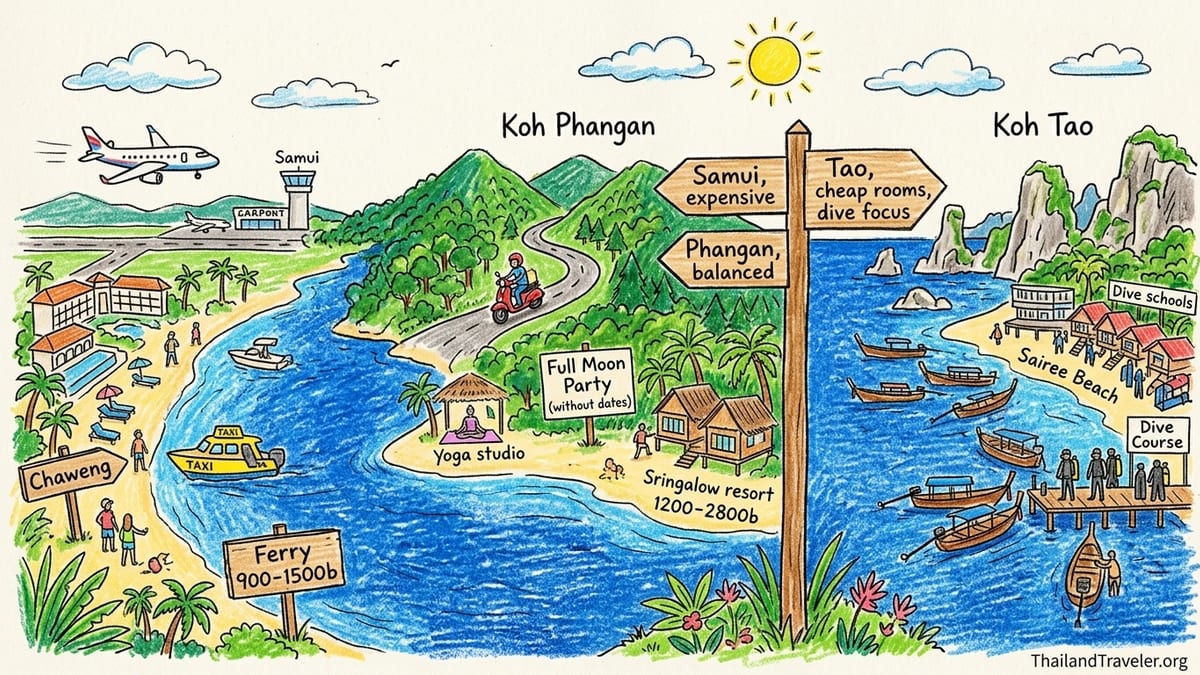
Before comparing the islands, it helps to understand how I moved around and what I actually paid on the ground in 2026. I arrived twice via Surat Thani, using combined bus and ferry tickets that bundled a van transfer from the airport to Don Sak pier and a ferry ticket onward to the islands. On recent price checks for late 2026, these joint tickets typically ran around 900 to 1,500 baht per person one way from Surat Thani Airport to Koh Samui, depending on the speed of the boat and company chosen. Standard walk up ferry fares from Don Sak to Samui were around 210 baht for a passenger on the slower car ferries, with higher prices for faster catamarans and for the longer Don Sak to Koh Phangan route.
From Koh Samui onward, I used the regular catamaran routes that link Samui, Phangan and Tao. On current 2026 schedules, a Samui to Phangan ticket on a high speed ferry generally falls in the 300 to 450 baht range one way, while the longer Samui to Tao sector usually costs in the low to mid 700s. Newer combined van and catamaran tickets from Surat Thani Airport direct to Koh Phangan and Koh Tao, offered by major operators, sit in roughly the same 1,000 to 1,600 baht band depending on how fast you want to get there and how close to peak season you are booking.
On all three islands I rented scooters where it was practical and stayed within local laws and contract conditions; daily rental rates remained clustered around 200 to 300 baht for a standard automatic scooter, with some shops asking a deposit or passport copy. Songthaews and taxis were much pricier on Samui than on the smaller islands, where informal pickup truck taxis still run fixed or negotiable fares along the main road. For meals, a plate of pad thai or basil chicken at a simple local restaurant was still often 70 to 120 baht, while a Western main in a beachside restaurant easily jumped to 250 to 450 baht.
To keep comparisons fair, I focused on mid range but comfortable accommodation: air conditioned rooms or bungalows near the beach, usually with a pool, Wi Fi and breakfast available. In Chaweng on Samui, current 2026 rate checks showed many hotels in the 1,650 to 5,000 baht per night range for a double room, with Lamai slightly cheaper. Bophut’s popular Fisherman’s Village area pushed mid range averages closer to the equivalent of 5,000 baht in properties that tried hard for a boutique feel. On Phangan and Tao, a similar standard often cost noticeably less, with plenty of mid range options in the 1,200 to 2,800 baht band outside peak holiday periods.
Koh Samui: Big Island Convenience and Big Island Prices
Koh Samui is the only one of the three islands with its own airport, served by frequent flights from Bangkok and a few regional hubs. Landing at Samui Airport changes the feeling of the whole trip. Instead of a three to six hour combination of vans and ferries from the mainland, you can be at your resort thirty to forty five minutes after wheels down. A private taxi from the airport to Chaweng or Bophut is often quoted in the 400 to 700 baht range, higher to the far west or south coasts. This is not cheap by Thai standards, but the convenience of skipping the mainland journey is hard to ignore, especially after a long haul flight.
I split my time on Samui between four main areas: Chaweng, Lamai, Bophut and a quieter northwest beach. Chaweng is the beating commercial heart. Here the main road is dense with malls, pharmacies, 7 Eleven stores, restaurants and nightspots. The beach itself is long and mostly sandy with a gentle slope that makes swimming straightforward in calm weather. In February and March, I found the water clear and swimmable through most of the day, though wind can quickly whip up chop. Room for room, Chaweng felt the most expensive relative to what you get. Many mid range hotels crowd right up to the sand, but you pay for the privilege.
Lamai, further south, had a looser, slightly older beach town atmosphere, with simpler guesthouses mixed in among modern resorts. Recent nightly prices for mid range Lamai hotels typically run a bit lower than Chaweng, and I was able to find an air conditioned room in a pool resort back from the sand for a little over 1,500 baht even close to high season. The beach here is also good for swimming, though at the northern end the seabed shelves more abruptly and waves can be stronger. Bophut, home to the tourist friendly Fisherman’s Village, leaned heavily into stylish dining and design led accommodation. Beachfront boutique hotels along the bay asked for two to three times what I was paying for a similar standard bungalow in quieter corners of Samui, with averages over 5,000 baht per night common in rate checks.
North and west Samui offered the calm I missed in the busier zones. Around Maenam and parts of the northwest coast, resorts opened onto wide, often underused beaches, and road traffic thinned considerably. The drawback was transport. Local songthaews did run the main ring road, but flagging one down outside peak hours sometimes meant a half hour wait, and drivers quoted higher fares than on the mainland. A ten to fifteen minute ride could easily cost 100 to 150 baht per person, and many drivers tried to push for more. For couples or families unwilling to ride scooters, this quickly made taxis or private car hires the biggest daily expense after accommodation.
Daily Life on Samui: Restaurants, Transport and Swimming Conditions
As a place to live for a week, Samui felt like a small city with a beach attached rather than a sleepy island. Supermarkets were large and modern, there were hospitals and international clinics, a full choice of ATMs and banks, and more restaurant variety than the other two islands combined. In Chaweng and Bophut particularly, I ate excellent Japanese one night, Italian the next, and then Thai street style food from a market stall for a fraction of the price. A sit down Thai dinner for two with soft drinks in a mid range restaurant in Chaweng often ran about 400 to 700 baht, while cocktails in an upmarket bar pushed individual drinks into the 200 to 350 baht range.
Transport, however, was the constant annoyance. App based ride services were limited, and official taxis often used laminated price sheets that quoted 400 baht or more for short trips that would cost a fraction of that in Bangkok. Scooter rental around 250 baht per day helped, but Samui’s ring road has heavy traffic, regular trucks and frequent police checks. Anyone not comfortable on two wheels or traveling with children will probably rely on resort shuttles, hotel arranged transfers or those expensive taxis, and should factor that into the budget when comparing Samui with the smaller islands.
For swimming, Samui’s main beaches are generally reliable. Chaweng and Lamai both have stretches deep enough for proper swimming even at low tide, though pockets of rock and coral exist. Bophut’s water was more affected by wind and boat traffic and sometimes felt murkier, but on calm mornings it was still pleasant for a quick dip. In the northwest and parts of Maenam, tides made more of a difference. At some times of year, the water withdraws hundreds of meters, leaving seagrass and mud flats and turning the beach into more of a walking than swimming spot for several hours a day. For families wanting consistent swimming directly in front of the resort, it is worth checking recent reviews that mention tidal depth before committing.
Koh Phangan: Beyond Full Moon Stereotypes
Koh Phangan sits less than an hour by ferry from Samui, but daily life feels very different as soon as you step off the boat in Thong Sala. The road network is smaller, the terrain steeper and more forested, and the atmosphere changes from resort island to something more village like. Many travelers know Phangan only for the Full Moon Party at Haad Rin, but staying multiple nights in several areas showed me there are effectively several Phangans, each with its own mood and drawbacks.
In Haad Rin, where I stayed away from Full Moon dates and again during the party week, the beach itself was one of the best pure swimming beaches of the trip. The bay faces southeast and has a broad arc of soft sand with a consistent depth that remains chest high for a good stretch from the shore. Outside party periods, daytime was almost sleepy, with a few sunbeds and families scattered along the sand. On Full Moon weeks, however, accommodation prices jumped sharply. Simple guesthouses that were 700 to 1,200 baht a night earlier in the month doubled or more, and many properties imposed minimum night stays or non refundable terms. The huge sound systems and crowds also meant sleep near the main strip was almost impossible on the party night.
The west coast around Srithanu was another world entirely. Here I stayed in a mid range bungalow resort a few minutes walk from the sea for under 1,500 baht a night booked a month in advance. The area had a mix of yoga studios, vegan cafes, co working spaces and sunset facing bars. The beach itself was beautiful at high tide, but at low tide the water retreated far, leaving shallow pools over seagrass that made real swimming difficult. The reward was the evening view: almost every night the sun sank directly into the water, and the relaxed atmosphere felt designed for longer stays rather than short party trips.
Chaloklum, towards the north, had a stronger local flavor. It is a fishing village first and a tourist town second, with long tail boats lining the shore and basic seafood restaurants facing the bay. I found some of the best value rooms here, around 1,000 to 1,400 baht for simple but clean bungalows a short walk from the beach. Swimming conditions varied by season and wind; on calm days, the inner bay was ideal for paddle boarding and casual dips, but when wind funnelled in, waves chopped up quickly. Thong Nai Pan, a pair of curving bays on the northeast, felt more like a compact resort enclave, especially Thong Nai Pan Noi with its high end hotels. Here, five star beachfront resorts quoted nightly rates comparable with upper tier Samui properties, but there were still low key bungalows in the 700 to 1,200 baht bracket tucked at the ends of the beach.
Phangan’s Terrain, Transport and True Costs
Compared with Samui, the most striking difference in daily life on Phangan was the terrain. Once you leave the relatively flat west coast road and the central area near Thong Sala, roads start to climb and twist over steep hills, particularly on the ways to Haad Rin and to Thong Nai Pan. On a scooter this demanded constant attention, and in heavy rain I was glad to have chosen accommodation that did not require crossing the steepest passes at night. For visitors not confident on two wheels, local taxis and pickup trucks fill the gap, but they charge accordingly for the gradients they have to tackle.
Shared songthaew rides from Thong Sala to Haad Rin or Thong Nai Pan could easily reach 200 to 300 baht per person, more at night or during Full Moon periods. Private taxi trucks, often little more than the same vehicles chartered for one group, pushed prices higher still. Over a week this eroded much of the accommodation savings compared with Samui if you moved around a lot for dinners and bars. The answer on Phangan is often to choose an area and treat it as your village, especially if you will not ride a scooter.
Food and activities, on the other hand, were slightly cheaper than Samui for similar quality. Local Thai restaurants offered main dishes for 80 to 120 baht, and a beachfront barbecue in Haad Rin or Thong Nai Pan might come to 250 to 400 baht per person without drinks. Yoga classes in Srithanu averaged in the 300 to 500 baht range, and boat trips to nearby snorkeling spots or to the marine park typically started around 1,000 to 1,500 baht for a shared tour. Outside the narrow Full Moon window, mid range accommodation offered some of the best value of the three islands, as long as you did not need resort level facilities.
Swimming overall was more tide dependent than on Samui. Haad Rin was the most consistently swimmable, followed by Thong Nai Pan’s deeper bays. The west coast, including Srithanu, had postcard sunsets but very shallow water at low tide, while parts of the north were exposed to wind shifts. Travelers who want to swim laps every morning in front of their resort should choose their bay carefully and read recent guest comments about depth and rocks.
Koh Tao: Compact, Steep and Laser Focused on Diving
Koh Tao is smaller again and widely known as one of the world’s busiest entry level diving destinations. Ferries arrive at Mae Haad, a functional pier town with shops, cafes, dive schools and a couple of mid range hotels. I stayed a few nights in Mae Haad itself, then moved to Sairee Beach and finally to Chalok Baan Kao in the south, with day trips by taxi boat to quieter bays.
Sairee is the main tourist strip, with a long west facing beach, dense clusters of dive schools and bars, and a lively backpacker and young traveler scene. Accommodation checks in late 2026 showed a typical mid range room near the beach going for roughly 1,500 to 3,000 baht per night, slightly cheaper if you stayed inland, more if you wanted a pool directly on the sand. The beach is shallow for a long way out; at high tide it was pleasant to float and wade, but for real swimming I often walked to the deeper northern end. Sunsets here rivalled Srithanu on Phangan, and almost every evening the sand filled with beanbags and low tables for casual drinks.
Chalok Baan Kao, on the southern side, shifted the tone dramatically. The bay is smaller, framed by hills, and sheltered in many conditions, and the development is lower rise and slower paced. I found mid range bungalows within minutes of the sand in the 1,200 to 2,500 baht per night range. The beach itself was not as expansive as Sairee but offered calm water in the mornings that worked well for casual swims and paddle boards. Mae Haad was the most practical base for quick access to ferries, shops and the island’s network of walk in dive centers, but its beach was the least attractive of the three to linger on.
The other face of Koh Tao is its ring of quieter bays, many reached by steep concrete roads or taxi boats. Busy snorkeling spots such as Shark Bay and Hong Thien attracted tour boats daily, and smaller beaches required negotiating with taxi boat drivers at fixed rates posted on boards along Sairee. While independent shore snorkeling from some of these bays still rewarded with coral and fish, it was clear from local briefings that the heaviest underwater traffic clustered around the main dive sites offshore. Almost every street in Sairee and Mae Haad included at least one dive center advertising open water courses, with packages whose pricing and inclusions changed too frequently to responsibly quote here, but which were consistently positioned at the budget end of global diving costs.
Getting Around Koh Tao and Evaluating Its Limitations
Koh Tao’s compact size makes it look easy on a map, but the reality of moving around felt more constrained than on Phangan. Roads are steep and narrow in places, with sharp concrete ramps climbing over headlands and dropping into hidden bays. Scooter rentals were again quoted around 250 to 300 baht per day from multiple shops, but I saw more new scratches and bandaged limbs here than on either of the other islands. If you are an inexperienced rider or traveling with children, relying on motorbikes here is a serious decision, not a casual holiday add on.
Taxi trucks operate between main areas, but the small island size and limited competition keep prices high relative to distance. It was common to be quoted 100 to 200 baht per person for trips that took less than fifteen minutes. Taxi boats from Sairee or Mae Haad to nearby bays often worked on fixed posted rates per boat, not per person, which could be good value for a group but felt expensive when traveling solo or as a couple. Walking is perfectly possible between some clusters of accommodation and town areas, but the heat and hills restrict how much most travellers will reasonably do on foot.
From a cost perspective, Koh Tao often delivered lower room rates at a given comfort level than Samui and slightly undercut Phangan for basic mid range rooms, especially in shoulder seasons. Food prices were close to Phangan levels, with Thai dishes around 80 to 140 baht and Western meals 250 baht and up. The major extra expenses were diving and boat trips. A conservative daily budget for a diver including accommodation, food and a couple of fun dives quickly ran into the several thousand baht territory, although many travelers accept this because Koh Tao is still one of the more affordable places in the world to learn to dive.
In terms of swimming, Tao’s beaches were the least reliable for deep water right off the shore. Sairee was excellent for lounging and paddling but often too shallow for proper swimming outside certain tides. Chalok’s bay could feel warm and still, more like a natural pool than open sea. For confident swimmers and snorkelers, the best experiences came from short long tail rides to outer bays or dive boats to offshore pinnacles, not from the main beaches themselves.
Five and Seven Night Cost Comparisons
To compare the islands fairly, I looked at realistic 2026 prices for a couple traveling together and staying in similar mid range accommodation near a good swimming beach, eating a mix of local and Western food, and using enough local transport to explore but not every single day. These are not the absolute cheapest possible numbers but reflect what many readers actually spend on holiday.
On Koh Samui, a comfortable double room in Chaweng or Lamai in the current market will often be around 2,500 to 3,500 baht per night outside peak festive dates, more for Bophut beachfront. For a five night stay, that comes to roughly 12,500 to 17,500 baht in accommodation alone. Add 1,000 to 2,000 baht per day for food and drinks for two, depending on how often you dine in tourist restaurants, and another 400 to 800 baht per day for a mix of scooter rental and occasional taxis or songthaews, and a typical five night Samui total lands somewhere in the 22,000 to 32,000 baht range before excursions. A seven night stay scales that to roughly 30,000 to 44,000 baht. Higher end choices in Bophut or the quieter luxury resorts on the north and west coasts can easily double these figures.
On Koh Phangan, using Haad Rin, Srithanu or Chaloklum as an example outside Full Moon weeks, equivalent mid range rooms often fall in the 1,200 to 2,200 baht range per night. Five nights then cost about 6,000 to 11,000 baht in accommodation, and seven nights 8,400 to 15,400 baht. Food bills run a touch lower than Samui, perhaps 800 to 1,600 baht per day for two if you mix market food, Thai restaurants and the occasional Western cafe. Transport depends heavily on whether you ride a scooter. With one scooter at around 250 baht per day and occasional shared taxis on longer or steeper runs, an average daily transport spend of 300 to 600 baht is realistic, though this rises sharply if you rely solely on taxis.
Koh Tao, finally, often provided comfortable rooms near Sairee or Chalok Baan Kao for 1,200 to 2,000 baht per night in 2026 spot checks. That translates to 6,000 to 10,000 baht for five nights and 8,400 to 14,000 baht for seven. Food costs were broadly aligned with Phangan at 800 to 1,600 baht per day for two with some Western choices. Transport was slightly more constrained, but if you use a scooter carefully or base yourself where you can walk to most places, daily non diving transport spending can be kept around 200 to 500 baht. The significant extra on Tao comes if you dive several days in a row, which can easily double your overall daily budget but is specific to those who choose that activity.
Which Island I Would Choose for Different Trips
After staying on all three, being caught in rainstorms on Samui’s ring road, getting lost on Phangan’s hillsides, and hauling dive gear up Koh Tao’s piers, I found that no single island is best for everyone. Each solves a different travel problem, and your priorities matter more than the marketing gloss.
For a honeymoon, I would book Koh Phangan, specifically one of the higher end resorts in Thong Nai Pan or a well run boutique place on a quieter stretch of the west coast. Samui certainly has more overtly luxurious resorts, but the combination of Phangan’s lush hillsides, swimmable bays like Thong Nai Pan, and the feeling of being somewhere a little harder to reach made it feel more romantic. The caveat is to avoid the Full Moon dates if you do not want party crowds around on your transfer days.
For a family holiday with young children or older relatives, I would lean toward Koh Samui. The ease of flying directly into Samui Airport, the presence of hospitals and supermarkets, and the reliable infrastructure outweigh the higher transport and accommodation costs. Areas like Chaweng Noi and parts of Bophut combine gentle beaches, family friendly resorts and enough nearby restaurants that you can walk out to dinner without grappling with taxis every night. Budget accordingly for transfers and you gain a smoother, less stressful week.
For a diving focused trip, Koh Tao remains the obvious choice. The concentration of dive schools, variety of sites and competitive pricing for courses and fun dives are unmatched by the other two islands. Base yourself in Mae Haad if you want quick boat access and easier logistics, or in Sairee if you care more about sunset social life, and accept that most of your best water time will be off the beaches and out at the reefs. Phangan offers decent diving day trips, but Tao is built around it.
For a budget beach vacation prioritizing value over variety, I would choose Koh Phangan outside Full Moon weeks and stay either around Srithanu or Chaloklum. Here it was still possible in 2026 to live on a moderate daily budget, especially if you rent a scooter and eat frequently at local Thai places. Tao can be even cheaper for simple rooms, but the added dive temptation and the steeper, more limited transport make Phangan feel friendlier to long, slow, frugal stays.
For a nightlife focused holiday, particularly if you want beach parties and a festival like atmosphere, Haad Rin on Koh Phangan still defines the experience, though you should be prepared for inflated prices and extreme noise around the Full Moon. Chaweng on Samui offers more conventional nightlife, with bars, clubs and beach venues, but lacks the singular focus of the Full Moon events. Sairee on Tao has a fun younger scene, but on a smaller scale.
Is Splitting a Week Between Two Islands Worth It?
One of the biggest questions readers ask is whether it is worth dividing a short holiday between islands. Having done the transfers several times, my view is that splitting a single week between all three is not a good use of time. Every move consumes at least half a day door to door, through packing, check outs, ferry timing, pier transfers and check ins on the other side. Add the mental overhead of re orienting yourself in a new place, and you can easily lose the relaxed rhythm that makes island time valuable.
Dividing seven nights between two islands can make sense in specific situations. A common pattern is to fly into Samui, spend three nights there to recover from long haul travel while enjoying the ease of Samui’s infrastructure, then take a short ferry to Koh Phangan for four nights of quieter beach time or a Full Moon party. Because the ferry run between Samui and Phangan is short and frequent, the transfer feels less tiring than the longer hauls to or from Tao.
Another workable combination is Koh Phangan plus Koh Tao for travelers focusing on diving and chilled beaches rather than flight convenience. In that case, I would put the longer stay on the island that best matches your priority. For example, if diving is central, base yourself five nights on Tao and two on Phangan for a taste of its different bays and sunsets. Bear in mind that weather related ferry disruptions affect all three islands, and building at least one buffer day before a flight out of Samui or the mainland is wise.
If your holiday is only five nights in total, I recommend choosing a single island, full stop. The lost time and added cost of even one inter island transfer compress your usable relaxation time to the point where the variety does not compensate. Commit to Samui for convenience, Phangan for atmosphere or Tao for diving, and explore just that one island properly instead.
The Takeaway
Living on Koh Samui, Koh Phangan and Koh Tao for several nights each confirmed that choosing the right island is less about social media photos and more about infrastructure, terrain, transport and what you truly want to do each day. Samui felt like a small tropical city, with busy roads, high prices and big conveniences, anchored by the unique advantage of its airport. Phangan revealed itself as a set of distinct micro destinations, from Haad Rin’s party beach to Srithanu’s slow living west coast and the romantic bays of Thong Nai Pan. Tao, compact and steep, thrived as a dive engine with limited but manageable transport and a strong backpacker energy along Sairee.
If I personally had to choose one island to return to next month with no specific brief, I would pick Koh Phangan and stay well away from Full Moon dates, using a scooter to balance days between Srithanu’s sunsets, Chaloklum’s calmer pace and a few deep swimming sessions at Thong Nai Pan. For a once in a lifetime family trip or for travelers who value predictability and easy logistics above all, Samui’s airport and services still win. For anyone dreaming in bubbles and coral ridges, Koh Tao will continue to call.
Whichever island you choose, arriving informed about real world prices, transport realities and how tides and terrain shape your days will do more for your holiday than trying to tick all three names off a list. These islands are close on the map, but they offer very different lives once you unpack your bag.
FAQ
Q1. Is Koh Samui, Koh Phangan or Koh Tao cheapest for a one week stay?
For similar mid range accommodation, Koh Phangan and Koh Tao usually work out cheaper than Koh Samui, especially outside peak party periods, though exact costs depend on where you stay and how much you spend on transport and activities.
Q2. Which island is best for beginners who do not want to ride scooters?
Koh Samui is the most practical choice without a scooter because it has the most taxis, hotel shuttles and developed infrastructure, despite higher fares, while Phangan and Tao rely more on scooters and pickup trucks.
Q3. Is the Full Moon Party on Koh Phangan worth planning a trip around?
It can be a memorable experience if you enjoy very loud, crowded beach parties, but it raises room prices and makes Haad Rin noisy for at least one night, so it is best avoided if you prefer quiet.
Q4. How far in advance should I book accommodation around Full Moon dates?
During busy months it is wise to book several weeks ahead for stays in or near Haad Rin, as cheaper rooms sell out early and many properties impose higher rates and minimum stay rules.
Q5. Is it realistic to visit all three islands in one seven night holiday?
It is technically possible but not recommended, because each transfer eats half a day and you may feel you are always in transit instead of relaxing, so one or at most two islands work better.
Q6. Which island has the best beaches for swimming right off the sand?
Haad Rin and Thong Nai Pan on Koh Phangan and Chaweng and Lamai on Koh Samui usually offer the most consistently swimmable water, while parts of Koh Tao and Phangan’s west coast are shallow at low tide.
Q7. Is Koh Tao only for divers, or is it good for non divers too?
Koh Tao can still suit non divers who enjoy small scale nightlife and boat trips to snorkeling bays, but the main focus of businesses is diving, and its beaches are less ideal for deep swimming than the others.
Q8. Are ferries between the islands reliable year round?
Services run year round but can be delayed or cancelled in rough seas, especially during stormy months, so it is sensible to allow a buffer day before any onward flight from Samui or the mainland.
Q9. Which island is safest for families with young children?
Koh Samui offers the most family friendly setup with direct flights, hospitals and a range of resorts on relatively calm beaches, provided parents take care with traffic and sun exposure.
Q10. Should I book ferries in advance or buy tickets at the pier?
In quieter periods it is often possible to buy combined bus and ferry tickets on arrival at Surat Thani or at piers, but around Thai holidays and Full Moon dates advance booking provides more certainty and choice of departure times.