


Reaching Thailand’s Gulf islands in 2026 is easier than it looks, but only if you understand that there is no single ferry system. Instead, you will navigate several competing networks, separate mainland piers and a mix of slow car ferries, high-speed catamarans and bundled bus-and-boat tickets. This guide focuses on the practical details you need to book transport to Koh Samui, Koh Phangan, Koh Tao, Koh Chang, Koh Kood, Koh Samet and Koh Larn, using the latest routes, approximate fares and travel times available in October 2026.
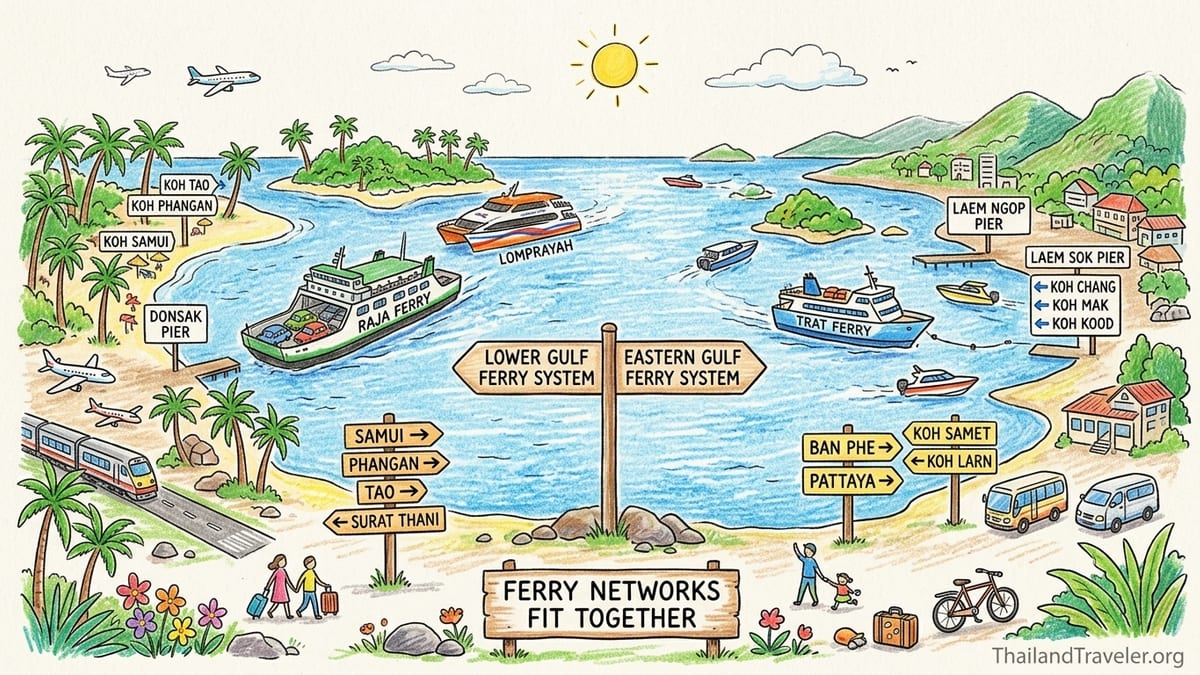
How the Gulf of Thailand’s Ferry Networks Fit Together
The Gulf of Thailand is effectively split into two main ferry systems. In the Lower Gulf, you have Surat Thani and Chumphon on the mainland feeding Koh Samui, Koh Phangan and Koh Tao. In the Eastern Gulf, Trat and Rayong provinces serve Koh Chang, Koh Mak, Koh Kood and Koh Samet, while Pattaya links to tiny Koh Larn. There are occasional seasonal boat links between some island groups, but almost all practical routes involve returning to the mainland and switching networks rather than attempting a direct cross-Gulf hop.
For the Lower Gulf, the main players are Raja Ferry and Seatran Ferry car ferries between Donsak and Koh Samui or Koh Phangan, plus high-speed operators such as Lomprayah, Songserm and Seatran Discovery on passenger-only routes between Chumphon, Surat Thani, Koh Tao, Koh Phangan and Koh Samui. These services feed into domestic flights to Surat Thani, Nakhon Si Thammarat and Chumphon, as well as overnight trains and buses from Bangkok.
In the Eastern Gulf, Boonsiri High Speed Ferries, Koh Kood Express and Seudamgo operate from Laem Sok near Trat to Koh Kood, while a single main car ferry operator carries vehicles from the Laem Ngop area to Koh Chang. Independent speedboat companies connect Laem Ngop to Koh Mak and sometimes on to Koh Kood. Farther west, Ban Phe serves Koh Samet and Pattaya’s Bali Hai Pier serves Koh Larn on entirely separate, very localised routes that are not integrated with the Trat network.
Because of this fragmentation, booking the “right” ticket depends less on finding one master timetable and more on choosing the right pier, operator and vessel type for your priorities. This guide is structured geographically: first the Lower Gulf routes, then the Eastern Gulf, then the separate Ban Phe and Pattaya networks, followed by a comparison section and practical multi-island combinations.
Lower Gulf Gateway: Surat Thani Airport to Donsak and Koh Samui
Most travellers heading to Koh Samui, Koh Phangan or Koh Tao on a budget still funnel through Surat Thani Airport. From there, you have two basic choices. The first is to buy a combined bus-and-ferry ticket from operators such as Seatran or Raja, which include a shuttle from Surat Thani Airport or town to Donsak Pier and a car ferry to Koh Samui’s Nathon Pier or Koh Phangan (usually Thong Sala). Typical 2026 one-way combined fares from the airport to Koh Samui are in the region of 450 to 600 baht for adults, depending on operator and whether pier transfers on Samui are included, with travel times of around 3.5 to 4.5 hours door to pier.
The second option is to arrange your own road transfer to Donsak and buy a ferry ticket at the pier. Raja Ferry and Seatran Ferry both run frequent daily car ferries. Raja primarily uses Lipa Noi and Nathon piers on Samui, while Seatran focuses on Nathon. Crossing times are around 90 minutes to two hours. Recent travellers report paying in the area of 200 to 250 baht per walk-on passenger and around 500 to 700 baht for a small car, not including additional passengers, after a regulated fare increase earlier in 2026. Vehicles pay per vehicle plus a per-passenger supplement, so families driving a rental should factor that into their budget.
Most combined tickets include baggage as standard, but very large or oversized luggage may attract a small fee on high-speed catamarans. Raja and Seatran’s car ferries are relatively relaxed about checked luggage, since passengers stay with their vehicles or in passenger lounges. However, do not assume hotel transfers on Samui are included in the base ferry fare: pier-to-hotel minivans are widely available on arrival at Nathon and Lipa Noi and typically cost 150 to 250 baht per person to major beaches such as Chaweng or Lamai.
For cancellation and changes, Raja and Seatran tickets bought directly are often flexible on the day of travel. Recent passenger reports describe being allowed to take an earlier sailing than originally booked when space was available at no extra cost. Third-party agents and online platforms, though, may charge rebooking or cancellation fees, so check the fare conditions at the time of purchase if your plans are not fixed.
Island Hopping in the Lower Gulf: Samui, Phangan and Tao
Once you are in the Lower Gulf, the busiest short-hop route is Koh Samui to Koh Phangan and back. High-speed catamarans and speedboats serve this 30 to 50 minute run, primarily between Samui’s north and northeast piers and Phangan’s Thong Sala. Lomprayah uses its own pier at Maenam on Samui and arrives at Thong Sala on Phangan. Other speedboat operators use Bangrak or nearby piers. As of 2026, one-way fares for passenger-only high-speed boats generally sit in the 350 to 500 baht range for pre-booked tickets, with prices spiking for last-minute departures around Full Moon Party dates.
The longer runs between the three main islands are a mix of high-speed catamarans and slower ferries. Lomprayah, Seatran Discovery and Songserm operate Samui to Koh Tao via Koh Phangan, as well as direct and indirect Phangan to Tao sailings. Lomprayah’s 2026 timetable lists at least one Samui to Tao sailing most days, with an advertised crossing time from Maenam to Koh Tao’s Mae Haad Pier of approximately 3 hours via Thong Sala. Songserm’s slower boats can take closer to 4 to 5 hours on the same route but are usually a little cheaper, with online examples showing Samui to Tao fares often 100 to 200 baht below Lomprayah on comparable dates.
For Chumphon to Koh Tao, a key route for travellers arriving by train or bus from Bangkok, high-speed catamarans from Lomprayah and Seatran typically clock in at about 1 hour 45 minutes to just under 2 hours to Mae Haad, while slower ferries like Songserm can take 2 to 2.5 hours. Recent fare checks in 2026 show one-way adult tickets in the 700 to 1,100 baht bracket depending on operator, sailing time and whether a bus connection from Chumphon town or train station is included.
These operators sell through-tickets that combine bus or minivan transfers with the ferry leg, for instance Bangkok to Koh Tao via Chumphon or Surat Thani to Koh Phangan via Donsak. While convenient, the trade-off is tight connections and less flexibility if one segment runs late. In practice, monsoon-season delays between October and January can add 30 to 60 minutes to crossing times, and some smaller boats will be cancelled altogether in rough seas. When buying a combined ticket that connects to a flight or train, choose earlier departures and allow generous buffers rather than gambling on the last possible boat of the day.
Choosing Between Catamarans, Slow Ferries and Car Ferries
The Lower Gulf routes give you a clear choice between high-speed catamarans and slower, more traditional ferries and car ferries. High-speed catamarans such as Lomprayah and Seatran Discovery are the fastest and usually the most expensive, with air-conditioned interiors, assigned seating and sometimes basic snacks or drinks for sale. They are ideal if you want to minimise time at sea, especially on longer legs like Chumphon to Koh Tao or Samui to Tao. However, catamarans can be bouncy in choppy seas and may be cancelled earlier than larger ships when wind and waves pick up.
Conventional ferries such as Songserm or the car ferries of Raja and Seatran are slower but more forgiving for those prone to seasickness, thanks to open decks where you can sit outside and watch the horizon. They are generally cheaper than the cats on passenger fares, and Raja and Seatran allow vehicles, motorbikes and sometimes even small trucks. If you are travelling with a rented car or motorbike and plan to use it on the island, these are your only realistic options, though many car rental contracts exclude taking vehicles on ferries, so always check the terms before driving aboard.
In 2026, typical baggage allowances on high-speed ferries include one medium suitcase or backpack and one small carry-on, with extra or very heavy items incurring a modest fee per item. Surfboards, diving gear and bicycles are often chargeable. On the slower ferries and car ferries, bag checks are more relaxed, but space is not infinite in peak season. Always keep valuables and essential documents in a daypack you carry with you on deck instead of leaving them in luggage piles.
Cancellation and change rules vary by operator and sales channel. Direct tickets from operators often allow date changes up to 24 hours before departure with little or no fee, while non-refundable promotional tickets sold by online agents can be strict. When sea conditions deteriorate and a sailing is cancelled outright for safety reasons, operators typically offer transfer to the next available sailing at no additional cost, but refunds may take time if you booked through third parties.
Eastern Gulf: Bangkok to Trat, Koh Chang and Koh Kood
The Eastern Gulf is reached mainly via Trat province. From Bangkok, travellers either fly to Trat Airport or take a 5 to 6 hour bus or minivan ride from Ekkamai or Mo Chit terminals to ferry piers near Laem Ngop and Laem Sok. Combined bus-and-boat tickets are popular and widely sold at travel agencies and online platforms, especially for Bangkok to Koh Chang or Bangkok to Koh Kood. These bundles usually cost somewhere between 900 and 1,400 baht one way in 2026, including bus, short transfers and the ferry or catamaran ticket.
For Koh Chang, vehicle ferries operate from piers in the Laem Ngop area to the island’s northern tip. As of mid 2026, local reports indicate that one main company is running these services after the closure of a competing line. The crossing to Koh Chang takes about 30 to 45 minutes and the ferries can accommodate cars, vans and motorbikes. Following a regulated fare review announced in April 2026, walk-on passenger fares and vehicle fares have risen for the first time in several years, with driver plus car fares now often in the low hundreds of baht one way, plus a small per-passenger fee.
Once on Koh Chang, shared songthaews run from the arrival pier down the west coast to popular beaches such as White Sand, Klong Prao and Lonely Beach. Fares depend on distance but generally start around 60 to 80 baht for shorter hops and climb for more distant bays. Cars and motorbikes drive straight off the ferry and onto the island’s main ring road, although the south coast beyond Bang Bao is narrow and winding.
For Koh Kood, the crucial mainland hub is Laem Sok Pier, roughly 30 kilometres southeast of Trat town. Boonsiri High Speed Ferries, Koh Kood Express and Seudamgo all operate catamarans and speedboats on the Laem Sok to Koh Kood route. Up-to-date 2026 schedules show Boonsiri running two to three daily departures depending on season, with typical crossing times of about 1 hour to Ao Salad Pier on Koh Kood. Koh Kood Express lists multiple daily services, including slower ferries at around 1 hour 10 minutes and speedboats in under an hour.
Current published fares for Laem Sok to Koh Kood in 2026 cluster around 600 baht one way for standard seats on Boonsiri and Koh Kood Express, with slightly higher prices for VIP seating on some boats. One practical advantage of these companies is that their fares usually include resort transfers on Koh Kood or at least a shared pickup drop-off service from Ao Salad to major beaches such as Klong Chao, Ao Phrao and Bang Bao. From Trat Airport, shuttle buses timed to meet flights can connect with mid-morning and early afternoon ferries, with combined air and sea journeys from Bangkok’s Suvarnabhumi to Koh Kood often taking around 6 to 7 hours in total.
Koh Kood, Koh Mak and Koh Chang: Local Eastern Gulf Connections
The Eastern Gulf islands have limited but useful inter-island links, particularly involving Koh Mak. From Laem Ngop’s various small piers, several speedboat operators, including Panan, Leelawadee, Koh Mak Ferry and M Marine, run year-round services to Koh Mak, with more departures from November to April and reduced schedules in the rainy months. Typical advertised travel time is around 45 to 60 minutes, and published fares for 2026 sit in the 450 to 550 baht range one way, making Koh Mak one of the more affordable island hops in the region.
Some of these boats also offer seasonal connections onward to Koh Kood, using a triangular pattern between Laem Ngop or Laem Sok, Koh Mak and Koh Kood. Travel media sources in late 2026 report departures such as a late-morning boat from Koh Mak’s Ao Nid to Laem Sok in about 30 minutes, as well as direct Koh Mak to Koh Kood speedboats in high season. Fares for these legs are usually slightly higher than the mainland links, reflecting lower passenger volumes and smaller boats, but still tend to fall in the mid-hundreds of baht.
Between Koh Chang and Koh Kood, there are no daily big-ferry services. Instead, a patchwork of seasonal speedboats link the two, often marketed through resort desks or local agents rather than centralised websites. These speedboats can be convenient if you want to combine, for example, a week on Koh Chang with a few days on Koh Kood without returning to Trat, but numbers are limited and sailings may be cancelled in rough seas. As of late 2026, travellers report one-way fares typically above 1,000 baht per person for these inter-island legs, reflecting the longer distances and low capacity.
Because these Eastern Gulf inter-island boats are small, monsoon conditions have a proportionally larger impact than on the big Koh Chang car ferries. From June to October, expect more cancellations or schedule changes at short notice, and build flexibility into your itinerary if you intend to use Koh Mak or Koh Kood as stepping stones between islands. If your schedule is tight or you are travelling with children, it can be wiser to route back via the mainland, even if that feels less direct on the map.
Separate Networks: Ban Phe to Koh Samet and Pattaya to Koh Larn
Koh Samet and Koh Larn feel like part of the same coastline as Koh Chang and Koh Mak, but their ferry systems are entirely separate and much more local. To reach Koh Samet, travellers head to Ban Phe in Rayong province, about three hours’ drive from Bangkok by bus or minivan. Several local operators run passenger ferries and speedboats from different piers at Ban Phe to Ao Wong Duan, Ao Vongduern and other landing points on Samet, but the main tourist ferry still runs to Na Dan Pier on the island’s northern tip.
Standard slow ferries from Ban Phe to Na Dan generally take about 30 to 40 minutes and remain one of the best-value island hops in Thailand, with one-way fares in 2026 commonly around 100 baht or less per adult when bought at the main ticket counters near the pier. Speedboats cut the crossing time to as little as 10 minutes but can cost several hundred baht per person, or a flat charter price per boat for small groups. As Koh Samet lies inside Khao Laem Ya–Mu Ko Samet National Park, expect to pay a separate park entry fee on arrival, collected at the pier by park staff; this is not included in ferry tickets.
Koh Larn, off Pattaya, is even more of a commuter-style route. Ferries depart from Bali Hai Pier in South Pattaya roughly every two hours from around 07:00, with the crossing to the island taking about 30 to 45 minutes by slow ferry. A 2026 fare check places the standard one-way ticket at approximately 40 baht per person, with return fares in the region of 80 baht, making it a very cheap day trip option. Speedboats from various points along Pattaya Beach and Bali Hai can transport small groups to specific beaches on Koh Larn in under 15 minutes, at significantly higher per-person cost.
Neither the Ban Phe nor Bali Hai routes generally require advance booking except on major Thai holidays. Tickets for slow ferries are sold from basic booths on the pier and are valid for the next available sailing. However, as with other local boats, safety and comfort vary. Look for lifejackets on board, avoid overcrowded vessels on peak weekends and keep in mind that these local networks are not suitable for tight onward international connections on the same day.
Weather, Monsoon Seasons and Flight Connections
The Gulf of Thailand has two overlapping monsoon patterns that affect ferries differently in the Lower and Eastern Gulf. Around Koh Samui, Koh Phangan and Koh Tao, the heaviest seas and rainfall typically arrive between October and January, with November often bringing the most disruption. In the Eastern Gulf around Koh Chang and Koh Kood, the roughest period tends to run from about June to September, although heavy squalls can appear outside these windows. Smaller high-speed catamarans and speedboats are more likely to see cancellations or severe delays when wave heights climb.
For travellers, the key implication is not to plan tight connections to or from international flights after long sea journeys. For example, if you have an intercontinental flight leaving Bangkok at midnight, it is unwise to take the last evening ferry from Koh Samui to Donsak and then rely on a bus to Surat Thani Airport and a domestic connection on the same day. A cancelled or heavily delayed ferry could cascade into missed flights, expensive last-minute rebooking and overnight stays at your own expense.
As a rule of thumb, treat any long ferry segment of more than 90 minutes as something you should complete at least one day before a major international departure. This applies especially to Chumphon to Koh Tao, Laem Sok to Koh Kood and cross-Gulf services such as Samui to Koh Tao. For shorter hops like Ban Phe to Koh Samet or Pattaya to Koh Larn, same-day connections to domestic flights are more realistic, but even then you should build in several spare hours in case of road traffic or brief weather-related pauses.
Operators publish their intended timetables months ahead, but schedules in 2026 continue to show minor day-to-day adjustments and seasonal tweaks, particularly on Eastern Gulf routes. Before committing to non-refundable flights or hotel bookings, check ferry timetables in the fortnight before travel and, where possible, buy flexible tickets that allow changes without heavy penalties if conditions require.
Route-by-Route: Cheapest, Fastest and Most Convenient Options
For Surat Thani Airport to Koh Samui, the cheapest realistic option in 2026 remains a combined bus-and-ferry ticket with Raja or Seatran using car ferries from Donsak to Nathon or Lipa Noi. These packages are relatively slow but affordable, with door-to-pier times of around 3.5 to 4.5 hours and prices often between 450 and 600 baht. The fastest option is to fly directly to Koh Samui Airport on Bangkok Airways and then take a short transfer by taxi or minivan to your hotel, but airfares are much higher. The most convenient balance for many travellers is a pre-booked Seatran or Raja combo ticket that meets your arriving domestic flight into Surat Thani, while avoiding the very last ferry of the day.
Between Koh Samui and Koh Phangan, the cheapest option is usually the slower passenger ferries or occasional car ferries charging a few hundred baht, especially if you have time and do not mind a 45 to 60 minute crossing. The fastest routes are high-speed catamarans or dedicated Full Moon Party speedboats, which can cut the journey to around 30 minutes but command fares of 350 baht and up. For most visitors, standard catamaran services via Maenam and Thong Sala offer the best combination of reliability, frequency and comfort, though those prone to seasickness might prefer larger, slower vessels on rougher days.
For Chumphon to Koh Tao, Lomprayah and Seatran’s high-speed cats deliver the quickest crossings at roughly 1 hour 45 minutes to Mae Haad, with fares commonly near the top of the 700 to 1,100 baht range. Songserm’s slower boats are cheaper and more forgiving in choppy seas but add 30 minutes or more to the trip. Similarly, for Laem Sok to Koh Kood, Boonsiri and Koh Kood Express catamarans offer fast, comfortable rides including pier-hotel transfers at around 600 baht per person, which is often the best value when you account for included minivans and reliable connections from Trat Airport.
On the Eastern Gulf’s car ferry routes to Koh Chang, slow vehicle ferries are the only option, so your choice is essentially about timing and whether you are on foot or in a vehicle. Walking on as a passenger after arriving by bus from Bangkok is usually the cheapest method, leaving you to hire transport on the island. Driving across with a rental car gives flexibility but adds vehicle ferry charges and may conflict with rental agreements. For Ban Phe to Koh Samet and Bali Hai to Koh Larn, the slow ferries are simultaneously the cheapest and the most atmospheric option, while speedboats are worth considering if you are travelling in a group and value time savings over cost.
In terms of practical multicentre itineraries, the most realistic Gulf combinations avoid cross-Gulf transfers. Good examples include Samui–Phangan–Tao using Lomprayah or a mix of high-speed and slow ferries; Koh Chang–Koh Mak–Koh Kood loops using Trat-based boats and seasonal speedboats; or combining Koh Samet and Koh Chang on a Rayong-to-Trat overland swing. What generally does not make sense is trying to string together, say, Phuket, Koh Samui, Koh Chang and Koh Kood in one continuous overwater route. In such cases it is usually faster and less stressful to fly or bus between coasts and treat each island group as a separate leg.
The Takeaway
Ferry travel in the Gulf of Thailand in 2026 is more structured than it first appears, but it rewards travellers who pay attention to routes, piers and seasons rather than searching for a single all-encompassing timetable. Understanding that Koh Samui, Koh Phangan and Koh Tao form one network linked mainly to Surat Thani and Chumphon, while Koh Chang, Koh Mak and Koh Kood form another linked to Trat and Laem Ngop, makes it easier to piece together realistic, time-efficient itineraries.
When choosing between high-speed catamarans, slow ferries and car ferries, think in terms of your own priorities: speed versus price, seasickness tolerance, whether you need to move a vehicle and how flexible your schedule is. High-speed cats cost more but save time; car ferries are cheaper and forgiving but require longer days. Across all routes, build generous buffers around long ferry segments before or after international flights, and favour flexible or refundable tickets during monsoon periods.
With the latest 2026 fares and schedules in mind, travellers can plan classic island-hopping routes within each Gulf network, from Samui–Phangan–Tao in the Lower Gulf to Koh Chang–Koh Mak–Koh Kood in the east, and add quick escapes to Koh Samet or Koh Larn as short breaks from Bangkok or Pattaya. The key is to keep your plans grounded in the reality of separate ferry systems, not the illusion of a single, seamless sea highway stretching across the entire Gulf.
FAQ
Q1. How far in advance should I book ferry tickets in the Gulf of Thailand?
For most standard ferries, booking a few days ahead is enough, but in peak periods such as Christmas, New Year, Songkran and around Full Moon Party dates, it is wise to reserve high-speed catamarans and inter-island speedboats at least one to two weeks in advance. Ban Phe to Koh Samet and Pattaya to Koh Larn ferries can usually be booked on the day except on major Thai holidays.
Q2. Can I take a rental car on ferries to Koh Samui or Koh Chang?
Yes, Raja and Seatran car ferries to Koh Samui and the vehicle ferries to Koh Chang carry cars and motorbikes for an additional fee, but many rental contracts forbid taking vehicles on ferries or restrict which islands you can visit. Always check the rental agreement and, if necessary, get written permission from the rental company before driving onto a ferry ramp.
Q3. What is the approximate cost of ferry travel from Surat Thani Airport to Koh Samui in 2026?
Combined bus-and-ferry tickets from Surat Thani Airport to Koh Samui using car ferries from Donsak typically cost in the region of 450 to 600 baht one way for adults in 2026. This usually includes the road transfer to Donsak and the ferry to Nathon or Lipa Noi but not always the final transfer to your hotel.
Q4. How rough are the seas on routes to Koh Tao and Koh Kood?
In calm conditions, crossings to Koh Tao from Chumphon or Samui and to Koh Kood from Laem Sok are straightforward. During monsoon periods, however, waves can be high, making high-speed catamarans bouncy and leading to occasional cancellations. Travellers prone to seasickness may prefer larger, slower ferries where available, choose morning departures and carry motion-sickness medication.
Q5. Are hotel pickups included in Eastern Gulf ferry tickets?
On Koh Kood and often on Koh Mak, tickets with operators such as Boonsiri and Koh Kood Express commonly include or offer low-cost shared minivan transfers between Ao Salad or Ao Nid piers and major beaches or resorts. In contrast, Koh Chang car ferries usually do not include island transfers, though songthaews are readily available at the pier. Always confirm what is included when you buy your ticket.
Q6. Is it safe to book bus-and-boat combo tickets for the same day as my international flight?
It is safer to avoid this. Because ferries and connecting buses can face weather or traffic delays, planning a long combo journey on the same day as an international flight creates a real risk of missed departures. A better strategy is to complete ferry and overland segments at least one day before your flight, especially in monsoon months.
Q7. How much does the Koh Samet ferry from Ban Phe cost in 2026?
Standard slow ferries from Ban Phe to Na Dan Pier on Koh Samet generally cost around 100 baht or less one way per adult in 2026. Speedboats are considerably more expensive but faster. Remember that Koh Samet lies within a national park, so you will also pay a separate park entry fee on arrival, which is not included in the ferry fare.
Q8. What is the cheapest way to reach Koh Tao from Bangkok?
The budget-friendly route is usually an overnight bus or train from Bangkok to Chumphon, followed by a morning ferry to Koh Tao. Combined bus-and-boat tickets sold by companies like Lomprayah and Songserm bundle these segments, with overall costs generally lower than flying plus connecting ferries, though travel time is significantly longer.
Q9. Can I travel directly between Koh Chang and Koh Kood by boat?
There is no large daily public ferry between Koh Chang and Koh Kood. Instead, seasonal speedboats, often arranged through local agents or resorts, make the crossing for a higher per-person fare than mainland routes. Because sailings can be cancelled in rough seas and capacity is limited, many travellers prefer to route via Laem Ngop or Laem Sok on the mainland when connections are important.
Q10. Do Gulf of Thailand ferries have strict baggage limits?
Most large ferries and car ferries are relatively relaxed and allow standard luggage plus carry-on bags without weighing each item. High-speed catamarans usually allow one main bag and one smaller item, with extra or oversized baggage, bikes or surfboards charged a modest fee. Regardless of formal rules, always keep valuables, passports and electronics with you in a small daypack rather than in checked piles on deck.