


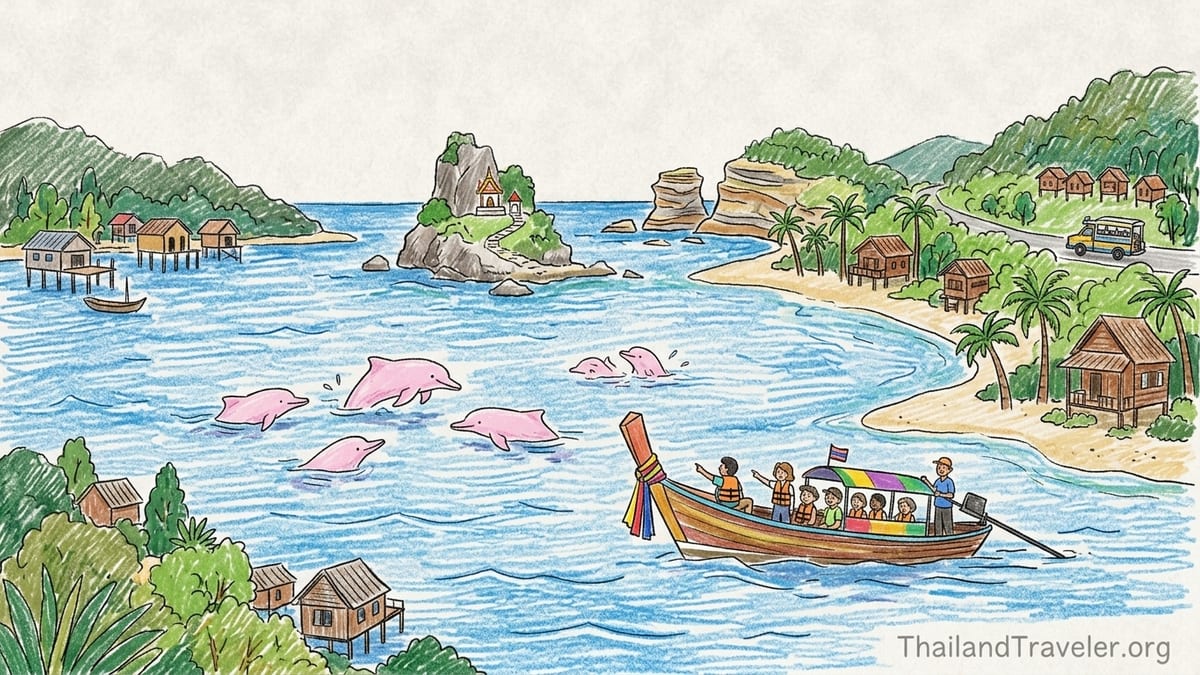
The first time I saw Khanom’s pink dolphins I was not leaning over a packed party catamaran from Koh Samui. I was sitting on the low wooden bow of a longtail boat, knees brushing chipped blue paint, while a fisherman in a faded football shirt cut the engine and let us drift off a quiet Nakhon Si Thammarat shoreline. This is mainland Thailand, not an island theme park, and the difference shapes everything about the experience.
Setting Off From Khanom: Where I Stayed and What I Paid
I based myself in Khanom rather than Koh Samui so I could see how the pink dolphin trips work from the mainland side. The town is spread along a low-key beach road behind Nai Plao and Khanom beaches, with a string of small resorts and guesthouses instead of high-rise hotels. I checked into a midrange seafront bungalow south of Nai Plao for 1,200 baht per night in October 2026, which put me about a 20-minute drive from Laem Prathap, the main pier for dolphin tours on this part of the coast.
The day before I wanted to go out, I asked at my guesthouse and they called a local operator that runs longtail boats from Laem Prathap fishing village. Several operators here quote similar prices, and recent checks with local tourism information and traveler reports in 2026 showed shared morning trips in the 800 to 1,200 baht range per person for a 2 to 3 hour excursion, with a minimum of 4 to 6 passengers. Private charters in a longtail boat for a couple or family have been around 2,500 to 3,500 baht for the boat, depending on the route and time.
I joined a shared trip at 900 baht per person, paid in cash at the pier. That price covered the boat, fuel and a basic life jacket, but not transport from my guesthouse to Laem Prathap, which added another 300 baht each way by pre-booked songthaew. In total, the morning on the water cost about 1,500 baht for one person including local transport. It felt like a community-scale operation: the man taking payment was clearly from the fishing village, and most of the crew were related to one another.
The boat was a classic southern Thai longtail, about 10 meters in length, with a wooden hull, shaded roof and the familiar exposed engine on a long propeller shaft. Including me, there were 8 passengers on board: two German couples, a Thai family of three and myself. That meant plenty of space along the sides, and everyone had a place to sit without crowding the bow. Our captain was a middle-aged local fisherman who introduced himself by nickname only, a common practice among Thai boatmen.
Safety Briefing and Responsible Viewing Rules
Before we left the concrete pier at Laem Prathap, one of the crew handed out life jackets. They were the standard orange foam type, not new but in good repair, with functional buckles. He asked everyone to wear one for departure and return to the pier, and said it was optional once we were out in calm open water. There was no formal checklist with laminated cards or multilingual safety script, but he pointed out the life jackets, demonstrated how to fasten them, and showed where a simple first-aid kit and fire extinguisher were stored under the canopy.
What mattered more for this trip was whether they understood and followed responsible dolphin-watching guidelines. Thailand’s Department of Marine and Coastal Resources has published advice for whale and dolphin watching, including speed limits within a few hundred meters of the animals, avoiding sudden course changes and keeping a respectful distance. Local captains in Khanom do not quote the rules point by point, but the better ones follow the spirit of those recommendations. As we eased away from the pier, our captain spoke in Thai and simple English to explain that we would not chase the dolphins, that sightings were never guaranteed, and that he would cut the engine if the animals came close.
He described the plan: more than an hour of slow steaming along the edge of Ao Thong Nian and the low headlands around Laem Prathap, watching the sea surface for blows or fins. If we were lucky and met dolphins, we would stay with them a while without surrounding or herding them. Only after that would we move on to optional stops such as Koh Nui Nok, known for its Luang Pu Thuat shrine and freshwater pool in the sea, and the layered rock formation often called Pancake Rock. The line between core dolphin viewing and extra sightseeing was clear from the start.
Language-wise, explanations were basic but understandable. The guide pointed to a simple laminated sheet with photographs of Indo-Pacific humpback dolphins in both grey and pink phases, and stressed that they are wild, protected animals. There was no promise of guaranteed encounters, money-back assurances or lures such as feeding. That restraint was reassuring in a region where some marine tours still oversell wildlife.
Out on the Water: Route, Scenery and How We Searched
We left Laem Prathap just after 8 a.m. The bay was calm, light green under a pale sky, and the only other boats moving were a couple of small fishing vessels heading back toward the pier. Unlike Koh Samui, where departure piers are lined with ticket offices and branded speedboats, here the shore was a working fishing community: wooden houses on stilts over the mangroves, nets hung to dry, dogs asleep under longtail hulls pulled onto the sand.
Our route followed the northern curve of Ao Thong Nian before angling out toward deeper water where the captain said the dolphins often feed in the early morning. The shoreline on our right was a mix of low forested hills, narrow pocket beaches and occasional rocky outcrops. In the distance to the northwest, the hazy shape of Koh Samui’s hills reminded me how relatively close, yet different in atmosphere, the island really is.
The sea conditions that morning were cooperative. A light breeze from the northeast raised only small ripples, and visibility across the water surface was good. This mattered, because spotting dolphins from a low boat depends on picking up subtle cues: a faint blow, a pale back rolling in the swell, or seabirds circling where fish school near the surface. Our captain and his younger assistant stood high on the engine cover and bow, narrowing their eyes and scanning slowly, while we passengers were encouraged to look in all directions and point out anything suspicious.
For about forty minutes, we saw nothing larger than flying fish and a few floating logs. The captain throttled back to a slow cruise, clearly aware of the national guideline that boats should reduce speed around areas where dolphins might be present. Even without sightings, the ride itself was peaceful, and this was one of the key differences from a more commercial Koh Samui speedboat outing: there was no loud music, no shouted commentary into a microphone, and no rush to tick off multiple stops. We were simply at sea, watching and waiting.
The Moment The Pink Dolphins Appeared
The first sign was a shout from the bow in Thai, followed quickly by an arm stabbing toward the open water off our port side. At least 200 meters away, a pale shape broke the surface, rolled and vanished. A few seconds later it appeared again, joined by another slightly darker animal. Only after we had seen the backs several times did the captain alter course, turning gradually and moving closer at low speed rather than racing toward them.
Over the next twenty minutes, we were in the presence of what seemed to be a small group of Indo-Pacific humpback dolphins, probably three to five individuals. At the closest, they passed perhaps 40 to 60 meters off the bow, far enough that no one on the boat could have reached them with anything, close enough for naked-eye views of their color and shape. The clearest animal was a very pale pinkish white, with a low dorsal hump rather than a sharply curved fin. Another was mottled grey and pink. None approached or bow-rode, and at no point did the captain try to cross in front of them or cut off their direction of travel.
Behavior-wise, they were calm and focused on feeding. We could see brief surfacings, a partial tail flick here and there, and one higher roll where the entire back arched out of the water. They were not leaping or playing near the boat, which fits with what marine biologists have documented for this species off Khanom and similar coastal habitats: these dolphins are resident animals that feed in shallow, turbid waters and often move in loose groups rather than tight acrobatic pods. They surfaced in a consistent general direction, and our captain paralleled them at a modest distance instead of closing in.
I took photographs with a 200 mm lens from my seat along the side of the boat. At that distance, the images clearly showed the animals’ pale bodies and the characteristic hump-backed profile, but nothing like the close headshots that appear in some tour brochures. That is important to stress. Responsible tours in Khanom should not be promising or using images of people swimming with the dolphins or touching them, because local regulations classify them as protected wildlife and discourage intrusive encounters.
After just under half an hour of intermittent surfacing, the dolphins changed direction, headed offshore and became harder to track. Our captain did not follow them far; he cut the engine and let the boat drift for several minutes, giving them clear water. Only when they were well on their way did he turn back toward the coast, explaining that it was better not to stress the animals by lingering too long.
Why These Dolphins Are Pink: The Science Behind the Colour
The pink dolphins off Khanom are Indo-Pacific humpback dolphins, Sousa chinensis, a coastal species that ranges across parts of the Indian and western Pacific oceans, including the Gulf of Thailand. They are sometimes called Chinese white dolphins or simply humpback dolphins. The “pink” label is descriptive rather than taxonomic, and can cause confusion with an entirely different group of animals: the pink river dolphins of South America, which live in the Amazon and Orinoco basins and belong to a separate family.
Marine biology research from regional institutions and journals on Indo-Pacific humpback dolphins has documented how the colour change happens. Calves are born dark grey. As they mature, they lose pigment in the skin and develop a patchy grey and pink pattern. Older individuals can appear almost white with a marked pink flush. The pink itself is not a pigment like you see in tropical fish; it comes from blood vessels visible through relatively pale skin. When the animals are active, blood flow to the skin increases to help regulate body temperature, and the color can intensify, giving the deep rosy tone that appears in some photographs.
This is very different from the pink river dolphins of the Amazon, often known as botos. River dolphins live in freshwater, have longer beaks and very different body shapes, and face their own conservation challenges from dam construction and river pollution. They are not found in Thailand, and travelers should be wary of any marketing text that suggests the Gulf of Thailand “Amazon dolphins.” In Khanom, what you are seeing are marine coastal dolphins that have adapted to shallow, sometimes muddy estuarine waters near river mouths and mangroves.
Importantly, a pink dolphin is not automatically older or unwell. While age plays a role in the transition from dark grey to paler tones, researchers point out that individual variation and short-term blood-flow changes both affect how pink a given animal looks at any moment. On our trip, we saw at least one very pale animal and one more mottled individual, yet with no way to assess their exact age or health from a casual boat observation. Responsible guides, like the one on our longtail, avoid telling guests that any particular dolphin is “very old” or “sick” based purely on color.
Assessing the Ethics: Distance, Chasing and Disturbance
Because dolphin-watching in Khanom has grown largely out of local fishing communities, standards on the water can vary between operators. Some conservation-focused studies in the wider Indo-Pacific humpback dolphin range have warned that boats which crowd, chase or intersect the path of dolphins can disrupt feeding and resting behavior, and that repeated disturbance in small home ranges may have long-term impacts on vulnerable populations. That concern also applies here.
On the longtail trip I joined from Laem Prathap, the captain’s behavior remained cautious. When we first saw the dolphins, he slowed well before we were anywhere near them. During the main period of observation, our boat stayed an estimated 40 to 100 meters away, roughly in line with national whale and dolphin-watching guidance that encourages slow speeds and buffer zones around animals. He avoided sudden acceleration, refrained from cutting across their heading, and turned off the engine at times so that they passed us without propeller noise.
Equally important was what he chose not to do: he did not radio or call other boats to rush in, even though we could see one other longtail in the distance. We were the only vessel near this group of dolphins for most of the encounter. From the animals’ behavior, there were no obvious signs of stress such as repeated abrupt dives, tight clustering as if fleeing, or sudden changes in direction coinciding with our approach. They simply surfaced, fed and moved on.
However, talking later that day with another guest at my bungalow who had seen dolphins from a speedboat tour booked on Koh Samui, I heard a more mixed account. Their group had been part of a larger day trip that combined the Khanom dolphin search with visits to a well-known “pig island” near Koh Samui and a beach stop. While their operator advertised respect for wildlife, the guest described at least three speedboats converging on the same pod, encircling them at closer distances than we experienced from Khanom. This second-hand story aligned with some conservation conference abstracts that have flagged concerns about crowding of Indo-Pacific humpback dolphins in popular Gulf of Thailand sites. It reinforced my impression that choosing a small-boat, locally run operator from Khanom reduces, but does not eliminate, the risk of harmful disturbance.
Optional Stops: Laem Prathap Village, Koh Nui Nok and Pancake Rock
Once the dolphins had disappeared into the glare to the east, our captain asked if the group was interested in continuing to Koh Nui Nok and Pancake Rock. These are classic optional stops on many Khanom routes, often combined with dolphin watching but not essential to it. Everyone agreed, so we continued along the coast, always within sight of land.
Koh Nui Nok is a small rocky islet topped with a shrine to Luang Pu Thuat, a revered monk in southern Thai Buddhism. Boatmen time visits here with the tide; in a crack between the rocks, there is a natural pool of fresh water that remains even when the surrounding sea is salty. Local legend says the monk turned seawater fresh here to help his followers. When we landed at the simple concrete steps, a few Thai visitors climbed up to light incense and make offerings, while foreign travelers took in the panorama of Khanom’s coastline. The stop lasted about twenty minutes and added a cultural layer to what might otherwise be a purely wildlife-focused outing.
On the way back toward Laem Prathap, we idled briefly off a layered rock formation rising from the sea, often called Pancake Rock because of its flat sedimentary strata that look like neatly stacked stone. It is photogenic in soft morning light, especially with a small longtail passing before it. Again, the captain made it clear that this was a scenic detour, not a required part of dolphin viewing, and he did not prolong the stop once everyone had taken a few photographs.
Back at Laem Prathap itself, as we stepped off the boat, the fishing-village setting framed the end of the tour. Fish traps were being unloaded, shrimp paste from the community’s small producers was drying in the sun, and a few small stalls sold snacks and cold drinks. This everyday coastal economy is part of what distinguishes Khanom’s pink dolphin experience from more commercial hubs in the Gulf of Thailand. You are entering a working marine landscape, not a purpose-built attraction.
It is worth noting that some operators also offer extended programs that add snorkeling near small offshore islands, or lunch stops at local coastal restaurants. These can be enjoyable in good weather, but travelers focused primarily on dolphin watching should regard them as extras rather than the main purpose of the excursion, and should not feel obliged to add more time on the water if they are concerned about the cumulative disturbance to wildlife.
Khanom Longtail or Koh Samui Excursion: What Is the Real Difference?
For travelers already staying on Koh Samui, the pink dolphin tours sold on the island are an obvious option. Current 2026 brochures from Samui-based agencies describe half-day speedboat trips that include a dolphin search off Khanom, a scenic pass by Pancake Rock, and a beach or snorkeling stop around Koh Madsum or nearby islands. Prices advertised to foreign tourists at the time of writing ranged from about 2,300 to 3,000 baht per adult, including hotel transfers on Samui, boat, guide and a light lunch or fruit on board.
From a purely logistical perspective, the Samui excursions are convenient. You are picked up at your island hotel, travel by minivan to the pier, board a modern speedboat and return in time for a late lunch or afternoon by the pool. Boat travel time from Samui across to the Khanom coast is often under an hour in calm conditions, meaning more of your morning budget goes into transit across open water and multiple stops rather than slow searching along the specific coastal stretch where the dolphins live.
By contrast, booking from Khanom usually involves land-based travel to Laem Prathap and then a slower longtail ride that spends far more time in the dolphins’ core habitat. My 900-baht shared trip plus local transport totaled around 1,500 baht for the morning, less than many Samui packages but without lunch or hotel pick-up included. If I had chartered the entire longtail as a couple, the cost for two people would have been similar to a mid-priced Samui shared speedboat tour, but with complete control over timing and route.
The practical differences extend beyond pricing and time. Longtail boats are more exposed to weather and less comfortable in rough seas, but they are quieter at low speed and, when operated thoughtfully, easier to hold at a respectful distance from wildlife. Speedboats cover ground quickly, which is efficient for multi-stop itineraries that also include pig beaches and snorkeling, yet that same power can tempt guides to accelerate suddenly toward dolphins or to move frequently between groups of animals. On crowded days with several speedboats converging on the same pod, the cumulative disturbance may be higher than with a handful of local longtails searching quietly out of Khanom.
Weather, Dolphin Movements and Enjoying the Trip Without Sightings
Pink dolphin encounters in Khanom are never guaranteed, and several variables shape your chances on any given day. Season matters: local tourism boards and field observations point to the cool and dry months from roughly November to April as generally offering calmer seas and more comfortable conditions. Time of day also counts. Most responsible operators prefer early morning departures, when the sun is lower, the sea is often smoother and the dolphins tend to be more active near the surface.
On my October outing, a light northeast wind and good visibility helped us pick up distant surfacings. If strong monsoon winds had been blowing, the low profile of the dolphins and the chop would have made spotting far more difficult, even if the animals were present. Likewise, heavy rain reduces both visibility and comfort. Reputable captains in Khanom will cancel or postpone trips in truly bad weather, especially when safety on small longtail boats is at stake.
The dolphins themselves move in response to prey, tides and possibly human activity. Some mornings they may stay close to their favored feeding grounds off Laem Prathap and Ao Thong Nian; on others they may travel farther out or along the coast beyond the normal tourist range. Boatmen who fish here year-round have an intuitive sense of likely hotspots, but even they cannot predict with certainty. In 2026, local researchers estimated a resident population of only several dozen animals using this stretch of coast, which underscores how important it is that tourism pressure does not push them away.
This uncertainty raises the question of whether the excursion is worth it if you do not see dolphins at all. For me, the answer from Khanom was yes. The slow glide along a relatively undeveloped coastline, the view back to the coconut-fringed beaches, the chance to visit a small shrine on Koh Nui Nok and to watch a fishing village at work, all combined into a genuinely distinctive mainland Gulf of Thailand experience. It would not have felt the same on a faster, louder, more crowded boat hopping between island photo-stops.
The Takeaway
Looking back on my pink dolphin morning from Khanom, three things stand out: the small scale, the sense of place and the restraint shown around the animals themselves. We shared a wooden longtail with local families rather than joining a mass excursion. We left from a fishing pier that still smells of nets and shrimp paste, not a concrete complex lined with souvenir shops. And when the dolphins finally appeared, our captain altered speed and direction carefully, staying at distances that balanced good viewing with minimal disturbance.
Was the tour ethical? Based on what I observed that morning, it leaned strongly in the right direction. There were no attempts to feed or touch dolphins, no hoarding of animals between multiple boats, no high-speed chases or cutting across their path. The captain acknowledged from the start that sightings were not guaranteed, and he limited our time with the group once it was clear they were moving away. That does not mean every operator in Khanom follows identical standards, but it does show that responsible dolphin watching is possible here when local knowledge and conservation awareness meet.
Was the cost justified? For roughly 1,500 baht including local transport, a 2.5-hour low-impact boat trip that yielded a half-hour encounter with Indo-Pacific humpback dolphins, along with a short stop at Koh Nui Nok and views of Pancake Rock, felt like good value. If no dolphins had appeared, I would have seen it as a paid opportunity to experience a still relatively undeveloped stretch of Thailand’s Gulf coast from the water, with the understanding that wildlife remains unpredictable. The key is to approach the excursion as a chance to support local communities and learn about coastal ecosystems, not as a ticket to a guaranteed show.
As for whether I would stay overnight in Khanom again rather than visiting from Koh Samui, the answer is yes. Khanom itself, with its long, quiet beaches, low-rise guesthouses and easy access to Laem Prathap, offers a slower, more grounded base for anyone interested in responsible wildlife experiences. Coming from Samui can fit a packed island itinerary, but if pink dolphins are the main draw and you value a calmer, less commercial atmosphere, planting yourself on the mainland side gives you more flexibility with weather windows, more time on the right stretch of water, and a better chance to see how dolphins, fishers and visitors all share the same bay.
FAQ
Q1. Are pink dolphin tours in Khanom guaranteed to see dolphins?
Encounters are not guaranteed. Even in good season and calm weather, dolphins may be feeding elsewhere or surface too briefly to spot, so it is possible to return without sightings.
Q2. What is a realistic price for a dolphin tour from Khanom in 2026?
Shared longtail trips from Laem Prathap typically cost around 800 to 1,200 baht per person for 2 to 3 hours, with private charters starting from roughly 2,500 baht per boat.
Q3. How much do pink dolphin tours from Koh Samui cost compared with Khanom?
Recent Samui-based speedboat excursions that combine the Khanom dolphin search with other stops usually range from about 2,300 to 3,000 baht per adult, including island hotel transfers and a light meal.
Q4. When is the best time of year and day to look for pink dolphins?
The most reliable conditions are generally from about November to April, with early morning departures favored for calmer seas, cooler air and more surface activity from the dolphins.
Q5. What kind of boat is used in Khanom and how many people are on board?
Khanom tours mostly use wooden longtail boats with canopies. Shared trips often carry 6 to 10 passengers, which leaves enough room to move along the sides without crowding.
Q6. Are the Khanom pink dolphins the same as South America’s pink river dolphins?
No. Khanom’s animals are Indo-Pacific humpback dolphins, a marine coastal species, while South America’s pink river dolphins live in the Amazon and Orinoco rivers and belong to a different family.
Q7. How close do responsible boats get to the dolphins?
On well-run tours, boats usually hold back around several dozen meters or more, adjust speed gradually and avoid cutting across the animals’ path or surrounding them with multiple vessels.
Q8. Is it possible or allowed to swim with the pink dolphins?
Swimming with the dolphins is strongly discouraged. They are protected wildlife, and entering the water near them can disturb their behavior and increase the risk of accidental injury from boat traffic.
Q9. What should I bring to stay comfortable on a Khanom dolphin trip?
Essentials include a hat, sunscreen, water, a light long-sleeve layer for wind, a dry bag for electronics and a camera or binoculars if you want clearer views at a distance.
Q10. Is it better to stay in Khanom or visit on a day trip from Koh Samui?
Staying in Khanom gives more flexibility with weather and departure days, a quieter coastal base and longer time on the dolphins’ home waters, while Samui day trips prioritize convenience and multi-stop itineraries.