


Koh Tao has spent decades building a reputation as one of the world’s easiest and most affordable places to learn scuba diving. For 2026 and 2027, competition between dozens of dive schools keeps prices sharp, but it also makes choosing a course more confusing. This guide focuses on real-world options for PADI and SSI Open Water certification, Discover Scuba Diving experiences, Advanced Open Water, refreshers, fun dives and specialist trips, with concrete examples from established operators such as Big Blue Diving, Ban’s Diving Resort, Roctopus Dive, Sairee Cottage Diving and Crystal Dive.
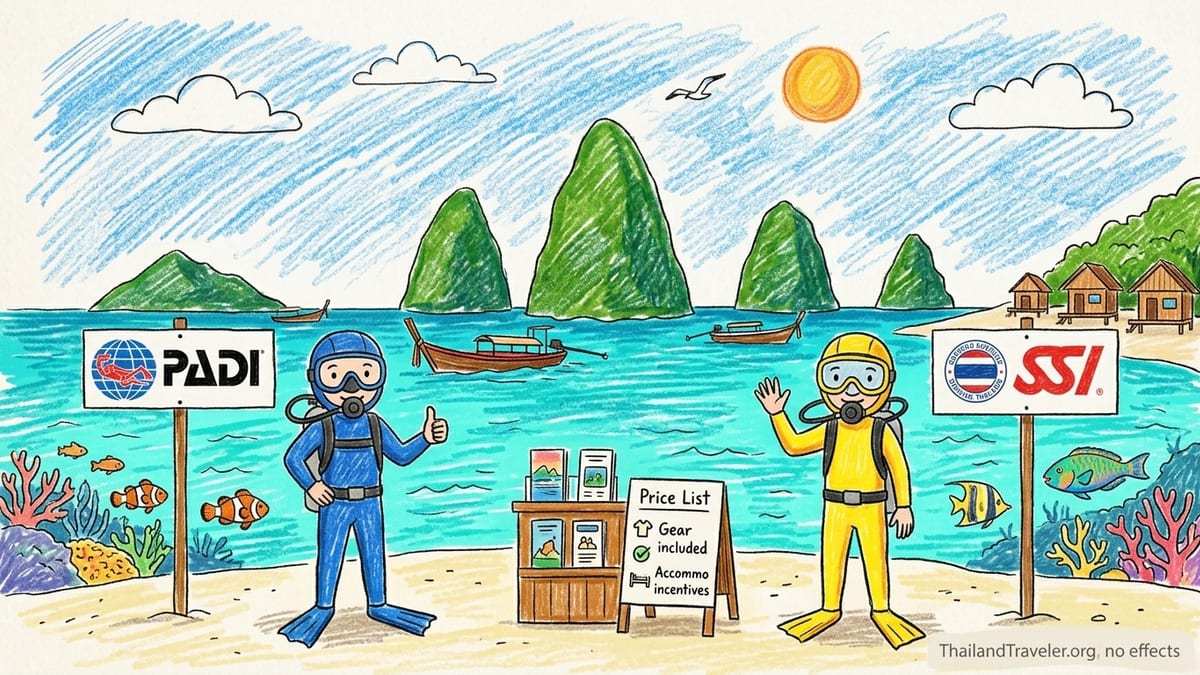
PADI vs SSI on Koh Tao: What Really Matters
The first question many visitors ask is whether to train with PADI or SSI. On Koh Tao, both agencies are firmly established and recognised worldwide, so the name on the certification card is usually less important than the quality of the individual school and instructor. PADI, based in the United States, has been the dominant global brand for decades, while SSI, founded in 1970 and now owned by Head, has grown quickly through flexible digital learning and strong partnerships with dive centres around the world. Both agencies teach similar skills for entry level and advanced recreational diving, and both are widely accepted for boat dives across Thailand, Southeast Asia and beyond.
In practical terms, the course content for an entry level Open Water programme is broadly similar: you complete theory (in person or via e-learning), confined water sessions where you learn basics such as mask clearing and buoyancy, and a minimum of four open water dives. The specific order and style of teaching can vary by agency and by instructor, but skills such as buddy checks, emergency ascent procedures and controlled buoyancy are common to both. Your PADI Open Water Diver card or SSI Open Water Diver card will both qualify you to dive with a buddy to a recommended recreational limit of around 18 metres in conditions similar to those you trained in, subject to local operator policies.
Where you may notice a difference is in course logistics and pricing. SSI’s business model allows centres to bundle digital learning materials and certification fees in different ways, which is why some Koh Tao schools offering SSI can advertise slightly lower package prices or more flexible course start dates. PADI’s standardised materials and fees tend to make pricing a little more uniform. However, on the ground in 2026 you will find PADI Open Water courses on Koh Tao advertised from around 11,000 to 12,950 Thai baht including equipment and boat dives, and SSI Open Water courses starting around 9,900 to 12,500 baht, often with accommodation incentives attached. Those ranges overlap significantly, so it is worth looking beyond the agency logo and comparing what is included.
If you are already certified with one agency, there is no requirement to stay with it for life. It is common on Koh Tao to see divers who took a PADI Open Water course in the Caribbean later complete an SSI Advanced Adventurer on Koh Tao, or vice versa. For most recreational divers, dive boats and resorts care about your certification level and logged experience far more than whether the plastic card is branded PADI or SSI.
Key Koh Tao Dive Schools and What They Offer
Several long established dive schools underpin Koh Tao’s reputation. At the larger end, Ban’s Diving Resort on Sairee Beach is a PADI 5 Star CDC centre known for its resort-style campus, multiple swimming pools and large teaching teams. Recent price checks in late 2026 list its PADI Open Water course at around 11,000 baht, equipment and boat fees included, with discounted on-site accommodation across a range of room types. Ban’s focuses on PADI training all the way up to professional levels, including Divemaster and Instructor Development Courses, and is often chosen by travellers who like the energy of a busy resort environment and the option to continue training up the ladder.
Big Blue Diving, based on Sairee Beach, is another long standing operation that has shifted heavily toward SSI recreational training. Its own materials promote SSI Open Water as the default entry level, with one day introductory dives and continuing education available for certified divers. In 2026, independent price trackers and traveller reports place Big Blue’s Open Water packages from roughly 9,900 baht for shore focused options up to around 13,900 baht for boat-heavy schedules, with variations depending on how many dives are included and whether accommodation is bundled. Big Blue is often highlighted for smaller class options and for balancing social atmosphere with structured training.
Roctopus Dive is smaller than Ban’s but well known among independent travellers and backpackers who prefer intimate group sizes. Roctopus offers SSI courses at beginner and advanced levels, typically capping Open Water groups at four students per instructor and emphasising flexible scheduling. Its Open Water prices generally sit midrange for Koh Tao, often around the 11,000 to 12,000 baht mark with full gear, boat dives and digital materials included, though exact figures depend on seasonal promotions. The atmosphere tends to be relaxed and social, appealing to solo travellers who want to meet others without being on a huge boat with dozens of students.
Sairee Cottage Diving and Crystal Dive represent two further well established choices. Sairee Cottage, on central Sairee Beach, trains both SSI and PADI on request, with a strong focus on multi language teaching teams, comfortable beachfront accommodation and a social pool area. Crystal Dive, based in Mae Haad, is closely associated with SSI training and is frequently cited in up to date pricing guides for its Open Water package at around 12,500 baht including four nights of private air conditioned accommodation, full equipment and certification costs. For travellers weighing price against comfort, those bundled room deals can be attractive, especially when compared with schools that advertise a slightly lower base course fee but exclude housing.
What Your Money Buys: 2026–2027 Course Prices and Inclusions
Across Koh Tao in late 2026, Open Water course prices at reputable schools broadly cluster between 9,900 and 12,950 baht. At the lower end of that spectrum, you may find SSI Open Water packages at smaller centres that include four training dives, rental equipment and boat fees but no accommodation. A typical midrange example is an SSI Open Water course at around 11,000 baht where digital learning materials, certification fees, four training dives, full rental gear, tank fills and boat transport are all bundled, but you book your own guesthouse nearby.
On the PADI side, Ban’s Diving Resort’s PADI Open Water price of around 11,000 baht includes classroom and pool sessions, four open water dives, all equipment and boat costs, plus access to on site facilities. Accommodation is extra but discounted, so many travellers report overall package costs comparable to midrange SSI offers once rooms are factored in. PADI focused centres like Black Turtle Dive, also on Koh Tao, are listed in current independent roundups with Open Water courses at approximately 12,950 baht including digital learning, gear and certification fees, with accommodation on request as an add on rather than bundled by default.
SSI oriented schools sometimes compete more directly on inclusive packages. Crystal Dive’s 12,500 baht Open Water deal, for instance, wraps four nights in a private air conditioned room into the course price, effectively lowering your separate lodging costs. Carabao Diving Resort in Chalok Bay has advertised an SSI Open Water course at around 9,900 baht with three nights in a dorm room included, which can suit budget travellers who are comfortable in hostel style accommodation. At the time of writing, DPM Diving offers an SSI Open Water course in the 11,000 baht range with the option of adding three nights of accommodation for around 1,000 baht more, illustrating how room costs can be flexibly bolted on.
Whenever you compare prices, it is essential to confirm what is and is not bundled. Check whether the quoted figure includes digital or printed learning materials, certification processing fees, all necessary rental equipment including dive computer, daily boat trips to training sites, local dive insurance and transfers between the pier and the dive centre. Many Koh Tao schools now include basic dive accident insurance automatically in course packages, reflecting local pressure from insurers and operators, but it is still wise to confirm. If two courses are listed at 11,000 baht but one requires you to pay an additional fee online for e learning access and charges daily gear rental, the sticker price may not reflect your true cost.
Discover Scuba, Open Water, Advanced and Beyond
Not everyone who comes to Koh Tao knows if they want a full certification. For complete beginners, a one day introductory experience called Discover Scuba Diving (DSD) or a similar try dive programme is widely available. PADI’s DSD involves a short safety briefing, shallow water skills and one or two supervised dives to a maximum depth of 12 metres. On Koh Tao, these one day programmes are typically priced below a full course, and schools like Big Blue, Ban’s and Sairee Cottage adapt them both for pool plus shallow bay introductions and for simple boat based dives at very easy sites such as Japanese Gardens near Koh Nang Yuan.
The full Open Water course is usually scheduled over three to four days. The first day or evening often covers theory and homework using PADI or SSI materials, while days two and three focus on confined water training in a pool and open water dives from the beach or boat. Many Koh Tao schools structure the course as one half day in the classroom and pool, followed by two days of boat trips with two dives per day at sheltered sites. Training includes emergency skills like sharing air with a buddy and practising controlled emergency ascents from shallow depths. Completing the course certifies you for recreational dives with a buddy but does not automatically qualify you for deep diving beyond recreational limits or for environments such as caves, wreck penetrations or overheads, which require additional specialised training.
For certified divers, Advanced Open Water or SSI Advanced Adventurer programmes are a popular way to extend skills while enjoying more complex sites. These courses typically involve five training dives, including core topics such as navigation and deeper diving to a maximum of about 30 metres, plus elective dives such as peak performance buoyancy or night diving. On Koh Tao, operators often run Advanced courses over two days, with prices in late 2026 commonly sitting slightly below Open Water because they involve less classroom time and no pool sessions. Refresher or Scuba Review sessions are available for lapsed divers who have not been underwater for a year or more, normally involving a short theory recap and a confined water skills session before heading out on fun dives.
Once you are comfortable at Open Water or Advanced level, most Koh Tao schools are happy to book you on guided fun dives. Typical fun dive packages in 2026 cluster around a few thousand baht for two or three boat dives, with discounts for multiple days. Specialist trips, such as deep dives to offshore sites, photography focused dives or eco programmes like coral restoration, are offered by several operators at modest premiums over standard fun dive rates. These options can be especially appealing for divers who already hold an Advanced or equivalent certification and want to sharpen a specific skill.
Course Structure, Safety Standards and Choosing a School
Regardless of agency, reputable Koh Tao schools follow similar safety frameworks. Before training starts, you complete a medical questionnaire based on PADI or SSI standards. This form screens for conditions such as asthma, heart disease, recent surgery or pregnancy that may require clearance from a diving physician. If any answers are flagged, good operators will refer you to a local or regional doctor familiar with diving medicine rather than pressing ahead. You will also sign liability releases and acknowledge the inherent risks of scuba diving, which is standard practice worldwide.
Instructor to student ratios are a crucial but often overlooked point of comparison. While agencies set maximum ratios for entry level training, many Koh Tao schools aim for smaller groups in practice. A widely cited example is Roctopus limiting Open Water classes to four students per instructor. In contrast, large resort operations like Ban’s may legally accommodate more students in a group, though they often also assign certified assistants or divemasters to help. When comparing options, ask directly how many students are typically in each Open Water group in the season you are visiting, and whether private or semi private upgrades are available if you prefer more attention.
Equipment quality and maintenance deserve close scrutiny, especially on budget packages. Dive gear on Koh Tao tends to be heavily used, given the island’s volume of entry level courses, but well managed schools will have regular servicing schedules for regulators and tanks, keep logbooks for hydrostatic tests and visual inspections, and retire damaged wetsuits and buoyancy compensators rather than patching indefinitely. During a visit or video call, do not hesitate to ask when their tanks were last inspected and whether regulators are serviced in house or by an external technician. If a school cannot provide clear answers, consider looking elsewhere even if its prices are attractive.
Safety procedures on boats and at dive sites should also inform your decision. Look for briefing boards that outline emergency oxygen locations, life jackets and boat evacuation routes, and listen carefully to how instructors explain lost diver procedures and low on air protocols. Reputable Koh Tao operators will have emergency oxygen and first aid kits on every boat, staff trained in CPR and oxygen administration, and clear lines of communication with hyperbaric chambers on nearby islands or the mainland. It can be tempting for backpackers to choose the absolute cheapest option they find in a bar or hostel flyer, but traveller reports and instructor testimony increasingly highlight that extremely low prices may reflect shortcuts in maintenance, rushed skills sessions or oversized groups.
Weather, Dive Sites and Matching Conditions to Experience
Koh Tao’s diving calendar is shaped by monsoon patterns in the Gulf of Thailand. From roughly February to September, seas around the island are often calm, visibility is frequently between 10 and 25 metres at popular sites, and rain showers tend to be short. Late October through January can bring stronger winds, heavier seas and shorter windows of good visibility, though conditions vary year by year. Local operators adjust schedules accordingly, prioritising sheltered sites when waves pick up and avoiding the more exposed offshore pinnacles if currents are strong.
Beginner training dives are usually held at protected, shallow sites that combine gentle conditions with interesting marine life. Japanese Gardens, a shallow reef system next to Koh Nang Yuan, is a classic choice for Discover Scuba and early Open Water dives, with sloping sand patches used for kneeling during skills and coral bommies filled with reef fish in 5 to 12 metres of water. Twins, a pair of reef mounds not far away, offers similar depths and sheltered conditions, along with the occasional sighting of resident saddleback clownfish and blue spotted rays. White Rock, closer to Koh Tao itself, adds slightly more depth and complexity while remaining well within Open Water limits, making it a favourite site for the later training dives of both Open Water and Advanced courses.
More experienced divers and Advanced students often head to deeper, more challenging sites. Chumphon Pinnacle, north of Koh Tao, is one of the signature deep dives in the area, with the main rock rising from around 30 metres to the mid teens and cleaning stations that attract schooling barracuda, trevally and, in some seasons, whale sharks. Sail Rock, located between Koh Tao and Koh Phangan, is another iconic site known for its chimney swim through and depths down to 30 metres. Shark Island, off the southeast of Koh Tao, offers more varied topography and, at times, stronger currents and surge. These deeper or more exposed sites are not appropriate for absolute beginners learning basic skills, and reputable schools reserve them for certified divers or the later stages of an Advanced course, always within agency depth guidelines.
Weather and sea conditions directly influence daily planning. If heavy rain reduces visibility to a few metres at offshore pinnacles, instructors may reschedule deep training dives and instead complete navigation or buoyancy modules at more sheltered reefs. Strong surface chop can lengthen boat journeys to outer sites and make entries more challenging, so schools may rotate to leeward bays where waves are lower. When planning your trip, allow some flexibility in your schedule so that if wind or currents require a change of plan, you still have a buffer day or two to finish dives without rushing.
Flying After Diving and How Many Days to Allow
A recurring planning question for Koh Tao visitors is how long to wait between finishing their dives and boarding a flight from nearby airports such as Koh Samui, Surat Thani or Bangkok. Pressurised aircraft cabins expose you to reduced ambient pressure compared with sea level, which can increase the risk of decompression sickness if you still have excess nitrogen dissolved in your tissues from recent dives. International diving medicine guidance, heavily informed by research from organisations such as Divers Alert Network, recommends minimum surface intervals before flying that vary with dive profiles.
Recent consensus statements and educational materials summarising current guidance suggest waiting at least 12 hours after a single no decompression dive and a minimum of 18 hours after multiple dives in one day or multiple days of diving, with longer intervals advised after any dive requiring decompression stops. Some aviation authorities and conservative dive operators now commonly suggest a blanket 24 hour no fly interval after recreational diving for simplicity, particularly for holiday divers who may not closely track computer based no fly timers. When scheduled flights and ferries are involved, adding several extra hours of buffer beyond agency or computer minimums reduces risk further.
For a typical Koh Tao Open Water course that involves four open water dives across two days and perhaps additional fun dives, planning at least 24 hours between your final dive and your departure flight is a prudent and commonly adopted rule of thumb. As a practical example, if your last training dive finishes at 10:30 in the morning, taking a flight out of Koh Samui or Chumphon no earlier than late morning the following day allows a comfortable safety margin. If your itinerary includes deep dives to sites such as Chumphon Pinnacle or Sail Rock, particularly at or near the recreational depth limits, it is sensible to be even more conservative and schedule your onward flight a full day and a half after you surface.
In addition to no fly times, remember general health considerations. After several days in warm salt water, minor dehydration is common, and boat travel back to the mainland can add fatigue. Hydrate well, avoid heavy drinking immediately after your last dive day, and resist the urge to squeeze in a final deep dive the same morning you plan to leave. Travel insurance policies increasingly reference adherence to established flying after diving guidelines when assessing claims, so respecting those windows is both medically and financially wise.
Who Each Option Suits: First Timers, Certified Divers and Couples
For first time divers, Koh Tao’s combination of warm water, gentle entry level sites and competitive pricing remains very attractive. If you have never dived before and are not yet certain you will enjoy it, starting with a Discover Scuba Diving or similar try dive with a reputable school such as Big Blue, Sairee Cottage or Roctopus can be a smart way to test the waters before committing three or four days to a full course. Choose a school that caps group sizes at four students per instructor, uses a pool or calm bay for the first skills session and schedules initial dives at sheltered sites like Japanese Gardens or Twins. The choice between PADI and SSI is less important than the centre’s safety culture, communication and patience with nervous beginners.
Certified divers coming to Koh Tao primarily for fun dives or advanced training should look beyond headline Open Water prices and focus on operator strengths. If your goal is to dive deep pinnacles such as Chumphon or Sail Rock, ask which boats regularly schedule these trips, what minimum certification and recent experience they require, and whether nitrox training is available if you prefer longer no decompression times. Some centres, including Ban’s and Crystal Dive, have the scale to run dedicated boats for advanced or pro level divers, while others like Roctopus may focus on smaller, mixed experience groups but still offer deep sites when conditions allow. Confirm maximum group sizes for fun dives, and consider paying a bit more for smaller guided groups if you value personalised attention.
Couples and friends at different experience levels often find Koh Tao convenient because large schools can run parallel courses and fun dives on the same days. It is common, for instance, for one partner to complete an Open Water course at Ban’s while the other finishes a Rescue Diver or simply joins fun dives from the same boat once training schedules align. When researching, explain your differing levels to the school and ask how they can structure dives so you share transport and surface intervals where possible, even if training sessions themselves are separate. Accommodation focused centres like Crystal Dive or Ban’s may particularly suit couples who want an integrated resort feel with a pool, restaurant and rooms on site.
For travellers weighing Koh Tao against Koh Samui or Koh Phangan for scuba activities, cost and logistics are key differentiators. Koh Samui and Koh Phangan both offer diving, but many trips from those islands involve long boat rides out to sites located closer to Koh Tao, and course prices tend to be higher due to greater overheads. By basing yourself on Koh Tao itself, you are closer to the majority of the training reefs and pinnacles, enjoy a denser choice of dive schools and often pay noticeably less for equivalent PADI or SSI qualifications. If your main goal is diving and you are comfortable with a smaller, more dive focused island, Koh Tao generally offers better value and more course options than its larger neighbours.
The Takeaway
Choosing a Koh Tao dive course in 2026 or 2027 ultimately comes down to far more than just PADI versus SSI or who advertises the lowest price. Both agencies offer globally recognised entry level and advanced certifications, and both are well represented on the island. Focus instead on verified course inclusions, instructor to student ratios, equipment maintenance standards, safety culture and how well a school’s style matches your travel personality, whether that means a large social resort like Ban’s, a mid sized centre like Big Blue, or a smaller, more intimate operation such as Roctopus or Sairee Cottage Diving.
When comparing prices, read beyond the headline figures to see whether learning materials, certification fees, boat trips, insurance, equipment and accommodation are included, and do not be seduced by bargain offers that undercut island wide norms by thousands of baht without a clear explanation. Plan your training dates with weather and sea conditions in mind, allow at least 24 hours between your last dive and your onward flight, and remember that an entry level certification is the start of your diving journey rather than a ticket to deep, technical or overhead environment dives.
Handled thoughtfully, a Koh Tao diving course can be one of the most rewarding investments of your trip through Thailand. With a bit of research and realistic scheduling, you can leave the island not only with a plastic certification card but with solid foundational skills, memorable encounters at reefs like Japanese Gardens and Chumphon Pinnacle, and the confidence to explore more of the underwater world on future travels.
FAQ
Q1. Is PADI or SSI better for learning to dive on Koh Tao?
PADI and SSI are both internationally recognised recreational training agencies, and both are well established on Koh Tao. The more important choice is the individual dive school and instructor: look for small groups, good safety procedures, well maintained equipment and clear communication, rather than focusing solely on the brand of certification card.
Q2. How much does a Koh Tao Open Water course cost in 2026–2027?
At reputable schools, Open Water courses generally range from about 9,900 to 12,950 Thai baht, depending on the agency, how many dives are included and whether accommodation and digital learning materials are bundled. Packages at the lower end may not include rooms, while slightly higher priced offers, such as those from Crystal Dive or Ban’s, may add discounted or free on site accommodation.
Q3. What is included in typical Open Water prices?
Most Koh Tao Open Water packages include instructor time, pool or confined water training, at least four open water dives, full rental equipment, tank fills and boat trips to training sites. Many also include agency learning materials, certification processing fees and basic local dive insurance. Always confirm inclusions in writing, especially for gear rental, digital course access and room nights.
Q4. How many days do I need for an Open Water course, and how long before I can fly?
Plan three to four days on Koh Tao for an Open Water course itself, plus at least an extra full day before flying. Current diving medicine guidance suggests waiting a minimum of 18 hours, and many operators recommend 24 hours or more between your final dive and boarding a plane, especially if you have done multiple deep dives or an Advanced course.
Q5. Can I go straight from Open Water to deep or cave diving?
No. Entry level Open Water courses qualify you for recreational dives with a buddy in open water to agency recommended depth limits, usually around 18 metres. Deep diving beyond standard recreational limits, overhead environments like caves or wreck penetrations and technical profiles all require additional specialist training, experience and equipment that go well beyond what is covered in an initial course.
Q6. Are cheaper dive schools on Koh Tao unsafe?
Not necessarily, but extremely low prices compared with island wide norms can be a warning sign. Because equipment maintenance, instructor salaries, insurance and boat operations have real fixed costs, a school offering dramatically cheaper courses may be cutting corners by increasing group sizes, shortening dives, reducing skills practice or delaying gear servicing. Compare safety procedures and group sizes as carefully as you compare prices.
Q7. Which Koh Tao dive sites are best for beginners?
Japanese Gardens near Koh Nang Yuan, Twins and the shallower parts of White Rock are classic beginner sites, offering sandy bottoms for skills, gentle depths and plenty of reef life. These locations are often used for Discover Scuba experiences and early Open Water dives because they combine easy conditions with a rewarding first look at Koh Tao’s underwater scenery.
Q8. Which Koh Tao dive sites need more experience?
Chumphon Pinnacle, Sail Rock and the deeper or more exposed sections of Shark Island generally suit divers with an Advanced certification or equivalent experience, as they can involve greater depths, stronger currents or more complex navigation. Reputable schools schedule these dives for certified divers with recent logs and may include them in Advanced programmes once basic skills are solid.
Q9. Can couples or friends with different levels dive together on Koh Tao?
Yes. Larger schools such as Ban’s, Big Blue and Crystal Dive routinely handle mixed experience groups by running parallel courses and fun dive trips. One partner may be in an Open Water class while the other joins advanced or fun dives on the same boat. You may not be in the water together for every dive, but you can still share transport, surface intervals and accommodation.
Q10. Is Koh Tao better for diving than Koh Samui or Koh Phangan?
For most travellers focused on scuba, Koh Tao offers better value, more dive schools and shorter boat rides to key sites than Koh Samui or Koh Phangan. Many trips from Samui and Phangan travel to dive sites located closer to Koh Tao anyway, often at higher overall prices. If diving is your priority and you are comfortable with a smaller, more laid back island, basing yourself on Koh Tao usually makes practical and financial sense.