


Ang Thong National Marine Park is the classic full-day excursion from Koh Samui, a scattered necklace of limestone islands that delivers exactly what many visitors picture when they imagine the Gulf of Thailand. The challenge is not whether to go, but how: in 2026 there are big-boat cruisers, small-group speedboats, sailing junks and private charters, each promising similar highlights but very different days. This guide compares the main Ang Thong tour types side by side, explains what you actually do at Emerald Lake, Ko Wua Talap, kayaking and snorkelling stops, and helps you work out which option offers the best value for your style of travel.
Why Ang Thong Deserves a Full Day From Koh Samui
Mu Ko Ang Thong National Marine Park protects 42 jungle-cloaked limestone islands spread across about 100 square kilometres of sea northwest of Koh Samui. Sheer cliffs plunge into clear water, small coves hide pocket beaches, and several islands shelter an inland tidal lagoon. From above, the archipelago really does look like a loop of scattered green gems resting in pale turquoise water.
Most tours from Samui follow a similar geographic pattern. The day usually includes a crossing of around 31 kilometres to the park, a stop at the viewpoint and Emerald Lake on Ko Mae Ko, time on Ko Wua Talap for hiking or the beach, a snorkelling session around reefs near Ko Wao or neighbouring islets, and at least one slot for sea kayaking. Operators differentiate themselves less by the landmarks they visit and more by how they move you between them, how many people share the boat and how much time you spend at each highlight.
Ang Thong is primarily a landscape and seascape experience rather than a world-class coral destination. Visitors consistently rate the towering karst scenery, elevated viewpoints and the experience of paddling below sea cliffs higher than the snorkelling. This is worth bearing in mind when comparing brochures that might all show the same type of underwater photo, even though real visibility and reef quality vary by day and by site.
Another essential planning detail for 2026 is seasonality. The park authority and Thailand’s Department of National Parks list Ang Thong as closed to visitors each year from 1 November to 15 December for monsoon recovery and safety. That means any late-year booking in this window will involve either an alternative route or automatic cancellation, so it is worth checking that your chosen tour date falls outside this annual closure before you lock in flights or hotels.
Key Sights: Emerald Lake, Ko Wua Talap and Life On The Water
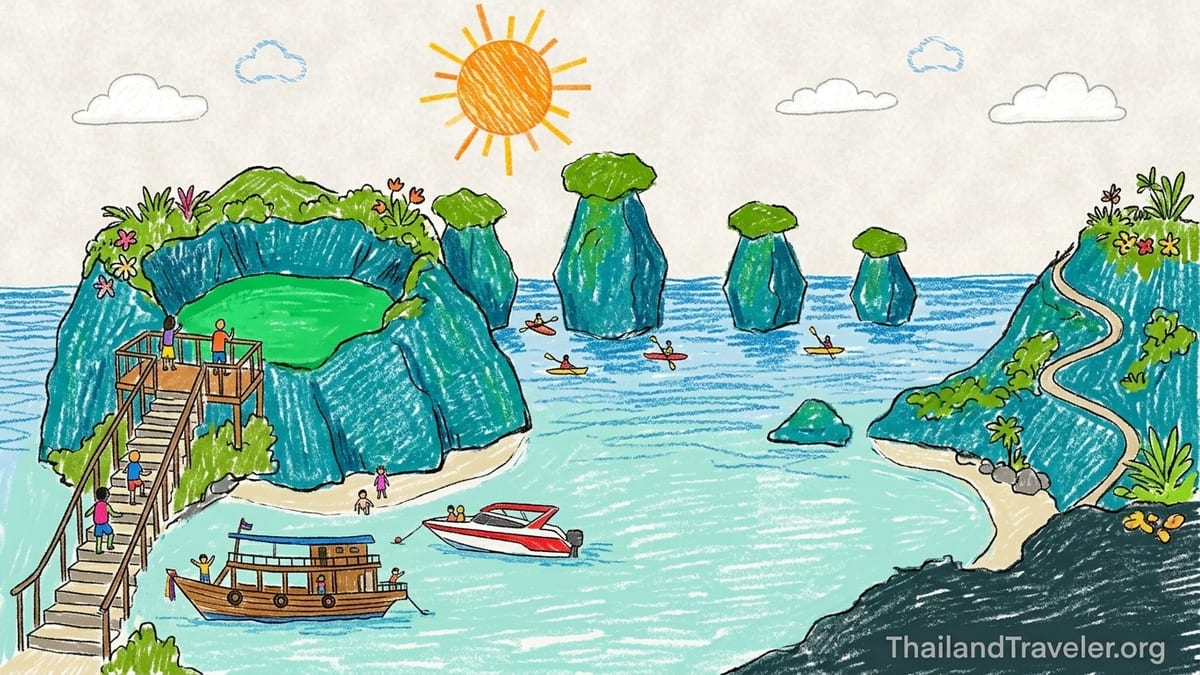
The poster image of Ang Thong is usually Talay Nai, the Emerald Lake on Ko Mae Ko. The lake is a saltwater lagoon filling a steep-sided crater in the middle of the island, connected to the sea by underground channels. Tour boats moor at a small jetty, passengers climb a series of stepped walkways through the forest and emerge at a timber platform high on the rim looking straight down into glowing green water ringed by cliffs. The colour shifts with the sun, from deep bottle green on overcast days to bright jade around midday.
The climb to the Emerald Lake viewpoint is short but steep. From the jetty to the main platform is roughly 10 to 15 minutes of solid uphill on narrow steps and handrails. The surface can be slippery in humidity and there is little shade on the final section. Most reasonably mobile adults and older children manage it without trouble, but anyone with knee issues, very young children or limited mobility may prefer to enjoy the lower viewpoints and boardwalk around the island instead of pushing for the top.
Ko Wua Talap provides the other headline viewpoint and the main chance to see the park from above its island cluster. From the headquarters beach, a marked path climbs through forest and then up rockier ground to progressively higher viewpoints that take in a broad panorama of the whole archipelago. Fit walkers who tackle the full route report needing around 45 to 60 minutes up and 30 to 40 minutes down, much of it on steep, irregular steps and sections of rough limestone. There are ropes for support on some pitches, and the heat in the middle of the day can be intense.
Between these climbs, much of the day is spent on and in the water. Kayaking routes usually hug the base of cliffs, weave beneath small rock arches and skim along the edges of bays where the big boat cannot approach closely. Snorkelling stops tend to focus on Ko Wao and nearby islands, where fish life is reliable but coral has suffered the same stress as much of the Gulf. Conditions can swing from 2 to 8 metres of visibility depending on wind, rain and currents, so honest operators now describe the snorkelling as a pleasant extra rather than the core reason to book Ang Thong.
Big-Boat Tours: Best For Budget, Space and Stability
Large-boat or “big-boat” tours are the most economical way to reach Ang Thong from Koh Samui and often the most comfortable for anyone nervous about choppy seas. These vessels are broad-beamed cruisers or converted fishing boats with several decks, shaded seating and open areas where you can move around, take photos and escape engine noise. They generally depart from Nathon Pier or piers on Samui’s northwest coast, which keeps the crossing relatively direct.
In 2026, published prices for standard big-boat Ang Thong tours from Samui commonly start around 1,600 to 1,900 baht per adult, with child rates typically between 1,100 and 1,400 baht depending on age bands. Several local booking sites confirm that these rates include the 300 baht park fee for adults and 150 baht for children, plus hotel transfers, a buffet Thai lunch and basic snorkelling equipment. Crossing times run at roughly 75 to 90 minutes each way, so you spend longer on the water but in a more spacious environment than a speedboat.
Big-boat itineraries normally carry the largest groups. It is not unusual to share the deck with 40 to 60 passengers, and at peak times numbers can sit higher. The upside is that even with larger groups, the sheer size of the vessel makes it easier to find a corner to yourself, stretch out on a bench or stay under shade, which parents with young kids and travellers prone to motion sickness often appreciate. The ride is generally smoother because the hull cuts through waves rather than bouncing over them, though nobody can guarantee a completely dry crossing on windy days.
Most big-boat tours include at least one kayaking session and a snorkelling stop, but paddling is sometimes limited to a short, guided loop near the mother boat. Lunch tends to be a Thai buffet served either on board or on an island, with rice, curries, fried dishes and fruit. Reviews often describe the food as filling rather than gourmet. If you prioritise cost, space to move and a more relaxed, cruise-like feel over the fastest transfers or the smallest groups, the big boat is usually the value leader.
Speedboat Tours: Maximising Island Time and Activity
Speedboat tours trade deck space for time. Powerful twin or triple outboard engines cut the crossing from Samui to Ang Thong down to roughly 45 to 60 minutes in good sea conditions, which means more of your day happens among the islands themselves. Most operators depart from piers around Bangrak, Bophut or the northeast corner of Samui, chosen for their direct line out to the park and easier hotel pick-ups in the main resort areas.
Standard full-day speedboat tours to Ang Thong in 2026 are commonly advertised from about 2,100 to 2,600 baht per adult, with child rates around 1,700 to 2,100 baht. These prices almost always fold in hotel transfers, snorkelling gear, soft drinks, lunch either at a beach restaurant or on a quieter island, and the mandatory park fees. Group sizes are capped by the boat design, and many operators limit numbers to around 25 to 35 passengers, which feels more intimate than the very largest cruisers but is still a shared experience.
The typical speedboat itinerary tries to pack in several distinct stops. A well-reviewed pattern is an early snorkel at Ko Wao or a neighbouring reef, followed by kayaking along limestone walls or through small caves, then the climb to the Emerald Lake on Ko Mae Ko and finally free time on Ko Wua Talap for hiking or the beach. Because speedboats expend more fuel and time is tighter, they often manage each transfer quickly and keep the group on a firmer schedule. This can feel efficient and active for fit travellers, but more hurried for families who like to linger.
The main trade-offs with speedboats are motion and space. When seas are calm between February and April, most guests enjoy the fast, breezy ride. In periods of residual swell such as late December or January, the same trip can involve frequent slapping over waves and spray across the bow. Travellers with back issues, very young children or a strong tendency toward seasickness should factor this in. That said, people who dislike long journeys often find the shorter crossing worth the extra cost compared with a big-boat cruise.
Small-Group, Sailing and Private Charters
Alongside the mainstream big-boat and standard speedboat tours, Samui now offers a tier of small-group and sailing trips aimed at travellers who place a premium on space, service and a slower pace. Semi-private speedboat options, often capped at 12 to 16 guests, sit at the top of the shared-tour market. Prices in 2026 for these curated products commonly fall between 2,800 and 3,500 baht per adult, with a clear emphasis on avoiding crowded timings, offering higher-quality lunches and including extras such as stand-up paddleboards or upgraded snorkel gear.
Sailing cruises, sometimes aboard traditional-style wooden junks or catamarans, frame Ang Thong as a day of relaxed travel rather than a checklist exercise. These vessels move more slowly than speedboats but smooth out the ride and often provide more shaded lounging space and comfortable seating. Sailing itineraries may skip the steep Ko Wua Talap hike in favour of longer swim stops, paddle sessions and lazy time on quieter beaches. Departure is usually a little later in the morning, with sunset returns giving a softer light over the islands.
Private charters exist in almost every format: private speedboats for couples or small groups, fully crewed catamarans for families and friends, and larger yachts that can host celebrations. In 2026, a private mid-sized speedboat for up to 10 to 12 people to Ang Thong regularly quotes day-rate prices in the low tens of thousands of baht, often starting around 18,000 to 22,000 baht including crew, fuel, soft drinks and basic equipment, but without catering or park fees. Adding gourmet food, alcoholic beverages and bespoke route tweaks can push the total far higher.
These higher-end options are rarely the cheapest way to see the park, but they do address common complaints about crowding and rigid timetables. Small-group tours are usually the sweet spot for travellers who want more personalised guiding and space without paying full charter prices, while private boats are best reserved for specific occasions such as multi-generational family trips, proposals, honeymoons or groups of friends who will truly use the flexibility.
What Exactly Is Included: Fees, Lunch, Kayaks and Gear
One of the most confusing aspects of choosing an Ang Thong tour is working out what is genuinely included in the ticket price and what you will be asked to pay on the day. For 2026, most reputable operators from Koh Samui clearly state that the Mu Ko Ang Thong National Park entrance fee is included in their quoted rates. Current guidance pegs this fee at 300 baht per adult and 150 baht per child, charged by the park and remitted by the operator, so on a well-run tour you should not be lining up to pay cash at the ranger station.
Hotel transfers are almost always part of the package for guests staying in the main areas of Chaweng, Lamai, Bophut and Maenam. Collection usually begins around 7.00 to 7.30 in the morning for big boats and 7.30 to 8.30 for many speedboats, depending on how many hotel stops the minivan must make. If you stay in more remote corners of Samui, such as the far south or hillside villas, you may be asked for a small surcharge or to meet at a designated rendezvous point en route to the pier.
Sea kayaking is widely advertised but not always delivered in the same way. On some big-boat cruises, kayaks are loaded on board and guests take turns paddling in pairs around an island for 20 to 30 minutes under the supervision of guides. On others, particularly speedboats and small-group trips that market themselves heavily around kayaking, paddling can be a more central part of the experience, with routes that slip under small rock arches, into tiny coves or along stretches of high cliff. Reading recent reviews or asking how long you actually spend in the kayaks can prevent disappointment.
Snorkelling gear is generally available, typically including mask and snorkel and sometimes fins. Hygiene-conscious travellers may prefer to bring their own mask and snorkel or at least their own mouthpiece. Lifejackets are standard on all legal tours and worn during crossings and often during snorkelling sessions. Lunch quality varies from basic Thai buffet dishes on larger boats through to restaurant-cooked meals on island beaches or upgraded spreads on premium and private tours. If you have allergies or follow a specific diet, it is important to alert the operator in advance; many can arrange vegetarian options, but not every boat handles more complex needs smoothly.
Emerald Lake Viewpoint vs Ko Wua Talap Hike
The two most talked-about walks in Ang Thong differ in length, gradient and how demanding they feel in the tropical heat. The Emerald Lake viewpoint climb on Ko Mae Ko is the more accessible of the pair. From the landing pier, wooden and concrete steps rise in a fairly direct line through forest to a lookout platform facing directly into the lagoon. Railings are installed along most of the route, and you can pause at lower terraces that already offer satisfying views. The full climb is steep enough to raise the heart rate but short enough that many people complete it comfortably in sandals or walking shoes.
In contrast, the Ko Wua Talap viewpoint hike is a more sustained effort. The path begins gently behind the park headquarters and quickly steepens, alternating between earthen trail, concrete steps and stretches of rough sharp-edged limestone where you use both hands and feet to progress. There are several designated viewpoints along the way; many visitors choose to stop at the first or second, which already reveal wide panoramas of the archipelago, rather than forcing themselves to the very top. The combination of humidity, direct sun on exposed sections and the rough footing means that sturdy footwear, such as trainers with good grip, is far preferable to flip-flops.
For people with mobility limitations, either climb can be challenging, but Ko Wua Talap is particularly unforgiving. The steepest sections are not suitable for anyone with serious knee, hip or balance issues. Families with small children often split up, with one adult staying on the headquarters beach, which offers calm swimming and a small café, while others hike up for photos. There is no shame in skipping the highest viewpoint; the landscape from water level and from boat decks is already impressive.
Timing also matters. On many big-boat itineraries, the Ko Wua Talap hike falls around midday or early afternoon, when temperatures peak. Carrying at least one bottle of water per person, wearing a hat and using reef-safe sunscreen can make a significant difference to how enjoyable the climb feels. If reaching the top viewpoint is a priority, it can be worth choosing a tour that arrives early enough in the day to let you hike before the full brunt of the heat sets in.
Snorkelling and Sea Conditions: Managing Expectations
Marketing images for Ang Thong tours often suggest flawless snorkelling, but the reality is more mixed. The park’s reefs have experienced bleaching and storm damage over the years, and while there are still pockets of healthy coral, snorkellers are more likely to remember the limestone backdrop and schools of fish than fields of untouched hard coral. Sites around Ko Wao and nearby islets are common stops because they offer relatively reliable fish life and access for groups.
Sea conditions play a big role in what you see. During the calmer months of roughly February to April, visibility in the water often improves, making snorkelling more rewarding. In the shoulder seasons, wind-driven waves can stir up sand and reduce clarity to just a few metres. Operators cannot control this, and reputable ones now tend to describe snorkelling as an enjoyable option rather than promising “world-class” underwater scenery on every departure. If snorkelling is your primary goal, combining Ang Thong with a separate trip to Koh Tao, known more for diving and snorkel sites, may be the better strategy.
Safety around snorkelling is generally good on organised tours. Lifejackets are available for weak swimmers, and guides frequently stay in the water to keep an eye on the group. Confident swimmers who want more freedom can bring their own fins for better propulsion and consider a lightweight rashguard to avoid sunburn. The region’s marine regulations discourage feeding fish or touching coral, and guests are increasingly reminded to use reef-safe sunscreen to limit chemical impact on the water.
For those prone to seasickness, it is worth knowing that snorkel spots are sometimes in slightly more exposed areas than sheltered bays. Big boats feel steadier at anchor, but the up-and-down motion can still affect sensitive travellers. Taking motion sickness tablets in advance, staying above deck in the fresh air and focusing on the horizon between swims remain simple, effective tactics.
Costs in 2026: Couples vs Families
Comparing the real cost of different Ang Thong tours is easiest when you look at the total spend for typical travel parties. Consider first a couple staying in a midrange hotel around Chaweng or Bophut. A standard big-boat Ang Thong trip at around 1,700 baht per adult with the park fee included would set them back roughly 3,400 baht in total for the day, covering transfers, lunch, kayaking and snorkelling gear. A standard speedboat tour at about 2,300 baht per adult would come to about 4,600 baht for the pair, buying them a faster crossing and smaller group size.
At the top end of shared tours, a semi-private small-group speedboat or boutique sailing trip priced around 3,200 baht per adult would put the daily spend near 6,400 baht for two. The difference over the budget big-boat option, roughly 3,000 baht, represents the premium for a quieter, more curated experience and higher-quality food. Couples who place a high value on comfort and tranquillity often judge this jump worthwhile for one signature day of their trip.
For a family with two adults and two children, the math shifts further in favour of big boats and promotions. Taking sample rates of 1,700 baht per adult and 1,200 baht per child on a big-boat cruise yields a total of about 6,800 baht for four, including park fees. A standard speedboat with adult rates around 2,300 baht and child rates around 1,800 baht would climb closer to 8,200 baht. Semi-private options might push the family’s total above 10,000 baht. Promotions, early-booking deals or family discounts can trim these numbers slightly, but the relative differences tend to remain.
Private charters change the equation again. If a mid-range private speedboat quotes 20,000 baht for the day including soft drinks and snorkelling equipment but excluding food, a group of four would effectively be paying 5,000 baht per person, more than most small-group premium tours. The same charter split between eight friends or two families would bring the per-person cost down to 2,500 baht, which suddenly competes with standard shared speedboat pricing while delivering a fully customised day. This is why private boats make the most financial sense for larger groups who genuinely want to travel together.
The Takeaway
Choosing the right Ang Thong National Marine Park tour from Koh Samui in 2026 starts with deciding what you value most. For families, the big-boat option usually offers the best balance of price, space and relative stability. Children have room to move, parents can find shaded seating and the included park fees, lunch and equipment keep add-on costs predictable. If the main aim is to give kids a memorable day among islands with at least a taste of kayaking and snorkelling, the savings compared with speedboats are significant.
Couples who prioritise spending more time at the islands than on the water, and who enjoy an active day, often find speedboats or small-group tours the better fit. Speedboats minimise crossing time and maximise the number of distinct stops, while semi-private or boutique options reduce crowding and upgrade the overall feel of the day. Photographers tend to favour departures that include both the Emerald Lake and Ko Wua Talap viewpoints, with enough time on Ko Wua Talap to climb at least to the first or second viewpoints, so checking the detailed timetable pays off.
Confident swimmers and those who enjoy paddling will get the most from itineraries where kayaking is a central activity rather than a brief add-on. Reading recent guest feedback helps identify operators that genuinely allow a decent time on the water. Travellers who are strongly prone to seasickness or have back issues should lean toward slower, larger vessels or sailing trips, accepting the longer crossing in return for a gentler ride. No operator can completely avoid bumps when Gulf winds rise, but hull size and speed do make a noticeable difference to comfort.
As for private boats, the premium is usually justified when the group is large enough to bring the per-person cost close to a quality shared tour, or when there is a specific reason to value flexibility and privacy, such as a reunion, celebration or desire to avoid other groups altogether. For solo travellers and couples, private charters to Ang Thong are a luxury splurge rather than a value choice. Whatever you choose, verifying the seasonal closure dates and park access for your intended travel window, wearing sensible footwear for the climbs and keeping realistic expectations about snorkelling will go a long way toward ensuring that your Ang Thong day lives up to the archipelago’s reputation.
FAQ
Q1: When is Ang Thong National Marine Park open in 2026?
Ang Thong National Marine Park is scheduled to be closed from 1 November to 15 December 2026 for seasonal monsoon recovery. Tours operate outside this window, but it is still wise to confirm your exact date with the operator, as weather can cause occasional additional suspensions.
Q2: How long does the boat ride from Koh Samui to Ang Thong take?
Large tour boats usually take about 75 to 90 minutes each way, while speedboats cover the crossing in roughly 45 to 60 minutes in normal sea conditions. Sailing-style vessels may sit somewhere between these times depending on their engines and the day’s winds.
Q3: Which tour type is best for families with young children?
Big-boat tours are generally the most family-friendly choice, thanks to lower prices, more open space, shaded seating and a steadier ride. Children can move around more easily, and parents have more options to sit in comfort compared with the tighter seating on a speedboat.
Q4: Is the snorkeling at Ang Thong as good as Koh Tao?
No, Ang Thong is not considered as strong a snorkelling destination as Koh Tao. While you will usually see fish and some coral, reef health and visibility are more variable. Most visitors rate Ang Thong higher for its limestone scenery, viewpoints and kayaking than for underwater life alone.
Q5: Do I need to pay the national park fee separately?
On most reputable Ang Thong day tours from Koh Samui, the national park entrance fee is already included in the advertised price. The operator pays the park on your behalf, so you should not need to bring cash for this specifically, though carrying some baht for drinks or snacks is always sensible.
Q6: How difficult are the hikes at Emerald Lake and Ko Wua Talap?
The Emerald Lake viewpoint involves a steep but short stair climb of around 10 to 15 minutes and is manageable for most reasonably fit visitors. The Ko Wua Talap viewpoint hike is considerably more demanding, with longer, steeper sections over uneven rock and in hotter conditions, and is best attempted in proper footwear by those without significant mobility issues.
Q7: What should I wear and bring for an Ang Thong day trip?
Lightweight clothing, a swimsuit, reef-safe sunscreen, a hat, sunglasses and sturdy sandals or trainers are recommended. A small backpack, refillable water bottle, lightweight towel and, if you snorkel regularly, your own mask can also improve comfort and hygiene on the day.
Q8: Are kayaking and snorkeling always included?
Most Ang Thong tours include at least a short guided kayaking session and a snorkelling stop, but the amount of time spent on each varies. If extended paddling or snorkelling is important to you, confirm the approximate duration of these activities with your chosen operator rather than assuming all tours offer the same.
Q9: Is a private charter worth the extra cost?
A private charter can be worth the premium for larger groups, special occasions or travellers who strongly value privacy and flexible timing. For small parties of two or three, however, the cost per person is usually far higher than well-run shared small-group tours, so it becomes more of a luxury indulgence than a value decision.
Q10: Can I still enjoy Ang Thong if I am prone to seasickness?
Yes, but you should choose your tour carefully. Larger, slower big boats and some sailing vessels tend to feel more stable than fast speedboats, especially in choppier conditions. Taking motion sickness tablets before departure, staying in fresh air on deck and avoiding heavy food or alcohol before the trip can also help reduce discomfort.