


The photo of three tiny jungle-topped islets stitched together by a white sandbar has sold countless trips to Koh Tao. I had seen that image of Koh Nang Yuan for years before finally making the short hop over from Koh Tao to see if the reality, from the steep viewpoint and in the water with a snorkel, lived up to the hype. What I found was a beautiful but carefully controlled private island where the sandbar crowds fast, rules are enforced more than you might expect and the snorkeling, while still good in places, is not quite the untouched reef many brochures promise.
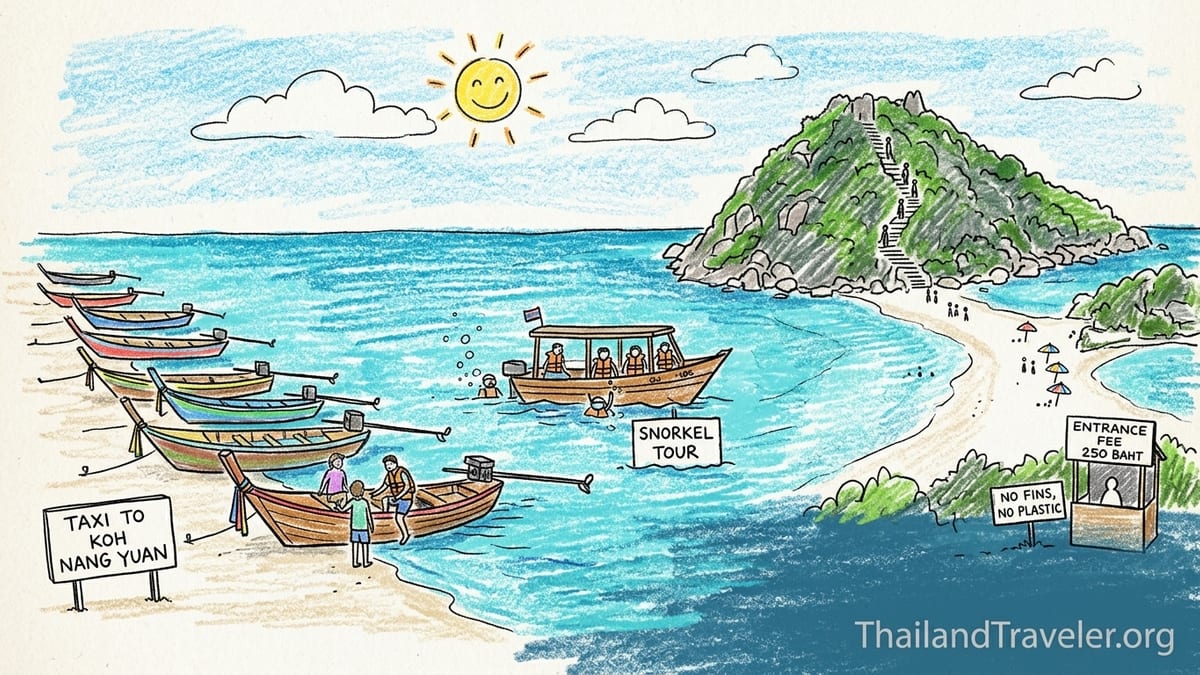
Getting to Koh Nang Yuan from Koh Tao
I based myself on Koh Tao and treated Koh Nang Yuan as a classic day trip. The island lies only a few hundred meters off Koh Tao’s northwest coast, and in October 2026 there were two realistic ways to reach it: hire a local water taxi from Sairee Beach or Mae Haad, or join a full-day snorkeling excursion that includes several bays around Koh Tao plus time on Koh Nang Yuan. Both options are easy to arrange on the ground, and there is no need to book weeks in advance for a simple crossing.
For an independent visit, the simplest departure point is Sairee Beach, the main strip on Koh Tao. Longtail taxi boats line the sand with hand-painted signs offering trips to Koh Nang Yuan. The tourism association and current island guides describe the crossing as 5 to 10 minutes from Sairee and about 15 to 20 minutes from Mae Haad, depending on sea conditions and the power of the engine. Fares in late 2026 were commonly quoted at around 200 to 300 baht per person for a same-day return from Sairee, paid in cash directly to the boatman at one of the small taxi stations along the beach. Many visitors still negotiate, especially for two or more people, but those ranges were consistent with what competing shops were charging.
Snorkeling excursions take a different approach. Rather than going straight to Koh Nang Yuan, they loop around Koh Tao for six or seven hours, stopping at bays such as Mango Bay, Ao Leuk and Shark Bay before finishing at the famous sandbar. Current listings for 2026 show shared snorkel tours that include Koh Nang Yuan priced around 1,400 baht per person, with masks, snorkels, lunch and soft drinks included. Boats typically carry 25 to 45 people, so while you get more snorkeling overall, you also arrive on Koh Nang Yuan as part of a sizable crowd.
I chose to visit independently on one day, and then slotted Koh Nang Yuan into a multi-stop snorkeling tour later in the week. That made it easy to compare both styles of visit. In each case, departure was straightforward. From Sairee, I walked along the sand just before 9:30 am, agreed a 500 baht return fare for two with a boatman and climbed into the longtail. On the snorkel tour day, the operator collected me from my guesthouse in a pickup truck around 8:30 am and we joined about 30 other guests at Mae Haad pier before heading around the island on a larger wooden boat.
Arrival, Fees and First Impressions
Regardless of how you reach Koh Nang Yuan, you meet the first difference between the dream photo and the real island as soon as you step ashore. This is a privately managed resort island rather than a casual public beach, and access is tightly controlled. As of late 2026, the official “Visit Koh Nangyuan” information set the day-visitor entrance fee at 250 baht per person, payable in cash at the pier reception. There is no way to prepay this with your taxi fare or your snorkeling tour; each visitor is handed a ticket on arrival after queuing for a few minutes at a small kiosk behind the jetty.
My longtail from Sairee nosed up to the main concrete pier on the southern side of the central islet, and we disembarked directly onto the steps. On both visits, there was no need to step into the water; even when several boats arrived at once, staff managed the flow so that each unloaded at the pier in turn. A handful of larger snorkel tour boats tied up to mooring lines a little farther out, then used their own small ladders or inflatable platforms to transfer people to a side of the pier when it cleared.
The island accepts day visitors only between roughly 10 am and mid-afternoon. In October 2026, official guidance and on-site signs stated opening hours for non-residents as approximately 10 am to 3 pm, with the last taxi boats leaving for Koh Tao around 4:30 to 5 pm so that the island could empty before dusk. Resort guests, who stay in bungalows tucked into the hillside, are allowed on the beaches outside these hours. For everyone else, arrival feels structured: line up, pay the fee, have bags glanced through and listen to a short explanation, partly in English, about what you can and cannot bring.
First impressions of the sandbar are undeniably striking. From the pier, the white arc of sand runs off in both directions, one side facing Koh Tao and the other opening into deeper blue water. On my independent early arrival, there were only a few dozen people already on the island, and it was possible to take in the classic scene without too much distraction. By the time I returned as part of a large snorkel tour closer to midday, the sandbar was busy with color: life jackets drying on the sand, groups queuing at the viewpoint trail entrance and clusters of snorkelers learning to kick without fins.
Island Rules and What Was Actually Enforced
Koh Nang Yuan’s rules are often mentioned in passing in brochures, but it is only when you arrive with a daypack that you see how they change the feel of a visit. At the reception area and again near the start of the sandbar, several signs list prohibited items: single-use plastic bottles, foam containers, drones, smoking materials on the beaches and snorkeling fins. Staff were not conducting airport-style checks, but they did open large daypacks and were proactive about enforcing the most visible bans.
The strictest enforcement I saw concerned single-use plastic bottles. At both my arrivals, visitors who brought clear disposable bottles of water from 7-Eleven were politely asked to leave them in a crate near the pier for collection later. Reusable metal and hard plastic bottles were allowed, and drinking water could be bought on the island in glass or refillable containers. The intention, according to the resort’s own description of its rules, is to cut plastic trash on such a small land area where waste has to be boated out.
The no-fins rule was also actively enforced. Signs on the beach reminded visitors that fins are not permitted while snorkeling around the island, with staff occasionally walking along the shoreline to ask people to remove them. This surprised some snorkelers who had brought their own gear, but rental shops on Koh Tao are well aware of the policy and many already supply mask and snorkel only for Nang Yuan visits. Guides on organized tours collected any fins left on the boat and explained that the shallow coral gardens off the island’s east side would be badly damaged by hard kicks.
Other rules, such as the ban on loud music and smoking on the sand, were enforced more gently. On my independent visit, a small group tried to play music from a portable speaker near the central part of the sandbar and were quickly asked by staff to turn it down. Smokers were directed to a designated smoking area behind the restaurant, away from the beach. The combination of rules meant the island felt more regulated than many Thai beaches, but the payoff was cleaner sand, less plastic trash and relatively calm surroundings despite the high number of people.
Walking to the Famous Viewpoint
The island’s upper viewpoint is the reason most people come, the source of the iconic photograph looking straight down over the Y-shaped sandbar and the three connected islets. From the information signs and my own timing, the walk from the sandbar to the top took around 15 minutes at a steady pace, not including pauses to let groups pass or to catch breath in the heat.
The path leaves from the back of the central islet, near the pier, and begins as a concrete walkway with wide steps that wind gently uphill through the trees. For the first third, the path is shaded and smooth enough for flip-flops, with simple handrails on one side. After about five minutes, the concrete gives way to a more natural trail, still stepped, but with uneven rock and timber risers and occasional tree roots catching unwary toes. Most people in basic sandals managed fine; a few who came in stiff fashion shoes looked less comfortable.
The final section is where congestion starts. A short wooden staircase leads to a jumble of large granite boulders, and from there you have to scramble up using narrow wooden platforms and metal railings that have been bolted into the rock. Only a handful of people can stand on the main viewpoint rock at once. On my early independent visit, I reached the top around 10:45 am and waited perhaps five minutes while two groups ahead of me took turns with their cameras. Guides were not controlling the flow, but visitors self-organized and took their shots quickly so others could rotate through.
When I climbed again with the snorkel tour group closer to 1 pm, the experience was very different. The last section before the boulders became a bottleneck, with two steady queues rising and descending the same narrow passage. There was very little shade on those upper steps, and the rock radiated heat. By the time I reached the viewpoint, a staff member was informally limiting time on the top platform so waiting groups did not grow too long. Getting a clear, people-free photograph of the sandbar at this hour was almost impossible. For anyone set on that classic shot, arriving on the island soon after opening time and hiking straight up before swimming makes a noticeable difference.
The Sandbar and Swimming Conditions
From the viewpoint, the sandbar looks huge and perfectly smooth. At water level, it feels smaller and more segmented. Koh Nang Yuan is really three little islands, and the sandbar connects them in a shallow, constantly shifting strip. On the day I visited independently, the tide was falling through late morning, exposing a wider arc of sand, while on the snorkel tour day the high tide ate into the central strip so that the two main beach sections on either side of the bar narrowed significantly by early afternoon.
Visitors cannot roam everywhere they might expect on a normal island. Large sections of the sandbar are roped off to protect turtle nesting areas and fragile seabed; parts of the outer beaches belong to the resort’s private area and are for in-house guests. Day visitors are directed to specific zones where they can lay towels or rent pairs of sun loungers with umbrellas. In 2026, lounger rentals were quoted on site at around 150 to 200 baht per set for the day. There are also wooden platforms with simple seating behind the sandbar for those who prefer shade.
Swimming conditions change sharply between the two sides of the sandbar. The inner side facing Koh Tao has calmer water, shallow enough near the shore for small children to splash, though the bottom has patches of broken coral rubble that can be sharp underfoot. The outer side opens into deeper turquoise water with a more noticeable current and regular longtail and snorkel-boat traffic passing just beyond the no-swim zone. Lifeguards were not obvious, but boat crew and island staff watched from the edge of the sand, blowing whistles if anyone drifted beyond the buoy lines.
Crowding affects how relaxing it feels. On my early independent trip, the central strip between the two main islets was busy but not overwhelming, with gaps where I could float and watch the view without bumping into anyone. By early afternoon on the tour day, the same area felt cramped. Groups from Koh Tao and day tours from Koh Samui had arrived, and finding a quiet patch of sand for two towels became difficult. The sand itself, pure white from afar, was tracked with footprints and paths from the constant circulation of people walking between the pier, the viewpoint trail and the beach areas.
Snorkeling Reality Around Koh Nang Yuan
Snorkeling is where the gulf between promotional photos and reality matters most. The area known as Japanese Gardens, off the eastern side of the island near one of the smaller islets, remains a popular shallow reef, and local snorkelers and recent visitors still mention it as one of the better spots around Koh Tao for coral gardens. Water clarity on my visits was very good compared with some mainland Thai beaches. Visibility ranged from perhaps 8 to 12 meters, enough to see the shape of the reef and schools of fish moving over it.
I snorkeled twice: first during my independent visit, renting a mask and snorkel from a small booth behind the main beach for 150 baht for the day, and then again on the tour where equipment was included in the package price. Both times, staff reminded us of the no-fins rule and pointed out the entry and exit points where sand rather than live coral covered the bottom. From these points, it was a short swim over shallow rubble to the more intact coral structures.
Marine life was pleasant rather than spectacular. Over about 45 minutes each session, I saw parrotfish crunching at the reef, small angelfish, sergeant majors, wrasse and the occasional titan triggerfish keeping a watchful distance. The coral itself showed mixed health: some heads of branching coral still had good color, while many areas were pale or broken from past storm damage and heavy visitation. Local dive operators frequently note that overall coral health around Koh Tao has declined in the last decade under tourism pressure, and Koh Nang Yuan is not immune, although the fin ban and roped-off sections help protect what is left.
Promotional materials from some tour companies still feature images of reef sharks and turtles alongside snorkelers near Koh Nang Yuan. They are present in the wider Koh Tao area, and regular snorkelers in 2025 and 2026 have reported seeing baby blacktip reef sharks in bays such as Shark Bay and occasional green turtles grazing on seagrass closer to Koh Tao itself. Around Koh Nang Yuan, however, I did not see either species on my two visits, and staff were careful not to promise them. Guides framed sightings as possible but not guaranteed, and made no announcements about sharks or turtles during our time in the water. That felt realistic and honest: expect colorful small fish and shallow coral gardens here, not big-animal encounters.
Independent Visit vs Organized Snorkeling Tour
Experiencing Koh Nang Yuan both independently and as part of a large group revealed clear trade-offs. Going on my own by longtail at 9:30 am, I reached the island just after opening. The sandbar still had open stretches of sand, the viewpoint trail was quiet enough that the final scramble only required a short wait and I could snorkel off Japanese Gardens with plenty of personal space. The downsides were that I had to organize everything myself and pay the entrance fee and any gear rental on top of the taxi fare.
The organized tour removed all logistics. The operator bundled hotel pickup, the boat around Koh Tao, snorkel equipment, a simple rice-and-curry lunch served on the boat and guidance at each stop into a single price of around 1,400 baht per person. Many such tours either include the Koh Nang Yuan entrance fee in the price or collect it on the pier and hand it over for you, but in every case it remains a separate charge. On the day I joined, we reached Koh Nang Yuan around 12:30 pm, which meant stepping into the heaviest part of the day’s crowd curve. Several other boats from Koh Tao arrived at roughly the same time, and staff estimated that day there were around 400 to 500 visitors on the island during the peak.
Time management also felt different. Independent, I could choose to hike to the viewpoint first, then swim as long as I wanted within the operating hours before hailing any longtail back to Koh Tao. On the tour, we had around 90 minutes total on Koh Nang Yuan, divided between those who wanted to climb and those focusing on snorkeling. Many people tried to squeeze in both and ended up rushing the viewpoint. A few skipped the climb completely when they saw the queue near the trailhead. For photographers or anyone who values a quieter moment at the top, that compressed time slot is a real limitation.
From Koh Samui, the equation changes again. High-speed catamaran and speedboat trips bring visitors across the sea to Koh Tao and Koh Nang Yuan in a single long day, often leaving Samui early in the morning and returning around sunset. Prices from Samui in 2026 were typically advertised in the 2,000 to 2,500 baht range per adult, including transfers to the pier, a simple lunch, snorkel gear and stops at several sites. These tours give a taste of Koh Nang Yuan but often less time on the island than people expect, usually about 60 to 90 minutes before the boats must turn back. For those already staying on Koh Tao, visiting from there either independently or on a local snorkel tour provides more flexible access and shorter travel times.
Food, Facilities and the True Cost of a Day
Koh Nang Yuan’s facilities are more developed than many small Thai islands but still limited enough to affect your day. Behind the main sandbar, the resort runs a restaurant and bar with indoor seating and a shaded terrace. The menu during my visits focused on simple Thai dishes such as fried rice, pad Thai and curries, plus sandwiches and basic Western plates. Prices were noticeably higher than on Koh Tao, which is to be expected given the island’s private management and supply logistics. A plate of fried rice with chicken was around 180 to 200 baht, soft drinks hovered around 60 to 80 baht, and coffee-based drinks a little more.
There are freshwater showers and changing rooms set back from the beach, plus toilets that were kept reasonably clean when I used them, though lines developed in the early afternoon when multiple tour groups converged. Shade is at a premium. Aside from the restaurant terrace and some trees behind the sand, most people rely on rentable sun loungers with umbrellas or erect small pop-up shades moved into the permitted zones. On busy days, visitors circled for a while to find any patch of shadow large enough for two towels. I found this more tiring than the hike itself and would plan my next visit more carefully around the sun.
For two adults visiting independently from Koh Tao, the arithmetic in October 2026 looked roughly like this. A negotiated longtail taxi return from Sairee set us back about 500 baht total. Entrance fees were 250 baht each, so 500 baht more. We rented one set of loungers with an umbrella at 200 baht and one mask-and-snorkel set at 150 baht for the day. Buying two simple lunches with soft drinks added another 500 to 600 baht. In total, our independent day came to somewhere around 1,850 to 2,000 baht for two, not including any beers or extras.
Comparing that with a standard multi-stop snorkeling excursion is illuminating. On my tour day, the operator charged around 1,400 baht per person, which for two adults meant 2,800 baht. That price included transfers on Koh Tao, lunch on the boat and use of masks and snorkels, plus stops at four or five bays and about 90 minutes on Koh Nang Yuan. Some tours included the island’s fee, others asked us to pay the 250 baht per person at the pier in addition. Taking that into account, a two-person total of roughly 3,300 baht for a full-day snorkel tour that included Koh Nang Yuan felt like fair value for the amount of boat time and the variety of sites, but more expensive than a focused half-day independent visit that concentrated only on the island itself.
The Takeaway
After two visits, one quiet and one at peak crowd, I came away with a more nuanced view of Koh Nang Yuan than the postcard promise. The famous viewpoint does deliver a genuinely stunning perspective on the sandbar and the three islets, especially in the softer light of late morning when the water shows multiple shades of blue. For me, that view and the sense of standing over one of the Gulf of Thailand’s most recognizable scenes did justify the entrance fee and the short, sweaty climb, but only when I arrived early enough that the platform at the top was not jammed.
What disappointed me most was not the rules or the cost but the feeling of compression once midday arrived. The sandbar, which looks expansive from above, feels narrow when several boatloads from Koh Tao and longer tours from Koh Samui land simultaneously. Finding a calm spot to float, or even a piece of shade, became a minor competition, and any illusion of being on a tiny, serene island slipped away. Visitors who come expecting a secluded paradise might feel frustrated; those who treat it as a popular but well-managed scenic stop will adjust more easily.
Snorkeling was enjoyable, but around Koh Nang Yuan it was not the highlight of my time in the Gulf. The shallow reefs at Japanese Gardens still have charm, with clear water and plenty of small fish, but the coral shows signs of wear. I found more varied marine life at other spots around Koh Tao that receive fewer mass-tourism day trips. If your main goal is serious snorkeling, allocating a full-day tour or arranging private longtail trips to quieter bays might be a better use of time, using Koh Nang Yuan as one of several sites rather than the sole focus.
If I returned, I would aim for the earliest practical arrival from Koh Tao, catching a longtail to reach the pier near opening time, hiking straight to the viewpoint before the queues build, then snorkeling and enjoying the sandbar until just after lunch. By leaving around 1:30 or 2 pm, I would dodge the heaviest afternoon crowds and the fiercest sun. Koh Nang Yuan is still worth seeing with clear expectations: a highly photogenic island where access is structured, rules are enforced for environmental reasons and the reality, while busier than the brochures suggest, rewards those who time their visit with care.
FAQ
Q1. How long does the boat ride from Koh Tao to Koh Nang Yuan take?
The crossing by longtail water taxi from Sairee Beach typically takes around 5 to 10 minutes, while boats from Mae Haad usually take closer to 15 to 20 minutes, depending on sea conditions and engine size.
Q2. What is the current entrance fee for Koh Nang Yuan and how do you pay it?
As of late 2026, day visitors pay an entrance fee of 250 baht per person on arrival at the island pier, in cash, at a small ticket kiosk before accessing the beach and viewpoint.
Q3. Are plastic bottles and fins really banned on Koh Nang Yuan?
Yes. Single-use plastic drink bottles are not allowed and staff ask visitors to leave them at the pier. Snorkeling fins are also prohibited for day visitors to protect the shallow coral gardens, and staff walk the beach to enforce this rule.
Q4. How difficult is the hike to the famous viewpoint?
The walk takes about 10 to 20 minutes each way along a stepped path with some uneven sections and a short scramble over boulders near the top. Most reasonably fit visitors manage it in flip-flops, but it can feel steep and hot, especially around midday.
Q5. What are the island’s opening hours for day visitors?
Day visitors are usually admitted from around 10 am until mid-afternoon, with the island requesting that non-guests leave by roughly 3 pm and the last taxi boats to Koh Tao departing around 4:30 to 5 pm.
Q6. Can you explore the entire island and all its beaches?
No. Large parts of the beaches belong to the resort or are roped off to protect sensitive areas. Day visitors are directed to designated sections of the sandbar and nearby shorelines, and cannot wander freely over every part of the private island.
Q7. Is snorkeling at Koh Nang Yuan good enough to be the main reason to visit?
Snorkeling around areas such as Japanese Gardens is enjoyable, with clear water and plenty of small reef fish, but coral health is mixed. For dedicated snorkelers, it is better seen as one highlight among several sites around Koh Tao rather than the sole reason for a trip.
Q8. How crowded does the sandbar get during the day?
Late morning to early afternoon can be very busy when multiple boats from Koh Tao and day tours from Koh Samui arrive. At peak times it may be difficult to find quiet space or shade, and queues can form on the upper part of the viewpoint trail.
Q9. What is the approximate total cost for two adults visiting independently from Koh Tao?
A typical day for two might include a 500 baht return longtail taxi, 500 baht in entrance fees, around 350 baht for loungers and snorkel hire, and roughly 500 to 600 baht for lunch and drinks, bringing the total to about 1,850 to 2,000 baht.
Q10. When is the best time of day to visit Koh Nang Yuan for fewer crowds?
Arriving soon after opening, around 10 am, provides the best chance of a quieter sandbar and a less congested viewpoint. Visiting early also makes it easier to hike before the heat builds and to leave before the busiest mid-afternoon period.