

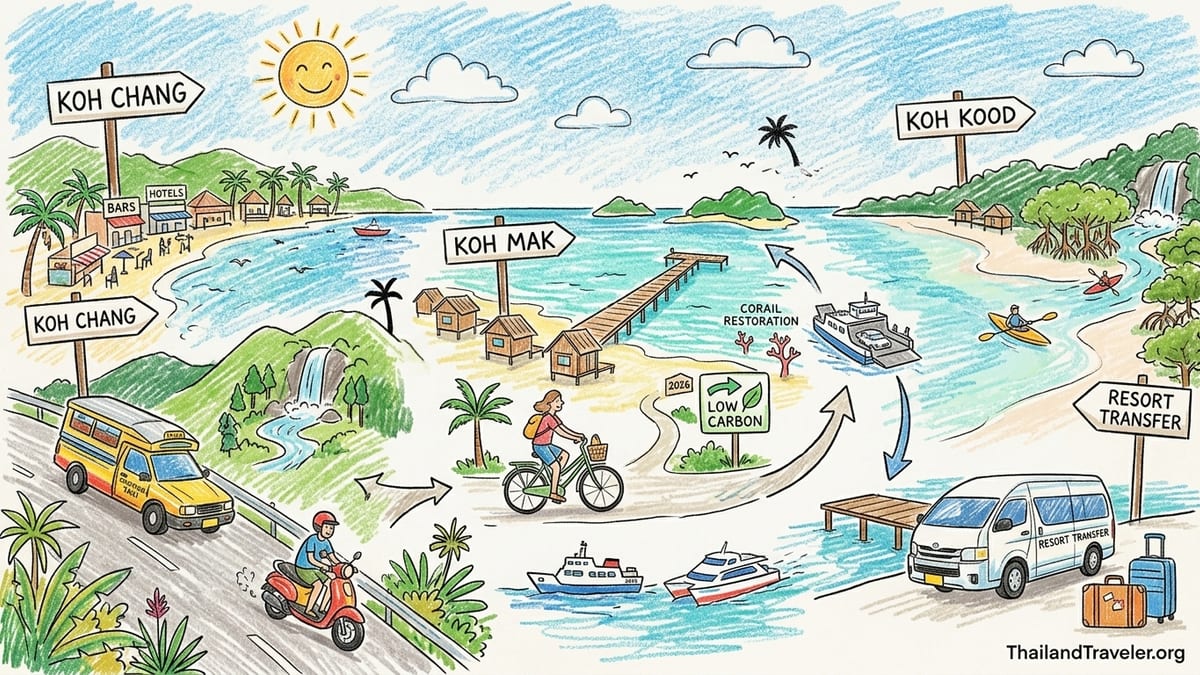
When travelers ask me which Trat island to choose, they usually say the same thing: they want soft sand, clear water and fewer people than on Phuket or Samui, but they are confused by three very different options sitting in the eastern Gulf of Thailand. So I went back to do it properly. On one February trip, I stayed three nights each on Koh Chang, Koh Mak and Koh Kood, in equivalent midrange accommodation, traveling between them by the same speedboat and catamaran services that run in 2026. What follows is not a brochure overview, but a practical comparison built on real ferry tickets, actual hotel receipts and sandy feet.
How I Structured The Trip And What It Really Cost
I based this comparison on a nine night circuit in February, during the dry northeast monsoon when seas are usually calm and most services are running at full schedule. I flew into Trat, used shared minivans and resort transfers, and avoided complimentary press trips to keep the experience as close as possible to what an independent traveler would book. On each island I chose a clean, air conditioned room in the lower midrange bracket, roughly 1,500 to 2,000 baht per night in 2026, close to a swimmable beach but not in the most exclusive resorts.
From Trat airport I joined the standard shared minivan and ferry package to Koh Chang, which currently uses the car ferry from Ao Thammachat pier and costs the equivalent of roughly 550 to 650 baht per person including pier transfer and ferry ticket, depending on the agent and whether you book online or at the desk. The ferry crossing itself takes around 30 to 40 minutes, with departures throughout the day and a short drive at the other end along Koh Chang’s steep coastal road to White Sand Beach.
After three nights on Koh Chang, I traveled back to the mainland and onward to Koh Mak. In 2026, the most reliable connections are from Laem Ngop and Laem Sok piers near Trat town. Catamaran operators such as Boonsiri sell combined van plus boat tickets from Koh Chang via Trat to Koh Mak and Koh Kood, with prices from around 900 to 1,100 baht for each leg including land and sea transfers. Published fares at Laem Ngop for direct speedboats to Koh Mak itself sit in the 450 to 550 baht range one way, while the air conditioned catamaran via Laem Sok is around 550 baht.
For Koh Kood, I booked the same style of package, taking the morning catamaran from Laem Sok to Ao Salad pier on Koh Kood. Current one way fares for fast catamarans to Koh Kood in 2026 are widely advertised at roughly 750 to 900 baht, with an additional fee if you need a minivan pick up from Trat airport. Importantly, almost all Koh Kood resorts still include pier transfers in their room rate. That generous policy shapes daily life on the island, especially because there is no functioning public taxi system once you arrive.
Koh Chang: Big Island Convenience And Busy Beaches
Koh Chang is the giant of the three, both in land area and in the range of services. The west coast string of communities from White Sand Beach down through Klong Prao, Kai Bae and Lonely Beach offers everything from 7-Eleven branches and ATMs to tattoo studios and cocktail bars. The main coastal road is paved but steep and twisting, especially around the hills south of White Sand Beach, and scooter accidents are a genuine risk for inexperienced riders. Shared songthaew taxis shuttle up and down the coast from early morning until late evening, though prices after dark rise noticeably.
White Sand Beach is the island’s most developed strip. The southern half still feels tropical at high tide, with a decent swimmable bay and sunset views, but the narrow sand is backed by a dense wall of budget and midrange hotels, beach bars and massage salas. Evening barbecues and music give it a bustling, sometimes slightly package tour energy. Three nights here made it clear that if you want nightlife, live music and plenty of cheap Thai food stalls, this is the most convenient base in Trat province. It is also the most commercial, with beach hawkers, jet skis in high season and crowded sandph.
Klong Prao, just to the south, spreads out along a longer bay interrupted by a tidal canal. The northern section near Chai Chet offers wide sand and shallow, family friendly water. It felt quieter than White Sand Beach while still having supermarkets, coffee shops and local restaurants on the roadside. Kai Bae has another curved bay ringed by midrange resorts, with small islets visible just offshore that you can kayak to on calm days. Lonely Beach, further again, retains a backpacker feel, with more hostels and simple bungalows, late night bars and cheaper street food, but the beach itself is rockier and less impressive for all day swimming.
Inland, Koh Chang has the only substantial waterfalls and forest walks of the three islands. Klong Plu waterfall near Klong Prao remains the most accessible, with a national park entrance fee payable in cash and a short walk to a deep, swimmable pool. Than Mayom and Klong Nonsi offer alternative cascades for those with their own transport. Because development has been concentrated on the west coast, it is quite easy to fill three or four days here with waterfall visits, boat trips to offshore snorkeling reefs, Thai cooking classes and bar hopping without ever feeling stranded. The tradeoff is that you rarely have a wide, empty stretch of sand entirely to yourself.
Koh Mak: Slow Bicycles, Quiet Evenings And A Low Carbon Vision
Arriving on Koh Mak after Koh Chang feels like stepping into a slow motion version of Thailand. The island is small and mostly flat, with a grid of concrete and dirt lanes that are safe for bicycles. There are no big hotels or high rises, and community ownership of the land has kept a tight rein on outside development. Koh Mak has also been officially promoted as Thailand’s first low carbon destination, recognized by the Designated Areas for Sustainable Tourism Administration and by international sustainable tourism organizations. Local authorities and families have worked with projects such as Trash Hero, coral gardening groups and a low carbon calculator to monitor and limit the impact of tourism.
Most visitors stay on one of two main beaches. Ao Kao, on the south coast, has a long sandy curve with shallow water and a series of small to medium sized resorts, bungalow operations and beach bars spread out under the trees. It felt sociable but never crowded during my stay, even in February. Ao Suan Yai, on the northwest side, faces the sunset and nearby Koh Kham islet. The sand here is slightly whiter and the water a deeper turquoise, with a wooden pier stretching out toward the views. A few established resorts and newly modernized boutique properties line the back of the beach, while coconut groves still dominate the inland views.
Instead of constantly jumping on a scooter, I rented a simple bicycle from my guesthouse for about 150 baht per day. That was enough to reach both main beaches, the small village near Ao Nid pier, local temples and rubber plantations. The roads are mostly quiet, with only a handful of pickup trucks, motorbikes and electric buggies sharing the space. This calm, combined with the environmental initiatives, gives everyday life on Koh Mak a noticeably relaxed atmosphere. Beach cleanups, community recycling points and small signs explaining mangrove and coral conservation do not get in the way of a holiday, but they do subtly nudge visitors to think about the island’s future.
Evenings on Koh Mak are quiet. There are a handful of friendly beach bars, a couple of small art bars and a growing cluster of cafes, but no large nightclubs or late night thumping music. You will not find 24 hour convenience store chains or international coffee franchises here yet. Instead, you eat at locally owned restaurants around Ao Kao, Ao Suan Yai and the inland crossroads, serving seafood, simple Thai curries and the occasional wood fired pizza. For some travelers, that simplicity for an entire week might feel limiting. After three nights I felt blissfully rested, but I had visited most of the obvious viewpoints and cafes. A full seven days is realistic if you enjoy cycling, reading, snorkeling, yoga and doing very little. If you need constant new activities and social buzz, you may find that four or five nights is the sweet spot before gentle boredom arrives.
Koh Kood: Sublime Beaches And The Price Of Seclusion
Koh Kood has built a reputation on having some of the most beautiful beaches in Thailand, and after staying there again in 2026 I still agree. It is also significantly less developed than Koh Chang, and slightly more built up than Koh Mak, with most life focused along the west and southwest coast. The trade off for those postcard scenes is higher average room rates, fewer restaurants and almost no public transport once you step off the pier.
The main arrival point for fast catamarans is Ao Salad on the northeast coast. From here, resort pickup trucks and minibuses fan out to Klong Chao, Bang Bao, Ao Tapao and Ao Phrao. Unlike Koh Chang, there are no shared songthaews lining up to advertise transfers. Fortunately, almost all midrange and higher end resorts still include pier transfers; budget guesthouses may charge a small additional fee or help arrange a taxi. Without those transfers, getting around would be genuinely awkward, because you cannot simply hail passing taxis on the main road.
Klong Chao is the most central bay and still my preferred base. The beach is long and soft, with a river estuary at its southern end that leads inland to Klong Chao waterfall. Kayaks line the sand, and paddling up the mangrove fringed creek in the late afternoon is one of the island’s classic experiences. Accommodation here ranges from simple huts across the road from the beach to multi hundred dollar villas right on the sand. Restaurants cluster around the bridge over the creek, meaning you can walk to dinner from many of the small guesthouses without needing a scooter. The feel is quietly sociable in the evening, with low key bars, seafood grills and a couple of bakeries.
Bang Bao, further south, offers smaller coves with very clear water, excellent swimming and some of the higher end boutique resorts on the island. Ao Tapao, to the north of Klong Chao, has a long straight beach backed by a few established resorts and coconut groves, with a pier used by some boat services earlier in the day. Ao Phrao, at the southern end of the main road, felt the most remote of the four, with a bumpy final section of track and just a handful of resorts. The sea here during my stay was crystal clear with almost no day visitors, but dining choices without a scooter were limited to in house restaurants.
Waterfalls on Koh Kood fluctuate in strength with the seasons, but Klong Chao and Klong Yai Kee were both accessible in February. The walking trails are shorter and less rugged than Koh Chang’s interior hikes, but the settings feel more untouched because there is less traffic and fewer buildings nearby. Sea kayaking is easy all along the west coast, either in sheltered bays or on guided trips to islets off the southwest tip. Snorkeling from the shore is possible, although for the best coral you still need to join a boat tour. Overall, the natural beauty does justify the premium over Koh Chang and Koh Mak if your priority is time on immaculate beaches rather than nightlife or long menus of activities.
Beaches, Cleanliness And Water: How The Three Islands Really Compare
After a week of daily swims, the pattern became clear. Koh Kood wins for pure beach beauty. The sand at Klong Chao, Bang Bao and Ao Phrao is soft and pale, the water usually very clear in the dry season, and many stretches remain uncrowded even at midday. Beachfront resorts maintain their sand with regular raking, and the lack of heavy boat traffic keeps the water looking clean. Occasional plastic debris still washes up, as across the Gulf of Thailand, but I saw far fewer discarded bottles and bags than on some more commercial islands.
Koh Mak’s beaches come second for looks but first for character. Ao Suan Yai in particular is lovely in the late afternoon, with offshore islets and long shallow sections that glow gold at sunset. Cleanliness here benefits from the island’s environmental focus and frequent community cleanups. Natural driftwood and leaves are left in some sections to protect the sand, so the shoreline feels slightly more rustic than manicured. Swimming is pleasant at high tide, but at very low tides the water retreats a long way, especially on Ao Kao, which can leave wide, rippled sandflats for children to explore rather than deep water for laps.
On Koh Chang, beach quality varies dramatically from bay to bay. Parts of Klong Prao and Kai Bae give you wide, gently shelving golden sand and calm swimming when the sea is flat. White Sand Beach still works well for a daytime lounge and dip if you are comfortable with a busier scene behind you. However, the presence of more boats, occasional jet skis and busier roadside drainage meant that I noticed more flotsam at the high tide line and minor litter in some corners. None of it was enough to ruin a swim, but the difference with Koh Kood’s more pristine feel was obvious.
For snorkeling, all three islands use boat trips to reach healthier coral. The reefs immediately off common swimming beaches have suffered from past anchor damage and warming seas. Koh Chang’s national park islands to the south, accessible as day trips, still offer colorful fish and some coral gardens, but group tours can be busy. Koh Kood and Koh Mak have smaller scale operations, with longtail and speedboat trips heading to nearby reefs and satellite islets. Community driven coral restoration projects around Koh Mak reflect a growing awareness that clear water is no longer enough without active conservation.
Transport, Road Safety And Getting Around Each Island
From a practical point of view, transport is where these three islands diverge most strongly. Koh Chang is the easiest to move around without planning ahead. Songthaew taxis run along the west coast, and you can flag them down almost anywhere. Fares are posted but often negotiable at quieter times. Scooter rental is widely available from 250 to 350 baht per day. The downside is safety: the steep hill between White Sand Beach and Klong Prao, and other sharp climbs and descents further south, catch out many inexperienced riders. During my stay I saw more than one bandaged leg and a few bent rental scooters.
Koh Mak sits at the other extreme. The island is compact and mostly flat, and traffic is so light that even nervous cyclists feel comfortable. Bicycle rental from resorts and independent shops typically costs around 150 baht per day, while small scooters are available from about 250 baht. There is no formal taxi system; instead, some accommodations will pick you up from the pier in a pickup truck or golf style buggy, often included in the room rate. Once you are settled, the distances between Ao Kao, Ao Suan Yai and the main village are easily manageable with pedal power.
On Koh Kood, the question of how you move around shapes your entire stay. With very limited public transport, the complimentary resort transfer from the pier to your hotel is extremely useful on arrival. However, if you want to explore beyond your immediate bay, you will almost certainly need a scooter. Rentals hover around 300 to 400 baht per day, sometimes higher for newer bikes. The main road is paved and in fair condition, though smaller side roads to Ao Phrao or hilltop viewpoints can be rough in places. For travelers who do not ride scooters, it is possible to ask your resort to arrange a private taxi to waterfalls or other beaches, but prices add up quickly and services are not as on demand as in more commercial destinations. After a few days, I found the reliance on either in house facilities or scooters mildly frustrating compared with Koh Chang’s flexible songthaews and Koh Mak’s bicycles.
Accommodation, Food And Overall Value For Money
To compare costs as fairly as possible, I booked air conditioned double rooms with private bathrooms and walking access to a swimmable beach on each island, choosing independent properties rather than international brands. Nightly rates in February 2026, including taxes but excluding breakfast, worked out as follows: roughly 1,600 baht on Koh Chang near Klong Prao, 1,800 baht on Koh Mak at Ao Kao, and just over 2,400 baht on Koh Kood a short walk from Klong Chao beach. Prices were checked across common booking platforms and confirmed with the accommodation websites, then averaged to reflect typical midrange options rather than occasional flash deals.
Food costs tracked the same hierarchy. On Koh Chang, local roadside restaurants still offer plates of fried rice, pad krapao and noodle soups from around 70 to 90 baht, with seafood dishes starting from about 150 baht in Thai style shops and higher in beachfront tourist venues. Happy hour cocktails on White Sand Beach and Lonely Beach commonly land between 120 and 180 baht. Koh Mak sits slightly above that: simple Thai dishes in many beach restaurants run from roughly 90 to 120 baht, while Western dishes and pizzas are closer to 200 to 300 baht. Koh Kood, with its heavier reliance on in house dining and imported ingredients, often charges from 120 to 150 baht for basic Thai plates in resort restaurants, and 250 baht or more for Western mains.
To give a concrete snapshot, here is a simplified cost table for a three night stay for two people in 2026, excluding flights and alcohol but including midrange rooms, local transport and casual meals:
On Koh Chang, three nights of accommodation around 1,600 baht per night totals about 4,800 baht. Add approximately 1,000 baht for shared taxis and local songthaews over the stay, and 2,400 to 3,000 baht for meals if you eat mainly at simple restaurants. That puts a long weekend in the region of 8,200 to 8,800 baht for two, not counting excursions. On Koh Mak, three nights at roughly 1,800 baht reach 5,400 baht. With pier transfers often included, bicycle rental at around 150 baht per day and slightly higher food prices, a realistic three night total lands around 9,000 to 9,800 baht. On Koh Kood, three nights at 2,400 baht sum to 7,200 baht before you eat or move. Add higher scooter or taxi costs and restaurant meals, and a comparable three night stay for two trends closer to 11,000 to 12,000 baht, again before adding organized tours.
Viewed this way, Koh Chang clearly delivers the strongest pure value, Koh Mak offers fair midrange pricing given its low carbon focus and quieter feel, and Koh Kood positions itself as a semi boutique destination where you pay a visible premium for beautiful bays and fewer people.
Which Island Felt Too Commercial, Which Was Inconvenient And Which Would I Revisit?
After nine nights of comparing notes, my impressions were surprisingly consistent. Koh Chang, particularly around White Sand Beach and the busier sections of Kai Bae, felt the most commercial. That is not necessarily a negative; it simply means that you have convenience at your fingertips, along with big roadside signs, tour desks and a denser strip of bars. If your idea of a holiday includes hopping between live music venues, grilling satay skewers from street stalls at midnight and buying a new hat every other day, Koh Chang is the natural choice in Trat.
Koh Kood was the island that flirted most closely with inconvenience. The lack of public transport is a double edged sword: it preserves a quiet, village like atmosphere, yet it leaves non scooter riders somewhat captive to their resorts. After a couple of days at Klong Chao I enjoyed the ease of walking to dinner and the waterfall trail, but when I wanted to visit Bang Bao and Ao Phrao without riding a scooter, I had to negotiate a relatively expensive private taxi. That extra friction is manageable for a short stay, but it is worth factoring into both your budget and your tolerance for planning every outing in advance.
Koh Mak, in contrast, struck the best balance between tranquility and practicality. Its sustainable tourism initiatives are noticeable but not preachy, the roads feel calm, and the scale of the island makes a bicycle or occasional scooter enough for almost everything. Evenings are peaceful yet not dead, with just enough cafes, small bars and locally owned restaurants to keep a one week stay interesting if you enjoy slow travel. Of the three, this is the island I am most keen to return to for my own off duty holiday.
For travelers trying to decide whether to combine islands, a one week holiday divides neatly into three nights on Koh Mak and four on Koh Kood if you prioritize beaches and calm, with a brief stop on Koh Chang before or after for a dose of convenience and nightlife. If you only have seven nights and do not want to waste daylight on ferry transfers, staying entirely on Koh Mak or entirely on Koh Kood makes more sense than bouncing between all three. The choice between them comes down to whether you value slightly lower costs and easier cycling, or are willing to pay extra and deal with limited transport for access to some of the best beaches in the country.
The Takeaway
If I had to sum up the three Trat islands in one sentence each after this comparative trip, I would say: Koh Chang is the practical, sometimes brash big brother; Koh Mak is the thoughtful middle child focused on sustainability and slow living; and Koh Kood is the beautiful, slightly high maintenance younger sibling that rewards effort with unforgettable scenery.
For honeymooners, my personal ranking starts with Koh Kood. A beachfront boutique resort at Bang Bao or Klong Chao, a kayak on the lagoon at sunset and dinners by the sand are hard to beat, provided you are comfortable paying more and relying mainly on resort facilities. Koh Mak comes second for couples who want intimacy and room to explore by bicycle, with Ao Suan Yai’s sunsets and quiet art bars adding just enough atmosphere. Koh Chang trails for honeymoons unless you specifically want nightlife and a bigger choice of spas and restaurants.
For families, Koh Chang has the edge thanks to its variety of accommodation, accessible medical clinics, supermarkets and activity options, from elephant sanctuaries and cooking schools to boat trips. Klong Prao in particular works well for children, with wide sand and relatively gentle surf in the right season. Koh Mak is a close second for families with older kids who enjoy cycling and do not need kids’ clubs. Koh Kood is wonderful for families who are happy staying mostly in one bay with occasional waterfall trips, but the lack of public transport and higher costs make it a less obvious first choice.
Independent travelers and budget visitors will usually get the best deal on Koh Chang, especially if they are willing to stay slightly back from the beach in local guesthouses and eat where Thai families dine. Koh Mak suits independent travelers who like talking to owners, joining beach cleanups and feeling part of a small community for a week, even if prices are marginally higher than on Koh Chang. Koh Kood can still work for backpackers, particularly in the small cluster of cheap rooms near Klong Chao, but overall room and food prices push it out of the true budget bracket.
Finally, for couples of any age seeking peace, my ranking is Koh Mak first, Koh Kood second and Koh Chang third. Koh Mak’s mix of empty lanes, community run sustainability projects and quietly charismatic beaches make it feel special without being exclusive. Koh Kood is calmer still in some corners, but its higher costs and practical constraints tip the balance for me toward Koh Mak as the island I most want to revisit. With a week to spare, I would happily split my time between Koh Mak and Koh Kood, letting Koh Chang handle the logistics on the way in or out, rather than trying to fit all three into a single, rushed itinerary.
FAQ
Q1: Is it realistic to visit Koh Chang, Koh Mak and Koh Kood in a single week?
It is technically possible, but you will spend a lot of time on ferries and in minivans. For seven nights, I recommend choosing two islands at most, such as three nights on Koh Mak and four on Koh Kood, and using Koh Chang only if you have extra days or need its transport connections.
Q2: How far in advance should I book ferries and catamarans in 2026?
On busy weekends and during peak holiday periods, it is wise to book at least a few days in advance, especially for catamarans between Laem Sok and Koh Kood and speedboats to Koh Mak. Outside of peak dates, you can usually secure tickets one or two days ahead through your accommodation or a local agent.
Q3: Do I really need a scooter on Koh Kood?
If you want to see more than your immediate beach and the nearest waterfall, a scooter is the most flexible option. Travelers who do not ride can still enjoy Koh Kood by choosing a resort with a good beach and nearby restaurants, and by arranging occasional taxis through their accommodation, but exploring will be more limited and more expensive.
Q4: Is Koh Mak too quiet for a week long stay?
For travelers who enjoy reading on the beach, cycling, snorkeling, yoga and unhurried meals in small restaurants, Koh Mak has enough to fill a relaxed week. If you prefer nightly bar hopping, large markets and constant new activities, you may find that four or five nights is enough before the slow pace feels repetitive.
Q5: Which island is best for cheap food and accommodation?
Koh Chang offers the broadest range of budget guesthouses and local eateries, especially around White Sand Beach, Klong Prao, Kai Bae and Lonely Beach. You can still find simple rooms and inexpensive street style meals on Koh Mak and Koh Kood, but overall nightly rates and restaurant prices tend to be higher on the smaller islands.
Q6: How do seasonal changes affect ferries between the Trat islands?
From roughly June to September, when the southwest monsoon brings rougher seas, some speedboat and catamaran schedules to Koh Mak and Koh Kood are reduced or suspended. Many small resorts also close temporarily. In the dry season from November to April, services run more frequently, giving you more flexibility to combine islands.
Q7: Are the beaches safe for swimming on all three islands?
In the main dry season months, swimming conditions are usually calm and safe on the popular west coast beaches. On Koh Chang, waves and currents can become stronger in the rainy season, and red flag warnings should be respected. As always, avoid swimming alone at deserted spots, especially after drinking or after dark.
Q8: How strong is the sustainability focus on Koh Mak in daily life?
You will notice recycling points, beach cleanup announcements, limited chain businesses and information about coral and mangrove conservation, but these initiatives sit quietly alongside normal tourism. They rarely feel intrusive, yet they do influence details such as the popularity of bicycles, reduced plastic use and smaller scale, locally owned resorts.
Q9: Can I snorkel directly from the beach on any of the islands?
There are a few rocky headlands and small reefs close to shore where you can see fish, particularly on Koh Kood and Koh Mak, but for the best coral you will want to join an organized boat trip. These are easy to arrange on all three islands through resorts and local tour agents, with half day and full day options.
Q10: For a first time visitor to Thailand’s eastern Gulf, which single island would you choose?
If I had to pick just one island for a balanced first visit, I would choose Koh Mak. It combines good beaches, a friendly scale, visible sustainability efforts, safe cycling and enough independent restaurants and cafes, all without the heavier commercialization of Koh Chang or the higher prices and limited transport of Koh Kood.