


Choosing where to stay on Thailand’s Andaman Coast is often a bigger decision than which hotel to book. Distances between islands are longer than many first-time visitors expect, transfers can eat into precious beach time, and each resort area has a very different personality. This guide focuses on the main bases used by international travelers, comparing real hotels and current conditions so you can decide whether Phuket, Krabi, Khao Lak, Koh Lanta, Koh Phi Phi, Koh Yao Noi or Koh Lipe is the best match for your style and budget.
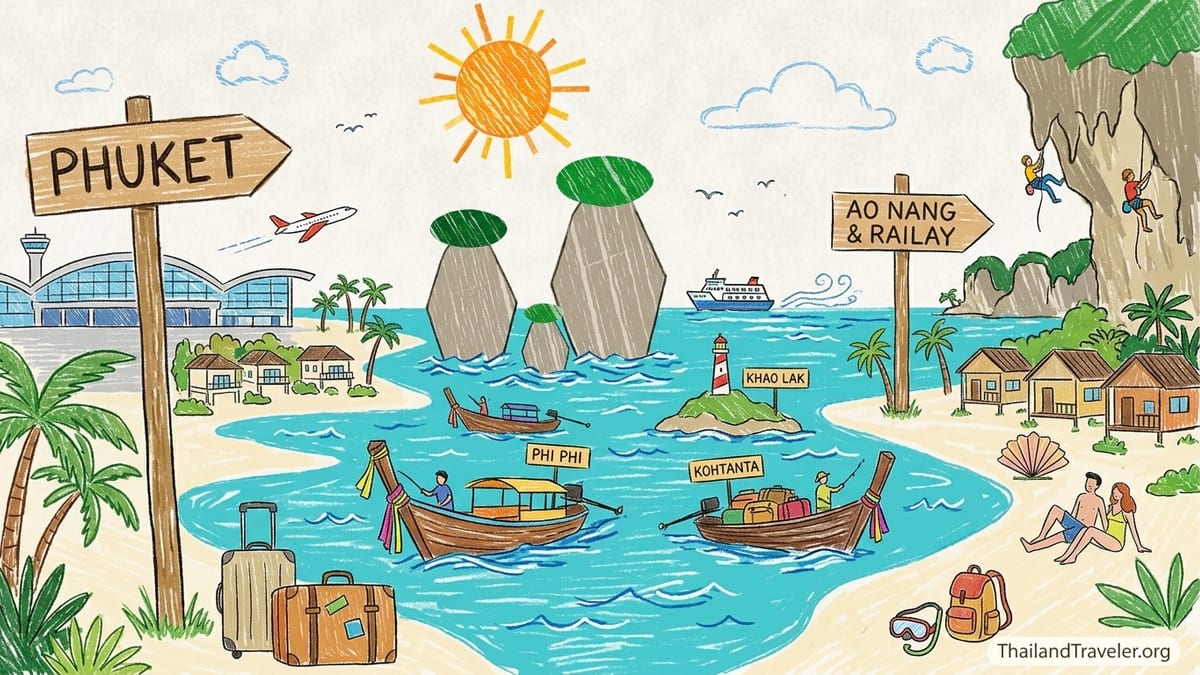
How to Choose Your Andaman Coast Base
The Andaman Coast in southern Thailand stretches from Phuket in the west to the islands near the Malaysian border. On a map it looks compact, but in practice moving between resort areas often involves a combination of minivan and boat transfers. For example, traveling from Phuket to Koh Lanta via shared minivan and ferry commonly takes 4 to 6 hours door to door, depending on traffic and ferry timings. That makes it important to choose one or two bases that match the holiday you want, instead of trying to visit every island in a single short trip.
Each major destination offers a different balance of accessibility, price, nightlife and natural scenery. Phuket works best for international arrivals, luxury resorts and nightlife. Ao Nang and Railay in Krabi suit travelers who want affordable island-hopping. Khao Lak appeals to guests seeking quiet beachfront hotels and easy access to northern marine parks such as the Similan and Surin Islands. Further south, Koh Lanta, Koh Phi Phi and Koh Lipe all offer beach-focused stays, but with distinct atmospheres, transfer times and price levels.
Accommodation types range from basic fan bungalows under 50 US dollars per night in low season to private pool villas over 1,000 US dollars per night at flagship resorts. On Koh Yao Noi, for instance, independent reporting in 2026 describes high-season rates at Six Senses Yao Noi starting around 45,000 Thai baht per night, or roughly 1,250 US dollars, for an ocean pool villa, rising much higher for multi-bedroom residences. In contrast, a comfortable midrange hotel in Ao Nang might cost 60 to 120 US dollars per night in the same period, with frequent promotions in shoulder season.
When deciding where to stay, think first about how often you want to move. A single-base holiday keeps logistics simple and suits three- to five-night trips. Multi-center itineraries work better for seven to fourteen nights, when you have time to settle into two or three contrasting bases. This article focuses on the main resort areas in order of how travelers typically combine them, with concrete examples of rates, transport links and what you can realistically do from each base.
Phuket: International Hub, Luxury Resorts and Nightlife
Phuket is the main international gateway to the Andaman Coast, with direct flights from long-haul hubs in the Middle East, Europe and Asia. For many travelers arriving on evening flights, spending the first night in Phuket avoids a long land transfer after a long-haul journey. Popular beach areas include Patong for nightlife, Kata and Karon for a more balanced scene, and the quieter west-coast headlands of Kamala, Surin and Layan for luxury stays. Patong’s midrange hotels often start from about 60 to 100 US dollars per night, while five-star properties such as Amanpuri or Trisara usually charge several hundred to well over 1,000 US dollars per night in high season, according to recent published price ranges.
Phuket offers the widest restaurant and nightlife scene in the region. In Patong, Bangla Road remains the main nightlife strip, with late-opening bars, live music venues and clubs. Families and couples who prefer quieter evenings often choose Kata or Kamala instead, where beachside restaurants and hotel bars close earlier. Beach access varies by area. Patong, Kata and Karon have broad public beaches with easy access for swimmers, though waves can be strong during the southwest monsoon months, roughly May to October. In contrast, some luxury resorts on headlands rely on smaller coves or shuttle services to larger beaches.
For families, Phuket has a growing range of resorts with dedicated kids’ clubs, shallow pools and interconnecting rooms. Many four-star beachfront or near-beach hotels in Karon and Kata offer rates from roughly 120 to 250 US dollars per night in the 2026 high season, based on major booking platforms, which is often lower than comparable large resorts on smaller islands where supplies and staffing are more expensive. Transport is straightforward: metered taxis, ride-hailing services within regulations, and shared minivans connect the airport to most western beaches in 45 to 70 minutes, depending on traffic.
Phuket also works as a launch point for day trips, though travelers interested primarily in quieter islands may prefer to move bases rather than commute long distances by speedboat. Island excursions to the Phi Phi islands and Phang Nga Bay typically depart early in the morning and return by late afternoon. While Phuket can work as the only base for a short five-night trip, many visitors combine two or three nights here at the start or end of a multi-stop Andaman itinerary so they can experience the nightlife and dining scene without sacrificing time on smaller islands.
Ao Nang and Railay: Affordable Island-Hopping and Dramatic Scenery
Ao Nang, near Krabi Town, is the main mainland beach resort for visitors who want to explore the islands of Krabi province on a budget. The beach itself is pleasant rather than spectacular, but longtail boats and speedboats depart directly from here to Hong Island, Chicken Island, Poda Island and the Phi Phi group. Midrange hotels in Ao Nang typically cost 50 to 120 US dollars per night in high season, with frequent promotions bringing some four-star properties under 80 US dollars for advance bookings. Basic guesthouses and hostels reduce costs for backpackers, who benefit from the dense competition among tour operators and restaurants.
For travelers seeking more dramatic scenery and a car-free setting, Railay Peninsula is reached only by boat from Ao Nang or Krabi Town, usually in 15 to 30 minutes. Sheer limestone cliffs frame Railay West, Railay East and Phra Nang beaches, making this one of Thailand’s most photographed coastal landscapes. High-end properties include Rayavadee, a member of a leading hotels collection, whose circular pavilion suites sit among tropical gardens between Railay West and Phra Nang. A 2026 travel guide notes that rooms at Rayavadee often start around 14,000 Thai baht, or roughly 380 to 420 US dollars, per night in high season, with package offers and seasonal promotions also available.
Railay also offers midrange alternatives such as Railay Bay Resort & Spa and Railay Phutawan Resort. Recent price checks on major booking engines show promotional rates for Railay Bay Resort & Spa around 100 to 150 US dollars per night for double rooms outside peak festive dates, including pools and direct beach access on Railay West. The area is particularly popular among rock climbers, who come for bolted climbing routes on Tonsai and Railay cliffs, and among couples seeking dramatic sunsets without the party intensity of Phuket’s Bangla Road.
Families should note that Railay’s beaches are tidal, with shallow water at low tide and occasional boat traffic close to shore. Swimming is best a couple of hours either side of high tide, especially for younger children. Access also depends on sea conditions. In periods of heavy swell or storms, transfers can be delayed or rerouted, so it is wise to allow generous time between Railay and any onward flights from Krabi International Airport. Ao Nang itself, with its road connections, is more reliable if you expect to make multiple day trips or need very early airport departures.
Khao Lak: Quiet Beachfront Resorts and Similan Islands Access
Khao Lak, in Phang Nga province north of Phuket, suits travelers who want a quieter base with long, uncrowded beaches and easy access to northern marine parks. The coastline here consists of several named beaches such as Nang Thong, Bang Niang and Pakarang, lined with midrange and upscale resorts set back from the sand. Flagship properties include The Sarojin, a luxury boutique beach resort known for its adults-oriented atmosphere, personalized excursions and all-day a la carte breakfast service. Industry brochures for the 2025 to 2026 seasons describe The Sarojin as occupying a beachfront site close to several national parks, with two restaurants, a spa and non-motorised water sports available.
Room rates in Khao Lak span from around 50 to 80 US dollars per night for simple guesthouses in Bang Niang up to several hundred dollars per night at five-star properties in high season. Publicly available package information suggests that The Sarojin typically prices in the upscale bracket, though discounted shoulder-season offers sometimes bring entry-level rooms under 300 US dollars per night for advance bookings. Families with young children often choose larger beachfront resorts that provide kids’ pools and kids’ clubs; some of these are operated by well-known international chains at relatively moderate prices compared with Phuket’s west coast.
Khao Lak’s main advantage is proximity to the Similan and Surin Islands, which are among Thailand’s top diving and snorkeling destinations. Day trips and liveaboard boats depart from pier areas such as Thap Lamu, a short drive from the main resort strip. This makes Khao Lak particularly convenient for divers and for travelers whose main focus is marine-park excursions. By contrast, using Khao Lak as a base for frequent island-hopping trips to Krabi’s islands would be impractical. Reaching areas like Hong Island or Railay from Khao Lak would require long road transfers south toward Krabi or Phuket followed by additional boat legs, turning a day trip into a long, tiring journey.
The atmosphere in Khao Lak is quieter than in Phuket or Ao Nang, with fewer late-night venues and a small-town feel in Bang Niang’s night market and restaurant area. Those who enjoy a relaxed dinner followed by a drink at their resort bar will feel comfortable, but visitors seeking clubs and live music streets are usually happier basing themselves in Phuket or Ao Nang. Transfers are straightforward: Phuket International Airport is around 70 to 90 minutes away by road, and private cars or pre-booked minivans are widely used for arrivals and departures.
Koh Lanta and Koh Phi Phi: Relaxed Holidays and Island Scenery
Koh Lanta, in Krabi province, appeals to travelers looking for a laid-back, family-friendly island without the intense nightlife of Phi Phi or Phuket’s busiest beaches. The main island, Lanta Yai, has a west coast lined with beaches that grow progressively quieter as you head south. At the high end, Pimalai Resort & Spa occupies a large, green hillside and beachfront estate on Ba Kantiang Bay. Thai-language hotel reviews and international tour brochures from 2026 describe Pimalai as a five-star destination resort with around 900 metres of private beachfront, 121 rooms and villas, two main pool areas and a spa, affiliated with a global small luxury hotel collection.
Recent rate checks on hotel aggregators show Pimalai with nightly prices from around 200 to 300 US dollars for entry categories outside peak festive periods, rising for pool villas and prime beachfront accommodation. Midrange properties along Long Beach (Pra Ae) and Klong Dao often price between 60 and 150 US dollars per night in high season, with simple bungalows under 50 US dollars during shoulder periods. Many of these midrange hotels offer family rooms, shallow pools, small playgrounds and convenient access to beachside restaurants where children can play in the sand while parents dine.
Koh Lanta works well as a base for snorkeling trips to Koh Rok, Koh Haa and the nearby karst islands. Contract rate documents for local tour partners list regular snorkeling excursions from Lanta to Koh Rok between October and July, with speedboat departures on most days when sea conditions allow. Roads on Lanta are relatively easy to navigate by scooter or songthaew, so guests can explore Lanta Old Town, visit viewpoints or move between beaches without complex logistics. Nightlife is relaxed, centering on sunset bars and occasional fire shows rather than late-closing clubs.
Koh Phi Phi offers the opposite mood. The main settlement on Phi Phi Don is compact and pedestrian-only, with accommodation ranging from basic guesthouses to upscale resorts. The scenery, with steep cliffs rising out of turquoise water, attracts day-trippers as well as overnight guests. Beachfront party bars in the central village area can be noisy into the small hours, which appeals to some but not all visitors. Those seeking quieter stays often choose resorts on Laem Tong Beach or other more secluded bays, reached by longtail boat from the pier. Prices for midrange hotels in or near the village typically run from about 80 to 180 US dollars per night in high season, with premium beachfront resorts charging more.
Koh Yao Noi and Koh Lipe: Boutique Retreats and Remote Escapes
Koh Yao Noi sits roughly between Phuket and Krabi in Phang Nga Bay. Compared with Phi Phi, it remains quieter, with a mix of small local communities, boutique resorts and a few upmarket properties. Six Senses Yao Noi is the island’s most famous resort, with private pool villas cascading down a forested hillside facing the limestone pinnacles of the bay. Reporting from 2026 places published nightly rates in a wide band, roughly between 860 and over 6,000 US dollars depending on villa category and season, with high-season entry rates often quoted around 45,000 Thai baht per night for ocean-facing pool villas. Guests reach the resort via speedboat transfers from Phuket or Krabi, arranged to connect with flights.
Aside from Six Senses, Koh Yao Noi offers smaller boutique accommodations and midrange resorts that typically price between 80 and 250 US dollars per night in the dry season. These might provide simple beachfront bungalows, infinity pools and compact spas, often run by local families or Thai-owned small chains. The island has a modest restaurant scene focused on local seafood and low-key bars. There is very little nightlife; most visitors are couples or small groups interested in kayaking, cycling through rubber plantations, or taking longtail excursions to Phang Nga’s islands while returning to a quiet base each afternoon.
Much farther south, near the Malaysian border, Koh Lipe sits inside the Tarutao National Marine Park. Reaching Koh Lipe requires additional planning, because there are no direct flights. Most travelers fly to Hat Yai, Trang or sometimes Phuket and then connect via minivan and speedboat. In good sea conditions, the boat leg from Pak Bara Pier in Satun province usually takes around 90 minutes one way. From mid-October to around May, seasonal speedboat routes also link Koh Lipe to islands such as Koh Lanta and Langkawi, but these services are subject to weather and may not operate daily early or late in the season.
Koh Lipe’s three main beaches, Pattaya, Sunrise and Sunset, host a concentration of small resorts and guesthouses. Accommodation here ranges from simple wooden bungalows starting near 40 to 60 US dollars per night in high season to midrange beach resorts charging 120 to 250 US dollars per night for air-conditioned rooms near the sand. A few higher-end boutique properties ask more, with beachfront suites and in-house dive centers. The island is effectively car-free, with walking streets connecting most areas. Beach-focused days, snorkeling trips inside the marine park and relaxed evenings at beach bars define the experience.
Quieter Alternatives: Koh Mook, Koh Kradan and Koh Phayam
Travelers willing to trade nightlife and shopping for quieter beaches have a growing choice of smaller islands that still feel less developed than the main resort hubs. Koh Mook, in Trang province, is known for the Emerald Cave, reachable by swimming or kayaking through a short sea tunnel at appropriate tides. Accommodation consists mainly of small resorts and bungalow operations on Hat Farang and the eastern shore. Nightly rates in high season typically sit between 40 and 150 US dollars, with simple bamboo huts at the lower end and air-conditioned beachfront rooms at the upper end.
Nearby Koh Kradan has become popular among travelers who value clear water and a compact footprint. From about 2023 onward it received more social media attention, yet it remains small enough that guests usually walk the entire beachfront within half an hour. There is no dense village; instead, a string of resorts lines the main beach. Prices in peak months can be similar to or slightly higher than Koh Mook for comparable room standards, partly due to limited supply. Many guests stay three or four nights, using longtail boats to visit nearby islands by day and returning to quiet dinners at their own resort.
Koh Phayam, off the coast of Ranong near the Myanmar border, attracts independent travelers and long-stay guests looking for a mellow scene with surfable waves in some seasons. Electricity supply has improved over the years but remains more limited than on Phuket or Lanta, and development is low-rise and low-key. Accommodation spans simple huts under 30 to 40 US dollars per night in shoulder seasons to comfortable bungalow resorts around 70 to 150 US dollars per night in the main dry season. There are no cars; transport consists of motorbikes and local taxis, contributing to a relaxed, back-to-basics atmosphere.
These quieter alternatives are less convenient for short holidays because reaching them often involves two or three legs of travel after landing in Bangkok or Phuket. They suit travelers who have already experienced the main Andaman destinations or who prioritize tranquillity and a sense of remoteness over choice of restaurants and organized excursions. Families with very young children may find the limited medical facilities and sometimes bumpy transfers a consideration when choosing between these islands and more developed bases such as Phuket, Khao Lak or Koh Lanta.
Practical Itineraries: 3, 5, 7 and 14 Nights
For a three-night stay, it usually makes sense to choose a single base with easy access from your arrival airport. In this timeframe, Phuket, Ao Nang or Khao Lak are the most practical options. For example, a long weekend might involve flying into Phuket, spending three nights at a midrange hotel in Kata or Karon, enjoying one day on the beach and one boat trip to nearby islands such as Coral Island or the Phi Phi group. Alternatively, a diver could land in Phuket and transfer directly to Khao Lak for three nights at a midrange beachfront resort that offers or arranges day dives to the Similan Islands, limiting travel days and maximizing time on the water.
With five nights, travelers can still base themselves in one place or split their time between two nearby destinations. One realistic split is two nights in Phuket to shake off jet lag, followed by three nights on Railay or Ao Nang for island-hopping around Krabi. Another option for couples seeking a quieter experience would be two nights in Phuket followed by three nights on Koh Yao Noi at a boutique resort, including one full day at leisure and one day of longtail excursions around Phang Nga Bay. Moving further afield, spending all five nights on Koh Lanta or Koh Phi Phi works well for visitors who prefer to unpack once and enjoy a deeper sense of place.
A seven-night trip opens more combinations. Honeymooners might choose three nights in a luxury resort on Phuket’s west coast followed by four nights at Six Senses Yao Noi, using private speedboat transfers between the two. Families could consider seven nights on Koh Lanta at a resort such as Pimalai or a midrange family hotel on Long Beach, with built-in downtime for children and a couple of boat trips to Koh Rok or Koh Haa. Budget-conscious travelers might split three nights in Ao Nang and four nights in a midrange Koh Phi Phi hotel, accepting a livelier nightlife scene in exchange for easy access to iconic viewpoints and beaches.
With fourteen nights, multi-center itineraries become particularly appealing. One example for a first-time visitor could be four nights in Phuket, three nights on Koh Yao Noi, four nights on Koh Lanta and three nights in Krabi (Ao Nang or Railay), moving roughly west to east and ending near Krabi airport. Divers might prefer a week in Khao Lak to access the Similan and Surin Islands, followed by a week on Koh Lanta for day trips to Koh Haa and Koh Rok, thus experiencing both northern and central Andaman marine environments. Slow travelers who dislike frequent moves could simply spend all fourteen nights on Koh Lanta or Phuket, perhaps changing hotels once within the same island to see a different beach.
Matching Destinations to Travel Styles
Honeymooners and couples looking for privacy tend to gravitate toward resorts such as Six Senses Yao Noi, Pimalai Resort & Spa and The Sarojin, along with other upscale properties on Phuket’s quieter headlands. These resorts justify their higher prices not only through villa hardware but through location, service and curated experiences, such as private sandbank dinners, longtail charters and in-villa spa treatments. However, plenty of midrange boutique hotels on Koh Yao Noi, Koh Lanta and in Khao Lak offer romantic settings at more accessible prices, particularly outside the Christmas and New Year peak.
Families often prioritize shallow swimming areas, kids’ facilities and straightforward transfers over extreme seclusion. Phuket’s Kata, Karon and Bang Tao beaches, midrange resorts in Ao Nang, and larger beachfront properties on Koh Lanta and Khao Lak all fit these needs. When considering Railay or Phi Phi with children, parents should factor in boat-only access, tidal swimming conditions and the energy of the nightlife zones. Many prefer to visit busier areas on day trips, returning to a quieter base with predictable routines for younger children.
Divers and snorkelers should think first about which marine areas they want to explore. Those targeting the Similan and Surin Islands tend to base themselves in Khao Lak because day boats and liveaboards depart from nearby piers, avoiding long predawn transfers from Phuket. Central Andaman sites around Koh Haa, Koh Rok and the Bida islands near Phi Phi are better accessed from Koh Lanta or Phi Phi itself. Koh Lipe and the Tarutao National Marine Park appeal to repeat visitors who do not mind extra transfers in exchange for access to southern reefs and smaller islands within the park boundaries.
Budget travelers usually find the best combination of price and variety in Ao Nang, parts of Phuket away from the most fashionable headlands, and on islands like Koh Phayam, Koh Mook and Koh Kradan. Dorm beds and basic fan rooms can reduce nightly costs dramatically, though travelers should remember to add in the cost of boat transfers, park entry fees and excursions, which can quickly exceed hotel bills on shorter stays. First-time visitors who want an easy introduction often choose to split time between Phuket and one nearby island such as Koh Phi Phi or Koh Yao Noi, avoiding the need for domestic flights after landing in Thailand.
Decision Guide: Destinations and Accommodation Styles
To help narrow choices, it is useful to match broad traveler profiles with typical bases and accommodation types. Honeymooners and couples seeking seclusion might prioritize Koh Yao Noi or Koh Lanta, staying in private pool villas at resorts such as Six Senses Yao Noi, Pimalai or other boutique properties. Those with higher budgets might add two or three nights at a flagship resort on Phuket’s west coast, while couples with midrange budgets could choose smaller beachfront hotels on Koh Lanta or Khao Lak that still offer candlelit dining and spa treatments.
Families often find the best balance in Phuket, Khao Lak or Koh Lanta, where larger resorts provide kids’ clubs, children’s pools and easy access to restaurants. A typical family of four might book a family room or two interconnecting doubles at a four-star Phuket resort for around 180 to 300 US dollars per night in high season, based on publicly available 2026 prices, and then move to Koh Lanta for a slower-paced second week. For parents of toddlers, destinations with shorter boat legs, such as Koh Yao Noi or Phi Phi from Phuket, may feel more manageable than longer open-sea trips to Koh Lipe.
Divers and snorkel-focused travelers should align their base with their chosen reefs. Khao Lak works best for the Similan and Surin Islands because transfer times to the departure piers are short and trip operators are clustered nearby. Using Khao Lak as a base for frequent trips to Krabi’s islands would result in long road journeys south for each outing, so it is generally more efficient to combine Khao Lak with a stay in Krabi or Koh Lanta rather than commuting repeatedly. Those more interested in Phi Phi’s walls and central Andaman sites might base themselves on Koh Lanta, which offers both family resorts and simple dive lodges close to pier departures.
First-time visitors who want a mix of ease and variety could plan an itinerary such as three nights in Phuket and four nights on Koh Phi Phi, or five nights in Phuket followed by five nights on Koh Lanta. Those on a tight budget might instead choose Ao Nang for the entire trip, combining inexpensive accommodation with day trips to Railay, Hong Island and even an organized tour to Phi Phi. Repeat visitors who value quiet often phase out the biggest hubs and instead spend ten to fourteen nights divided between Khao Lak, Koh Yao Noi and one of the smaller islands like Koh Phayam or Koh Kradan, accepting simpler infrastructure in exchange for fewer crowds.
FAQ
Q1. What is the easiest Andaman Coast destination to reach on a short trip?
For most international travelers, Phuket is the easiest base for a short three- or four-night stay because it has its own international airport, a wide choice of hotels near the main beaches and day-trip access to islands like Phi Phi and Coral Island without needing additional domestic flights.
Q2. Why is Khao Lak recommended for trips to the Similan Islands but not for Krabi island-hopping?
Khao Lak sits close to departure piers for the Similan and Surin Islands, so boat trips begin after a short road transfer. To reach Krabi’s islands from Khao Lak, you would first need to travel several hours south by road toward Krabi or Phuket and then board another boat, making frequent day trips long and tiring.
Q3. Is Koh Lipe worth the extra transfer time?
Koh Lipe is rewarding for travelers who want clear water, small-island atmosphere and access to the Tarutao Marine Park. However, it requires at least one domestic flight plus minivan and boat transfers in each direction, so it suits trips of seven nights or longer when you can stay on the island for at least four or five nights.
Q4. Which Andaman destinations are best for families with young children?
Phuket, Khao Lak and Koh Lanta are particularly good for families because they offer a wide choice of family rooms, kids’ clubs, shallow pools and easy access to restaurants. Shorter boat rides and established medical facilities also give parents extra peace of mind.
Q5. Where should budget travelers stay if they want to visit several islands?
Ao Nang is one of the best bases for budget-conscious travelers because it has many guesthouses, hostels and inexpensive midrange hotels, along with affordable longtail and speedboat trips to nearby islands like Railay, Hong Island and the Phi Phi group.
Q6. Are Railay and Phi Phi suitable for travelers who dislike nightlife?
Both Railay and Phi Phi have lively bars, especially in the central village areas on Phi Phi. Travelers who prefer quiet evenings can still enjoy these destinations by choosing hotels in calmer parts, such as Railay’s garden resorts or Phi Phi’s Laem Tong Beach, and avoiding rooms close to the main party streets.
Q7. How far in advance should I book luxury resorts such as Six Senses Yao Noi, Rayavadee or Pimalai?
For stays in the main dry season from roughly December to March, it is sensible to book high-end resorts several months in advance, especially if you want specific villa categories or travel during Christmas, New Year or Chinese New Year, when minimum-stay requirements and higher rates often apply.
Q8. Can I base myself in one place and still see several islands?
Yes, if you choose a well-connected base such as Phuket or Ao Nang, you can visit several nearby islands on day trips. However, reaching more distant islands like Koh Lipe or the Similan Islands usually requires overnight stays or very long travel days, so they are better combined with a change of base.
Q9. What swimming conditions should I expect on the Andaman Coast?
In the dry season, seas are usually calm and suitable for swimming at most beaches, though some areas are shallow at low tide. During the southwest monsoon months from roughly May to October, waves and currents can be stronger, especially on open west-facing beaches in Phuket and Khao Lak, and red flags may indicate no-swim conditions on some days.
Q10. Is it better to book packages with transfers included or arrange everything independently?
Travelers who value convenience, particularly on short trips or when visiting remote islands, often find it easier to book hotel packages or use local agents that include transfers. Independent travelers with more time and flexibility can save money by arranging each leg separately, though this requires checking current boat timetables and allowing buffers between connections.