


Arriving at Railay Beach for the first time, I had the strange feeling of landing on an island that is not actually an island. Railay sits on a small peninsula between Krabi Town and Ao Nang, but the sheer limestone cliffs that frame it cut off all road access. Everything and everyone comes in by boat. That single fact shapes almost every part of a Railay trip, from how you pack your luggage to when you swim, where you eat and whether staying overnight is worth the higher room rates compared with Ao Nang.
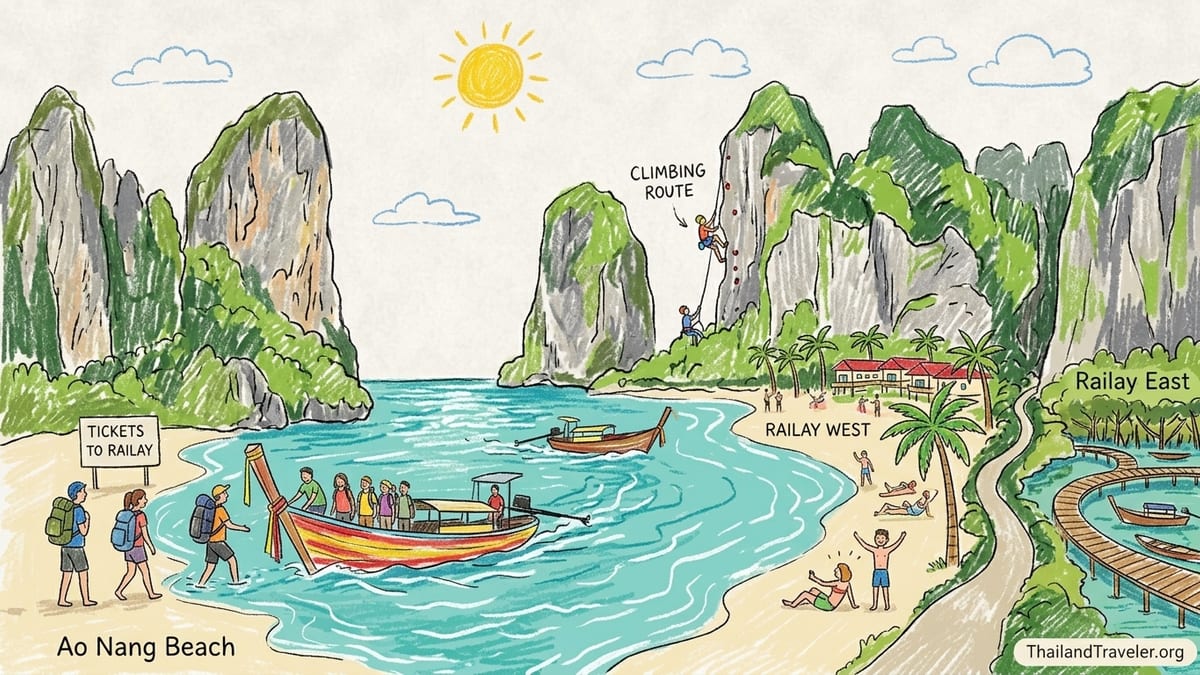
Getting from Ao Nang to Railay by Longtail Boat
I started in Ao Nang, which is where most visitors base themselves before hopping over to Railay. To get to Railay West, I walked to the eastern end of Ao Nang Beach, where the Ao Nang Longtail Boat Service Club has its main ticket booth right on the sand near the steps by the headland. There are other vendors and online sellers, but this is the standard departure point for walk-up passengers heading directly to Railay West.
In October 2026, the posted one-way fare at the booth was 120 to 150 baht per person between Ao Nang and Railay West, depending on time of day and season, with a minimum of eight passengers needed before a boat departs. Staff also sold open return tickets that worked out slightly cheaper per leg than buying two singles, but the saving was small enough that I chose to keep my options open and buy one-way tickets on each segment.
Waiting time varied by hour. When I arrived at 10:30 in the morning, it took around 15 minutes to fill a boat with day-trippers and hotel guests. Travelers who have visited in recent months report that in peak late-morning periods, boats can fill within 5 to 10 minutes, while in the late afternoon it can take longer to assemble enough passengers, especially outside the November to April high season. The actual crossing from Ao Nang to Railay West is short, usually about 10 minutes of chugging over the Andaman’s small chop, with the cliffs growing taller and more dramatic ahead.
Boarding is part of the adventure. There is no pier in Ao Nang for the longtails to tie up to. The boats line up just offshore, and passengers wade out. On my trip, the tide was halfway out, so I stepped into water above my knees while carrying a small backpack. Other visitors who traveled at lower tide reported water close to the waist. Dry bags, sandals instead of heavy shoes and luggage you can comfortably hold above the waterline all make this process far easier.
Arriving at Railay West and Understanding the Beaches
The longtail dropped us directly on Railay West, which feels every bit like the postcards. This is the main sandy swimming beach, a soft arc of pale sand backed by palms and low-rise resorts, and framed at both ends by towering limestone walls. Boats nose into the shallows along the central stretch, so you again step down into calf or knee-deep water and wade to shore. There is no jetty, only sand, which keeps the scene informal and slightly chaotic in a charming way.
Railay West is the peninsula’s best swimming beach for a few simple reasons. The seabed shelves gently, with fine sand underfoot rather than mud or rocks. The bay is open enough for decent water circulation but protected by offshore karst towers that break larger swells, so waves are usually modest. Views at sunset are spectacular, and most of Railay’s upscale beachfront accommodation, such as Rayavadee and Sand Sea Resort, lines this coast, which keeps sand grooming and general maintenance high.
Walking across to Railay East takes about five minutes along a paved and sandy path that cuts through the interior of the peninsula. Once there, the contrast is immediate. Railay East is a long fringe of mangroves and mudflats rather than an open swimming bay. At low tide the water retreats far out, leaving a mushy, barnacled foreshore. Longtail and transfer boats from Krabi Town and Ao Nam Mao tie up to floating pontoons or simple concrete jetties here, sheltered from the swells. It is scenic in its own way, with overhanging cliffs and a wooden boardwalk backed by bars, budget hotels and climbing shops, but it is not a beach you come to for a dip.
From the southern end of Railay East, a signed path winds under leaning limestone formations and through small patches of jungle to Phra Nang Cave Beach. This walk takes about 10 minutes at a gentle pace. Phra Nang is visually the most dramatic of the three main beaches, a narrow curve of sand beneath honeycomb cliffs and overhangs, with a sea cave and a local shrine to a mythical sea princess tucked into one end. The atmosphere feels more enclosed than Railay West, with cliffs and small offshore islands creating a natural amphitheater. It is an excellent place for swimming in calm conditions, but space fills quickly when day-trip boats arrive, and there is more shade under the cliffs compared with the open, sun-soaked expanse of Railay West.
Walking Paths, Cliffs, Caves and Everyday Logistics
One thing that surprised me was just how compact Railay is. The peninsula is crisscrossed by a few main footpaths and there are no cars at all. From Railay West to Railay East, you can walk in 5 minutes on flat ground. From Railay East down to Phra Nang, allow another 10 minutes. A rougher trail leads northwest from Railay West to Tonsai, the next bay along, in about 20 minutes if you are reasonably sure-footed and the tide is not too high.
The cliffs are never out of sight. They tower 100 meters or more above the beaches, pocked with pockets and tufas that climbers love. Along the path to Phra Nang, the limestone overhangs dramatically above the trail, and you duck beneath dripping stalactites. About halfway, a side path climbs to the viewpoint and the entrance to the hidden lagoon. Local authorities and climbing guides consistently warn that this scramble is steep, polished and muddy, and that falls are common, especially in wet months. On my visit, the dirt was slick from recent rain and I opted not to attempt it after watching several people slide back down on their backsides. The safer cave to explore is Diamond Cave near Railay East, where a low entry fee grants access to a walkway inside a large chamber full of stalactites and bats.
Restaurants and cafes cluster mainly along Railay East’s boardwalk and just inland from Railay West. On the east side, I found many mid-range Thai restaurants and a few backpacker-style bars advertising happy hours and live music. On the west side, beachfront hotel restaurants dominated, offering grilled seafood, Thai curries and Western dishes at resort prices. Expect to pay around 120 to 180 baht for a simple pad thai or fried rice at an inland eatery and 200 to 400 baht for mains at higher-end beachfront spots, with cocktails often 200 to 350 baht per glass. Food is more expensive than in Ao Nang, where similar dishes often cost 20 to 30 percent less, reflecting the extra effort of transporting supplies in by boat.
Daily life here revolves around the boat schedules and the tides. Hotel porters with carts meet supply boats on Railay East and trundle beer cases, fruit and gas cylinders along the same paths that tourists use. When it rains heavily, puddles form in the unpaved sections, and flip-flops become the default footwear. The cliffs and jungle create a sense of separation from the mainland that you feel as soon as you realize there are no motorbikes buzzing past and no road noise at all.
Experiencing Railay Through a Beginner Rock Climbing Lesson
Railay is famous among climbers for its bolted limestone routes, and I wanted to experience that side of the peninsula without taking foolish risks. Several established schools operate here, including King Climbers, Hot Rock, Real Rocks and others, each with modest storefronts either on Railay East or along the walking paths. I booked a half-day beginner course with one of the longer-running Railay-based outfits operating from Railay East for 1,200 baht per person, which matched current 2026 rates that several schools advertise for group beginner sessions.
The session ran from 8:30 to around 12:30. Group sizes in high season are usually capped around six participants per instructor for beginner courses, which local guides and recent visitors recommend as a reasonable ratio for top-rope instruction. After being fitted with climbing shoes, a harness and helmet, we walked to a nearby crag close to Phra Nang that offered several routes between grade 5 and 6a on bolted sport lines suitable for first-timers. The school provided all gear, ropes and quickdraws, which looked in good condition.
The instructor briefed us carefully on basic knot tying, how the belay device worked and the importance of clear voice commands. As a first-time climber, what struck me about Railay’s limestone was both the abundance of holds and the way the rock demanded attention to texture. Overhangs were decorated with stalactites that looked almost sculpted, while the vertical faces had pockets and ribs that felt secure when dry but noticeably slicker in humid patches. Good schools here emphasize three points for beginners: respect the bolted routes and do not attempt to climb where there are no fixed anchors, never climb without a rope and belayer and pay close attention to the instructor’s commands, especially when lowering.
The climbing itself was exhilarating rather than terrifying. The first route was a low-angled slab that allowed me to get used to the feel of the shoes and the rope system. By the second and third routes, we were on steeper sections where using smaller foot edges and trusting my weight on pockets became necessary. Looking down, I could see the green water and longtail boats anchored just offshore, which made the exposure feel far greater than the actual height. After about three hours, my forearms were spent but I felt safe and well looked after, and I came away with a new appreciation of why Railay is regarded as one of the most accessible places in Asia to try outdoor rock climbing in a controlled environment.
Staying Overnight: Costs, Luggage and Evening Atmosphere
To understand Railay beyond the day-trip experience, I booked a basic air-conditioned bungalow on Railay East. In October 2026, mid-range rooms on the east side were widely available in the 1,500 to 2,500 baht per night range for a double, with simpler fan rooms under 1,200 baht. On Railay West, comparable beachfront or near-beach rooms commonly ranged from about 3,000 baht up to 6,000 baht and beyond in popular winter months, with luxury villas at Rayavadee and similar resorts far higher. The price difference between east and west can easily be 30 to 50 percent or more for similar comfort, which is why many travelers choose to sleep on the east and walk a few minutes to the west to swim and watch sunset.
Luggage logistics matter more here than in Ao Nang because of the boat access. With no pier at Railay West and longtails often stopping in knee-deep water, large hard-shell suitcases are awkward to handle. I saw several families struggling to keep their rolling bags dry while stepping off boats in soft sand. Railay East has pontoons and more structured landing points, so you can usually avoid wading there, which makes it friendlier if you have heavier luggage. Some of the higher-end resorts on Railay West arrange their own transfers via Ao Nam Mao, where a pier allows for easier pier-to-boat boarding and staff help with bags.
After 6 p.m., regular shared longtail services between Ao Nang and Railay largely wind down, with the last scheduled boats commonly leaving around that hour outside major holiday periods. Travelers arriving later often report needing to charter a private longtail, paying significantly more per boat, to reach Railay in the evening. On my stay, I simply planned to arrive earlier in the afternoon and stay overnight so that I did not have to watch the clock for a return ride.
As day-trippers departed on the mid- to late-afternoon boats, the character of Railay changed noticeably. Midday brought lines of paddlers, group tours, and longtail engines revving just off Railay West. By 5 p.m., the beach felt calmer, with mainly overnight guests strolling the sand. After dark, Railay East took over as the social hub, with live music drifting from a few bars and people lingering over seafood dinners. It never felt like a full-scale party destination during my visit, more a relaxed beach village with a climbing crowd, but visitors during peak Christmas and New Year weeks describe far busier evenings.
Food, Drinks and Daily Spending Compared with Ao Nang
Spending a night on Railay gave me a concrete sense of how costs stack up against Ao Nang. For breakfast, my bungalow’s simple buffet of eggs, toast, fruit and coffee was included in the room rate. A comparable breakfast plate at an independent cafe off the beach ran about 150 to 200 baht. At lunch on Railay West, a Thai curry and rice at a resort restaurant cost just over 250 baht, and a fruit shake was an additional 90 baht. Dinner on Railay East at a casual Thai place ran to around 400 baht for two dishes to share, plus 70 baht for a large bottle of local beer.
By contrast, in Ao Nang the week before, I had eaten at street-facing Thai restaurants where mains hovered closer to 80 to 120 baht and drinks were cheaper. Over a full day, I estimate that food and drink on Railay cost me about 30 to 40 percent more than my meals in Ao Nang for similar quality, with the premium highest at beachfront locations. The premium felt similar to what you might pay in any isolated beach resort that relies on boat access for supplies rather than a town attached to the road network.
For snacks and basic groceries, Railay has a few minimarts scattered between the east and west sides. Prices for bottled water, sunscreen and snacks are higher than in Krabi Town or Ao Nang, but not outrageous. If you are budget-conscious or traveling as a family, buying a few essentials in Ao Nang before boarding the boat can trim your daily costs, especially items like diapers, kids’ snacks, and extra sunscreen that you know you will use.
Railay for Families, Climbers and Couples
Railay feels very different depending on who you are traveling with and what you want from your days. As a family destination, Railay West works well for confident swimmers and school-age children who can handle wading in and out of boats. The gently shelving sand and lack of vehicles make it a safer environment than busier town beaches. However, parents with strollers or toddlers need to plan more carefully. Longtail boarding involves steps into the water, there are no paved promenades right on the beach, and carrying a child plus bags on and off boats can be stressful, as some recent visitors have described when tempers flared over gear storage and ticket misunderstandings at the Ao Nang boat club office.
For climbers, especially beginners or those wanting to transition from indoor gyms to outdoor rock, Railay is close to ideal. You wake up within walking distance of multiple crags. A half-day course fits neatly into a relaxed schedule where you climb in the cooler morning, swim in the afternoon and eat by the water in the evening. More experienced climbers often stay closer to Tonsai, with its cheaper bungalows and steeper, harder routes, but still come over to Railay for food and services. Because equipment rental, guided courses and route access cluster on Railay East and around Diamond Cave, climbers often prefer to sleep nearby rather than on Railay West’s quieter but more expensive strip.
For couples seeking a quieter beachfront stay, Railay West and Phra Nang are the romantic postcards. Staying at a west-side resort, with sunset right in front of your room and breakfast under the palms, feels far removed from the traffic and neon of Ao Nang. The trade-off is cost and a slightly more curated resort experience, where you may eat most meals on property. Couples on a tighter budget can split the difference by staying on Railay East and simply walking over to Railay West each evening, returning along the well-lit paths after dinner. After 9 or 10 p.m., things quieten quickly across the peninsula, which suits travelers who prefer early swims and starry nights to late clubs.
The Takeaway
After traveling from Ao Nang by longtail, swimming and exploring each beach, trying a supervised beginner climbing lesson and sleeping a night on Railay, a few conclusions stand out. First, the boat-only access really does change how the place feels. Stepping off the longtail into the sand with my bag over one shoulder, knowing there was no road behind me, made Railay feel more like a compact island village than a suburb of Krabi. That sense of separation is part of its charm, but it also means you need to be realistic about luggage, boat times and slightly higher costs.
Second, the three main coasts have distinct personalities. Railay West is the heart of the swimming and sunset scene, with soft sand and easy water access when the longtails are not lined up. Railay East is more about mangroves, boats and the practical side of life, with budget rooms, bars and climbing offices. Phra Nang offers the most dramatic scenery, a place to float beneath overhanging cliffs and visit a cave shrine while longtail boats bob offshore. Walking between them is effortless, so you can sample each during your stay instead of feeling locked into a single strip of sand.
Third, climbing is not just an optional extra pasted onto a beach holiday here; it is woven into Railay’s identity. Even as a beginner, tying in on a top rope beneath the limestone formations and trusting the small pockets under my fingers changed how I saw the cliffs when I later walked the beaches. I left with tired arms, a healthy respect for limestone’s slick, polished holds and gratitude for the focus on safety that established schools maintain with gear, instruction and route choice.
Compared with Ao Nang, what I liked most about Railay was the quiet once the last regular boats left, the complete absence of road traffic and the sense that the cliffs were always within reach, whether for a viewpoint, a cave walk or a climb. Was staying overnight worth the higher accommodation cost? For me, yes. Watching sunset on Railay West without needing to think about catching a return boat, and then strolling unhurriedly along the paths to dinner, felt very different from a day trip compressed between departure and last-boat times.
If I were organizing the trip again, I would pack lighter, with a single soft backpack instead of any rolling luggage, and I would schedule my arrival earlier in the day to leave more margin for delayed flights or slower boat departures. I would also prebook a climbing course for my first full morning, leaving time on the second day to revisit favorite beaches at a slower pace. Above all, I would commit to at least one night in Railay rather than treating it as a quick photograph stop from Ao Nang. The cliffs and the tides reward the extra time.
FAQ
Q1. How much does the longtail boat from Ao Nang to Railay cost?
The standard one-way fare in late 2026 was around 120 to 150 baht per person between Ao Nang Beach and Railay West, with a minimum number of passengers needed before departure.
Q2. Do you have to get your feet wet when boarding the longtail boats?
Yes, on both Ao Nang and Railay West you normally step into knee-deep water to board or disembark because there is no pier, so sandals and light luggage help.
Q3. Is Railay East suitable for swimming?
No, Railay East is lined with mangroves and mudflats, and boats use it as a landing area, so it is not a good swimming beach compared with Railay West or Phra Nang.
Q4. How long does the boat trip from Ao Nang to Railay take?
The crossing itself usually takes about 10 minutes once the boat leaves Ao Nang, though you may wait another 10 to 20 minutes for enough passengers to fill the boat.
Q5. How much does a beginner rock climbing course on Railay cost?
Group half-day beginner courses with established climbing schools typically cost around 1,000 to 1,500 baht per person in 2026, including equipment and instruction.
Q6. Is it safe to try rock climbing in Railay as a complete beginner?
Yes, provided you book with a reputable school that uses certified guides, modern equipment and bolted routes, and you follow their safety instructions closely.
Q7. What is the price range for accommodation on Railay?
On Railay East, simple rooms start under 1,200 baht and mid-range doubles around 1,500 to 2,500 baht, while beachfront resorts on Railay West commonly charge from 3,000 baht upward.
Q8. Are there boats between Ao Nang and Railay in the evening?
Regular shared longtail services usually finish around early evening, often around 6 p.m., after which you may need to charter a more expensive private boat if available.
Q9. Is Railay a good choice for families with small children?
Railay’s car-free paths and gentle beach on the west side are family-friendly, but boarding longtails in shallow water and pushing strollers on sand can be challenging with toddlers.
Q10. Is staying overnight in Railay worth the higher cost compared with Ao Nang?
Many visitors find that one or two nights are worth it for the quieter evenings, lack of traffic, easy access to all three beaches and the chance to enjoy sunrise and sunset without rushing for boats.