


Between mid-October and mid-May, Khao Lak becomes the launch pad for two of Thailand’s most memorable marine-park experiences: the Similan Islands and the Surin Islands. For the 2026–2027 season, both parks reopened on 15 October 2026 and are scheduled to welcome visitors until around 15 May 2027, conditions and park decisions permitting. If you are weighing up where to spend your limited sea days, this guide compares Similan and Surin for snorkeling, scuba diving, underwater photography, families and overall value, with concrete 2026–2027 prices and tour examples from Khao Lak and nearby piers.
Season, Marine Park Rules and Who Each Archipelago Suits
Mu Ko Similan and Mu Ko Surin are both national marine parks in the Andaman Sea with tightly controlled dry-season windows. For the 2026–2027 season, official park and operator information confirms that both reopened on 15 October 2026, with the normal visitor season running until approximately 15 May 2027. Boats operate during daylight hours only, so you should think of each trip as a long but concentrated day: early hotel pickup, speedboat ride, several snorkeling or dive sessions, then back to your base before or just after sunset.
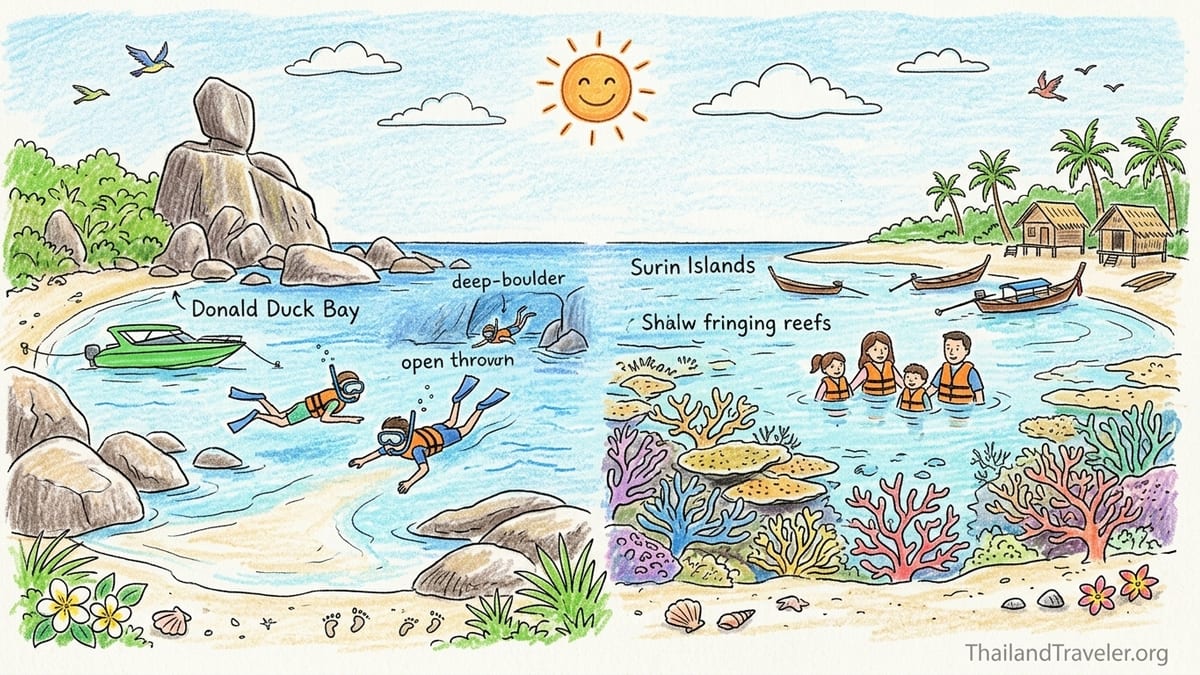
The Similan Islands are best known for their sculpted granite boulders, long white-sand beaches, and open-ocean dive sites. This is where you come for the Sail Rock viewpoint above Donald Duck Bay, clear blue water and the chance of deep boulder swim-throughs and pelagic life. Similan works well for confident snorkelers and strong swimmers, certified divers and underwater photographers who want wide-angle scenes and dramatic topography more than shallow coral gardens.
The Surin Islands sit further north, closer to the Myanmar border, and feel wilder and more low-key. Here the headline is shallow fringing reef almost close enough to step onto from the beach. Protected bays and sandy coves make Surin especially forgiving for first-time snorkelers, younger children and anyone who prefers relaxed floating over finning in waves. The park is also home to a semi-permanent Moken sea-nomad community, which adds a cultural layer if visited respectfully on a guided trip.
In practical terms, both parks share similar basic rules: visitor numbers are capped, no single-use plastic on boats where operators follow best practice, no picking coral or shells, no feeding wildlife, and no drones or loud music in most zones. Alcohol is effectively banned on park beaches, and overnight stays are only possible through park accommodation or authorized liveaboards. Everyone pays a marine park entry fee on top of the tour price, usually bundled into the package for simplicity, and passports or ID must be shown at the pier or to park staff.
Departure Points: Khao Lak, Thap Lamu, Ban Nam Khem and Kuraburi
Most Similan and Surin excursions are sold as “from Khao Lak” because this resort area sits closest to both parks by road. In reality, your speedboat leaves from one of several piers. For the Similan Islands, almost all mainstream tours use Thap Lamu Pier, about 20 to 30 minutes south of central Khao Lak by minivan, depending on your hotel’s location. Licensed day boats cannot depart directly from Khao Lak beaches, so even “Khao Lak early-bird” trips involve an early road transfer before boarding.
For the Surin Islands, there are two main patterns. Some Khao Lak based operators, including those selling shared Surin snorkeling days, also depart from Thap Lamu Pier, combining hotel pickups with a 90 minute or so speedboat crossing. Others partner with Kuraburi (Khura Buri) Pier, a small town around 1.5 hours’ drive north of Khao Lak. In this second scenario, you are collected in Khao Lak between roughly 06:30 and 07:30, shuttled to Kuraburi, then board the boat for an additional 60 to 90 minutes to reach the islands.
Ban Nam Khem, on the coast northwest of Khao Lak, functions mainly as a pier for local fishing and some charter boats rather than a standard Similan or Surin day-trip gateway. A few niche operators and private charters use it for customized itineraries, but the mass-market snorkeling and diving trips almost always go from Thap Lamu or Kuraburi because of infrastructure, fueling and park check-in arrangements. When an agent in Khao Lak tells you that “the boat leaves nearby,” confirm which pier they mean, because that determines your wake-up time and how long your family sits in a minivan.
If you stay as far south as northern Phuket and book a “Similan from Phuket” or “Surin from Phuket” tour, expect considerably longer logistics. Shared vans commonly collect guests around 05:30 to 06:00 to drive two to three hours to Thap Lamu or Khao Lak, often stopping en route at pier check-in stations. You still reach the same boats used by Khao Lak guests, but you start your day in the dark and often return to Phuket around 19:00. For travelers already planning some nights in Khao Lak, shifting your marine-park tours to that part of the trip saves several hours of road time.
Boats and On-board Comfort: Speedboats, Catamarans and Liveaboards
From Khao Lak and nearby piers, Similan and Surin day trips use a handful of boat types. The workhorse is the standard fiberglass speedboat with three or four outboard engines, seating 30 to 45 guests plus crew. This is the cheapest and most common choice. In October 2026, advertised Similan snorkeling day tours from Khao Lak on standard speedboats cluster around 3,600 to 4,100 baht per adult, including marine park fee, basic snorkeling gear, guide, breakfast at the pier and buffet lunch on the islands. Surin snorkeling days are similar, often around 3,700 baht per adult including the 500 baht park fee.
Larger speed catamarans are emerging for guests who want more ride comfort. These twin-hull boats spread passengers between two decks, offer slightly more elbow room and reduce slamming in choppy seas. Prices are usually a notch higher than basic speedboats. For example, premium Similan tours marketed from Khao Lak that highlight “small-group catamaran” experiences typically price around 4,000 to 4,500 baht per adult, with a capped group size of about 20 to 25 people and extras such as thicker seat cushions, shaded lounging areas and more attentive guiding.
On the diving side, many operators in Khao Lak such as long-established dive centers run dedicated dive speedboats or mid-size dive vessels for two-dive or three-dive Similan and Surin day trips. Current examples show two-dive Similan day trips in the 6,000 to 6,500 baht range per diver, including tanks, weights, guide and park fee, but excluding rental gear if you need it. Rental kits add around 500 to 750 baht per day. These boats carry fewer people than the mixed snorkeling trips and provide tank racks, camera rinse buckets and shaded kitting-up areas.
For serious divers and photographers, liveaboard boats remain the signature Similan and Richelieu Rock experience. Schedules for the 2026–2027 season show one to two night “mini liveaboards” starting around 16,500 baht per person for six to ten dives at Similan and adjoining sites, with higher-end vessels charging into the thousands of dollars for week-long expeditions that combine Similan with Surin and Richelieu Rock. Liveaboards usually depart from Khao Lak or nearby piers in the evening, cruise overnight and maximize daytime underwater time with three or four dives per day. These trips are only suitable for certified divers who are comfortable on boats and do not get seasick easily.
Snorkeling vs Scuba: Similan’s Boulders, Surin’s Shallows and Richelieu Rock
From a surface perspective, Similan and Surin both offer warm, clear water and busy reef life, but the character of each archipelago is different. At Similan, many of the most photogenic sites for divers drop quickly from boulder-strewn shallows into deep channels. Snorkeling stops are chosen in more protected coves and sand-and-coral fringes where the reef tops out in the three to six meter range. Typical Similan snorkeling itineraries include two reef sessions and one or two beach stops, often at islands numbered 4, 7, 8 or 9. The climb to the Sail Rock or “Donald Duck” viewpoint on Island 8 is a highlight for many visitors, though it involves uneven steps and scrambling over boulders.
At Surin, the reefs tend to be shallower overall. Many coral gardens start almost at the waterline and reach only five to eight meters deep along large sections of the coast. This makes the Surin Islands particularly rewarding for those who prefer to float and watch rather than dive down repeatedly. Classic Surin snorkeling sites feature plate corals, branching coral heads and good fish density in relatively calm bays. Because of this gentle topography, guides often describe Surin as a better place for first-time snorkelers, nervous swimmers and younger children to gain confidence.
Scuba diving introduces a different tier of experiences. The Similan Islands are famous among divers for granite boulder landscapes, swim-throughs and the chance of encounters with manta rays and, in some years, whale sharks at outer sites. Most Similan dive day trips and liveaboards require at least Open Water certification, and some advanced sites ask for Advanced Open Water or demonstrable experience at deeper depths. Surface conditions can be choppy even in the dry season, and currents can run moderate to strong. These factors make Similan better suited to divers with a few tropical trips already under their belts rather than absolute beginners, although introductory dives in more sheltered spots are offered.
Richelieu Rock, often visited by liveaboards that also stop at Surin, is on another level. It is consistently ranked among the top dive sites in Thailand, but it is a pure scuba destination. The rock itself barely breaks the surface, with the reef plunging down to around 30 meters and subject to powerful currents at times. No casual snorkeling is conducted here, and operators insist on valid certification and recent diving experience. Underwater photographers book Richelieu-based itineraries very specifically to shoot its soft corals, schooling trevallies, macro life and occasional big pelagics, so it should not be confused with the more relaxed recreational snorkeling on the Surin reefs.
Who Should Choose Which: Families, Photographers and First-timers
If you are traveling with young children, older relatives or anyone anxious in the sea, Surin usually edges ahead. Travel times from Thap Lamu or Kuraburi are similar to Similan, but once you reach the islands, the sheltered bays, easy beach entries and shallow coral make life simple. Many Surin tours bring guests directly to soft-sand coves where even knee-deep water already offers small fish and coral fragments to look at. Guides tend to keep groups in tighter formations and spend more time on technique briefings such as mask clearing and basic finning, reflecting the higher proportion of novice snorkelers.
For families, the other advantage of Surin is the more low-key beach scene. There are picnic-style shaded areas, basic park facilities and often fewer boats anchored at any one spot than the most popular Similan beaches. Parents who prefer not to manage children on crowded sand may find Surin less stressful. However, facilities remain simple. Think park canteens and basic restrooms rather than cafes and beach clubs, so families expecting resort-like infrastructure should adjust expectations accordingly.
Underwater photographers with wide-angle ambitions almost always prioritize Similan and, if certified, Richelieu Rock. The combination of granite boulders, white sand channels and blue water produces the classic open, three-dimensional images that make the region famous. Visibility at Similan is often a little better than at Surin, especially later in the dry season, though conditions change day by day. Snorkelers with action cameras also appreciate the dramatic drop-offs and larger schools of fish around Similan, but they should be confident swimmers because the scenery sometimes comes with more swell and depth beneath them.
For snorkelers or swimmers whose primary goal is relaxed, colorful coral gardens rather than big vistas, Surin can deliver more satisfying results with less effort. The shorter distance between your mask and the reef means you see detail without duck diving, and the calmer water makes long sessions comfortable even for those who are not especially fit. Many travelers who have tried both describe Similan as the more spectacular landscape and Surin as the more intimate snorkeling, which is a useful rule of thumb when choosing where to allocate limited sea days.
Tickets, Prices, Inclusions and Cancellation Terms for 2026–2027
For the 2026–2027 season, published prices from Khao Lak based agencies and online booking platforms give a good sense of what you will pay. Similan snorkeling day trips from Khao Lak usually start around 2,600 to 3,000 baht for basic shared packages booked locally without the park fee and rise to 3,600 to 4,100 baht per adult when the 500 baht marine park fee, lunch and transfers are bundled in. Child rates are commonly about 800 to 1,000 baht lower than adult prices. Surin snorkeling day trips hover around 3,200 baht plus the 500 baht park fee if charged separately, or roughly 3,700 baht all-in per adult, again with reduced child fares.
The marine park entry fee for foreign visitors is currently 500 baht per adult and 300 baht for children up to around 14 years for both Similan and Surin. An additional diving fee applies per day for scuba divers, which your dive center typically includes in the quoted price. These rates have remained consistent since a nationwide adjustment in 2022, but they are subject to change by the Department of National Parks, so always check your booking confirmation to see if the fee is included or payable in cash at the pier.
Standard day-trip inclusions follow a predictable pattern. You can expect hotel pickup and drop-off within the Khao Lak area, a light breakfast at the pier, drinking water and soft drinks on board, snorkeling equipment such as mask, snorkel, fins and life jacket, an English-speaking guide, buffet lunch either on one of the islands or at a park canteen, seasonal fruit and basic accident insurance. Premium tours may add extras such as thicker towels, dry bags, upgraded lunch menus and smaller group sizes. Things usually excluded are optional wetsuit rental, alcoholic drinks, snacks bought on the islands, tips and any surcharges for pickups from remote resorts or Phuket.
Booking and cancellation conditions differ by operator but share several common threads for 2026–2027. Online agents and larger boat companies often allow free cancellation up to 24 or 48 hours before departure, with a full refund to your payment card. Within that window, you may receive a partial refund or credit, or nothing at all if you simply do not show up. When the operator cancels due to rough seas, strong winds or park instructions, it is standard practice to offer either a full refund or a change of date. Travelers should be aware that during the shoulder months of October and May, weather-related cancellations occur more often, so it is sensible to book marine-park trips early in your Andaman stay to allow flexibility.
Practicalities: Passports, Ages, Time in the Water and Boat Comfort
Because you are entering protected national parks, both Similan and Surin tours handle some basic bureaucracy at check-in. Foreign visitors are usually asked to provide passport details when booking and to bring the passport or a copy on the day so staff can register you with the park. Thai nationals show their ID card. This registration underpins the daily visitor quotas that limit numbers on the islands. If you forget your passport, operators can sometimes proceed with a photo on your phone, but it is safer to carry the real document or a high-quality copy.
Minimum age rules vary between operators and between snorkeling and diving products. Many Similan and Surin snorkeling day trips accept children from around 4 years old, provided they are accompanied by an adult and can wear a life jacket. Some companies insist on a minimum age of 5 or 6 because of the long travel times and potential for seasickness. For scuba diving, Discover Scuba style introductory dives at sheltered sites may accept participants as young as 10 or 12, but standard Similan and Surin dive excursions almost always require full certification and sometimes a minimum age of 12 or 15. Families should read the fine print carefully and err on the side of caution if children are nervous or have never snorkeled before.
Actual time in the water is a frequent concern. Typical itineraries from Khao Lak feature two or three snorkeling sessions of 30 to 45 minutes each, plus one or two beach stops that may include casual swimming. That means roughly two to three hours of water time within a 10 to 12 hour day from hotel pickup to drop-off. Dive trips usually organize two or three dives of 40 to 50 minutes each, amounting to a similar total immersion time. Some premium or “extended” itineraries advertise extra-long days with four snorkel stops, which may appeal to very keen swimmers but can be tiring for less experienced guests.
On-board comfort is improving each season, but basic realities remain. You will sit on bench-style seats along the sides of fast boats for an hour or more each way, and even catamarans can slam in short-period waves. Anti-nausea tablets taken 30 minutes before departure help those prone to seasickness. Sun exposure is intense, especially in late dry season, so wide-brimmed hats, reef-safe sunscreen applied well before boarding, long-sleeve rash guards and sunglasses are essential. Boat toilets are compact marine heads rather than full bathrooms, and storage for bags often means placing them in shared dry areas or under seats, so bring only what you truly need in a waterproof day pack.
Reef Protection, Wildlife Encounters and Visiting the Moken Community
Both Similan and Surin operate under Thailand’s increasingly strict marine conservation framework. Park rangers and reputable operators emphasize no-touch snorkeling and diving. This means never standing on coral, avoiding any contact with turtles or other marine life, and not collecting shells or sand. Tour guides will often brief guests on how to keep fins up at the surface so they do not kick coral heads and may adjust group plans if a site looks stressed. Some companies provide reef-safe sunscreen at the pier or encourage guests to use physical barriers such as rash vests and leggings instead of heavy chemical sunscreen use.
Wildlife encounters are one of the big draws, but no company can honestly guarantee sightings. At Similan, snorkelers and divers regularly report reef fish of many sizes, rays, occasional reef sharks and, if fortunate, sea turtles grazing in shallows. Larger animals such as manta rays and whale sharks sometimes appear at Similan dive sites and at Richelieu Rock, but these moments are unpredictable and should be treated as a bonus rather than an expectation. At Surin, the shallows teem with parrotfish, butterflyfish and damselfish, and turtles are often spotted cruising along reef edges or surfacing near snorkel groups.
The Moken community at Surin adds a human dimension that demands extra sensitivity. A number of day trips include a short visit to the Moken village, usually on Ko Surin Nuea. The best operators frame this as an educational stop, with guides explaining Moken history, their traditional boat-building skills and recent pressures from climate and regulation. Respectful behavior here means dressing modestly, asking permission before photographing individuals, not entering homes or school areas uninvited and buying handicrafts only if you genuinely value them, not as charity props. Avoid handing out sweets, coins or plastic toys, which can create dependency and waste problems.
Recent seasons have also seen tighter enforcement on where boats can anchor and how close they may approach beaches. Many snorkeling sites now use mooring buoys instead of anchors to protect the seabed. Guests may need to swim a short distance from the boat to reach the best coral, which again reinforces the need for at least basic swimming ability and comfort in a life jacket. Following crew instructions and entering and exiting the water calmly help protect both fragile reefs and your fellow travelers.
The Takeaway: Similan vs Surin and Is Two Trips Worth It
When time and budget only permit one marine-park excursion from Khao Lak, your choice between Similan and Surin in 2026–2027 should be guided by swimming confidence, family composition and photographic priorities. If you are a strong swimmer or certified diver looking for big seascapes, classic white-sand beaches and dramatic granite outcrops, the Similan Islands deliver more of the magazine-cover views. They are the better match for wide-angle underwater photography and for guests who want to climb Sail Rock, feel the energy of the open sea and accept that the day may be busier, both on boats and on beaches.
If ease and comfort rank higher, Surin is often the smarter pick. Shallow reefs close to shore, quieter bays and the chance to learn about the Moken community make Surin particularly suitable for first-time snorkelers, families with school-age children and older travelers who prefer to float in gentle water rather than swim over deep blue. From a value perspective, total trip costs for standard shared tours are broadly similar between the two parks, so the decision hinges more on style of experience than on price.
For underwater photographers and keen divers, especially those considering a liveaboard, combining both regions can be worthwhile. A schedule that includes a Similan-focused liveaboard or dive day plus a relaxed Surin snorkeling or overnight trip gives you access to both boulder landscapes and coral gardens, along with a possible visit to Richelieu Rock if your certification and budget allow. Just remember that every additional sea day magnifies the impact of weather risk, so build some flexibility into your Andaman itinerary and avoid booking all trips for your final days.
For many holidaymakers with one week in Khao Lak or southern Thailand, paying for two full-day marine-park excursions makes sense only if everyone in the group enjoys boat travel and long days in the sun. One intensive day at either Similan or Surin can already feel full-on. If your party is divided between keen snorkelers and more casual beachgoers, a balanced approach could be to book a single park trip, then spend other days exploring closer coastal spots or inland national parks. Used thoughtfully, the 2026–2027 Similan and Surin season offers enough variety that almost every traveler can find their own ideal Andaman island day.
FAQ
Q1. When are the Similan and Surin Islands open for visits in 2026–2027
The 2026–2027 marine-park season began on 15 October 2026 and is expected to run until around 15 May 2027, subject to weather and official park decisions.
Q2. How much does a Similan Islands day trip from Khao Lak cost this season
Shared Similan snorkeling tours from Khao Lak generally cost about 3,600 to 4,100 baht per adult in 2026–2027, including the 500 baht national-park fee, equipment, lunch and transfers.
Q3. What are current Surin Islands day-trip prices from Khao Lak
Surin snorkeling day trips usually price around 3,700 baht per adult for the 2026–2027 season, with the 500 baht park fee, snorkeling gear, guide, lunch and Khao Lak transfers included.
Q4. Which is better for first-time snorkelers, Similan or Surin
Surin is typically better for first-time snorkelers because of its shallow coral reefs, calmer bays and easy beach entries, which reduce anxiety for beginners and children.
Q5. Do I need to be a certified diver to visit Richelieu Rock
Yes. Richelieu Rock is a scuba-only site with depth and current, so operators require at least Open Water certification and recent dive experience, and do not offer casual snorkeling there.
Q6. How much actual snorkeling or diving time will I get on a standard tour
Most full-day trips offer two or three 30 to 45 minute snorkel sessions or dives, adding up to roughly two to three hours in the water, plus some additional free time for swimming at beaches.
Q7. Are passports required to visit the Similan or Surin Islands
Foreign visitors are asked to provide passport details when booking and to bring the passport or a copy on the day so staff can register them with the national park at the pier.
Q8. Is it suitable to take young children on these tours
Many operators accept children from about 4 to 6 years old on snorkeling trips, but parents should consider the early start, long boat rides and sun exposure; Surin usually feels gentler for families.
Q9. Can tour companies guarantee turtle, manta or whale shark sightings
No operator can honestly guarantee wildlife encounters. Turtles, rays and reef sharks are seen regularly, while manta rays and whale sharks are occasional bonuses that depend on luck and season.
Q10. Is it worth doing both Similan and Surin during a short holiday
Doing both parks can be rewarding for keen snorkelers and divers, but for a short trip many visitors are satisfied with one marine-park day and use remaining time for closer coastal or inland excursions.