


I spent eight nights on Thailand’s Andaman Coast in September 2026, deliberately splitting my time between Phuket and Krabi to answer the question almost every first-time visitor asks: where should I base myself? I stayed four nights in Phuket, dividing time between Patong and Kata/Karon with a day in Bang Tao, Kamala and Phuket Old Town, then four nights in Krabi split between Ao Nang, Railay, Klong Muang and Krabi Town. I booked comparable mid-range hotels, ate at ordinary Thai restaurants rather than resort dining rooms and joined standard small-group island tours. What follows is not a theoretical guide but a report from that trip, with real prices and on-the-ground trade-offs.
How I Structured The Trip And What I Paid
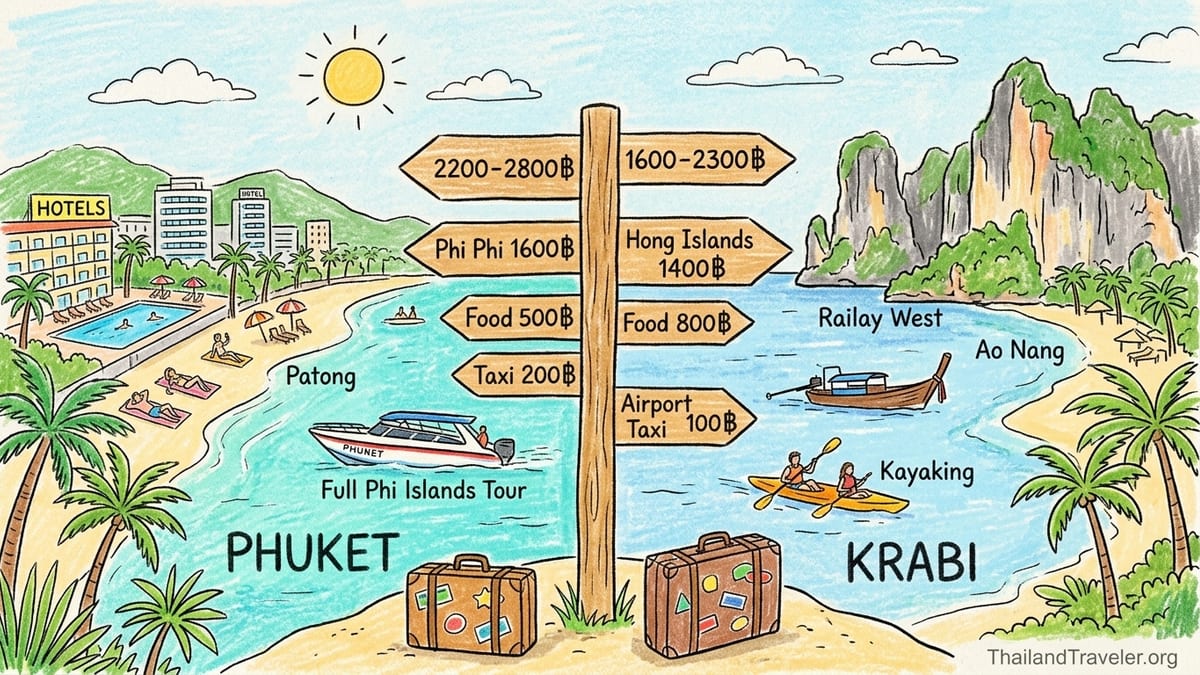
For Phuket, I based myself two nights in Patong and two nights near the border of Kata and Karon, both in three-and-a-half to four-star hotels with pools and breakfast included. Nightly rates in mid-September 2026 came out to about 2,200 to 2,800 baht per night in Patong and around 2,000 to 2,500 baht in Kata/Karon for flexible, refundable rates discovered through major booking platforms and confirmed against current area price ranges from several Phuket hotel guides. In Krabi, I spent two nights in Ao Nang, one night at Railay West and one night in a Klong Muang beachfront hotel, with an afternoon and evening in Krabi Town before flying out. Mid-range rooms in Ao Nang and Railay cost between 1,600 and 2,300 baht, while the Klong Muang resort was closer to 3,000 baht including breakfast, all in line with 2026 price bands for these areas.
To keep the comparison fair, I deliberately chose hotels with similar facilities in each destination: standard doubles with air conditioning, Wi-Fi, on-site pool and breakfast buffet but without private plunge pools or club lounges. I avoided flash sales that would skew one place much cheaper than the other, focusing instead on widely available public rates that a first-time visitor booking a few weeks out would realistically see. Where Phuket hotels often added the familiar 17 to 18 percent service charge and VAT on top of base rates, Krabi listings more often included all taxes in the headline price, a detail worth checking carefully at the booking stage.
For activities, I booked like a typical short-stay visitor. In Phuket, I joined a Phi Phi Islands speedboat day trip from Rassada Pier near Phuket Town and a half-day sunset cruise in Phang Nga Bay. In Krabi, I took a Hong Islands tour from Ao Nang and hired a private longtail from Railay for half a day of beach hopping. I bought all of these through local agents in person one day in advance, which allowed direct price comparison of almost identical tours sold in both provinces. Food-wise, I ate at simple Thai restaurants on side streets, a couple of seafront places, and a few international spots in Patong and Ao Nang, always ordering similar dishes so I could see how the bill shifted between locations.
Transport costs can vary a lot with negotiation and timing, so I recorded what I actually paid using a mix of official airport taxis, app rides and local shared shuttles. From Phuket Airport to Patong I took an official taxi-counter car, then used Grab and Bolt around the island; in Krabi I tried both the shared airport minivan and a fixed-price private taxi to Ao Nang, plus songthaew-style local trucks and a hotel-arranged transfer to Klong Muang. The result was a realistic snapshot of what a careful but not obsessive budget-conscious traveler can expect to spend in late 2026.
Hotel Prices, Beaches And Overall Atmosphere
Across equivalent mid-range hotels, Phuket cost me more per night than Krabi, although the gap was smaller than many forum comments suggest. In Patong, a modern four-star hotel with a rooftop pool and breakfast within a short walk of the beach ran just above 2,500 baht per night after tax. A similar category hotel in Ao Nang, with a pool and breakfast but set slightly back from the seafront up a side street, came in around 1,900 baht. Railay West, which feels more remote and depends on boat access, pushed prices back up to 2,200 to 2,400 baht for a comfortable but not luxurious room with garden views. Klong Muang, which concentrates more upscale beachfront resorts, delivered the highest Krabi price I paid at roughly 3,000 baht, comparable to some Kata or Bang Tao mid-range offerings.
Beach quality, though, did not correlate neatly with hotel price. In Phuket, Kata and Karon gave me the most enjoyable combination of wide sand, swimmable water and manageable crowds during my stay. Patong’s sand was clean and the sea warm, but jet skis, longtail boat shuttles and dense lines of beach chairs made it feel busy from mid-morning onward. Bang Tao and Kamala, which I visited on day trips, offered a softer vibe with more space between sunbathers, particularly toward the northern stretches of Bang Tao where large resorts are set back behind the tree line. In Phuket Old Town, of course, there is no beach, but its streets lined with Sino-Portuguese shophouses delivered the island’s most interesting urban walking experience.
In Krabi, Ao Nang’s main beach is pretty in wide-angle photos at sunset but less impressive at eye level during the day. The sand is coarser, the water a little murkier and longtail boat engines line the shore at the eastern end. Railay West, by contrast, looked like the poster image for Krabi: orange limestone cliffs, soft sand and longtails idling in shallow turquoise water. Klong Muang’s beach fell somewhere in between, with a peaceful, almost underdeveloped feel and fewer boats, though low tide revealed rocky patches that made swimming less appealing for a few hours each day. Krabi Town does not function as a beach destination, but the riverside promenade and night market added a local, workaday dimension that neither Patong nor Ao Nang fully matched.
Atmosphere is where Phuket and Krabi diverged most clearly. Patong felt unambiguously urban, with towering hotel blocks, shopping malls, tailors, massage shops and neon-lit bars packed into an easily walkable grid. Kata and Karon were more relaxed but still undeniably tourist-oriented, with music from bars, beachwear shops and tour booths at nearly every turn. Phuket Old Town, especially along Thalang and Dibuk roads in the early evening, replaced the resort soundtrack with cafés, galleries and local eateries, a welcome break from the beach vibe. In Krabi, Ao Nang’s compact seafront strip echoed aspects of Patong on a smaller scale, while Railay’s walking paths and Klong Muang’s quiet lanes felt more like self-contained resort bubbles surrounded by dramatic cliffs and sea.
Getting Around: Walkability, Traffic And Transfers
Within each individual neighborhood, walkability favored Krabi slightly, but Phuket offered more transport options at a cost. In Patong I could walk almost everywhere in 15 minutes, but crossing the main road and navigating uneven pavements required constant attention. Traffic along Rat-U-Thit and Thawewong roads was heavy from late afternoon, and crossing without a traffic island sometimes meant waiting several light cycles. Kata and Karon were easier, with quieter side streets between the main road and the beach, though the incline toward some hillside hotels required a short uphill walk. Phuket Old Town was the most pedestrian-friendly part of the island, with clearly marked crossings and many one-way streets keeping traffic calmer.
In Ao Nang, the seafront road is busy in the evening, particularly near the longtail boat ticket kiosks, but the main commercial strip runs for only about two kilometers and I walked the entire length in under half an hour. Side streets behind the beach hosted clusters of hotels and restaurants, and I rarely had to cross more than two lanes of traffic at once. Railay is entirely pedestrian after you step off the boat, with narrow concrete paths linking Railay West, Railay East and Tonsai. Klong Muang, however, is stretched along a fast main road with limited pavements; here, walking outside the immediate hotel zone felt less safe, and most guests seemed to rely on hotel shuttles or taxis.
Transfers from the airports highlighted a key cost difference. From Phuket International Airport to Patong, the official taxi-counter fare in October 2026 was in the region of 800 to 900 baht for a private car, slightly higher than many app quotes for Grab or Bolt but widely used by arriving tourists. An app-based ride at a non-peak time typically appeared 20 to 30 percent cheaper on my phone, although online reports described occasional surcharges and airport restrictions that can reduce those savings. The Phuket Smart Bus provided a cheaper alternative at around 100 baht per person along the west coast, but it required patience and an extra walk or tuk-tuk to reach some hotels.
In Krabi, a shared minivan from Krabi Airport to Ao Nang sold for about 150 baht per person, departing once the van filled and dropping passengers sequentially at their hotels. For two people, that worked out cheaper than a private taxi. When I tried the official private taxi desk another day, a car to Ao Nang was quoted around 600 to 800 baht, comparable to Phuket’s taxi counter prices for a similar distance. Because ride-hailing apps are more restricted around Krabi Airport, the shared vans and fixed-price taxis still dominate. Within Ao Nang and Krabi Town, local songthaew-style trucks running semi-fixed routes cost me around 30 to 50 baht per short ride, noticeably cheaper than Phuket’s tuk-tuks and taxis for equivalent distances.
Food, Nightlife And Daily Costs
For food, the biggest surprise was how close Phuket and Krabi came in everyday Thai meal prices once I stepped away from the busiest seafronts. In Patong, a plate of pad thai with prawns at a simple side-street restaurant cost around 80 to 120 baht, green curry with rice ran 100 to 150 baht and a large Chang beer was generally 80 to 120 baht. In Kata and Karon, slightly off the main tourist drag, I paid 70 to 100 baht for noodle dishes and 90 to 140 baht for main courses like stir-fried basil chicken or massaman curry. Seafront restaurants along Patong’s beach road charged more, with Thai mains starting closer to 180 to 220 baht and imported steaks and seafood towers escalating well beyond that.
In Ao Nang, side-street Thai restaurants offered very similar prices: 70 to 110 baht for classic rice and noodle dishes, 100 to 150 baht for curries and stir-fries with meat, and 70 to 100 baht for fruit shakes or non-alcoholic drinks. On Railay West, however, the logistical premium kicked in, especially during the evening. There I routinely saw basic dishes starting at 120 to 150 baht and beer closer to 120 to 150 baht per bottle, a reflection of everything arriving by boat. Klong Muang resort dining rooms were the priciest of my Krabi meals, with hotel menus listing main courses in the 250 to 400 baht range, although happy hour cocktails partially softened the blow.
Nightlife is where Phuket clearly pulled ahead for young adults and social travelers. Patong’s Bangla Road remained the densest cluster of bars, clubs, live music venues and late-night food stalls on the Andaman Coast. Drinks along Bangla ranged from about 100 to 160 baht for local beers to 200 to 300 baht for mixed drinks in the more elaborate bars. The atmosphere was loud, crowded and energetic until well after midnight. Kata and Karon offered a tamer scene of beach bars, sports bars showing football and low-key live music pubs that mostly wound down by one in the morning. Phuket Old Town had a small but appealing bar and café scene, especially on weekends when more locals and domestic tourists were out.
Krabi’s nightlife felt modest by comparison. Ao Nang’s main strip delivered a run of beer bars, small live music spots and a few late-opening clubs, but the energy level rarely matched Bangla Road’s intensity. Prices were marginally lower than Patong for basic drinks, with local beer often 90 to 130 baht in busy bars and cocktails from 150 baht upward. Railay had a handful of backpacker-style bars with reggae soundtracks and fire shows on the beach, which created memorable evenings but on a small, self-contained scale. Klong Muang and Krabi Town, at least on the nights I visited, were quiet after 10 pm, more suited to sunset cocktails and early nights than dancing or bar hopping.
Tours, Excursions And Time To The Islands
Both Phuket and Krabi work primarily as bases for island-hopping, and here the differences had less to do with price and more to do with travel times and crowd patterns. In Phuket, my full-day Phi Phi Islands tour picked me up in Patong around 7:30 am, then took nearly an hour in a minivan to reach Rassada Pier on the east side of the island as it collected passengers from several beaches. The speedboat then ran a circuit that looked much like the standard Phi Phi brochure: Maya Bay for photos under heavily regulated access, snorkeling stops and a lunch buffet on Phi Phi Don. The tour cost 1,600 baht booked at a local stand, including national park fees and hotel transfers.
From Ao Nang in Krabi, my Hong Islands day tour followed a similar small-group speedboat format. Hotel pick-up within Ao Nang took about 30 minutes, and the boat departed from Nopparat Thara pier on the town’s western edge. The tour visited Hong Island’s lagoon, Lading Island and Pakbia, with snorkeling and a picnic-style lunch. The price was just under 1,400 baht booked from a main-road agent, including transfers and fees. Travel times from hotel to first beach were slightly shorter than on the Phi Phi trip, largely because Krabi’s boat piers sit closer to most resort areas than Phuket’s main passenger docks do to Patong or Kata.
Private longtail and small group trips told a similar story. From Railay I hired a longtail for a half-day loop to Phra Nang Cave Beach, Poda Island and Chicken Island for 2,000 baht for the boat, split between two people. From Phuket, comparable private longtail excursions operated from Rawai or Chalong to Coral Island or the closer Racha Island, often starting around 2,500 to 3,000 baht for a half day without lunch. In practice, both provinces offered enough tour desks that price comparison within the same street quickly brought quotes into a narrow band. The key variation was how much land travel or extra boat time it took to reach exactly the same postcard-view lagoons and sandbars.
One practical difference is how early you have to wake up and how late you return. From Patong, most full-day island trips ran from about 7:30 am pick-up to 5:30 or 6 pm drop-off. From Ao Nang, Hong Islands and four-islands trips often started closer to 8:30 am and still returned around 4 pm, leaving more of the evening free. For couples or families who do only one or two big boat days, that may not matter. For groups intent on squeezing in as many excursions as possible, Krabi’s closer proximity to the karst islands and shorter transfers felt like a small but real advantage.
Couples, Families And Nightlife-Focused Groups
As a couple-focused base, the choice between Phuket and Krabi depends on what kind of evenings you imagine. If your ideal day includes a quiet beach, a mid-afternoon swim and a relaxed dinner, then a stay in Kata, Karon, Bang Tao or Klong Muang combined with one or two trips into livelier centers works very well. When staying in Kata and Karon, we could stroll hand-in-hand along lightly lit streets after dinner, duck into a wine bar or grab a late massage without the sensory overload of Bangla Road. In Klong Muang, evenings centered around hotel restaurants and sunset cocktails on the sand, with very little external buzz. For couples who want a feeling of escape and long, scenic walks, Krabi’s Railay or a Phuket base in Kamala or Bang Tao makes more sense than Patong or Ao Nang.
Families with small children may prioritize swimming conditions, shade and ease of movement. During my September visit, the Andaman Sea was still in its wetter season, with occasional strong waves and red-flag afternoons at both Patong and Karon. On calmer mornings, the gentle shallows of Kata and sections of Kamala felt suitable for supervised play, although currents and flags still needed close attention. In Krabi, the shallow water at Railay and around the Hong Islands made boat days particularly enjoyable for families, but I noticed more longtail boat traffic close to shore in Ao Nang, which could worry parents of very small children. Pavement quality and stroller-friendliness were also slightly better in Phuket’s more developed beach towns than along some of Ao Nang’s side streets.
For young-adult groups who put nightlife at the center of their trip, Phuket had a clear edge. Patong offered bar crawls, late-night clubs, live music and ample late food within a short walk or short taxi ride of most hotels. Even if your hotel sat in quieter backstreets, a 5 to 10 minute songthaew or app ride took you straight into the action. Ao Nang’s nightlife was enjoyable but compressed into a smaller area and tended to wind down earlier. Railay’s bars were atmospheric but limited in number, and access back to Ao Nang after the last official longtail departures was not straightforward. Friends who imagine multiple heavy nights out are likely to find Phuket, and specifically Patong or nearby Patong-adjacent hills, more suitable than any Krabi base.
Weather, Crowds And Seasonal Trade-Offs
Because I traveled in mid-September, which still counts as rainy season on the Andaman side, neither Phuket nor Krabi offered uninterrupted sunshine. During my four days in Phuket, I had two mostly dry days with long sunny spells, one day of passing showers and one late afternoon of heavy rain that cleared by evening. Sea conditions varied accordingly: on the calmest morning in Kata, the water was almost flat and clear, but on a windy afternoon at Patong, waves grew strong enough for red flags to appear on parts of the beach. Over in Krabi, I experienced one morning of drizzle that lingered over Ao Nang, but that same afternoon bright sunshine broke through and Railay looked almost postcard-perfect. Another day reversed the pattern, with clearer skies in Phuket when radar showed heavier showers nearer Krabi’s lime cliffs.
That experience matched what long-term climate data suggests: there is no consistent rule that “Phuket is sunnier than Krabi” or vice versa over any short stay. Both sit under the same monsoon system, and conditions can differ by a shower or a sunbeam even within the same day. What does differ is how each destination copes when the heavens open. In Phuket, shopping malls in Patong and Phuket Town, indoor attractions like trick-eye museums and cafés in Old Town provided easy rainy-day backups. In Krabi, options were more limited; Ao Nang had a small mall and some covered markets, but on my one very wet afternoon most visitors retreated to hotel lobbies, spa treatments or long lunches under awnings.
Crowds also felt different rather than consistently bigger in one province. Patong’s main streets remained busy throughout the evening, with peak density around Bangla Road where walking sometimes slowed to a shuffle. Kata and Karon were lively but never overwhelming. In Ao Nang, the busiest moments came around sunset when everyone seemed to converge on the seafront for photos and dinner, but side streets behind the beach stayed relatively quiet. Railay felt busy on the sand during mid-day when day-trippers arrived, then calmed noticeably in the evening as boats departed. If you are particularly crowd-sensitive, you may find more breathing space at Klong Muang, Kamala or Bang Tao regardless of whether you choose Phuket or Krabi.
The Verdict: Would I Split The Trip Again?
After staying in both destinations back-to-back, if I had seven nights on the Andaman Coast and had to pick a single base for a repeat trip, I would choose Krabi, specifically a split between Ao Nang and Railay within the province, rather than dividing the week between Phuket and Krabi again. Krabi’s scenery, with its close-up karst cliffs and shorter boat rides to Hong and the four islands, gave more of that “this could only be here” feeling. Daily costs were modestly lower, especially for accommodation away from the very top-end beachfront resorts, and traffic felt gentler on the nerves than Phuket’s west-coast roads.
Was splitting between Phuket and Krabi worthwhile once? Yes, especially to understand how each place feels. However, the practicalities of packing, checking out, driving several hours overland and checking in again ate nearly a full day of usable holiday time. For a first visit of ten nights or more, a two-center Phuket and Krabi trip makes sense. For a one-week holiday, I would now encourage most travelers to choose a single province and, if they enjoy variety, move once within it, for example Patong to Kata in Phuket or Ao Nang to Railay in Krabi.
Who should choose Phuket over Krabi without splitting? Travelers who prioritize nightlife, shopping, a wide choice of international restaurants and backup rainy-day activities will be happier in Phuket. Groups of friends, families with teenagers and visitors who want both Thai street food and familiar global brands in easy reach will find Phuket’s Patong, Kata, Karon and Bang Tao combination hard to beat, provided they are comfortable with higher taxi fares and busier beaches. Couples who like a bit of buzz can base in Kata or Kamala and dip into Patong for a night or two.
Who should choose Krabi instead? Visitors who value jaw-dropping limestone scenery, shorter island-trip transfers, quieter evenings and a slightly lower overall bill will likely prefer Ao Nang plus either Railay or Klong Muang. Families with younger children who plan more beach and boat days than shopping, and couples who care more about sunsets than nightclubs, may find Krabi closer to their mental picture of a tropical escape. After staying several nights in both, I came away feeling that Phuket’s greater variety did justify its higher costs for some travelers, but for my own future seven-night holiday I would stay in Krabi again and simply plan a separate trip if I wanted to immerse myself in Phuket’s urban energy.
FAQ
Q1. Is Phuket or Krabi cheaper overall for a one-week trip?
Based on my 2026 stay, Krabi worked out slightly cheaper overall, especially on accommodation and local transport, though food and standard tours were priced very similarly in both places.
Q2. Which has better beaches, Phuket or Krabi?
For classic long sandy beaches with infrastructure, I preferred Phuket’s Kata, Karon and Bang Tao, but for dramatic scenery and wow-factor views, Railay and the islands off Krabi were more memorable.
Q3. Where is better for nightlife, Phuket or Krabi?
Phuket is clearly stronger for nightlife, with Patong’s Bangla Road offering dense clubs and bars; Ao Nang and Railay in Krabi have enjoyable but much smaller and quieter scenes.
Q4. How much should I budget for mid-range hotels in each place?
In September 2026 I paid roughly 2,000 to 2,800 baht per night for mid-range Phuket hotels and about 1,600 to 2,300 baht in Ao Nang and Railay, with Klong Muang a little higher.
Q5. Are taxis and ride-hailing apps easier in Phuket or Krabi?
Phuket has more ride-hailing coverage with Grab and Bolt plus an airport bus, but fares are higher; Krabi relies more on fixed-price taxis, shared vans and cheaper local songthaews.
Q6. Which base is better for island-hopping tours?
Both work well, but from Krabi the boat rides to places like Hong and the four islands are shorter, while from Phuket you are better placed for Phi Phi and Phang Nga Bay routes.
Q7. Is it worth splitting a one-week holiday between Phuket and Krabi?
I found it interesting once, but the transfer eats time; for seven nights I now prefer choosing one province and, at most, changing areas within it rather than switching between both.
Q8. Which destination suits families with young children better?
For families, calmer areas of Phuket like Kata and Kamala or Krabi’s Ao Nang plus day trips to Railay work well, but Phuket offers more indoor backups if heavy rain sets in.
Q9. Which is better for a couple wanting relaxation over nightlife?
For relaxation, Krabi’s Railay or Klong Muang and Phuket’s Kamala or Bang Tao all work, but my personal pick for a romantic, scenic stay would be Krabi with a few nights on Railay.
Q10. If I only have seven nights, where would you personally stay again?
After trying both in one trip, I would base a future seven-night holiday in Krabi, splitting time between Ao Nang and Railay, and save Phuket for a separate, more nightlife-focused visit.