


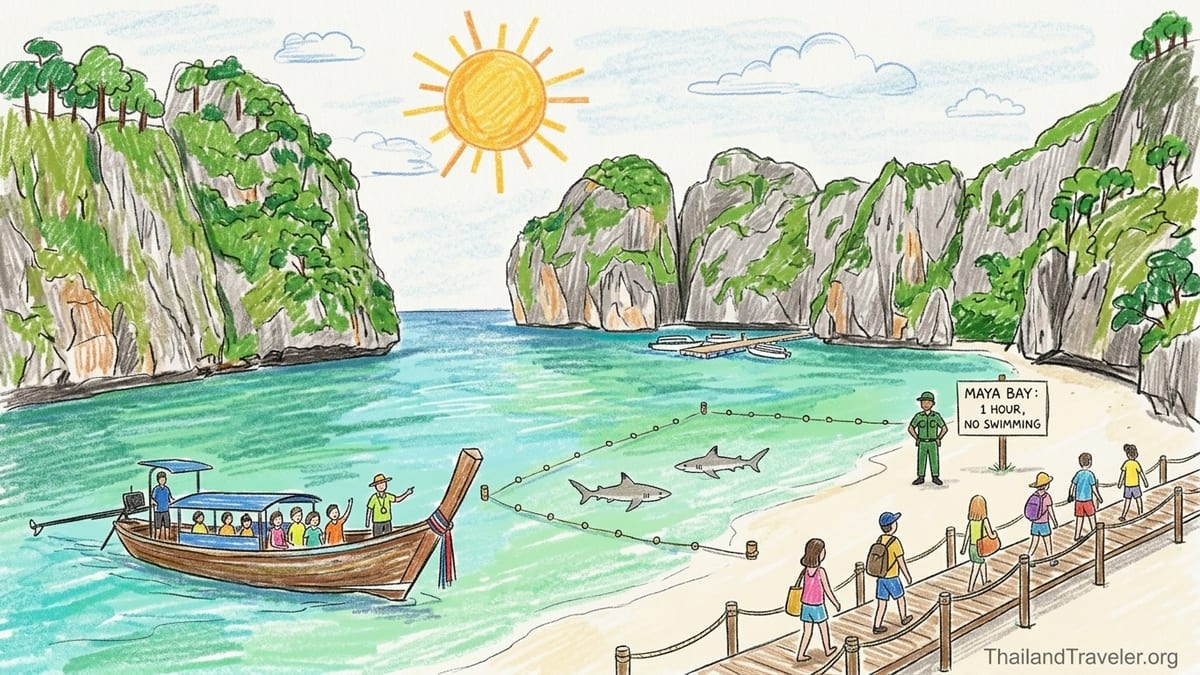
On a clear morning in late October 2026, I finally joined the procession of tourists headed for Maya Bay, the Thai beach that launched a thousand bucket lists after it appeared in the film The Beach. I wanted to see what remained of that cinematic dream now that boats can no longer enter the bay, swimming is officially banned and visits are limited to short, tightly controlled slots. What I found was a place that is still visually extraordinary, yet framed by queues, rules and loudspeaker reminders that you are walking through a recovering ecosystem, not an open playground.
When I Went, How I Got There and What It Cost
For this report, I visited Maya Bay on October 10, 2026, in the first weeks after its annual reopening on October 1, following the conservation closure that runs every year from August 1 to September 30 under Hat Noppharat Thara Mu Ko Phi Phi National Park rules. The bay, along with nearby Loh Samah and Lo Ko bays, is taken off the map for two months to give the reef, seagrass and blacktip reef shark nursery a respite from visitors, and by October the local boats are back on well worn routes around Phi Phi Leh.
I based myself on Phi Phi Don, the main inhabited island about 45 minutes by speedboat from Phuket or Krabi, and joined an authorized longtail and speedboat combination excursion booked through a Phi Phi pier agency. The tour was a standard early morning Phi Phi Leh loop marketed as a “sunrise plus Maya Bay” option. It departed Tonsai Pier on Phi Phi Don at 6.30 a.m., aiming to beat the bulk of the day trippers coming from Phuket and Krabi later in the morning.
The tour price I paid in October 2026 was 1,400 baht per person, which covered the boat, guide and soft drinks but not the national park fee. At the time of travel the posted Hat Noppharat Thara Mu Ko Phi Phi National Park entrance fee for foreign adults was 400 baht and 200 baht for foreign children, collected by rangers who boarded the boat shortly after we left Tonsai Bay. Thai nationals paid a lower posted rate. The total cost for an adult foreign visitor on a similar excursion, combining tour and park fee, worked out to about 1,800 baht.
We reached the back side of Phi Phi Leh at roughly 7.15 a.m., where all visiting boats are now required to use the floating pier in Loh Samah Bay. From there we were given a specific window: the ranger on the small jetty stated that our group would have 55 minutes from stepping onto the boardwalk to being back at the pier. That one hour cap reflects the national park’s general rule limiting Maya Bay visits to around 60 minutes per group, which has been in place since the site’s 2022 reopening under strict protocols that keep boats out of the bay, prohibit swimming and restrict visitor numbers at any given time.
How You Actually Reach the Beach in 2026
Old promotional images still show speedboats nosing into the turquoise water of Maya Bay and anchoring in neat rows on the sand. That scene no longer exists. Boats are banned from entering the bay itself to protect the reef and seabed, so every authorized tour now approaches Phi Phi Leh from the south and east and uses the small pier in Loh Samah Bay on the back of the island. The boat engines cut a few hundred meters from the pier, and longtails weave around one another to find a spot on the floating plastic dock.
Disembarkation is the first place where crowd management becomes very visible. At 7.15 a.m. there were already around 10 boats tied up, with rangers in green uniforms signalling which groups could move first. We waited roughly five minutes before our guide led us single file across the bobbing pontoon to a short metal staircase and a checkpoint hut. There the rangers checked that our national park tickets had been issued and reminded everyone, again, that there was to be no swimming or even wading deeper than the knee in Maya Bay.
From the pier, a raised wooden boardwalk and concrete path cut across the interior of Phi Phi Leh through secondary jungle and pockets of mangrove. The walk to the beach is about 350 meters and took less than 10 minutes at a steady pace. The path itself is wide enough for two way traffic, but at each bend queues formed as early morning groups bunched up behind visitors stopping to photograph small information panels about coral restoration and blacktip sharks. In places I felt less like I was approaching a wild cove and more like joining a theme park attraction queue, with clear ropes marking the edges of the walkway and rangers ushering people along so bottlenecks did not grow.
Near the end of the path, you pass a shaded rest area where one ranger was using a megaphone to repeat the bay’s nine core rules in Thai and English. These include prohibitions on swimming, feeding fish, bringing plastic foam onto the beach and flying drones without permission. Only after that briefing do you step down a short wooden ramp and get your first full view of the famous crescent of Maya Bay opening out in front of you.
First Impressions: Scenery Versus Atmosphere
Visually, Maya Bay still matches the dream that promotional photographs and film stills from The Beach have fixed in the global imagination. The sand is fine and pale, the water shifts between pale jade and electric turquoise, and the cliffs rise almost vertically in a jagged horseshoe that makes the bay feel enclosed and improbably sheltered. On the morning of my visit the sky was a hazy blue, the sun already catching the tops of the limestone karsts while the beach itself remained in soft shadow, which made the colors in the shallows stand out even more vividly.
Yet from the first few seconds, the atmosphere jarred with that wild, deserted lagoon ideal. Where the film and many tour brochures suggest a hidden cove, the reality in 2026 is closer to a small urban park in high season. Even at 7.30 a.m., benches along the back of the beach were nearly full, a translucent rope line marked the maximum wading depth with floats every few meters, and rangers paced up and down the shoreline reminding anyone venturing too far that swimming was not allowed. Loudspeakers crackled periodically with reminders about the one hour time limit and the next departure slot for specific boats.
The ropes and crowd management tools do their job. Although there were well over a hundred people on the sand during our allotted hour, the bay never felt dangerous or out of control, the way older descriptions from pre closure years often did when several thousand visitors and a dense ring of speedboats pressed into the bay at once. Instead, the experience is highly structured, and for some travelers that structure may feel at odds with expectations that were set by a Hollywood movie marketed as a story of escape and hidden paradise.
What You Actually Do During One Hour on Maya Bay
During our 55 minutes ashore, the pattern of behavior among visitors was remarkably similar. The first few minutes were spent walking to the central section of beach where the classic postcard view aligns the curve of sand, the turquoise shallows and the cliffs in a single shallow arc. You will recognize the angle from almost every travel brochure that still uses archival images from before the closure. Guides used this point as a rallying zone, fixing a meeting time and spot before dispersing and leaving guests to roam.
Most people, myself included, then moved straight into photography mode. Tripods are not practical in the soft sand and among the milling crowds, but smartphones and small cameras were everywhere. To capture a frame without dozens of strangers in it, you learn to work with shallow depth of field, shooting from low angles so that shoulders and hats on the far side of the frame disappear behind the gleaming band of wet sand. Others simply embraced the reality of a packed famous beach and leaned into group selfies with the cliffs behind them.
Swimming in Maya Bay remains prohibited. Rangers and signage are very clear that this is not a negotiable guideline but a core rule introduced when the bay reopened in 2022 and kept in place through 2026. The stated reasons are straightforward: the bay’s shallow, sheltered water has become an important nursery area for blacktip reef sharks and juvenile fish, and allowing hundreds of people in the water each hour would stir up sand over recovering coral, introduce sunscreen and other pollutants and physically disturb marine life. Instead, a narrow wading zone up to roughly knee height is tolerated within the rope line, and even there rangers ask guests not to linger long.
With swimming off the table, the rest of the hour is spent walking, people watching and, to some extent, simply sitting quietly. Along the back of the beach, shaded areas under casuarina trees provide some relief from the strengthening sun. Simple wooden signs explain the reef restoration project that began when Maya Bay was closed indefinitely in 2018 and only reopened four years later once transplanted coral and seagrass had started to take hold. Looking down into the shallows from a vantage on the right hand side of the bay, I saw two small blacktip reef sharks weaving in and out of shifting bands of light, a reminder that the restrictions are producing visible results.
How Crowded Was “Early Morning” Really?
One of the main reasons I chose to stay on Phi Phi Don rather than do a day trip from Phuket or Krabi was the widespread advice that early morning visits from Phi Phi face fewer crowds. There is truth to that, but it is relative. At 7.30 a.m. on October 10 there were perhaps 150 to 200 people spread along the sand, and more arriving every few minutes from the back path. An hour later, as we walked back toward Loh Samah, we passed several large groups moving in the opposite direction, each surrounding guides holding flags from Phuket and Krabi based speedboat companies.
Talking later that day with a couple who had taken an 8.00 a.m. departure from Phuket, I heard a very different description. Their boat reached Loh Samah after 9.30 a.m., and they arrived on the beach with so many other groups that it was difficult to find a clear piece of sand near the waterline. By then the sun was fully overhead, reflecting harshly off both the cliffs and the water and making photography more difficult. Seasonality matters too. Rangers and local operators describe peak crowding between November and April, especially around Chinese New Year and Songkran, when even the first time slots of the day can feel busy, and quieter windows in shoulder months like late October, May and early July when seas are calm but the region is outside the biggest holiday peaks.
Early morning from Phi Phi Don did bring two concrete advantages over later day tours from the mainland. The light was softer and more flattering for photography, and there were still brief moments when parts of the bay felt semi quiet, such as along the far right edge where few groups bothered to walk. However, anyone expecting an empty, Robinson Crusoe bay will be disappointed regardless of how early they arrive. The visitor limits and one hour cap have prevented a return to the worst levels of pre 2018 overtourism, but Maya Bay in 2026 is undeniably a busy, managed attraction, not a secluded beach day.
Swimming and Snorkeling Elsewhere on a Phi Phi Excursion
Because Maya Bay is now effectively sightseeing only, the quality of your day depends heavily on what the rest of the Phi Phi excursion offers. On my tour the main swimming stop was Pileh Lagoon, a stunning jade colored inlet on the eastern side of Phi Phi Leh where the cliffs pull back and form a deep natural swimming pool. Our boat reached Pileh around 8.30 a.m., after the Maya Bay slot, and this was the first time all morning we were allowed to fully enter the water.
Here the contrast with Maya Bay was sharp. Dozens of people jumped from longtails and speedboats into clear, chest deep water inside a buoy marked swimming area. The water was cooler and deeper, with rocky walls around rather than a strip of sand, but for anyone whose main goal was to swim in tropical sea, Pileh delivered far more than the brief knee deep wading permitted at Maya Bay. Later in the morning we stopped at a modest snorkeling site near Viking Cave, where visibility was variable but colorful fish and patches of coral were still visible beneath the surface.
This pattern is now typical. Operators out of Phuket, Krabi and Phi Phi Don advertise Maya Bay as the headline stop but quietly rely on Pileh Lagoon, Bamboo Island or other spots within the national park to provide the actual swimming and snorkeling that many travelers still expect on an island tour. When weather is rough, especially in the May to October monsoon period outside the August to September full closure, those swimming stops can be canceled or moved to more sheltered bays, while the tightly controlled landings at Maya Bay and Loh Samah continue as long as it is safe to use the pier.
If you are the sort of traveler who equates a beach visit with open water swimming, it is worth mentally reclassifying Maya Bay as a viewpoint or scenic stop inside a protected marine reserve. You will probably spend only one focused hour there, and your memories of swimming in emerald water are more likely to come from Pileh Lagoon or another bay on the same tour than from the famous arc of sand itself.
Phiphi Don Base vs Phuket or Krabi Day Trip
Another decision many visitors face is whether to base themselves on Phi Phi Don and visit Maya Bay independently on a local tour, or join a full day speedboat run direct from Phuket or Krabi. After experiencing the bay as a Phi Phi based visitor and talking with several travelers from mainland tours, some differences stand out that matter in practice.
From Phi Phi Don, boats can reach Loh Samah and Maya Bay in around 20 to 30 minutes, depending on sea conditions and whether you use a longtail or speedboat. This shorter distance makes very early departures viable, which is why many boutique operators on Phi Phi advertise 6.00 a.m. or 6.30 a.m. departures coordinated with the first or second national park time slots. Prices in October 2026 for small group sunrise tours from Phi Phi Don were commonly quoted around 1,200 to 1,800 baht per person, plus the 400 baht national park fee for foreign adults. Half day trips that focus only on Phi Phi Leh and nearby sites are common, leaving your afternoon free back on Phi Phi Don.
From Phuket or Krabi, travel times stretch considerably. Speedboats take around 45 minutes to one hour in each direction across open water, and tours often include hotel pickup well before dawn for so called “first in” options. Prices on mainland marketed Phi Phi and Maya Bay day trips in late 2026 frequently ranged between 2,500 and 4,000 baht per person, including transfers, light breakfast, lunch and the same 400 baht park fee. These tours tend to combine Maya Bay with several snorkeling stops, photo pauses at Viking Cave and time on Phi Phi Don itself, returning to Phuket or Krabi in the late afternoon.
If your schedule is tight and you do not plan to stay overnight on the islands, a mainland day trip is the most time efficient way to tick off Maya Bay, Pileh Lagoon and a glance at Phi Phi Don in one long day. The tradeoff is that you are more likely to hit Maya Bay in the mid morning peak window, when multiple large groups from different departure points converge on the same one hour slots. Staying on Phi Phi Don, by contrast, gives more flexibility to watch the weather, choose an early slot with your guesthouse or a local operator, or even delay a day if seas are rough or the park is especially busy.
Why the Strict Rules Exist and How They Shape the Experience
It is tempting to be frustrated by the no swimming rule at Maya Bay when you are standing ankle deep in warm, glassy water with cliffs wrapped around you. However, talking with guides and reading the park notices that line the path from Loh Samah, it becomes difficult to argue that anything less strict would preserve what makes the place special. Before Maya Bay’s closure in 2018, reports from Thai media and conservation groups described days when 4,000 to 5,000 people and hundreds of boats crowded into the bay, with anchors dropped onto coral, fuel slicks on the surface and almost constant churn from propellers over the reef.
The multi year closure that followed was not a symbolic gesture but a practical necessity for reef recovery. Coral fragments were transplanted onto new structures, seagrass beds were given time without prop wash, and young blacktip reef sharks, which are sensitive to disturbance in their nursery grounds, began to return in visible numbers. In 2022, when Maya Bay finally reopened under its new model, national park officials set out clear protocols: no boats in the bay, a one hour cap per visitor, no swimming and sharply reduced daily numbers linked to timed slots. Those rules remain in force in 2026, and while enforcement is not always perfect, the presence of rangers on the beach and on the boardwalk is a constant reminder that you are walking through a managed recovery project.
From a visitor perspective, the conservation rules make the experience more controlled and less leisurely. You have less freedom to wander, cannot spend a full lazy day in the bay and must constantly watch the clock to ensure you are back at Loh Samah for your assigned departure. Yet they also mean that when you look into the shallows and spot a juvenile shark, or simply notice that the water remains clear despite the number of people present, you are seeing the benefits of a park that has chosen to privilege ecosystem health over unregulated access. For travelers who care about sustainability, there is real value in supporting that model, even if it means trading away the fantasy of long swims under empty cliffs.
My Personal Verdict: Expectations, Disappointments and What Still Felt Magical
Going in, I expected Maya Bay to feel like a slightly regulated version of the movie scene that made it famous. In my mind it would still be possible to swim, perhaps within a smaller area, and I imagined boats floating at a respectful distance beyond a cordon while visitors enjoyed the sand with only a modest crowd. I also expected some visible environmental scars from the years of overtourism before 2018, perhaps in the form of bare patches of rock or obvious coral damage in the shallows.
The journey itself was smoother and more systematised than I anticipated. Rangers collected the national park fee on the move, the approach to Loh Samah felt efficient, and the boardwalk across the island worked like a conveyor belt feeding time slots on and off the beach. The actual hour on Maya Bay was a mix of awe and anticlimax. Awe at the way the cliffs wrapped around the bay in a tight arc, creating a surprisingly intimate feel despite the number of people, and anticlimax at how little you can actually do in that setting beyond take photographs, paddle in knee deep water and move aside for the next wave of visitors.
My main disappointment centered on the density of people relative to the short time allowed. Even early in the morning, you are never more than a few steps from another visitor. There are constant reminders over speakers about rules and timings, and the presence of rope lines and wardens means you never forget you are in a controlled environment. Anyone who still carries the image of Leonardo DiCaprio diving into an empty lagoon will find that fantasy punctured very quickly.
Yet there were moments when Maya Bay still felt undeniably special. Watching a small blacktip shark slip through the shallows only a few meters from the rope line brought home just how quickly marine life can return when given space. Choosing a quiet corner under the trees and looking back across the curve of sand toward the cliffs, with the bulk of the crowd focused near the center, created a more contemplative view that was closer to the promotional posters, only with backpacks and sun hats scattered across the frame. Above all, seeing the bay with my own eyes, after years of reading about its closure and cautious reopening, felt like bearing witness to a living example of tourism undergoing a course correction in real time.
The Takeaway
For photographers, Maya Bay in 2026 remains a compelling subject. The no boat policy has removed the clutter of anchored speedboats from the classic view, and early morning light from an eastern slot helps sculpt the limestone cliffs in soft shadow. You will need patience to frame around the crowds, but with careful angles and timing you can still capture images that convey the bay’s natural drama. A wide lens in the 16 to 24 millimeter equivalent range is especially useful for compressing the curve of the bay, and early slots from Phi Phi Don offer the best compromise between soft light and manageable numbers of people.
For families, the tightly timed, no swimming model cuts both ways. On the positive side, the rangers, rope lines and firm rules make the environment relatively safe and predictable for children, and you do not have to worry about boat traffic inside the bay. On the other hand, younger kids who expect to swim on a famous beach may find the shallow wading zone anticlimactic. In that case, planning extra time at Pileh Lagoon or a calmer beach near Phi Phi Don, like Loh Dalum, will help balance expectations.
Travelers primarily interested in swimming and snorkeling should not think of Maya Bay as their main aquatic destination. The bay is now a scenic stop, and your meaningful time in the water will almost always come at other locations on the same tour. When comparing packages, look closely at how long is allocated to Pileh Lagoon, Bamboo Island or other snorkel sites, and be prepared for last minute changes if weather turns rough, particularly outside the core dry season.
If you are choosing between a Phi Phi day trip from Phuket or Krabi and an overnight stay on Phi Phi Don, the decision comes down to pace and priorities. A day trip is efficient and works well if you simply want to say you have seen Maya Bay, swum in a lagoon and glanced at Phi Phi Don’s cliffs before returning to a more developed base. Staying overnight on Phi Phi Don, however, gives you a much better shot at an early, slightly less crowded Maya Bay time slot, more flexibility to dodge bad weather and the chance to experience the islands in the quieter evening and early morning hours when day trippers have gone.
Would I visit again? Yes, but with clear expectations and only in certain conditions. I would avoid the peak months of January through April, check that Maya Bay is not within its August to September closure window, and base myself on Phi Phi Don to secure one of the earliest slots of the day. I would go primarily for the scenery, the opportunity to see an actively managed marine recovery site and the surrounding Phi Phi landscapes, not for the swim at Maya Bay itself. For some travelers, especially those focused on swimming, there may be better options elsewhere in Thailand. For others, particularly photographers and visitors interested in how tourism and conservation can coexist, Maya Bay in 2026 is still worth a carefully planned, clear eyed visit.
FAQ
Q1. Can you swim at Maya Bay in 2026?
Swimming at Maya Bay remains prohibited as of late 2026. Rangers permit only shallow wading up to roughly knee depth within a roped off zone, and they actively enforce the no swimming rule to protect recovering coral and the blacktip reef shark nursery that has returned to the bay.
Q2. How much does it cost to visit Maya Bay now?
On my October 2026 visit, a small group sunrise tour from Phi Phi Don cost 1,400 baht per person, excluding the national park fee. The posted Hat Noppharat Thara Mu Ko Phi Phi National Park entrance fee for foreign adults was 400 baht and 200 baht for foreign children, collected by rangers before reaching Phi Phi Leh.
Q3. How long can you stay on the beach?
Visits to Maya Bay are limited to roughly one hour per group. During my trip the ranger at the Loh Samah pier announced a 55 minute window from the time we stepped onto the boardwalk to our required return to the pier, and guides planned their schedules around that limit.
Q4. When is Maya Bay closed each year?
Maya Bay, along with nearby Loh Samah and Lo Ko bays, closes every year from August 1 to September 30 for marine ecosystem recovery and safety during the roughest monsoon period. The bay reopened on October 1, 2026 after its most recent closure, and visitors should always verify the current year’s dates with official park notices or local operators before booking.
Q5. Is an early morning tour really less crowded?
Early morning tours from Phi Phi Don are generally less crowded than mid morning slots dominated by day trips from Phuket and Krabi, but “less crowded” is relative. On my October 10, 2026 visit at about 7.30 a.m., there were already well over 100 people on the sand, with more arriving. The main benefits were softer light for photography and slightly more room to move along the fringes of the bay.
Q6. What is the difference between visiting from Phi Phi Don and from Phuket or Krabi?
From Phi Phi Don, the ride to Maya Bay takes 20 to 30 minutes and makes very early departures feasible, which helps you secure earlier, somewhat quieter time slots and gives flexibility to reschedule in case of bad weather. From Phuket or Krabi, boats spend about 45 minutes to an hour each way on open sea and tours tend to be full day packages that hit Maya Bay later in the morning, when crowds are heavier but logistics are simpler for travelers based on the mainland.
Q7. Are there better places to swim on a Maya Bay tour?
Yes. Most of the real swimming and snorkeling on a Maya Bay itinerary now happens at other stops, particularly Pileh Lagoon on Phi Phi Leh or at offshore spots like Bamboo Island and reefs near Viking Cave. On my excursion the highlight swim was in Pileh Lagoon after the Maya Bay stop, where we could fully enter the water away from the protected nursery area.
Q8. Why did Thailand ban boats and swimming in Maya Bay?
Boats and unrestricted swimming were banned after evidence showed severe damage to coral and seagrass from anchors, propellers, sunscreen and sheer visitor numbers. The bay also serves as a nursery for blacktip reef sharks and juvenile fish, which are sensitive to disturbance in shallow water. By moving boat access to Loh Samah Bay, capping visits at about an hour and prohibiting swimming, park authorities aim to allow the marine ecosystem to recover while still permitting controlled sightseeing.
Q9. Is Maya Bay still worth it if I mainly want beach time?
If your main goal is to spend hours relaxing and swimming on a beach, Maya Bay’s one hour, no swimming model is unlikely to satisfy you on its own. In that case it works best as a scenic stop within a broader Phi Phi itinerary that includes longer beach time elsewhere, such as on Bamboo Island or beaches on Phi Phi Don, rather than as your primary place to swim and sunbathe.
Q10. How should I decide between a Phi Phi day trip and an overnight stay?
Choose a day trip from Phuket or Krabi if you have limited time, prefer a single organized excursion and are comfortable seeing Maya Bay at busier mid morning hours. Opt for at least one night on Phi Phi Don if you value flexibility, want a better chance at an earlier, slightly quieter Maya Bay slot, and are interested in exploring more of the islands beyond the main tour circuit once day trippers have left.