


The Andaman coast of Thailand is packed with famous names: Phi Phi, James Bond Island, Hong Island, Koh Yao, Koh Kradan. With so many brochures and online offers, it is easy to book two or three island-hopping tours that end up repeating the same viewpoints and beaches. This guide compares the main routes from Phuket, Krabi, Khao Lak, Koh Lanta and Trang so you can choose one or two memorable days on the water, matched to your priorities and travel style, without wasting money on near-identical excursions.
How Island-Hopping on the Andaman Coast Really Works
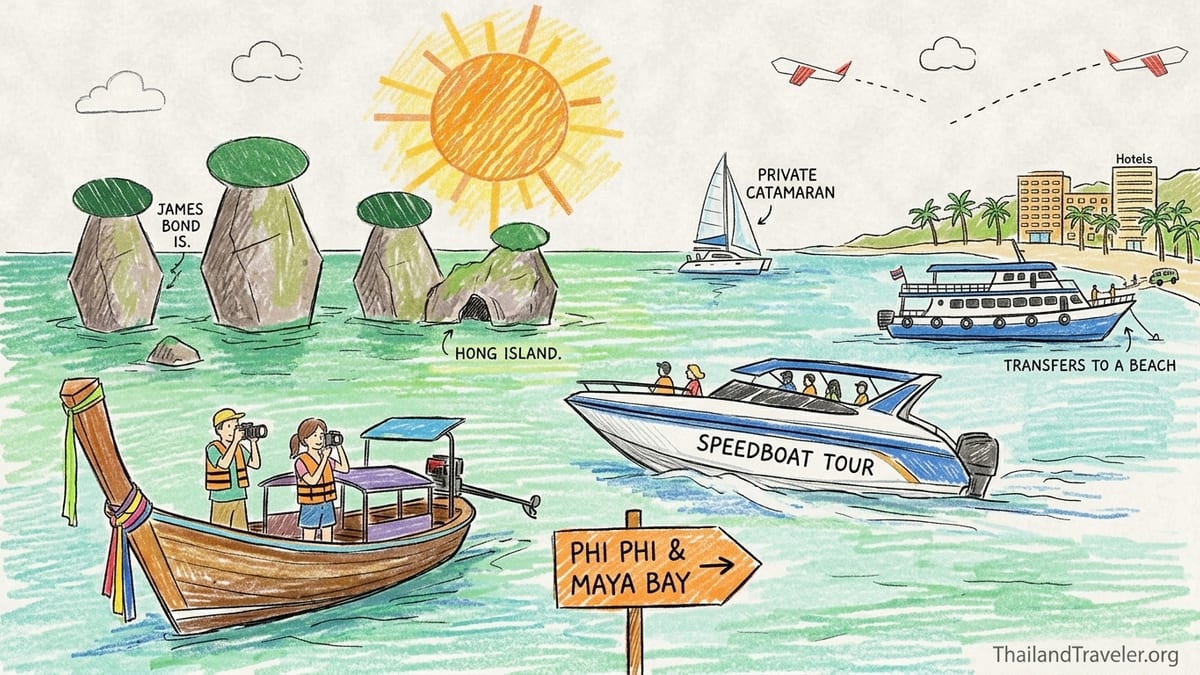
Most Andaman coast island tours are full-day trips of around 7 to 9 hours, including hotel pickup and drop-off. Operators collect guests by minivan in the morning, transfer them to a pier, then use either longtail boats, speedboats, big excursion boats or private catamarans to shuttle between islands. Time on board often exceeds time actually spent on beaches or in the water, so understanding routes and boat types is crucial if you want relaxed swimming rather than a day of queuing up ladders.
The headline routes fall into a few clusters. From Phuket and Krabi you have Phi Phi and Maya Bay, Phang Nga Bay and James Bond Island, Coral and Racha Islands, Koh Yao excursions, Hong Islands from Ao Nang and Krabi’s classic Four Islands route. Further south, Trang-based tours cover Koh Kradan, Koh Ngai and Koh Mook, often combined with the Emerald Cave. Many packages sound different but visit overlapping spots, especially around Phi Phi and Phang Nga, so it pays to read the detailed itinerary instead of just the tour name.
It is also important to separate two attractions that share a name. The famous Hong Island off Krabi is inside Than Bok Khorani National Park. By contrast, the “hongs” of Phang Nga Bay are interior sea caves and lagoons within Ao Phang Nga National Park, usually explored by kayak. They are in different areas, reached from different piers, and offer different experiences. A Hong Island beach day from Ao Nang is not the same as a Phang Nga sea-cave kayaking trip, even if brochures use similar wording.
National park fees are charged separately on many cheaper tours, currently often collected in cash at the first island stop. For example, Hong Island and Krabi’s Four Islands require separate Than Bok Khorani National Park tickets, while Phi Phi, Maya Bay and the Trang islands fall under their own park administrations. Some higher-end operators bundle these charges into the ticket. When comparing prices you should always check whether national park fees, snorkeling gear, kayaking, and a buffet lunch are included.
Boat Types, Comfort and Weather Limits
Traditional longtail boats are the wooden, open-deck workhorses of Thailand’s islands. They are atmospheric and great for short hops in calm seas, such as Krabi’s Four Islands or Hong Island runs from Ao Nang. Longtails are usually cheaper and can nose right up to shallow beaches. The tradeoff is exposure to sun, spray and noise, and more motion in choppy seas. For families with young children or anyone prone to seasickness, a longtail is better reserved for short routes on days when the forecast is calm.
Speedboats are the default for longer distances out of Phuket, Khao Lak and Koh Lanta, especially for Phi Phi, Maya Bay, Racha Island and some Phang Nga Bay programs. Modern speedboats seat roughly 25 to 45 people, with a mix of indoor and outdoor seating. They cover distance quickly, which means more time off the boat at key stops, but the ride can be bumpy in afternoon swells. If you pick a budget speedboat tour for Phi Phi, expect tight seating and limited shade; mid-range and premium operators limit passenger numbers for comfort.
Large excursion boats sometimes operate the cheaper Phi Phi itineraries from Phuket and some Phang Nga Bay cruises. These multi-deck vessels handle waves better and have toilets, shaded seating and sometimes air-conditioned cabins. They are more forgiving for those prone to seasickness but can feel crowded. Often the boat anchors offshore and guests transfer by smaller longtails to beaches or snorkeling spots, which eats into your actual island time.
Private catamarans and smaller yachts cater to travelers who want comfort, space and flexibility. Around Phuket and Koh Yao, private sailing catamarans offer shaded trampolines, stable platforms and custom routes, which are ideal for multi-generational families or small groups. The cost is several times a shared tour, but when split between eight to twelve people, a half-day Phang Nga or Coral Island charter can be comparable to a higher-end group speedboat. Weather restrictions still apply; during the monsoon months, departures may be canceled or rerouted for safety regardless of boat type.
Phi Phi & Maya Bay Tours from Phuket and Krabi
Phi Phi is the most famous island-hopping name on the Andaman coast, and for many visitors it is the tour they feel they cannot skip. Day trips run from both Phuket and Krabi. From Phuket, speedboats depart from Chalong Pier or Royal Phuket Marina, with hotel pickups starting as early as 7:00. From Krabi and Ao Nang, boats use Nopparat Thara Pier, making the crossing shorter. In both cases, total boat time can be three to four hours return, depending on sea conditions and how many stops are included.
A typical Phi Phi speedboat itinerary includes viewpoints around Phi Phi Leh such as Maya Bay, Pileh Lagoon, Viking Cave, plus snorkeling near Phi Phi Don and free time at a beach like Bamboo Island. Since Maya Bay’s reopening with restrictions, boats must stay in the designated bay area, and guests access the beach via a pier on the opposite side to protect the coral. Visitor numbers are controlled, and the bay closes periodically for conservation, so some tours now sell themselves simply as “Phi Phi Highlights” with Maya Bay included only when open.
For snorkeling, Phi Phi offers clear water and varied marine life, especially on calmer days outside peak monsoon. However, the most budget-friendly tours can feel rushed. You might receive 30 to 45 minutes of snorkeling, 45 to 60 minutes of beach time, and brief photo stops at lagoons where guests stay on board. Mid-range and premium operators that cap the group size and depart earlier often give closer to two and a half to three hours actually off the boat, spread across multiple stops, with better-quality equipment and guides who manage crowds more carefully.
If you already plan to stay on Phi Phi for a night or two, doing a full-day Phi Phi tour from Phuket is often redundant and tiring. In that case, it makes more sense to use your Andaman day trip from Phuket or Krabi for either Phang Nga Bay or the Hong / Four Islands area. Cruise passengers with only one day in port should be cautious about long Phi Phi runs from Phuket, because sea conditions or slow transfers back to the pier can cut it very close to last boarding times.
Phang Nga Bay & James Bond Island vs Krabi’s Hong Islands
Phang Nga Bay is the dramatic, sheltered stretch of sea north of Phuket, protected as Ao Phang Nga National Park. Its icon is James Bond Island, or Khao Phing Kan and the nearby limestone pillar Ko Tapu, made famous by the 1970s film. Standard tours from Phuket and Khao Lak include hotel pickups to a pier in Phang Nga province, followed by a longtail boat or speedboat circuit among islands and mangrove channels. The classic experience is sea kayaking into interior lagoons, often called “hongs,” that are only accessible through low cave tunnels at certain tides.
The focus in Phang Nga is not beaches and snorkeling but vertical limestone cliffs, green water, mangrove forests and the novelty of paddling through semi-enclosed lagoons. Many operators provide inflatable kayaks with a paddler who does the work while guests relax and take photographs. A full-day tour often includes two or three kayaking stops, a short visit to James Bond Island itself, lunch either on a floating village or boat, and a final swimming stop in a more open part of the bay. Water visibility is usually lower than around Phi Phi, so Phang Nga is more about scenery than underwater life.
Hong Island, by contrast, is off the Krabi coast within Than Bok Khorani National Park, reached in around 25 to 40 minutes by longtail or speedboat from Ao Nang. Tours here concentrate on soft white sand, shallow turquoise water that is friendly for families, and a central lagoon ringed by cliffs that you enter through a narrow passage. There is also a walking trail to a viewpoint. Even though there is a small inner lagoon at Hong Island, it is a different experience from the kayak-only sea-cave hongs of Phang Nga Bay. Phang Nga’s hongs are spread across many islands and are explored by kayak; Hong Island’s lagoon is a single spot on a beach-day itinerary.
If your priority is scenic limestone formations and sea kayaking, Phang Nga should be your main pick, ideally on a tour that spends more time paddling and less time shopping or in floating markets. If you want family-friendly swimming and a classic beach day with one or two kayak or snorkeling options, Hong Island tours from Ao Nang are a better fit. Doing both on a short holiday can feel repetitive in terms of scenery; many travelers who visit both later say that they would have replaced one of them with a different style of tour, such as a snorkeling-focused Racha Island or a quieter Trang itinerary.
Krabi’s Four Islands, Hong Island & Day Trips from Ao Nang and Koh Lanta
Krabi’s traditional Four Islands route visits a compact group off the Railay and Ao Nang coast: Chicken Island, Koh Poda, and the sandbar-linked pair of Tup and Mor Islets, with Railay or Phra Nang Cave Beach often included. Hotel pickups from Ao Nang typically start around 8:00, with boats using Nopparat Thara Pier. On a shared longtail tour, guests usually get a few brief snorkeling stops off Chicken Island or a nearby reef, plus one to two longer beach stops where the boat anchors just offshore.
For snorkeling, the Four Islands can be pleasant but are not as rich as Phi Phi or the Trang archipelago. The strengths here are the postcard sandbar, the backdrop of Railay’s limestone cliffs and the fact that travel times are short, which reduces the risk of seasickness. Because the total circuit is compact, private longtail charters are popular; couples or families often book a boat from local stands on the promenade or through a hotel to set their own timings, such as an early-morning or sunset loop that avoids the busiest hours.
Hong Island tours from Ao Nang or Klong Muang take a similar amount of time but focus on a smaller cluster of islands. Standard itineraries include the main Hong Island beach, the internal lagoon, and sometimes nearby islets like Pakbia and Lao Lading. Non-private tours often allow 60 to 90 minutes on the main beach, 30 to 45 minutes in the lagoon area and another stop of similar length elsewhere. Compared with the Four Islands, Hong offers calmer, clearer water for swimming, especially appealing for families with small children, but fewer separate stops.
From Koh Lanta, day trips extend the radius. Many operators run speedboat excursions to Koh Rok and Koh Haa for snorkeling, as well as longer Trang-leaning day trips that dip into Koh Ngai, Koh Mook and Koh Kradan. These can be very rewarding in terms of underwater life but entail longer journeys, often one to one and a half hours each way. If you are prone to seasickness, selecting a route that stays closer to shore or on larger boats is wise, or basing yourself in Trang or at one of the Trang islands instead of doing a long return from Lanta.
Coral Island, Racha Island & Koh Yao Excursions from Phuket
From Phuket, not every island tour has to be about Phi Phi. Coral Island, or Koh He, sits relatively close to Phuket’s southern coast. Speedboats and longtails from Chalong Pier take around 20 to 30 minutes to reach its main beaches. Packages here focus on accessible snorkeling just off the beach, banana boats and parasailing, and many are half-day trips. Because the crossing is short and the water is usually calmer than the open run to Phi Phi, Coral Island is a common recommendation for families with very young children or cruise passengers with tight schedules.
Racha Island, particularly Racha Yai, lies further out and offers noticeably clearer water and better snorkeling than Coral Island. Full-day trips from Phuket by speedboat generally include two or three snorkeling sessions around the island, with lunch at a beachside restaurant. The ride can be choppy in windy months, so a mid-morning departure with a return before late afternoon swells is more comfortable if you are worried about seasickness. For underwater enthusiasts staying in Phuket who do not want the crowds of a budget Phi Phi tour, a Racha-focused itinerary is one of the more satisfying options.
Koh Yao Noi and Koh Yao Yai, located in the bay between Phuket and Krabi, provide a slower-paced alternative. Many resorts on the islands offer in-house longtail or speedboat excursions to scattered limestone islets and quiet beaches that resemble a gentler version of Phang Nga Bay. From Phuket, organized day trips to Koh Yao often include a mix of village visits, easy cycling on quiet roads, and stops at small islands for swimming. These routes are not about headline attractions but about atmosphere and glimpses of local life.
In practical terms, Coral and Racha Island tours usually depart from Phuket’s south and east coast piers, with hotel pickups that may take an hour or more if you are staying in the north of the island. Koh Yao excursions can depart from Bang Rong Pier in the northeast or Ao Po. When comparing options, look at the time stated “on the water” versus time in transit. A well-run Racha tour might give three hours of snorkeling and beach time out of a nine-hour day, while a lower-priced Phi Phi cruise from Phuket might give a similar total but with more passengers and longer transfers.
Trang’s Koh Kradan, Koh Ngai & Koh Mook: Quieter Alternatives
South of Krabi and Koh Lanta, the Trang islands offer a quieter style of island-hopping. The core trio is Koh Kradan, Koh Ngai and Koh Mook, with day trips running from the Trang mainland, Koh Lanta and sometimes even as extended excursions from Krabi. Tour descriptions often highlight the Emerald Cave on Koh Mook, the white-sand beaches of Koh Kradan and the laid-back resorts of Koh Ngai. Compared with the more famous routes, visitor numbers are lower and day-trip boats more spaced out, especially outside peak holiday weeks.
The classic Trang “four islands” or “five islands” day tour from the mainland usually includes a longtail or speedboat departure from piers such as Pak Meng or Kuan Tung Ku, an 80 meter swim-through tunnel into the Emerald Cave at Koh Mook, beach time on Koh Kradan, and snorkeling around smaller islands like Koh Chueak or Koh Ma. Guides typically provide life jackets and simple snorkeling masks. While equipment quality may not match high-end Phuket operations, the water is often clear and shallow enough that even beginners enjoy the reefs close to the surface.
Koh Kradan in particular is known for its pale sand and clear lagoon within Hat Chao Mai National Park, while Koh Ngai sits within a different national park framework. Overnight guests on these islands often see day-trip boats come and go over midday, leaving mornings and late afternoons quieter. For travelers who dislike crowds, a good strategy is to base on one island such as Koh Mook or Koh Kradan and join shorter local excursions in small groups, rather than commuting all the way from Krabi or Lanta on a long day trip that repeats much of the same scenery.
Families with small children often find Trang tours easier than Phi Phi because the atmosphere is more relaxed and landings less hectic. The cave swim at Emerald Cave does require confidence in the water and can feel claustrophobic, so some operators provide flotation rings and guide-led chains of swimmers. If you are uneasy about this section, ask in advance whether you can skip the cave portion and stay on the boat during that stop. In return, you gain unhurried beach time on some of southern Thailand’s most attractive but still comparatively undeveloped islands.
Costs, National Park Fees, Guides and Time Off the Boat
On the Andaman coast, group island-hopping tours bought locally often span a rough range from lower mid-range to higher mid-range pricing, depending on route and season. Within a single route, such as a Phi Phi speedboat tour, prices can vary significantly between the most basic, tightly packed boats and operators that limit passenger numbers, include higher-quality snorkeling gear and pay more experienced guides. Since national park fees around popular sites such as Phi Phi, Hong Island and some Trang islands are collected per person, tours that advertise unusually low headline prices may not include these charges.
Beyond price, the genuine differentiator is how much time you actually spend off the boat. A budget Phi Phi or Four Islands tour might pack in many named stops but allow only 30 minutes at each beach and snorkeling site to keep the schedule. Mid-range and premium operations sometimes advertise fewer stops but double the time at their chosen sites, and provide clearer briefings from guides about currents, reef areas and safe swimming zones. When reading reviews or talking to agents, ask specifically how long the group usually stays at each of the main locations, not just the overall tour length.
Guide quality matters more in some routes than others. In Phang Nga Bay, having a guide and kayak paddler who times the cave entry correctly and explains the tidal conditions adds a lot to the experience. Around Phi Phi and Trang, attentive guides monitor snorkelers, point out marine life and set clear rules to protect coral. Cheaper tours may use freelance guides juggling large groups, while premium charters sometimes employ long-term staff with stronger English or additional languages. If you are traveling with older relatives or young children, it is worth paying more for calmer pacing and clearer safety practices.
Food and drinks vary from basic box lunches to generous buffet spreads. Many shared tours provide buffet Thai dishes on a beach or boat, with drinking water and soft drinks included and alcohol sold separately. On Coral Island and some Koh Yao excursions, lunch might be in a simple seafront restaurant. Those with dietary requirements should confirm options in advance; higher-end catamaran and resort-run trips are usually better at handling vegetarian, vegan or gluten-free requests. Snorkel masks are normally included; if you care about hygiene or fit, bringing your own mask is sensible, particularly on routes with multiple snorkel stops such as Racha or the Trang archipelago.
Advice for Cruise Passengers, Families and Seasick Travelers
Cruise passengers docking in Phuket or Krabi for a single day need to consider travel time and port logistics as much as the beauty of the islands. From the Phuket cruise port to Chalong Pier or Royal Phuket Marina can already take 45 to 75 minutes by road, each way. Combining that with a long speedboat run to Phi Phi leaves little buffer if seas build or boarding back to the ship is delayed. Safer choices for cruise visitors are nearer routes such as Coral Island, Koh Yao or a coastal Phang Nga Bay program that minimizes open-sea crossings.
Families with small children are usually best served by shorter routes, calm-water days and boats with shade and toilet facilities. Hong Island from Ao Nang, Coral Island from Phuket and certain Trang programs with flexible schedules fit this profile better than an all-day island marathon. Private or semi-private longtails or catamarans allow nap breaks, flexible snack stops and early returns if children become tired. For toddlers, choosing beaches with gently shelving sand and avoiding cave swims or strong-current snorkeling spots is more important than ticking off famous names.
Travelers prone to seasickness should favor routes that hug the coast or use larger vessels. Phang Nga Bay trips that remain inside the bay, Krabi’s Four Islands and Hong Island longtail tours on calm mornings, and some Koh Yao or Coral Island itineraries have shorter, more sheltered crossings than exposed rides to Phi Phi or Racha. Taking seasickness medication before boarding, choosing a seat toward the rear and center of the boat where motion is reduced, and avoiding heavy meals pre-departure all help. If conditions are forecast to be rough, postponing a trip by a day is preferable to enduring hours of discomfort.
Those looking for a premium private experience might consider chartering a catamaran from Phuket for a Phang Nga Bay or Koh Yao circuit, or arranging a private longtail in Krabi or Trang. In many cases, the price difference between a large group tour and a small-group private charter split among friends is narrower than expected, once you factor in the value of extra time at chosen locations and the ability to steer clear of crowds. For example, a family of six paying separately for a mid-range Hong Island group tour may approach the cost of chartering their own longtail for the day with a personalized timetable.
The Takeaway: What to Book from Phuket, Ao Nang, Khao Lak & Koh Lanta
With only one full free day in Phuket, most travelers must choose between a Phi Phi day trip, a Phang Nga Bay route, or something closer such as Coral or Racha. If you want world-famous scenery and clear blue water, a quality Phi Phi & Maya Bay speedboat tour is still the signature choice, provided you accept crowds and a long day. If you prefer calmer water, sea kayaking and limestone cliffs over snorkeling, pick a Phang Nga Bay and James Bond Island tour instead. For families with very young children or cruise passengers concerned about timing, a half-day or moderate-length Coral Island or Koh Yao itinerary is often the most practical option.
In Ao Nang or Krabi town with just one day, decide whether beaches or caves matter more. For easy family swimming and classic sand-and-sea views, choose either the Hong Island tour or the Four Islands, not both. Hong offers slightly clearer water and a scenic lagoon, while the Four Islands give a sandbar and varied backdrops. Travelers who have already booked a Phi Phi trip from elsewhere might skip the Four Islands in favor of Hong, to avoid repeating similar shallow snorkeling and limestone views. If you plan an extended stay, combining Hong with a mainland jungle or hot spring excursion gives more variety than stacking multiple, similar island days.
From Khao Lak, Phang Nga Bay is the most logical island-style day trip, as it sits relatively close by road and offers a sheltered bay rather than exposed crossings. Many Khao Lak operators specialize in Phang Nga, including sea-kayak focused programs and James Bond Island photo circuits. Trying to do Phi Phi from Khao Lak in one day is both long and weather dependent, often involving very early departures and late returns. If you only have one excursion day based in Khao Lak, a well-reviewed Phang Nga Bay and sea-cave hong tour is usually the highest-yield choice.
From Koh Lanta, you are well placed for either snorkeling-heavy day trips south to Koh Rok and Koh Haa or cross-archipelago runs into the Trang islands of Koh Ngai, Koh Mook and Koh Kradan. Doing Phi Phi from Lanta is possible but can feel redundant if your wider itinerary already includes busy islands. Many travelers report that one high-quality Trang-style tour from Lanta or Trang, combined with a separate Phi Phi or Hong day elsewhere, delivers far more variety than repeating similar speedboat circuits out of Phuket and Krabi alone. Geographically inefficient combinations include booking both Phi Phi and Racha from Phuket on consecutive days, or pairing a Phang Nga tour from Phuket with a similar limestone-and-lagoon program from Krabi when your schedule allows only two excursions.
FAQ
Q1. Are Hong Island in Krabi and the sea-cave hongs in Phang Nga Bay the same thing? No. Hong Island is a specific beach island off Krabi in Than Bok Khorani National Park, reached on a short trip from Ao Nang, while the sea-cave hongs of Phang Nga Bay are interior lagoons scattered across several islands inside Ao Phang Nga National Park, usually visited by kayak on separate Phang Nga tours.
Q2. Which tour is best if I only have one island day in Phuket? If you want the classic postcard experience and do not mind crowds, a well-reviewed Phi Phi and Maya Bay speedboat tour is the top pick. If you prefer calmer water and sea kayaking around limestone cliffs rather than snorkeling, choose a Phang Nga Bay and James Bond Island tour instead. Families with very young children may be happier with a shorter Coral Island or Koh Yao excursion.
Q3. Is Phi Phi better from Phuket or from Krabi? The ride from Krabi and Ao Nang is shorter, which often means less time in transit and more time at the islands. From Phuket you have a wider range of operators and departure piers but longer open-sea crossings. If your itinerary already includes nights in both provinces, it is usually more efficient to do Phi Phi from Krabi and keep Phuket for Phang Nga or Racha.
Q4. What is the most family-friendly island tour around Krabi? For most families with small children, Hong Island from Ao Nang offers the best balance of short boat time, shallow calm water and facilities on the beach. The Four Islands route is also suitable in good weather, but the sandbar can get busy at peak times and snorkeling may be less interesting for very young kids compared with simple paddling and sand play at Hong.
Q5. Which tour should I choose if I get seasick easily? Pick routes with shorter, more sheltered crossings. Phang Nga Bay tours that stay inside the bay, Hong Island or Four Islands longtail trips from Ao Nang on calm mornings, and Coral Island excursions from southern Phuket generally involve less motion than long runs to Phi Phi or Racha. Choosing a larger boat, sitting near the rear and center, and taking medication in advance also help.
Q6. Are the Trang islands worth the extra travel compared with Phi Phi? For travelers who value quieter beaches, clearer snorkeling and a slower pace, the Trang islands of Koh Kradan, Koh Ngai and Koh Mook are often a highlight. They lack the nightlife and infrastructure of Phi Phi but offer a more relaxed atmosphere and fewer boats, especially if you stay overnight and watch day trips come and go.
Q7. Should I book island tours in advance or on arrival? In peak months many travelers pre-book at least one key tour, such as Phi Phi or Phang Nga, to secure their preferred date and operator. For less famous routes, booking through local agencies or your hotel after arrival can offer flexibility and sometimes better pricing. If you have only one or two possible days for an excursion, advance booking is safer, especially for cruise passengers.
Q8. What is the difference between budget and premium island tours? Budget tours usually have more passengers per boat, shorter time at each stop, basic box lunches and mixed-quality snorkeling gear. Premium tours typically cap group sizes, provide higher-quality equipment, more generous meals, better guides and longer stays at key sites. On popular routes like Phi Phi and Hong, paying for a smaller group often has a bigger impact on your day than the specific boat type.
Q9. Is it realistic to combine Phi Phi and Phang Nga Bay in one day? No. The two areas are in different directions, require separate boat routes and are normally sold as distinct full-day tours. Any offer that appears to combine both in a single standard day is likely to involve rushed stops, very early departures and minimal time in each place, and is not recommended if you want a relaxed experience.
Q10. Which combinations of tours are the most efficient for a one-week trip? For a balanced week on the Andaman coast, many travelers pair one snorkel-heavy or beach-focused day, such as Phi Phi, Racha, Hong or the Trang islands, with one scenic limestone and kayak day in Phang Nga Bay. Inefficient choices include booking both Hong and a similar Phang Nga lagoon tour from neighboring bases, or stacking multiple Phi Phi-style speedboat days from different starting points when one well-chosen tour would cover that scenery.