


I went to Koh Lipe with the usual Instagram-fed expectations: powdery white sand, neon turquoise water and a sleepy, barefoot village that would somehow still feel like a secret. To see whether it is really worth the time, money and effort, I based myself on the island for four nights, arriving once via Pak Bara on the mainland and leaving via Koh Lanta using the high-season speedboat connections. What follows is a practical, value-focused account of the full journey, the three main beaches, snorkeling and what a stay here actually costs compared with Koh Lanta.
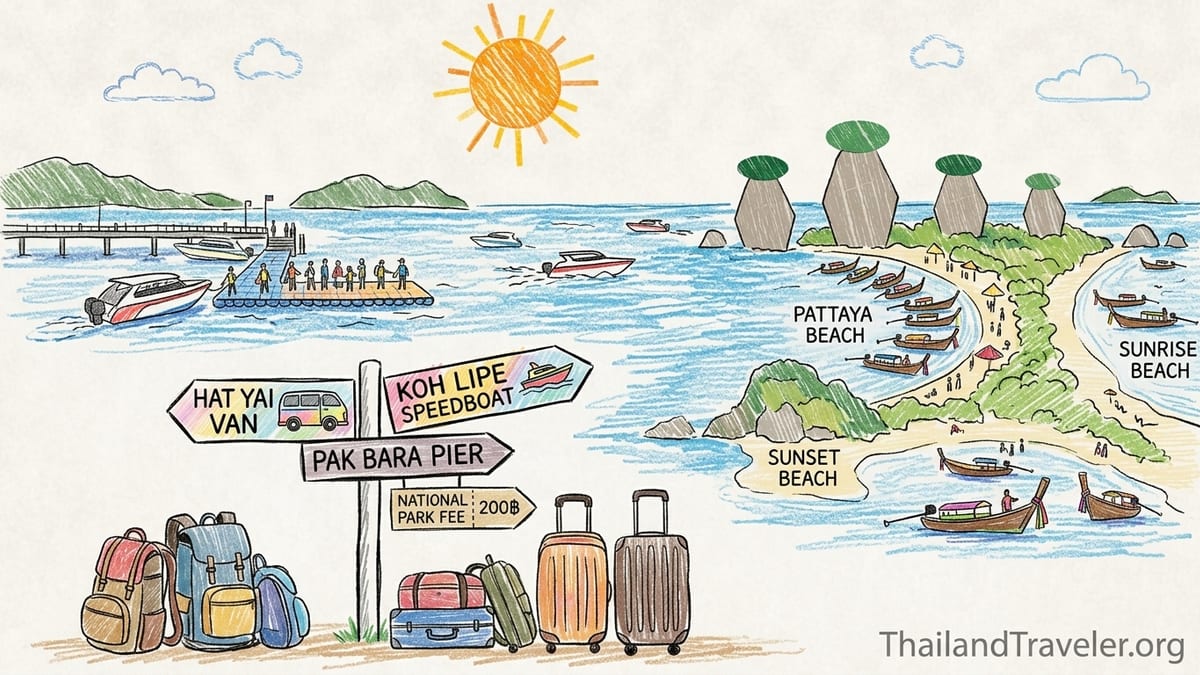
Getting to Koh Lipe: What the Long Journey Really Involves
My most straightforward gateway to Koh Lipe was Pak Bara Pier in Satun province, the main mainland hub for Tarutao Marine National Park. From Hat Yai, shared minivans to Pak Bara were advertised around 250 to 350 baht per person, taking roughly 2.5 hours depending on traffic and how many hotel pickups they squeezed in. I chose a prebooked shared van that collected passengers from several downtown hotels, then dropped us in front of Pak Bara’s ticket kiosks about three hours later, including a short fuel and bathroom stop.
At Pak Bara you do not simply walk to a single ticket window. Competing desks line the waterfront, selling similar packages that bundle the speedboat to Koh Lipe with the national park fee and, sometimes, a transfer from Koh Lipe’s offshore floating pier to your resort. On my October visit, published prices for shared speedboats to Koh Lipe ranged around 700 to 800 baht one way per adult on popular operators such as Satun Pakbara Speed Boat Club and Bundhaya Speed Boat, with three daily departures in the main season. The crossing is scheduled at about 1.5 hours but checks closer to 1 hour 30 to 1 hour 45 when sea conditions are rougher.
Once I had my ticket, there was a mandatory national park entry fee of 200 baht for foreign adults, payable at a separate counter before accessing the pier. I was given a colored sticker indicating my boat company and departure time, then told to wait in the shaded seating area. The wait was about 40 minutes, mostly spent watching porters stack luggage into plastic tubs. All large bags were tagged and taken separately to the speedboat. You keep only a small daypack with valuables and anything you might need on board, which is important because luggage sometimes sits exposed on the pier in the sun or light rain during boarding.
Boarding itself involved walking along a concrete jetty, then down onto a floating pontoon where several speedboats were tied up side by side. You call out your company name, hand over your luggage tag and climb onto the boat in turn. Seats are narrow and upright, with limited legroom. Life jackets were handed out or already on the seats, but storage space for daypacks was tight. The first thirty minutes felt fairly smooth as we skirted the coast past Tarutao and Khai islands, where some operators paused briefly so that day-trippers could take photos of the famous arch rock. Closer to Koh Lipe the sea opened up and the ride became choppier, occasionally slamming the hull hard enough that a few passengers clenched teeth and held armrests. Anyone with serious motion sickness will likely prefer the shorter Pak Bara crossing over the much longer routes from Phuket or Krabi.
Arriving in Koh Lipe: Floating Piers, Longtails and First Impressions
Speedboats from Pak Bara and the western islands now dock at floating piers off Pattaya Beach or Sunrise Beach, depending on the company and sea conditions. My first arrival was at the floating pontoon off Pattaya Beach. The water here was a clear, almost milky turquoise and I could see soft sand several meters below the surface, but the bay was busy: a ring of longtails waited to shuttle passengers ashore, dive boats idled farther out and the beach itself hummed with resort and restaurant fronts.
Luggage is unloaded in big plastic tubs and passed to the pontoon. Passengers step from the speedboat onto the floating platform, then onto a longtail. There is no direct walking ramp to the beach, so even if your accommodation is technically on Pattaya Beach you still board a longtail taxi for the last 200 to 300 meters. On my visit, the longtail transfer fee was 50 baht per person with luggage to any point along Pattaya or Sunrise Beach. Some beachfront resorts had prearranged pick ups and staff holding signs, and those guests had the fee bundled into their accommodation package.
Landings are relatively efficient but can feel chaotic in high season. Arrivals from Langkawi, Lanta, Phi Phi and Pak Bara often overlap around midday, which means a flotilla of speedboats and longtails all maneuvering in shallow water at the same time. The noise of multiple engines idling, captains shouting instructions and porters hauling bags up the sand makes the center of Pattaya Beach feel like a miniature transport terminal rather than a tranquil bay. It is not unsafe, but it is far from the tranquil first impression many travelers imagine when they dream about “Thailand’s Maldives.”
On my second visit, leaving Koh Lipe for Koh Lanta, I boarded the high-season speedboat from Sunrise Beach. Check in was handled from small desks directly on the sand at the northern end of the beach. Bags were weighed, tagged and collected into plastic tubs again, and we walked across a short floating jetty to reach the speedboat. Because Sunrise Bay is more open and deeper than Pattaya’s shallow crescent, there were fewer longtails anchored in the arrival zone and the whole procedure felt calmer, even though the boat itself was almost full.
Why Some Gateways Work Better: Pak Bara, Koh Lanta and Phuket Compared
After trying both the Pak Bara and Koh Lanta routes, I found there is a clear hierarchy of convenience. Pak Bara remains the simplest and most reliable entry year-round because speedboats run in most months, with three daily departures advertised in the current timetable, subject to monsoon conditions. Travel from Hat Yai to Pak Bara by van, then Pak Bara to Koh Lipe by speedboat, comfortably fits into a half day of travel if you leave Hat Yai in the morning. The sailing time of about 1.5 hours means even on choppy seas, the discomfort is limited in duration.
The direct speedboat link between Koh Lanta and Koh Lipe is much more seasonal. Operators associated with Satun Pakbara Speed Boat Club and others run high-season connections that typically start around mid October and finish at the end of April. A common timetable uses a 10:30 or 12:30 departure from Koh Lanta’s Saladan Pier, stopping at islands such as Koh Ngai, Koh Kradan and Koh Bulon before reaching Koh Lipe mid afternoon. Published fares for this island-hopping route have been in the region of 1,600 to just over 2,000 baht per person one way, depending on the operator and date. In practice, that means you can breakfast on Long Beach on Lanta and swim at Sunrise Beach on Lipe the same afternoon, with no road transfers, as long as your dates fall inside the high-season window.
Phuket and Krabi act as long-range gateways, but the value equation is less attractive. Direct boats from Phuket’s Rassada Pier to Koh Lipe operate in the main season and are often sold as “high speed ferries” or express speedboats, with travel times in the range of five to six hours and prices typically advertised above 2,000 baht one way. Several recent travelers describe the trip as exhausting, particularly in rough seas, with almost no ability to move around inside the cabin. An alternative is to travel by land from Phuket or Krabi down to Pak Bara, then take the shorter Pak Bara to Koh Lipe boat. Although this adds a road leg of five to six hours, the sea portion is only 1.5 hours, which is a meaningful consideration if you are prone to seasickness.
From a pure logistics and comfort standpoint, Hat Yai or Trang airport to Pak Bara to Koh Lipe is still the least stressful route, especially in shoulder months when some island-to-island links have not yet started or have already ended. The direct island routes via Koh Lanta and the Trang islands are wonderful for an Andaman hopping itinerary in peak season, but travelers planning for May, June or September should confirm timetables carefully before assuming they can arrive or depart any way except via Pak Bara.
First-Hand Look at Pattaya, Sunrise and Sunset Beaches
I split my four nights across Sunrise Beach and Pattaya Beach in order to compare them directly, with several long afternoon walks to Sunset Beach. Pattaya is still the busiest beach on the island and the one that tends to appear in first searches for “Koh Lipe beachfront resorts.” The sand here is bright white and flour-soft, and in the middle of the day the water colour is the sort of surreal turquoise that sells package holidays. Yet the impression changes once you factor in boat traffic. Longtails, speedboats and dive boats anchor along much of the bay, especially on the central and western sides. Water clarity is still good for swimming, but the nearshore area can be disturbed by propeller wash and fuel fumes, and noise is constant when boats arrive from Pak Bara and the northern islands.
Swimming at Pattaya is comfortable where swimming zones are roped off away from the main channels, but there are stretches where longtails are pulled up almost nose-to-sand in front of resorts. These areas feel more like a working harbor than a relaxing beach. Shade is relatively limited away from resort umbrellas and palm trees, which means non-guests either need to pay for a sunbed, buy food and drinks at a beachfront restaurant or retreat to the trees at the very eastern end. In the busiest weeks around Christmas and Lunar New Year, much of the central Pattaya beachfront can feel crowded with sunbeds and day-trippers.
Sunrise Beach felt very different. It runs along the island’s east coast, facing Koh Adang, and is longer and a little wilder. The beach is lined with low-key resorts, dive shops and a few bars, but there is more space between properties and far fewer heavy boat movements. Most longtails moor at one or two sections of the beach, leaving large parts of the shoreline comparatively open. On my visit in October, water clarity seemed higher than in Pattaya’s central sections, particularly at the northern end where the sand shelf drops into slightly deeper water. Swimming here felt calmer, with less worry about engines reversing nearby, and it was easier to find natural shade under casuarina trees or palms, especially in the early morning.
Sunset Beach, a short walk over the hill from the main Walking Street, is smaller and more compact. The sand is slightly coarser, and in the late afternoon a line of small bars and bungalows fills up with travelers waiting for the sun to drop behind the Adang archipelago. Boat traffic is modest, often limited to a few longtails and the occasional dive boat. Water clarity on my visits was decent but not as strikingly clear as Sunrise Beach’s northern stretches earlier in the day. Swimming is pleasant though shallower and rockier at the ends. Shade is excellent from mid afternoon onwards because of the steep hillside and trees behind the sand, which also helps keep the atmosphere relatively relaxed compared with Pattaya’s busy strip.
Snorkeling From Shore and Trips to Koh Adang and Beyond
Snorkeling is one of Koh Lipe’s major selling points, and I tested both the easy from-shore options and a guided day trip into Tarutao Marine National Park. Directly off Sunrise Beach, simple snorkeling is possible around the scattered coral heads in front of several resorts and near the offshore buoys facing Koh Adang. Even staying close to shore, I saw parrotfish, butterflyfish and small schools of sergeant majors, along with patches of branching coral and the occasional anemone. The key limitation is boat traffic. Longtails weave in and out between moorings, and swim zones are relatively narrow, so I wore a bright rash vest and stayed inside roped areas to stay visible.
From Pattaya Beach, worthwhile snorkeling from shore is more limited. Much of the nearshore area has been affected by anchoring and propellers over the years, and the better coral is either farther out or closer to rocky points at the edges of the bay. If you want serious snorkeling variety, booking a dedicated trip is a better use of energy. Prices for group longtail tours in the high season were commonly advertised on the island around 600 to 800 baht per person for a half-day “inner zone” trip and 800 to 1,200 baht for fuller day routes that reach the outer islands, sometimes including lunch and basic equipment.
I joined a full day longtail tour that visited several popular spots, including Koh Adang, Koh Rawi and Koh Hin Ngam. The day started from Sunrise Beach around 9:30 a.m., with eight passengers aboard. Our first stop was a shallow coral garden off Koh Adang, where visibility on that October morning reached several meters. We drifted over plates of hard coral, schools of yellowtail fusiliers and occasional clownfish in their anemones. Later, at Koh Rawi, the water deepened and turned a darker blue, with larger schools of fish and more complex coral formations. The stop at Koh Hin Ngam, known for its smooth black stones, was scenic but more about the beach itself than snorkeling.
Equipment quality varied. Basic masks and snorkels were included, but I was glad I had brought my own mask and a lightweight shorty wetsuit. Fins were not always available in all sizes on every boat. Reef shoes helped with walking on the stony shore at Koh Hin Ngam and the rougher sections of beach at some stops. Overall, the day trip delivered what I had hoped for from Koh Lipe: easy access to clear water, colorful fish and varied coral, with travel times of 20 to 40 minutes between spots rather than long open-sea slogs.
The Real Cost of Staying: Koh Lipe vs Koh Lanta
For accommodation, I booked a midrange beachfront bungalow on Sunrise Beach for two nights and a room just off the sand near Pattaya Beach for another two. Nightly rates in the main 2025 to 2026 season for true beachfront on Koh Lipe typically fall somewhere between about 2,500 and 5,000 baht, depending on the resort, room type and exact dates. Budget choices set a few minutes’ walk back from the beach can drop closer to 1,000 to 1,800 baht per night, but the reality is that Koh Lipe runs noticeably more expensive than many similarly popular islands because every piece of building material, every crate of vegetables and every fuel canister must arrive by boat.
By comparison, midrange beachfront accommodation on Koh Lanta around Long Beach or Klong Dao often starts under 2,000 baht in shoulder season and sits in the 2,000 to 3,000 baht range in busy weeks, with a wider spread of apartments, family rooms and basic bungalows under that. Averaged over four nights, my total accommodation spending on Koh Lipe was roughly one third higher than what I had paid for a comparable standard of room earlier in the season on Lanta, despite Lanta resorts often having larger pools and grounds.
Food followed a similar pattern. On Koh Lipe, simple Thai dishes on Walking Street, such as pad thai, stir-fried basil chicken or fried rice, often ran 90 to 140 baht per plate, while seafood barbecues and Western dishes on the beachfront pushed mains to 200 to 400 baht or more. Water and soft drinks sat higher than mainland prices, and alcohol prices reflected the cost of shipping bottles out to the island. On Koh Lanta, it was easier to find Thai eateries close to local pricing, especially a short ride inland from the main beaches, where plates under 80 baht remained common.
Transfers and activities added up. My Pak Bara to Koh Lipe ticket cost 700 baht one way. The onward Koh Lipe to Koh Lanta speedboat came in at just under 1,700 baht with a mid-season promotion. The full day snorkeling trip to Koh Adang and Koh Rawi, with simple lunch and equipment, was priced at 850 baht per person. Mask and snorkel rental on the island hovered around 50 to 100 baht per day, and fins added another 50 to 100 baht depending on the shop. Over four nights for two people, including accommodation, transfers, one organized snorkeling day and restaurant meals without excessive alcohol, my rough total on Koh Lipe ended up around 40 to 50 percent higher than what a similar four-night stay had cost on Koh Lanta, where we had comparable meals and one boat excursion.
Drawbacks: Crowds, Noise, Limited Facilities and Weather Risks
Despite Koh Lipe’s undeniable natural appeal, it is not a frictionless paradise. Overcrowding is an issue in high season, especially along Walking Street in the evenings and on the central section of Pattaya Beach. At certain times of day speedboats from all directions arrive almost back to back, and the nearshore water line in front of some resorts fills with longtails pulled up close together, leaving only narrow corridors of open sand. On the busiest days, Walking Street can feel jammed with restaurant touts, massage shops and souvenir stalls competing for attention, which will either feel lively or exhausting depending on your mood.
Environmental pressure is visible in small ways. Litter is not overwhelming but plastic bottles, food wrappers and cigarette butts do appear along some back lanes and under trees at the back of the beaches, especially after windy days. Resorts and local volunteers do conduct regular cleanups, and early morning walks revealed staff raking and bagging trash along the tideline, but the sheer number of daily arrivals means waste is a constant management challenge. Coral damage near busy anchor zones is easy to spot for anyone who has snorkeled healthier reefs elsewhere in Thailand.
Medical facilities are limited. Koh Lipe has a small clinic and pharmacies that can handle minor injuries, infections and common ailments, but for serious emergencies or anything requiring hospital care, evacuation to the mainland is necessary, usually via Pak Bara and onward to Hat Yai. Boat schedules and weather affect how quickly that can happen. For families with very young children, older travelers with complex health issues or anyone engaging in higher risk activities such as freediving, that lack of a full hospital is an important factor to consider.
Weather disruptions are another real constraint. Koh Lipe’s high season runs roughly from late October through April, when the Andaman is generally calmer, but even within that window storms can blow through and cancel or delay crossings. Operators and tour agencies are fairly upfront that in strong winds or high waves, speedboats can be postponed at short notice. During the May to October monsoon months, some island-to-island routes, such as direct boats to Lanta or Phi Phi, stop entirely and only the Pak Bara link remains, sometimes on reduced frequency. If you are on a tight schedule with a fixed onward flight, adding at least one buffer day between leaving Koh Lipe and flying out of Phuket, Krabi or even Bangkok is a wise precaution.
Expectations vs Reality: Was Koh Lipe Worth the Journey?
Before arriving, I expected Koh Lipe to feel like a smaller, more turquoise version of Koh Lanta: a place with similar laid-back vibe but better beaches and older, more rustic accommodation. What I actually found was a hybrid between that barefoot island dream and a mature, compact resort village that has already been thoroughly discovered. The journey from Pak Bara was more organized and less stressful than I had feared, yet the intensity of the arrival zone on Pattaya Beach contrasted sharply with the brochure images of untouched sand.
The beaches I enjoyed most were the quieter stretches of Sunrise Beach and the smaller coves near Sunset Beach in the late afternoon. Waking early and walking Sunrise while most visitors were still asleep delivered the postcard moments I had hoped for: pastel dawn light, glassy water and only the sound of longtail hulls rocking gently at anchor. Sunsets over Koh Adang from the west side were reliably beautiful and significantly less crowded than Pattaya’s central strip. Pattaya Beach itself delivered fine sand and swimmable water, but the constant background of engines revving, luggage being wheeled across the sand and day boats coming and going made it my least favorite place to linger.
In terms of value, certain elements felt overpriced or inconvenient. Beachfront accommodation that matched a midrange resort on Koh Lanta in quality routinely cost more. Boat transfers, both the essential mainland crossings and the optional snorkeling excursions, added meaningful cost to the trip, especially for couples or families. The limited choice of budget food options on the beach, with many places pushing seafood sets and international menus, occasionally made me miss Lanta’s deeper, more varied dining scene on and just off the sand.
The snorkeling, however, did largely justify the effort for me. Being able to wake up on Sunrise Beach, jump on a longtail and be over a healthy coral garden at Koh Adang or Koh Rawi within half an hour felt like a genuine luxury. The combination of easily accessible clear water, scenic offshore islands and manageable travel times between snorkel spots is something Koh Lanta cannot fully match without longer, more expensive boat days out to Koh Rok or Koh Haa. If underwater scenery and island scenery are your primary priorities, Koh Lipe punches above its size.
The Takeaway: Who Should Choose Koh Lipe and Who Should Skip It
For couples, Koh Lipe can be a very good choice if you are willing to spend a little extra. A three to five night stay in a tasteful beachfront or near-beach resort on Sunrise or Sunset Beach, combined with one or two snorkeling trips and unhurried evenings on Walking Street, creates a classic small-island romantic break. If your time is limited and you are flying in and out of Hat Yai or Trang, the Pak Bara route keeps travel manageable in a single day each way.
Families will find plenty to like in the shallow waters and gentle slopes of the sand, but should weigh that against the long travel days and limited medical facilities. For families with older children who enjoy snorkeling and do not mind speedboat travel, Koh Lipe works well, especially with a resort that offers family rooms and direct beach access so you are not constantly walking small kids through the heat. For those with toddlers or anyone nervous about fast boats, Koh Lanta often proves more comfortable because road access is simpler and hospitals are closer.
Independent travelers and backpackers will likely feel the higher prices more sharply. Dorm beds and basic fan bungalows do exist, but they are fewer and costlier than on larger islands. If you enjoy exploring on a scooter, Koh Lipe’s small size and walking-only layout may feel limiting after a couple of days. On the other hand, if your priority is maximizing beach and snorkeling time rather than nightlife or constant movement, the island can still make sense for three focused nights, especially in shoulder season when crowds thin out and some rates soften.
Dedicated snorkelers and casual freedivers will get the most obvious payoff from the journey. The proximity of Koh Adang, Koh Rawi and the other Tarutao Marine National Park islands means you can spend a high proportion of your trip actually in the water rather than commuting long distances by boat. Compared with Koh Lanta, where the best reefs are tied to longer full-day trips, Koh Lipe offers a “doorstep reef” feeling even when you join inexpensive longtail group tours.
When would I personally skip Koh Lipe, despite its beautiful scenery? If I only had a short Andaman itinerary of a week, I would choose Koh Lanta plus perhaps one smaller island nearby, because the logistics are simpler and the costs more forgiving. I would also think twice about Koh Lipe if traveling in the heart of the monsoon months, when crossings are rougher, schedules less stable and some services reduced. Finally, if my travel style relied heavily on budget guesthouses, cheap street food and spontaneous walk-in rooms, the premium pricing and limited last-minute availability on Koh Lipe would push me toward other islands. For travelers willing to plan ahead, pay the higher transport and accommodation premiums and prioritize clear water and snorkeling over everything else, Koh Lipe remains worth visiting. For those more focused on easy access, wider resort choice and better value, Koh Lanta is still the more practical and forgiving base on the southern Andaman Coast.
FAQ
Q1. How long does it take to get from Pak Bara Pier to Koh Lipe?
The shared speedboat from Pak Bara Pier to Koh Lipe usually takes about 1.5 hours, though in rough seas it can stretch closer to 1 hour 45 minutes.
Q2. What does a one-way boat ticket from Pak Bara to Koh Lipe cost?
Recent published prices for shared speedboats from Pak Bara to Koh Lipe are around 700 to 800 baht per adult one way, excluding the 200 baht national park entry fee for foreign visitors.
Q3. Is Koh Lipe more expensive than Koh Lanta for accommodation?
Yes. Beachfront midrange rooms on Koh Lipe commonly run from about 2,500 to 5,000 baht per night in high season, often one third or more higher than comparable beachfront resorts on Koh Lanta.
Q4. Which Koh Lipe beach is best for swimming and quiet?
For a balance of clear water and relative calm, Sunrise Beach generally offers the best experience, especially at its northern end, with fewer boats and more natural shade than Pattaya Beach.
Q5. Can you snorkel directly from the beach on Koh Lipe?
Yes. Basic snorkeling is possible from Sunrise Beach, where coral heads sit just offshore, though the best coral and fish variety are found on boat trips to nearby islands such as Koh Adang and Koh Rawi.
Q6. Is the long speedboat ride from Phuket or Krabi to Koh Lipe worth it?
The direct boats from Phuket or Krabi can take five to six hours and feel tiring in rough seas. Many travelers prefer going overland to Pak Bara, then taking the shorter 1.5 hour crossing instead.
Q7. How many nights should I spend on Koh Lipe?
Three nights is a sensible minimum, giving you one full day for snorkeling and one for relaxing on the beaches. Five nights works better for those who want multiple island trips or slower days.
Q8. Are there good medical facilities on Koh Lipe?
Koh Lipe has a small clinic and pharmacies that can handle minor issues, but serious problems require transfer to hospitals on the mainland, usually via Pak Bara and onward to Hat Yai.
Q9. When is the best time of year to visit Koh Lipe?
The main season runs from roughly late October to April, when seas are calmer and most island-to-island boat links operate. Outside these months, expect rougher crossings and reduced services.
Q10. Who is Koh Lipe best suited for compared with Koh Lanta?
Koh Lipe is ideal for couples and snorkel-focused travelers who value clear water and small-island atmosphere enough to justify higher costs and longer transfers, while Koh Lanta suits those prioritizing easier access, wider resort choice and better overall value.