

I thought I was booking a James Bond Island tour. What I actually booked was a slow, almost meditative journey into the limestone heart of Phang Nga Bay, where narrow sea caves open suddenly into silent, jungle-framed lagoons. The movie stop was just one brief chapter in a day that was really about paddling through rock tunnels on a guided sea-canoe and watching the tides reveal hidden worlds you cannot reach on foot or by big boat.
Choosing a Canoe-Focused Phang Nga Bay Tour
For this trip I wanted the caves and hongs to be the main event, not a rushed add-on between speedboat photo stops. After comparing several options, I booked a full-day "Phang Nga Bay Sea Cave Canoeing and James Bond Island by Big Boat" style excursion operated by Amazing Canoeing, a Thai company that runs large, stable double-deck boats with dedicated paddling staff. In October 2026, the all-in price from Phuket with hotel transfers, lunch and multiple sea-canoe sessions was listed online at about 3,400 to 3,900 Thai baht per adult, depending on the reseller and seasonal promotions. Children were discounted by roughly 30 to 40 percent.
The tour included return hotel pickup from the Kata, Karon, Patong and Phuket Town areas in air-conditioned minibuses. My pickup from a mid-range hotel in Patong was at 7:45 a.m., with a second stop in Karon before we crossed the Sarasin Bridge off northern Phuket and continued to a pier on the Phang Nga side of the bay. By the time we checked in, paid the national park fee in cash and boarded the main boat, it was just after 9:30 a.m.
On the day I joined, our big boat carried 32 guests plus a Thai guide team of 8 and the boat crew. This group size felt busy on deck but not overwhelming once we were out on the water, because guests were divided into pairs across 16 inflatable sea canoes, each with its own paddler. Most operators in this category cap groups somewhere between 30 and 60 passengers per departure, though some cheaper speedboat trips can carry 70 or more.
Crucially, this itinerary was structured around two proper sea-canoeing sessions at different islands, plus a short beach break and only a single, timed landing at Khao Phing Kan and Ko Tapu, the famous James Bond Island pair. That balance shaped the whole day: instead of sprinting between eight different viewpoints, we lingered in a smaller area of the bay where the tide permitted cave access.
Departure, Boat Type and First Glimpse of the Karsts
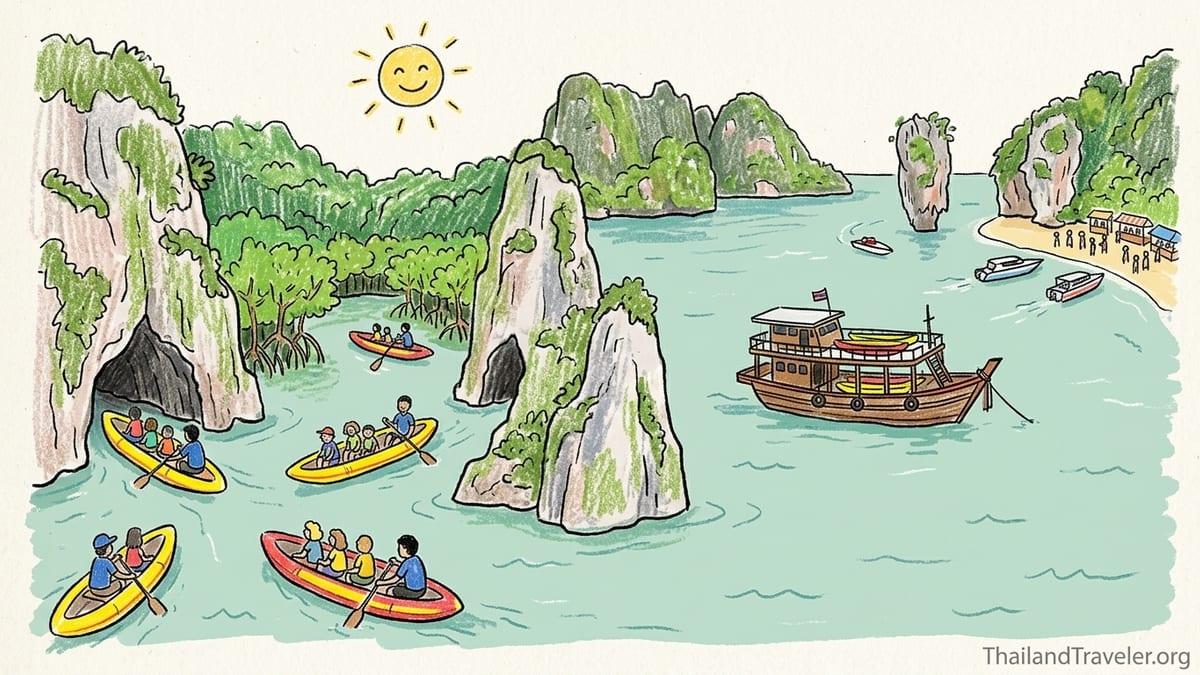
Our departure pier was a low-key marina on the Phang Nga mainland, a little upstream from the open bay. The boat itself was a two-deck wooden and fiberglass vessel about 25 meters long. The lower deck held the galley and indoor seating, while the upper deck was open-air with shade awnings and racks stacked with yellow and red inflatable canoes. Compared with the narrow fiberglass speedboats that blast out of Phuket’s eastern marinas, this “big boat” felt slow and stable, better for those worried about seasickness or cramped knees.
We eased down the river on a rising tide. The water was the color of milky jade, and within twenty minutes the banks opened onto the wider bay. This is where Phang Nga reveals its signature shapes: vertical limestone stacks and ridges erupting out of the sea, streaked with black and orange mineral stains. Some formations were undercut like mushroom stalks from centuries of wave action, and others were pierced by dark holes hinting at tunnels. From the top deck, the bay seemed almost flat, a mirror with jagged silhouettes rising from it.
The crew used this transit time to fit everyone with life jackets. They had a full range of adult sizes plus a separate rack of smaller vests for children. Jackets were technically optional while sitting in the canoes, but the staff “strongly recommended” them. I wore mine throughout the paddling sections and appreciated the extra buoyancy, particularly near narrow cave entrances with light current.
As we approached our first island, learning how the canoe system worked eased any nerves. The guide team inflated the boats on the lower deck and then launched each one directly from the side of the big boat. Guests climbed down a short ladder, sat in front, and the paddler crouched behind. There was no expectation that we would paddle ourselves, which is typical for Phang Nga’s cave routes because of tight spaces, tidal timing and the need to read water levels quickly.
Sliding into the Caves at Koh Panak
Our first paddling stop was at Koh Panak, an island riddled with sea caves that open into interior lagoons. By this time the tide was close to its mid-level rise, high enough to float through most low tunnels but still leaving a gap between ceiling and water. Phang Nga’s tides can vary by more than two meters between high and low, and access to particular cave systems changes hourly. Our head guide checked conditions with another boat already on site and made a quick call on which entrance to use first.
Approaching the cliff face, the island looked solid until you were almost at the rock. Then the entrance resolved itself: a horizontal crack about one meter high where the water disappeared into shadow. Our canoe nosed toward it, and the sudden cool air flowing from the cave felt like switching off the tropical heat. As we slipped under the low lip of limestone, daylight narrowed to a bright oval behind us and a faint patch of glow ahead.
Inside, sound changed completely. The slap of waves against the big boat vanished, replaced by the drip of water from the ceiling and the soft scrape of our inflatable sides against rock. The cave roof dipped so low in places that our paddler asked us to lie back flat in the canoe and tuck our fingers in. My life jacket brushed the ceiling as we glided through, and for a few seconds I understood why anyone with strong claustrophobia might find this unnerving. Yet the guides did this every day, and their confidence, plus the knowledge that the tide was still rising slowly rather than rushing, kept the mood calm.
Emerging into the hong, or interior lagoon, felt like floating into another world. The roof overhead simply ended where the cave had collapsed long ago, leaving a circular basin maybe 150 meters across, ringed by vertical jungle walls. Mangrove trees clutched the edge of the water, roots twisting down into the mud, and vines dangled from the canopy above. The light was soft and green, with sun filtered through leaves and bouncing off the pale rock. The only sounds were birdcalls from somewhere high on the cliff and the rhythmic pull of paddles from other canoes gliding silently around the edges.
How the Tides Shape Access and Why Guides Matter
The tides in Phang Nga Bay are not just a detail, they are the master schedule. Every cave we entered that day was accessible only during a relatively narrow window when the water level sat between a high “ceiling scrape” and a low “too shallow to float.” Our guides had printed tidal charts for the day and adjusted the order of stops in real time. At Koh Panak, for example, the low tunnel we took into the hong would have been impassable two hours later without lying fully flat and risking helmets scraping the ceiling. Some operators choose alternate, slightly higher routes on those days, while companies that mistime the tides simply have to skip certain caves.
This is where having local paddlers controlling the canoes made practical sense. They knew where stalactites jutted down unexpectedly, where currents swirled in the entrance, and how quickly water rose inside narrow passageways compared with the open bay. While a confident kayaker might be able to maneuver independently in a wide lagoon, trying to self-paddle through a half-meter-high rock tube while managing camera gear and watching headroom is a different challenge. On our trip, guides asked guests to keep hands inside the boat and, when needed, to lean to one side or fully recline to clear a tight pinch point.
Because access is so tide-dependent, most reputable operators schedule Phang Nga’s hong itineraries with exact departure times and limited flexibility. Twilight and “Hong by Starlight” style premium tours, including those run by long-established specialist companies, build their entire program around catching specific caves at just the right water level in late afternoon and early evening. That is a big part of why those trips tend to cost more than generic day tours. You are paying for deliberate timing and smaller groups in addition to sunset light.
On our tour, we paddled through two cave systems and into two separate tidal lagoons at Koh Panak and a nearby hong island. At both sites, the guides checked entrance height by physically gauging it with their paddles first. One low tunnel was deemed “too close” for that moment, and instead of forcing it, they redirected us to another lagoon. Having that caution built into the day felt reassuring.
Experiencing the Hongs: Light, Sound and Wildlife
Our second major canoeing stop was at Koh Hong, a classic hong island where the interior lagoon is almost fully enclosed. By this point the tide had risen further, and the entrance tunnel that would be dry mud at low water was now a narrow, floating corridor. Bats fluttered somewhere unseen overhead, and small crabs clung to the cave walls just above the waterline. The temperature dropped a few degrees as soon as we entered the shade.
Inside the hong, the mood shifted from exploration to quiet observation. Our paddler let the canoe drift while we craned our necks upward. The canyon walls rose 50 meters or more, streaked with green moss and black algae. Ferns sprouted in horizontal cracks, and small fig trees had somehow rooted in tiny ledges. In several corners, the rock overhang almost met the opposite wall, so the sky appeared as a series of irregular blue shapes rather than one open circle.
The acoustics were striking. Every paddle stroke echoed. When another group laughed on the far side of the lagoon, the sound bounced around like they were in a cave amphitheater. During one quiet spell we could hear insects and what sounded like monkeys or birds calling from high in the forest, noise filtering down like a soundtrack.
Wildlife sightings are never guaranteed, but our group did spot a monitor lizard sunning at the water’s edge and several mudskippers flicking along the mangrove roots. In the wetter corners of the cave ceilings, stalactites dripped constantly, adding to the echo. The guides pointed out delicate rock features by name, such as “elephant head” and “candle,” using their flashlights sparingly to preserve the natural dimness.
James Bond Island: How Much Time and What It Felt Like
After the second hong, our big boat motored toward the most famous landmark in the bay: Khao Phing Kan and Ko Tapu, known collectively as James Bond Island since they appeared in the 1974 film “The Man with the Golden Gun.” The approach by water is undeniably dramatic. The needle-like Ko Tapu rises about 20 meters out of the sea, slightly leaning, with a narrower base than top. Behind it, the higher cliffs of Khao Phing Kan form a curved backdrop and a small landing cove.
Our guide was upfront about expectations before we landed. The national park limits speedboats to short visits and asks passengers to disembark onto the main beach area, where a line of souvenir stalls now occupies part of the shore. We were told we would have around 35 minutes on the island, which matched what we experienced: 5 minutes to walk from the pier to the viewpoint, 15 to 20 minutes of free time for photos and wandering, and about 10 minutes to circle back along the path that passes a tilted rock wall and additional viewpoints of Ko Tapu.
The reality on a mid-season afternoon was that James Bond Island felt crowded. There were at least six other tour groups on the beach when we arrived, some with matching colored wristbands. Souvenir stands sold everything from seashell mobiles and carved soap to T-shirts printed with the famous rock spire. None of this ruined the scenery, but it did reduce the sense of isolation that defines the hongs. It was also the only part of the day when I felt gently pressured into browsing souvenirs, though the vendors accepted polite “no thank you” without issue.
Was it worthwhile? For me, James Bond Island was visually impressive from the water and mildly interesting onshore, but it was also the least essential part of the itinerary. If I had booked a tour that focused only on the movie stop plus a quick canoe loop, I would have felt short-changed. As one chapter of a broader sea-canoeing day, however, it added context and a different kind of spectacle.
Optional Village Visits, Crowds and Respectful Tourism
Some Phang Nga Bay itineraries include a lunch stop at Koh Panyee, a predominantly Muslim fishing village built on stilts against a sheer limestone cliff. Others, including many big-boat cave itineraries, choose to serve lunch on board and either cruise slowly past the village or skip it to maximize paddling time. On my particular tour, lunch was served buffet-style on the boat after the second cave session, and we only viewed Koh Panyee from a distance.
That meant no chance to walk the village’s narrow lanes or visit the floating mosque and school, but it also meant no large convoy of tourists funneling past restaurant tables and souvenir shops. Guides on our boat briefly explained that residents increasingly depend on tourism income and that those tours which do land now try to cluster eating and shopping in a few designated areas to reduce disruption to daily life.
If visiting Koh Panyee or another local community is important to you, read the fine print carefully when booking. Midrange tours with advertised village stops usually include a set Thai buffet lunch in a large over-water restaurant plus around 30 to 60 minutes of free time in the village itself. Premium small-group excursions sometimes arrange smaller, pre-booked venues and keep groups under 16 guests to reduce the feeling of being part of a crowd. Either way, the most respectful approach is to ask permission before photographing individuals, dress modestly and remember that behind the souvenir stalls there is a functioning village with people living regular lives.
Because my focus for this trip was sea-canoeing and caves, I did not feel that bypassing a village landing diminished the experience. Instead, it gave us more time in quiet bays without engines and more unhurried paddling.
Safety, Comfort and Dealing with Cave Conditions
A day built around sea caves raises a few practical concerns: low ceilings, dark spaces, mosquitoes and the chance of sudden rain. On our tour, safety protocols were clear without being overbearing. Life jackets were available in multiple sizes, and staff checked that children had theirs properly secured before any canoe left the main boat. During cave sections, the paddlers carried headlamps or flashlights but used them only when needed, preserving night vision so guests could see the natural glow at tunnel exits.
Low ceilings are part of the appeal and the challenge. Several times we were asked to lie flat in the canoe, resting our heads on the inflated backrest while the paddler ducked and pulled us through by gripping the rough rock above. This could trigger claustrophobia for some people. Anyone particularly nervous was steered toward slightly higher tunnels where possible, or they were encouraged to sit out the lowest section and enjoy open paddling instead. If you know confined spaces bother you, it is worth mentioning this when you first board so the guides can plan.
Mosquitoes were present inside the shady hongs, especially near mangrove roots. The guides recommended applying insect repellent before the first cave session, and I was glad I had long, lightweight sleeves and quick-dry pants rather than only a swimsuit. Rain is common in the monsoon months around Phang Nga, and short showers are possible even in the drier season. Our tour ran in light drizzle for about 20 minutes, which did little to affect the caves and actually made the cliffs glisten. Dry bags for phones and cameras were available for rent at the pier, and many guests used them.
Seasickness was less of a problem than on open-ocean speedboat trips. The big boat moved slowly inside the sheltered bay, and the only noticeable rocking was when a larger tour vessel passed close by. Still, a few guests took motion-sickness tablets before departure and drank ginger tea that the crew set out near the coffee station. Those prone to seasickness might prefer these larger, slower boats over smaller speedboats that can bounce heavily between islands.
Comparing Daytime, Sunset and Premium Small-Group Canoe Tours
During my stay I spoke with other travelers and compared brochures to understand how my midrange big-boat tour fit into the wider Phang Nga Bay market. Broadly, you can think of three main categories if your priority is sea-canoeing: standard daytime big-boat tours, late-afternoon or “twilight” cave tours, and premium small-group or specialist operators.
Standard daytime big-boat canoe tours, like the one I joined, tend to cost in the 2,800 to 4,000 baht per adult range from Phuket, including hotel transfers, national park fees, onboard buffet lunch, soft drinks, and at least two guided canoe sessions plus a James Bond Island stop. Group sizes often run between 30 and 50 people, and the boats are sturdy with shaded upper decks. These trips are good value if you want a mix of caves, lagoons, and landmarks without paying premium rates.
Twilight or sunset-focused tours come in slightly higher, often starting from around 3,800 to 5,000 baht, because they time their cave entries to late afternoon tides and finish with dinner on board as the sun sets behind the karsts. Some of the longest-running operators in this niche market closely track tide tables and adjust daily routes to maximize hong access in fading light. Travelers who choose these tours often mention the softer colors, cooler temperatures and lower number of other boats inside the hongs as big advantages.
Premium small-group tours, whether daytime or sunset, frequently cap numbers at 12 to 18 guests per boat and may use high-quality longtail boats or more comfortable cruisers. Prices can range from about 5,000 baht per person for shared small groups up to much higher for fully private charters. These experiences typically include additional touches such as upgraded meals, free rental of waterproof bags and sometimes extra snorkeling or swimming stops at quieter beaches. For serious photographers or those who dislike crowds, the extra cost can feel justified.
Across all categories, one consistent feature stands out: in the cave sections, it is almost always the local guides who control the canoes. Even on premium tours, guest paddling is usually limited to open lagoons and non-cave stretches for safety and tide-management reasons.
The Most Memorable Part of Phang Nga Bay and Would I Do It Again
Thinking back on the day, the image that stays with me is not the iconic spike of Ko Tapu, although that was striking. It is the feeling of lying back in the canoe as we slid under a rock ceiling only a few hand-widths above my chest, emerging into a hong flooded with soft green light and ringed by trees that seemed to grow straight out of the limestone. That combination of movement, tight spaces and sudden openness captured what makes Phang Nga Bay’s caves and lagoons so special.
The most memorable section for me was the pair of hongs at Koh Panak and Koh Hong, especially the second lagoon where the tide was just high enough to lift us nose-to-nose with mangrove roots. The sounds of birds and distant forest, the echo of paddles and the faint drip of stalactites replaced the boat engines and chatter of the main deck. For twenty minutes at a time, it felt as if the outside world had been shut out by walls of rock.
By contrast, the James Bond Island stop, while enjoyable enough, was clearly the least special part of the day. It checked a box, provided a famous photograph and a sense of connection to cinema history, but the commercialized beach and short time ashore made it feel more like an intermission than a highlight. I was glad it came late in the itinerary, after the more immersive cave sections had already framed our impressions of the bay.
Knowing what I know now, I would absolutely book a canoe-focused tour again instead of a standard sightseeing speedboat trip. The slower pace, the chance to sit low on the water and glide quietly into spaces invisible from a distance, and the guidance of experienced paddlers who read the tides and rock shapes turned the day into something closer to an exploration than a checklist. On a future visit, I would be tempted to try a smaller-group sunset or twilight sea-canoe itinerary to see the hongs under different light and with fewer boats on the water, but I would still want the caves and lagoons to be the main story, not just a fifteen-minute detour on the way to another selfie stop.
The Takeaway
If your image of Phang Nga Bay comes mostly from posters of James Bond Island, it is easy to assume that the trip is about a single famous rock. Spending a full day on a guided sea-canoe tour proves otherwise. The real drama lies inside the islands, in the low tunnels etched by tides and the hidden hongs where salt water, mangroves and jungle cliffs meet in a closed circle of light.
Booking a canoe-centric big-boat tour with clear information on group size, cave sessions and tide timing gave me a far richer experience than a conventional island-hopping speedboat day. I came away with wet feet, a camera full of stalactites and mangrove roots, and a sense of how delicate and dynamic this landscape is. The movie landmark was simply one vertiginous rock in a bay full of stories carved slowly by water.
If I had to choose again between a fast, multi-island sightseeing run and a slower, cave-focused excursion, I would pick the canoes every time. Phang Nga Bay rewards anyone willing to duck their head, trust a local guide and glide into the darkness for a few minutes in order to see what waits in the bright, echoing water on the other side.
FAQ
Q1. Do you have to paddle the kayak yourself on Phang Nga Bay cave tours?
On most sea-canoeing tours in Phang Nga Bay, local guides paddle the inflatable canoes while guests sit in front to enjoy the scenery and take photos. Some itineraries may allow limited self-paddling in open lagoons, but for safety and tide management, guides usually control the boats in the cave sections.
Q2. How much time do you actually spend at James Bond Island?
Standard sea-canoeing itineraries that include Khao Phing Kan and Ko Tapu usually allow about 30 to 40 minutes ashore. This is enough to walk from the landing beach to the main viewpoints, take photos of the rock spire, and briefly browse the souvenir stalls, but it is not a long hike or beach day.
Q3. Are the sea caves suitable for people with claustrophobia?
The caves involve low ceilings, narrow tunnels and short periods where you may need to lie back in the canoe as you pass under rock. Anyone with strong claustrophobia might find these moments uncomfortable. It helps to inform the guides in advance so they can steer you toward higher, wider passages or let you skip the tightest sections while still enjoying open-air paddling in the hongs.
Q4. What about safety equipment and life jackets?
Reputable operators provide life jackets in a range of sizes and encourage or require guests to wear them while in the canoes, especially during cave entries and exits. Boats also carry basic first aid kits, and guides are used to assisting children, older travelers and non-swimmers into and out of the canoes.
Q5. Do mosquitoes and rain spoil the experience?
Mosquitoes are common near mangroves and in shady hongs, but using repellent and wearing light long sleeves and pants usually keeps them manageable. Short rain showers are fairly normal around Phang Nga Bay and often do little to affect the caves, which are partly sheltered. Many travelers find that wet cliffs and mist add to the atmosphere, as long as cameras and phones are protected in dry bags.
Q6. Can you swim during a Phang Nga Bay canoe tour?
Some itineraries include a short beach or open-water stop for swimming, usually at a quieter island or sandbar away from the caves. Swimming is not permitted inside the hongs or narrow cave passages because of rocks, boat traffic and changing tides. If swimming is important to you, look for tours that clearly list a dedicated swim stop in their inclusions.
Q7. How do daytime and sunset sea-canoeing tours compare?
Daytime tours are generally more affordable and family-friendly, with brighter light for photos and a standard pattern of hotel pickup, lunch and afternoon return. Sunset or twilight tours cost more but often offer cooler temperatures, softer golden light on the cliffs, and fewer boats in the hongs. They may also include dinner on board as the sun sets behind the karsts.
Q8. Is seasickness a problem on big-boat canoe tours?
Phang Nga Bay is relatively sheltered, and the large, slow-moving double-deck boats used on many cave tours tend to be more stable than smaller speedboats. Some guests still prefer to take motion-sickness tablets as a precaution, but significant rocking is uncommon inside the bay except in unusually windy conditions.
Q9. How important is choosing a smaller group or premium operator?
Smaller-group or premium operators usually charge higher prices in exchange for fewer guests on board, more personalized guiding and sometimes more flexible timing around tides and crowds. If you dislike busy decks, value quiet time in the hongs or are focused on photography, paying extra for a small-group or specialist cave tour can make a noticeable difference to the experience.
Q10. Would you recommend a canoe-focused tour over a standard sightseeing speedboat trip?
For travelers most interested in landscapes, nature and a sense of discovery, a canoe-focused tour is usually more rewarding than a fast island-hopping speedboat run. The slower pace, guided passage through sea caves and time spent inside hidden lagoons offer a deeper impression of Phang Nga Bay than a quick series of photo stops, even if both options include a brief visit to James Bond Island.