


Thailand’s Andaman Coast links Phuket, Krabi, Phi Phi, Koh Lanta, the Trang Islands and remote Koh Lipe with an intricate web of ferries, speedboats and longtail shuttles. On paper the distances are short, yet real journeys involve competing operators, seasonal timetables, tide-dependent beach landings and a choice between slower big boats and bumpy speedboats. This guide brings those pieces together around the routes travelers actually search for, so you can plan multi-island trips without gambling with missed connections or rough crossings.
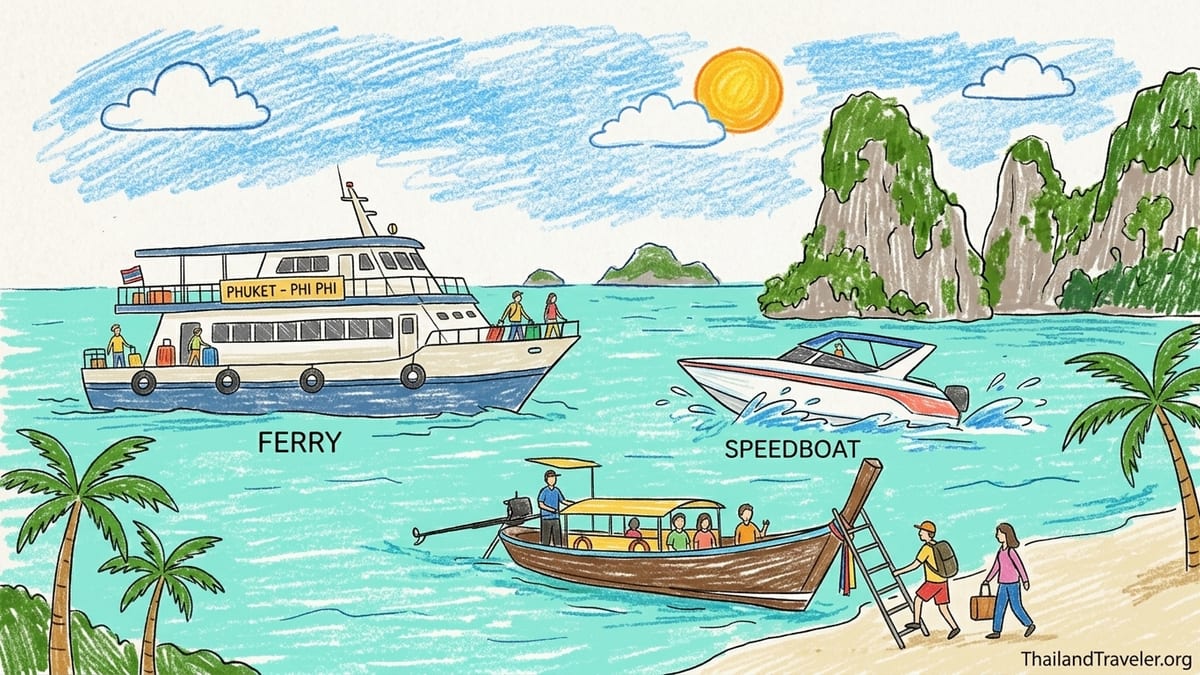
How Andaman Coast Sea Travel Really Works
Most boat travel along the Andaman Coast runs on two overlapping systems. The first is the year-round backbone that connects major hubs such as Phuket, Krabi, Phi Phi and Koh Lanta with large passenger ferries and some all-weather speedboats. The second is a seasonal high-speed network that extends further south and offshore, linking Koh Lanta and the Trang Islands with Koh Lipe, and adding long direct runs like Phuket to Koh Lipe. Those longer routes usually operate only in the calm, dry months, roughly from mid-October or November through late April, and are suspended when monsoon swells build up.
On the main lines, such as Phuket to Phi Phi and Krabi to Phi Phi, larger ferries typically offer the most stable ride, the lowest prices and more generous luggage policies. Published one-way fares on recent 2026 schedules from Phuket’s Rassada Pier to Phi Phi’s Tonsai Pier start around 450 to 500 baht on standard-class ferries, with multiple departures daily in both high and low season. Speedboats cover the same crossing in roughly half the time, but seats usually cost at least 750 baht one way and can go above 800 baht in peak periods, reflecting the higher fuel burn and smaller number of passengers.
Once you move beyond Phi Phi and Koh Lanta, seasonality becomes far more important. Direct speedboats from Phuket or Koh Lanta to Koh Lipe, or the through-services that hop via Koh Ngai, Koh Kradan and Koh Mook, generally run only during the dry season window. Timetables published for 2026 and 2027 by operators such as Satun Pakbara Speed Boat and Tigerline show these routes operating from around mid-October to late April. Outside those months, travelers heading to Koh Lipe or the Trang Islands usually combine overland vans or buses with shorter sea crossings from mainland ports such as Pak Bara or Trang’s Pak Meng Pier.
Another feature that shapes travel is the type of landing. Major hubs like Rassada Pier in Phuket Town, Nopparat Thara in Ao Nang and Saladan Pier on Koh Lanta use fixed piers where ferries can dock directly. Smaller islands and beaches often rely on floating pontoons or meet boats offshore with longtail shuttles, especially at low tide. This adds a short but sometimes awkward wet transfer, and it matters if you travel with young children, elderly relatives or luggage that you cannot easily carry in your arms.
Ferries vs Speedboats: Choosing the Right Boat Type
Larger ferries running between Phuket, Krabi, Phi Phi and Koh Lanta are typically two or three-deck vessels carrying well over a hundred passengers. Crossings like Phuket to Phi Phi are usually quoted at about two hours for standard ferries, and around one hour for speedboats. Ferries are slower but more spacious, with covered seating, basic snack bars or kiosks, open upper decks and toilets large enough to move around in. They tend to handle choppy seas more calmly, which is important on exposed legs such as Phuket to Phi Phi or Koh Lanta to Koh Phi Phi on a windy afternoon.
Speedboats, which dominate direct runs between islands such as Phi Phi to Koh Lanta or Koh Lanta to Koh Lipe, are much smaller, with rows of bench-style seating and limited space for bags. Operators on routes like Phuket to Phi Phi and Koh Lanta to Koh Lipe generally advise one medium suitcase or backpack plus a small carry-on per ticketed passenger, and may charge a fee for large or extra luggage. In practice, staff are often flexible, but the boat’s weight and balance set real limits. Boarding a speedboat typically involves stepping down from a pier or directly off the beach into shallow water, sometimes wading up to knee level, before climbing a short ladder into the boat.
For families with young children, travelers who suffer from motion sickness or anyone carrying heavy wheeled suitcases, the trade-off is clear. A big ferry is slower but far more forgiving. You walk onto a stable gangway and leave your larger bags stacked on the main deck, supervised by crew, then head to a seat. There is more fresh air on the upper deck, and the motion is less abrupt in most conditions. On smaller speedboats, the ride can be jarring when the captain throttles over oncoming swells and the cabin can get hot and noisy. Those with motion sickness often fare better on ferries, where they can sit outside and keep eyes on the horizon.
Speedboats do have advantages beyond speed. On busy routes such as Phi Phi to Koh Lanta or Koh Lanta to Koh Ngai and Koh Kradan, having several speedboat departures in late morning and early afternoon gives flexibility if you prefer a lazy breakfast or want to connect after a morning snorkel. Some operators sell through-tickets that bundle hotel pickup by minivan, pier check-in and all boat legs into a single voucher, which simplifies multi-stop journeys. Yet it is wise to remember that speedboat comfort varies between operators, and a calm morning run can feel very different from an afternoon return into onshore wind and chop.
Key Routes: Phuket to Phi Phi, Krabi and Koh Lanta
Phuket to Phi Phi is the classic Andaman crossing and also the simplest logistically. Boats use Rassada Pier near Phuket Town and arrive at Tonsai Pier on Phi Phi Don. Recent 2026 timetables list first ferries leaving Rassada around 08:30 and the last big boats around 15:00, with a cluster of speedboat departures across the morning and early afternoon. Sailing time is about two hours on ferries and around one hour on speedboats. One-way fares on ferries typically fall between 450 and 700 baht, depending on class and operator, while speedboats often cost from about 750 to 850 baht per person. Combined hotel-transfer tickets that pick you up in Patong, Kata or Karon add a few hundred baht per person and usually require you to be ready 1.5 to 2 hours before departure.
Phuket to Krabi by sea makes less sense, because most people travel overland. Air-conditioned minivans and shared transfers between Phuket and Ao Nang or Krabi Town take roughly 2.5 to 3 hours, with prices published around 400 to 700 baht per seat depending on pickup point and whether hotel drop-off is included. However, several boat combinations exist. For example, you can sail Phuket to Phi Phi, then continue Phi Phi to Ao Nang or Nopparat Thara Pier, which turns a transfer day into a scenic island stop. The ferry from Phi Phi to Ao Nang usually takes around 1.5 to 2 hours and runs all year, though it can be cut back in very rough weather.
Phuket to Koh Lanta is a route where both sea and road options genuinely compete. During the main dry season, operators run direct ferries and fast catamarans from Rassada Pier to Saladan Pier on Koh Lanta, with crossing times usually quoted between three and four hours including intermediate stops. High season price guides place one-way tickets in the 900 to 1,400 baht band depending on boat type and any included transfer. At the same time, road transfers connect Phuket with Koh Lanta via the mainland and short car ferries across Lanta Noi’s channels. Published journey times for private minivans and shared vans sit around four to five hours door to door, with shared services often starting around 600 to 800 baht per person and private vans costing more but allowing custom departure times and extra luggage.
Passengers with tight international flights should be careful with these longer crossings. A very common pattern is to attempt Koh Lanta to Phuket airport in one day, using a morning boat and then a road transfer across Phuket. Yet all Andaman sea routes face occasional weather delays, pier congestion and connection slippage. If your onward flight from Phuket is after 18:00, it is still wise to plan to be back on Phuket the night before, particularly in the wet season when sudden storms can suspend afternoon crossings.
Island-to-Island Routes: Phi Phi, Lanta and the Trang Islands
Phi Phi to Koh Lanta is one of the busiest island-to-island routes and a useful pivot when building multi-stop trips. Boats leave from Tonsai Pier on Phi Phi Don and arrive at Saladan Pier at the north of Koh Lanta Yai. High season schedules show multiple ferries and speedboats across late morning and early afternoon, with typical sailing times of 1 to 1.5 hours and promotional fares commonly published around 500 to 1,000 baht for a one-way seat. Some through-services continue south to Koh Ngai, Koh Kradan and Koh Mook, which lets you ride the same boat further into Trang waters.
Koh Lanta to Koh Ngai, Koh Mook and Koh Kradan is the classic move into the Trang Islands. According to route tables compiled for the 2026 to 2027 season, southbound boats usually leave Saladan mid-morning, then call at Koh Ngai after roughly 30 to 40 minutes, reach Koh Kradan in about an hour from Lanta, and continue to Koh Mook with total through-times of 60 to 90 minutes. Fares generally rise with distance, with sample guides quoting around 700 to 1,200 baht depending on how far along the chain you ride and whether you sail by speedboat or a slightly larger fast ferry. Landings at Koh Ngai, Koh Kradan and Koh Mook are normally beach or pontoon-based. Boats stay offshore while longtail taxis ferry passengers and bags to the beach, which can mean wading in shallow water with bags held above the waves.
Connections between Koh Mook and Koh Kradan are short hops, usually 20 to 30 minutes by speedboat or longtail. Local operators and guesthouses on either island arrange these crossings on flexible schedules in high season, often sharing boats between guests. Prices change with demand and boat type, but recent traveler reports indicate per-person rates that roughly match other short inter-island speedboat legs in the region, while private longtails charge by the boat. Since these small boats are particularly sensitive to swell and tide, departures can move forward or backward by an hour, and in rough afternoons captains sometimes wait for conditions to settle.
A final island-to-island link of growing interest is Koh Lanta to Koh Lipe. High season timetables by companies serving this line show one direct speedboat on most days, leaving Lanta mid-morning and arriving at Koh Lipe in the early afternoon after about 3 hours, sometimes with short stops at one or two Trang Islands. Fare bands for the 2026 and 2027 seasons are usually quoted between 1,000 and 2,000 baht for the full run, reflecting the long distance and fuel cost. The boat usually drops anchor off Pattaya Beach on Koh Lipe, where a floating pontoon and longtail shuttles connect passengers to the sand. Extra luggage or very heavy suitcases can make that last hop cumbersome, so packing into backpacks or soft duffels pays off here.
Ao Nang to Railay and Koh Yao Noi Links
Ao Nang to Railay is a short but iconic sea leg in Krabi. Railay is a peninsula cut off by towering limestone cliffs, so the only way in and out is by boat. Standard longtail shuttles run from Ao Nang beach across to Railay West, with tickets sold from small booths on the sand. Travel time is usually 10 to 15 minutes, but these public boats leave when they have enough passengers, often eight to ten people, and operate more frequently in the middle of the day. Notices on the beach and recent traveler reports commonly mention a last regular public boat around sunset or early evening, with later departures possible only by arranging a private longtail at a higher fare.
Alternative access uses Ao Nam Mao Pier, closer to Krabi Town, which connects by longtail to Railay East. This is often more sheltered than the open Ao Nang route in choppy seas, and some resort transfers default to this pier. In either case, expect fully open boats, wet boarding from the beach and unavoidable splashes in anything but the calmest conditions. Fares published in recent seasons for these short hops are modest, but payment is usually cash at the booth. Because these boats do not run reliably late at night, anyone landing at Krabi airport after mid-afternoon should consider staying their first night in Ao Nang or Krabi Town and moving to Railay the next morning.
Koh Yao Noi, the relaxed island sitting roughly halfway between Phuket and Krabi in Phang Nga Bay, is connected by a separate network of local speedboats and longtails. From Phuket, boats depart from Bang Rong Pier on the island’s northeast coast, with local speedboats and longtails crossing to Manoh Pier on Koh Yao Noi in about 30 to 45 minutes. Boats depart several times a day year-round, and current price boards at the pier list fares that are competitive with short inter-island hops elsewhere in the bay. From Krabi, the main gateway is Tha Lane Pier north of Ao Nang, with similar small-boat transfers across the mangrove-fringed channel. These services generally accept one piece of main luggage plus a daypack without question, but overloading a local speedboat in peak holiday weeks can still lead to delays or the need to wait for the next departure.
Because Koh Yao Noi sits inside Phang Nga Bay, it is somewhat sheltered compared with the open Andaman legs. Sea conditions are often calmer, though strong winds and heavy rain in the monsoon can still disrupt afternoon runs. Travelers combining Phuket, Koh Yao Noi and Krabi can often make these hops in a single day using morning boats and pre-booked road transfers on either side. Even then, anyone catching a same-day evening flight should choose an early morning departure to build in slack for local transport and airport check-in.
Southern Gateways: Pak Bara to Koh Lipe and Mainland Alternatives
For Koh Lipe, Pak Bara Pier in Satun province is the main year-round gateway. Multiple speedboat companies, including operators such as Satun Pakbara Speed Boat, Bundhaya, Marinee Travel and others, run between Pak Bara and Koh Lipe in high season, with recent schedules showing up to six departures a day when seas are calm and demand is high, and a reduced two-boat schedule in the off season. The crossing is usually advertised at around 1.5 to 2 hours, including brief intermediate stops at islands in Tarutao National Marine Park on some departures. Typical published one-way fares on current booking platforms range from about 700 to 1,200 baht per adult, depending on season and whether national park entry fees are included or paid separately at the pier.
Boats from Pak Bara normally arrive off Pattaya Beach at Koh Lipe, where passengers disembark via floating pontoon and longtail shuttle. In high season, departures begin in the morning and the last regular boats leave Pak Bara in mid-afternoon, more often around 11:30 to 13:30 for the main services. This makes it risky to attempt a same-day connection from a morning flight into Hat Yai or Trang that might be delayed. Most travelers now plan at least one night either in Pak Bara town or in Hat Yai before continuing to Koh Lipe the following morning, especially in the wet season when strong winds can cancel afternoon services with little warning.
When high season island-to-island speedboats such as Koh Lanta to Koh Lipe or Trang Islands to Koh Lipe are suspended, combining road and sea is the only realistic option. Typical routes involve a van from Krabi, Trang or even Phuket to Pak Bara, then a shorter open-sea hop to Lipe. Shared minivans and public buses connect Hat Yai, Trang and Krabi to Satun and Pak Bara, with approximate journey times of three to four hours from Hat Yai and similar durations from Trang depending on route and stops. While exact fares vary by operator and fuel prices, current examples fall in the same general bands as other inter-provincial Thai minivan services. The advantage is that this approach concentrates the weather risk into a shorter boat ride instead of four or five hours on a seasonal speedboat.
For Koh Mook, Koh Kradan and Koh Ngai outside the main dry season, reaching them often means traveling first to Trang province by air, rail or bus, then using local transport to coastal piers like Khuan Tung Ku or Pak Meng, followed by shorter longtail rides. Guesthouses and small agencies in Trang Town commonly arrange combined van-and-boat packages at walk-in desks, which can be a pragmatic solution when scheduled speedboats are not operating. Because these seasonal changes in service are significant, it is important to double-check route availability for your specific travel month when planning.
Itineraries: 7, 10 and 14 Day Andaman Island Hops
A week along the Andaman Coast is enough for a simple, low-stress two or three-stop itinerary. One practical seven-day plan in high season is Phuket to Phi Phi to Koh Lanta. You might spend two nights in Phuket, two on Phi Phi and three on Koh Lanta. Begin with a morning ferry from Rassada Pier to Phi Phi, which puts you in Tonsai around late morning or midday, then move on to Koh Lanta via a mid-morning ferry a day or two later. From Saladan Pier you have easy access to Klong Dao and Long Beach resorts, so changing hotels only twice in a week leaves time for boat trips to Bamboo Island or the Four Islands without constant packing.
With ten days, adding one Trang island works smoothly. A typical ten-day route could be Phuket to Phi Phi to Koh Lanta to Koh Ngai or Koh Kradan, then out via Trang. For example, arrive in Phuket and transfer straight to Phi Phi for two or three nights, continue to Koh Lanta for four nights, then take a mid-morning speedboat south to Koh Ngai or Koh Kradan for three nights. On departure day, ride a morning longtail to the Trang mainland, then a pre-arranged van to Trang airport for an afternoon or evening flight. This avoids very long single-day boat runs like Phuket to Koh Lipe, and uses the island-hopping speedboats as short hops rather than as marathon journeys.
A 14-day window allows you to reach Koh Lipe comfortably. One balanced plan in the high season could be Phuket to Phi Phi to Koh Lanta to one Trang island to Koh Lipe. For instance, you might spend two nights on Phuket to shake off jet lag, two nights on Phi Phi, four nights on Koh Lanta, three on Koh Kradan and three on Koh Lipe. From Koh Kradan, you can board a noon speedboat south to Koh Lipe if the direct route is running that season, or return to the mainland via Trang and loop through Pak Bara for the final hop. This rhythm gives you two to four nights per stop, enough time to settle, while keeping the number of pier experiences manageable.
In the rainy season, roughly May to early October, smart itineraries lean heavily on road links and focus on islands that retain more dependable access. A seven or ten-day trip might base you in Phuket and Krabi, using day trips to nearby islands but avoiding ambitious leaps to Lipe. If you still want one outlying island, Koh Lanta can work using road transfers plus its car-ferry links, though some beach businesses scale back in the quietest months. Reaching Koh Lipe in this period is typically done via Hat Yai and Pak Bara, accepting that your travel days should be flexible in case of short-notice boat cancellations.
Practicalities: Luggage, Check-in, Weather and Flight Connections
Most Andaman operators publish straightforward luggage rules, commonly allowing one main piece of up to about 20 kilograms plus a smaller daypack or cabin bag. In practice, staff weigh luggage rarely, but they do enforce limits on very large suitcases on small speedboats, because these affect trim and safety. If you travel with bulky dive bags, camera cases or family-sized suitcases, ferries are far more forgiving than speedboats. On late-season crossings when swell is higher, it is normal for crew to stack larger bags in waterproof tarpaulins or under tarps on the open rear deck, so using dry bags or lining luggage with plastic sheeting can protect sensitive gear.
Check-in requirements are usually modest but important. Most companies ask passengers to be at the pier 30 minutes before scheduled departure for larger ferries, and 45 to 60 minutes early for popular high-season speedboats or combined van-and-boat tickets. On routes with beach boarding, such as some Ao Nang to Railay boats or transfers from minor Trang piers, “check-in” may simply mean confirming your name at a small office on the beach and receiving a colored sticker that matches you with your boat. Always keep a paper or offline copy of e-tickets, because mobile data can be patchy around some piers.
Tide and weather shape the boarding experience. At low tide, Phi Phi’s Tonsai and some Trang Island beaches can see boats anchoring further offshore, which lengthens longtail shuttles and increases the likelihood of getting wet up to your knees while boarding. After heavy rain, wooden piers and steps can be slippery, and boat crews sometimes delay departures until lightning cells pass. Cancellations for rough weather are more common in the southwest monsoon months, especially for long, exposed speedboat routes like Koh Lanta to Koh Lipe or Phuket to Koh Lipe. In such cases, operators usually offer seats on the next available service, sometimes via an alternative pier, or issue partial refunds according to their policies.
The overarching rule for flights is simple: do not hinge an international departure on a same-day long sea transfer. A day that involves, for example, Koh Lipe to Pak Bara to Hat Yai airport to a long-haul flight, or Koh Lanta to Phuket Pier to Phuket airport to an evening intercontinental flight, leaves little margin for delays. Many recent traveler experiences show that even in calm weather, boats can depart late while waiting for connecting vans, and road transfers can be held up by traffic or accidents. Booking your final island night back on the mainland, ideally in the same city as your departure airport, greatly reduces stress and avoids expensive last-minute changes.
FAQ
Q1. Is there a year-round direct boat from Phuket to Koh Lipe?
In most recent seasons there has not been a reliable year-round direct service. Long direct speedboats from Phuket or Phi Phi to Koh Lipe typically run only during the high season months, roughly mid-October or November through April, and are suspended when monsoon seas become too rough. Outside that window you normally travel via road and Pak Bara Pier.
Q2. Can I travel between Koh Lanta and the Trang Islands in the rainy season?
Scheduled island-hopping speedboats between Koh Lanta, Koh Ngai, Koh Kradan and Koh Mook usually operate only in the calmer dry season. In the rainy months, it is often necessary to route via the Trang mainland by road and then use shorter local boat transfers, or to adjust your plans and focus on islands with more dependable year-round access.
Q3. How early should I arrive at the pier before a ferry or speedboat?
Most operators advise arriving at least 30 minutes before departure for large ferries and 45 to 60 minutes before departure for busy speedboat routes or journeys that include hotel transfers. This allows time for check-in, baggage tagging, ticket checks and walking out to the actual boat, which may be moored some distance from the main pier.
Q4. What is the best boat type for travelers with motion sickness?
For passengers prone to seasickness, larger ferries are usually the better choice. They move more steadily through chop, allow you to sit on open decks with a clear horizon and are less affected by individual waves. Smaller speedboats, especially on open-sea runs, can pound over swells and produce more abrupt motion, which many travelers with motion sickness find harder to tolerate.
Q5. Are Ao Nang to Railay boats suitable for young children?
The short longtail ride between Ao Nang and Railay is manageable for most families, but it is a completely open boat with wet boarding from the beach. Parents should be prepared for splashes, sun exposure and basic safety conditions, such as low sides and simple life jackets. For very young children or nervous swimmers, traveling earlier in the day in calmer seas and avoiding stormy or windy periods can make the experience more comfortable.
Q6. How strict are luggage limits on Andaman speedboats?
While exact policies vary, most speedboat operators assume one medium suitcase or backpack plus a daypack per passenger. Oversized or multiple large bags might incur extra fees or be refused if the boat is close to its weight or space limits. If you know you will carry unusually bulky items, booking a larger ferry where possible or arranging a private transfer can reduce potential problems at boarding.
Q7. Can I book hotel transfers together with my boat ticket?
Many companies on major routes like Phuket to Phi Phi, Phi Phi to Koh Lanta and Pak Bara to Koh Lipe sell combined tickets that include minivan pickup from or drop-off at your hotel. These packages cost more than pier-only tickets but simplify logistics, especially if you stay away from the main towns. Pickup times are often scheduled 1.5 to 2 hours before boat departure to allow for traffic and intermediate stops.
Q8. What happens if my boat is cancelled because of bad weather?
If an operator cancels a service due to safety concerns, they generally offer a seat on the next available departure, possibly via a different pier or route, or provide partial or full refunds in line with their policy. In practice, arrangements depend on the company and how widespread the disruption is. Keeping travel days flexible and avoiding tight onward connections is the best protection against these occasional disruptions.
Q9. Do I need to pre-book Andaman ferries and speedboats?
On the busiest routes and during peak weeks such as Christmas and New Year, pre-booking is strongly recommended because popular departure times can sell out. Outside those windows, it is often possible to buy tickets a day or two in advance at local agents or at the pier itself, especially for short hops. However, travelers on fixed schedules or with larger groups usually benefit from securing seats ahead of time.
Q10. Is it safe to plan multi-island trips with children along the Andaman Coast?
Thousands of families travel these routes every year without serious problems, but thoughtful planning makes a big difference. Choosing larger ferries where possible, limiting very long speedboat legs, building in rest days and avoiding reliance on same-day sea and flight combinations all help create a smoother experience. Islands like Phuket, Railay, Koh Lanta and some Trang Islands offer a good mix of calm beaches, family-friendly resorts and manageable boat journeys.