


I spent one week in Ao Nang in March 2026 and booked both of Krabi’s classic day trips: the 4 Islands tour around Poda, Chicken and Tup, and a separate Hong Islands trip into the national park. I did them three days apart, in similar weather and sea conditions, with one by shared longtail boat and the other by shared speedboat. With that back-to-back experience, and a notebook full of timings, prices and small frustrations, I can now answer a question almost every Ao Nang visitor faces: if you only have one day for a boat trip, should you choose the Krabi 4 Islands or Hong Islands?
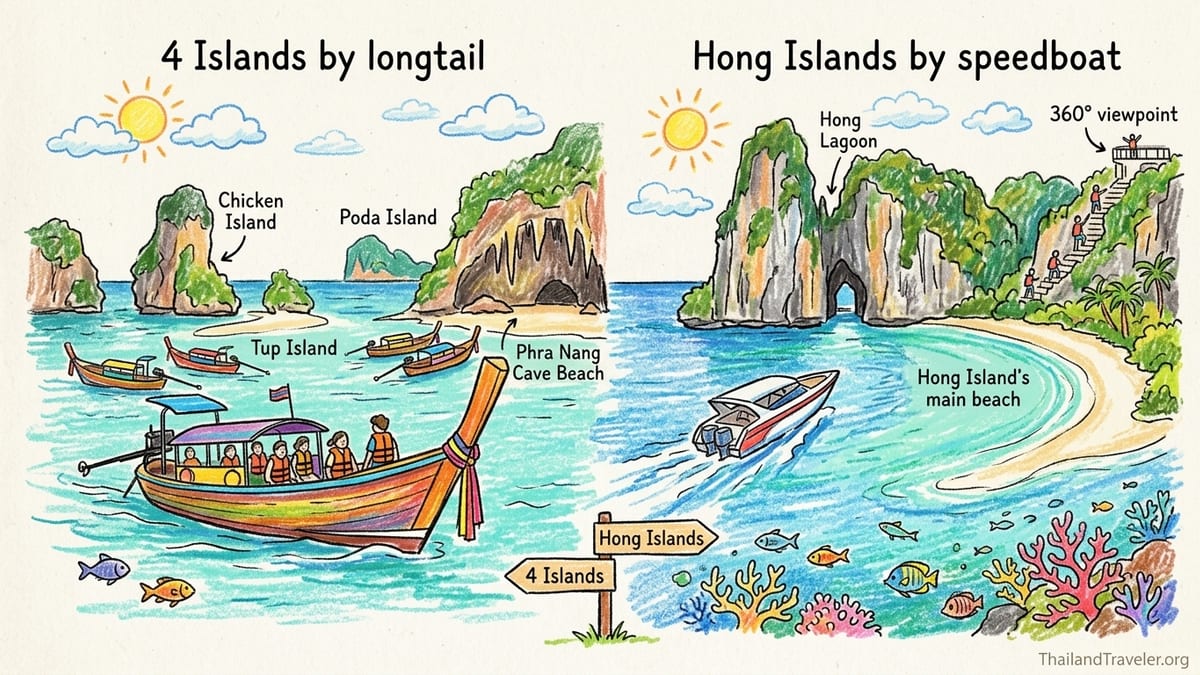
How I Tested Both Tours: Operators, Boats and Prices
To make this comparison fair, I booked both excursions while staying at the same hotel on Ao Nang Beach and in the same season. The first trip was the classic Krabi 4 Islands by shared longtail, departing on a calm, sunny Monday. The second was a Hong Islands group speedboat tour on the Thursday, when the forecast and actual conditions were similar, with light morning wind and a low swell. This meant differences I noticed were mainly about the itineraries and boat types, not the weather.
For the 4 Islands, I booked through a local booth on the main road in Ao Nang that used a cooperative longtail operator departing from Nopparat Thara Pier. I paid 800 baht per adult in March 2026 for the join-in longtail option, which matched the going range of about 599 to 1,000 baht listed by several current local operators for shared longtail tours that include hotel pickup, lunch box, soft drinks and snorkel gear. National park fees for the 4 Islands, which sit inside Hat Noppharat Thara–Mu Ko Phi Phi National Park, added 200 baht per foreign adult, paid in cash at the pier.
For Hong Islands I deliberately chose a shared speedboat, booked through a well-established Ao Nang agency working with a Krabi operator that runs daily Hong Island departures. The price at the booth was 1,200 baht per adult, which fits within the approximate 999 to 1,400 baht band that current Hong Island speedboat tours from Ao Nang advertise. On top of that, I paid a separate 300 baht per adult for the Than Bok Khorani National Park fee that covers Koh Hong and its lagoon.
Both tours included hotel pickup around 8:00 to 8:30 in the morning and returned between 15:30 and 16:00, so each was a genuine seven-hour day door-to-door. That similar duration made it much easier to compare how each operator used the time between riding the boat and actually being on the islands.
The 4 Islands Itinerary: Sandbars, Classic Cliffs and Tide-Dependent Magic
The 4 Islands tour looped through the usual Krabi highlights close to Ao Nang: Phra Nang Cave Beach by Railay, Chicken Island, Tup and Mor Islands at the Talay Waek sandbar, and finally Poda Island. From Nopparat Thara Pier, our longtail took about 20 minutes to reach the first stop at Phra Nang. Here we had 45 minutes on shore to walk under the cave, admire the huge stalactites hanging from the overhanging cliff and swim in shallow, often busy water facing the open sea.
The next stretch showcased why this tour is such a Krabi classic. The longtail motored past steep limestone karsts rising straight from the water, with Chicken Island’s rock formation clearly visible ahead. We stopped in a bay close to Chicken for snorkeling. The coral in this area is under pressure and not pristine, but I still saw small parrotfish, sergeant majors and several different damselfish in water with decent clarity, especially further from other boats. We had roughly 35 minutes in the water before moving on.
From Chicken, it was a short hop to Tup and Mor Islands, joined to Chicken by the Talay Waek sandbar at low tide. This is the iconic “separated sea” shot that fills Krabi brochures. Here, timing is everything. On my March visit the tide was halfway between low and rising, so the sandbar was visible but only ankle to knee deep in water. It was still possible to walk from Tup toward Chicken, but we did not get the endless dry ribbon of white sand promoted in posters. Several guests were disappointed that their photos did not match what they had seen online, and our guide made a point of explaining that the exact look of Talay Waek changes by the hour according to the tide.
The final main stop was Poda Island, with its long sandy beach facing a tall pillar of limestone slightly offshore. Poda delivered the most postcard-perfect Krabi beach of the day: wide sand, room to spread out, and clear shallow water over a mostly sandy bottom that was excellent for swimming but not especially rich in coral. Including time for the included lunch box, we had about one and a quarter hours here, long enough to swim, eat and walk the beach before the longtail returned to Ao Nang.
Hong Island’s Beaches, Lagoon and Viewpoint: What It Is Really Like
The Hong Islands tour felt different from the moment the speedboat left Nopparat Thara Pier. Instead of hopping between several small sandbars, this itinerary focused on fewer, more dramatic stops: Koh Hong’s main beach, the internal lagoon reached through a narrow rock gap, the 360-degree viewpoint on Koh Hong, and usually one or two smaller islands such as Lao Lading or Pakbia for lunch or extra swimming.
On my March Hong trip, the boat reached Koh Hong in about 45 minutes, cutting across deeper open water than the 4 Islands route. The first stop was the main bay on Koh Hong, a sweeping curve of creamy sand backed by jungle and enclosed by tall limestone cliffs on both sides. We had around one hour here to swim, sunbathe under scattered trees and take in the scenery. The water clarity on this day was noticeably better than I had experienced on the 4 Islands, with turquoise water and visibility good enough to see small fish wandering near the rocks at the edge of the bay.
After the main beach, our boat repositioned around the corner to the entrance of Hong Lagoon. Boats enter single file through a narrow notch in the cliffs, which opens into a sheltered bowl ringed by vertical limestone walls and mangroves. We idled inside for about 20 minutes, with time for photos and a short swim from the boat. There is limited shade inside the lagoon itself, but the enclosed nature of the space meant almost flat water, which felt reassuring for less confident swimmers and small children using life jackets.
The viewpoint climb was offered during our second stop on Koh Hong. From the beach, a signed path led to a metal staircase and raised walkway that zigzags up through the cliffs. The climb involves several hundred steps. I counted just over 400 on my way up, with small platforms at intervals. It took me about 15 to 20 minutes at a steady but unhurried pace to reach the top viewing deck. The reward was a 360-degree panorama over the emerald lagoon, scattered islands of the Hong group and the distant mainland around Krabi. There is little shade on the upper part of the climb, so doing it immediately on arrival, before the midday sun, made a big difference. The descent was quicker but required attention because the metal treads can be hot and slightly slippery when damp.
Water Clarity, Snorkeling and Time in the Sea
In terms of water quality, both tours offered inviting tropical seas, but Hong Islands had the edge for clarity during my week in Krabi. On the 4 Islands tour, visibility around Chicken Island was fair to good, enough to enjoy casual snorkeling but with patches of broken coral and cloudy sand stirred up by many fins. The shallows at Tup and Poda were excellent for relaxed swimming, but the seafloor was predominantly sand with only isolated coral heads and fewer fish close to shore.
At Hong, the water inside the main bay and especially near the rocky edges had better horizontal visibility, which made the snorkel experience more engaging, even if the coral was not spectacular compared with dedicated dive spots. I saw more schools of small reef fish and some healthier coral patches near Lao Lading, which was one of our additional stops. The lagoon itself is not primarily a snorkeling destination, but the glassy, protected water is ideal for floating and relaxed swimming, particularly for children or anyone nervous about waves.
Looking at time actually spent in the sea rather than on the boat, both tours provided several swim and snorkel opportunities. On the 4 Islands, I swam at Phra Nang, snorkeled at Chicken and swam again at Tup and Poda. However, each stop felt relatively short, and the transfers between islands, though not long, added up. I often had the sense of checking places off a list. On the Hong Islands trip, the number of stops was smaller, but each one was longer, especially the main Koh Hong beach, where one firm hour allowed for a proper swim, time in the shade and a walk along the shore.
From a snorkeling perspective and judging solely by these two days, Hong provided the better overall experience because of clearer water and more concentrated time in a couple of high-quality spots. For casual swimming over sand in classic Krabi scenery, the 4 Islands delivered more variety, but less depth at each location.
Crowds, Comfort and Boat Type: Longtail vs Speedboat
The style of boat made a tangible difference to both comfort and atmosphere. The 4 Islands longtail was a traditional wooden craft with a loud diesel engine at the back, a shallow draft and a shaded canopy mid-boat. My join-in group had about 18 passengers, which felt busy but not overcrowded. Seating is on wooden benches or the deck, and you are close to the water, which makes the scenery feel immersive. On the downside, the engine noise is continuous and conversations require raised voices when the boat is under way.
The Hong Islands speedboat carried roughly 30 passengers on upholstered seats under a hard roof, with open sides for airflow. It rode higher in the water and handled small chop with less up-and-down motion than a longtail at the same speed. However, speedboat travel comes with stronger engine vibrations and occasional slaps against waves. On my day, the ride across to Hong was smooth enough that no one looked visibly seasick, but I could see how the same route might become uncomfortable for motion-sensitive travelers during windier periods.
For children, both boats required life jackets while the boat was moving. The longtail’s lower sides made it easier for kids to look out at the sea and cliffs, which they enjoyed, but it also meant parents needed to keep them away from the edges. Transfer to the beach from both boat types involved stepping down into shallow water, sometimes onto a portable metal ladder on the speedboat. Families with very young children or travelers with limited mobility may find the speedboat slightly easier because there is usually a rear ladder and crew assistance, whereas longtails often require a bigger step into the surf.
Did the speedboat materially improve the day versus longtail? For Hong, where distances are greater, I appreciated the faster crossings because it left more time at the beach and lagoon. For the 4 Islands, which sit much closer to Ao Nang, the slower longtail pace felt appropriate and allowed more time to photograph the limestone towers up close. If you or your children are highly sensitive to motion in choppy seas, I would lean toward the 4 Islands by longtail on a calm day and be more cautious about Hong on a windy forecast, regardless of boat type.
Food, Facilities and How Rushed Each Trip Felt
Both of my tours included similar simple Thai lunches. On the 4 Islands, lunch was a packed box served on Poda Island’s beach. It consisted of fried rice with chicken, a small piece of fried chicken, a vegetable side and fruit. Drinking water and soft drinks were available from coolers on the boat. The setup was basic but efficient, and the trees along Poda’s shore offered enough natural shade for most people to sit comfortably. Simple toilets with a small usage fee were available behind the beach.
On the Hong Islands trip, lunch was served picnic-style on one of the smaller islands, in my case Lao Lading. The menu was similar in spirit: stir-fried vegetables, chicken curry, rice, fruit and water. There were more organized picnic tables here, though shade filled quickly once several boats arrived. Koh Hong’s main beach had basic park-style toilets and showers, but these saw heavy use at midday and short queues formed during our visit.
In terms of pace, the 4 Islands tour felt slightly more rushed. Although the overall duration matched Hong, the number of stops and short cruising distances meant that each time we settled into a spot, we were soon called back to the boat to move on. Photography was almost constant. By the time we reached Poda for lunch, many people appeared content but a little tired, and the final swim felt like the first chance to properly relax.
The Hong Islands itinerary was more spacious. With fewer locations and longer blocks of time at Koh Hong, I never felt hurried. The only exception was the viewpoint, where those who chose to climb had to watch the time carefully to fit the ascent, photos and descent into the one-hour window ashore. Overall, I spent more minutes of the day sitting quietly on a beach or floating in the sea on the Hong trip and more minutes changing locations on the 4 Islands day.
Private Charters, Flexibility and Real Value for Money
Across Ao Nang, agents and boat cooperatives advertise private longtail charters to both the 4 Islands and Hong Islands. During price checks in March 2026, I saw printed boards from local boat services and heard similar figures from vendors: around 3,000 to 4,000 baht per boat for a half to full-day private longtail to the 4 Islands from Ao Nang, and roughly 3,000 to 3,500 baht per boat for Hong Islands from closer beaches such as Klong Muang, slightly higher from Ao Nang once fuel and park fees were factored in. Online agencies sometimes listed higher all-inclusive packages, but the pier and beach rates for standalone boats stayed in that general range.
For a couple, that kind of private charter is obviously more expensive than a shared group tour. For a family of four or a small group of friends, the math looks different. Splitting 3,500 baht between four people can bring the per-person cost closer to or even below an organized speedboat trip, though national park tickets remain individual. The main advantage of a private boat is flexibility: you can leave Ao Nang earlier to beat the crowds, linger at a favorite island or skip a stop that does not interest you.
In practice, I have found that flexibility most useful at Hong Islands. Being able to start early, reach Koh Hong’s main beach before the bulk of group boats and spend longer inside the lagoon without hurry can change the feel of the whole day. For the 4 Islands, which are closer, group tours already operate on a fairly efficient loop, and many of the stops are small enough that an extra half-hour would not significantly alter the experience once crowds arrive.
That said, private charters do not transform the core ingredients of either tour. You still visit the same general set of islands, face the same tide conditions at Talay Waek and share beaches with other boats. What you mostly gain is control over timing and pace, which can be invaluable if you are traveling with young children, photographers who need more time to set up shots or anyone who dislikes rigid group schedules.
Avoiding Confusion: Krabi’s Koh Hong vs Phang Nga’s Sea-Cave Trips
One recurring confusion I heard from fellow travelers in Ao Nang was between Koh Hong in Krabi and the famous sea-cave kayaking tours in Phang Nga Bay. Although both involve dramatic limestone scenery and the word “Hong” appears in descriptions of each, they are different destinations in separate provinces.
The Hong Islands tour discussed here runs from Ao Nang or nearby Krabi beaches to a small island group in the Andaman Sea that is part of Than Bok Khorani National Park. Its signature experiences are the main beach on Koh Hong, the internal lagoon reached through a rock gap and the 360-degree viewpoint above the island. Boat types are longtails or speedboats, and travel time from Ao Nang is less than an hour in each direction.
Phang Nga Bay is further north and east, typically accessed from Phuket or the mainland around Phang Nga town. Classic “Hong” or sea-cave tours there involve sit-on-top kayaks paddling into flooded caves and interior lagoons under low rock ceilings. The rock formations are similar in character, but these itineraries are distinct from Krabi’s Koh Hong day trips. When booking in Ao Nang, ask clearly for “Hong Island Krabi” or “Koh Hong from Ao Nang” if that is the tour you intend, and be wary of assuming that any mention of “hongs” or caves means the same outing.
Keeping this distinction straight matters for expectations. If you want a relaxed beach day with optional snorkeling, climbing a viewpoint and a short lagoon visit, the Krabi Hong Islands tour is the correct choice. If you dream of kayaking through multiple sea caves and hongs in a larger bay filled with karsts, that is a separate Phang Nga Bay adventure that usually requires more travel by road and boat from Krabi.
Disappointments, Best Uses and My Final Verdict
No tour is perfect, and both of my Krabi boat days came with minor disappointments. On the 4 Islands, the biggest letdown was Talay Waek not looking like the brochure images. Even though I knew the sandbar appearance depends on the exact tide level, it was still slightly jarring to arrive and see a shallow, busy channel instead of the flawless white bridge between islands. The snorkeling near Chicken also showed signs of wear, with some damaged coral and cloudy sand in the shallows from heavy use.
At Hong Islands, my two frustrations were crowding on Koh Hong’s main beach at midday and the heat on the viewpoint climb. Several speedboats and longtails arrived within a short window, and despite the bay’s size, a noticeable cluster of people formed near the central section of beach. The viewpoint also lacked shade in its upper stretches, making the ascent sweaty even in the late morning. That said, both the lagoon and the panorama from the top still felt special enough to justify the effort.
If I divide the comparison into snorkeling versus scenery, my experience puts Hong Islands slightly ahead for in-water clarity and fish life, with the caveat that both areas face environmental pressure and visibility can vary by day. The 4 Islands were stronger for classic Krabi landscapes: sandbars connecting tiny islands, towering cliffs rising straight from emerald water and the iconic outline of Chicken Island. For first-time visitors looking to tick off famous views, the 4 Islands achieve a lot in a short radius from Ao Nang.
On value, both tours deliver a full day out for roughly 800 to 1,200 baht per adult for shared options as of early 2026, plus 200 to 300 baht per person in park fees. Given those similar price brackets, I judge value more by how each day felt. My Hong Islands speedboat trip provided longer, more relaxed stops and slightly better water quality, while my 4 Islands longtail was more frenetic but covered more named sights. Asked which one I would personally book again if I had only one available day from Ao Nang, I would choose Hong Islands by speedboat or a well-timed private longtail. The combination of main beach, sheltered lagoon and rewarding viewpoint gave me a deeper sense of place, even if the 4 Islands offered more individual locations.
FAQ
Q1. Which tour is better if I only have one free day in Ao Nang?
For a single day, I would choose the Hong Islands trip, ideally by speedboat in good weather. It offers clearer water, a dramatic lagoon, a rewarding viewpoint and longer, less rushed stops, even though the 4 Islands include more individual locations.
Q2. Is the Talay Waek sandbar really as dramatic as the photos?
The Talay Waek sandbar at Tup and Mor Islands can look stunning at very low tide, when a wide dry strip of sand links to Chicken Island. On many visits, including mine, the tide only exposes a shallow, knee-deep channel, which is still scenic but less dramatic than brochure images. What you see on the day depends heavily on the exact timing of low tide.
Q3. Which trip has better snorkeling, 4 Islands or Hong Islands?
Based on my back-to-back outings in March 2026, Hong Islands had clearer water and slightly healthier coral near rocks and smaller islands like Lao Lading. The 4 Islands offered enjoyable swimming and casual snorkeling, especially near Chicken, but the coral showed more damage and the water was more stirred up.
Q4. Are speedboats worth the extra cost compared with longtail boats?
For short hops around the 4 Islands, I did not find a speedboat essential, and I enjoyed the atmosphere of a traditional longtail. For the longer journey out to Hong Islands, the speedboat’s faster crossing meant more time on the beach and lagoon. If you are sensitive to long boat rides or want to maximize time ashore, paying more for a speedboat to Hong can be worthwhile.
Q5. Is either tour suitable for young children or travelers prone to seasickness?
The 4 Islands are closer to Ao Nang and sit in more sheltered water, so that tour generally feels gentler for motion-sensitive travelers, especially by longtail on a calm day. Hong Islands require crossing deeper, more open water that can become choppy when the wind picks up, though my speedboat ride was smooth in light conditions. In both cases, life jackets are provided and widely used.
Q6. How crowded do these tours get and can private charters avoid the crowds?
Both routes attract many boats, particularly between late morning and early afternoon. On my visits, small sandbars on the 4 Islands felt busy but manageable, while Koh Hong’s main beach saw a dense cluster of visitors at midday. A private charter lets you leave earlier or shift your schedule, which can help you reach key spots before or after the worst of the crowds, but it does not guarantee solitude.
Q7. Do I need to be fit to do the Hong Island viewpoint?
The Hong viewpoint involves climbing several hundred metal steps, roughly 15 to 20 minutes of steady ascent with small platforms to rest. You do not need to be an athlete, but you should be comfortable with stairs and heat. Those with knee or mobility issues may prefer to skip the climb and enjoy the beach and lagoon instead.
Q8. How much should I budget for each tour including extra costs?
In early 2026, a shared 4 Islands longtail from Ao Nang typically costs around 600 to 1,000 baht per adult, plus a 200 baht national park fee. A shared Hong Islands speedboat runs about 1,000 to 1,400 baht per adult, plus a 300 baht park fee. Private longtails to either area usually start around 3,000 to 4,000 baht per boat, not including park tickets, which remain per person.
Q9. Are there good shaded areas and facilities on both tours?
Yes, but they vary by stop. Poda Island and Koh Hong both have trees that provide natural shade, along with basic toilets and showers for a small fee. Smaller sandbars like Tup and Lao Lading have limited shade, so bringing a hat, sunscreen and plenty of water is important.
Q10. How can I make sure I am booking Krabi’s Koh Hong and not a different “Hong” tour?
When booking in Ao Nang, mention “Hong Island from Ao Nang in Krabi” and check that the itinerary includes Koh Hong’s main beach, the inner lagoon and the viewpoint. Avoid assuming that any tour mentioning “hongs” or sea caves is the same, as many Phang Nga Bay kayak trips also use that term but depart from different areas and follow totally different routes.