


The first sign that Koh Yao Noi would feel different from Phuket came at Bang Rong Pier. A rooster scratched between parked scooters, women in hijab stacked crates of vegetables beside sacks of ice, and on the water a long wooden boat slid past a fiberglass speedboat. Half an hour later, I stepped off at Manoh Pier on a working island that still runs on tide tables, fishing runs and school hours rather than resort schedules, and I spent the next two days getting to know it at the gentlest possible pace: by bicycle.
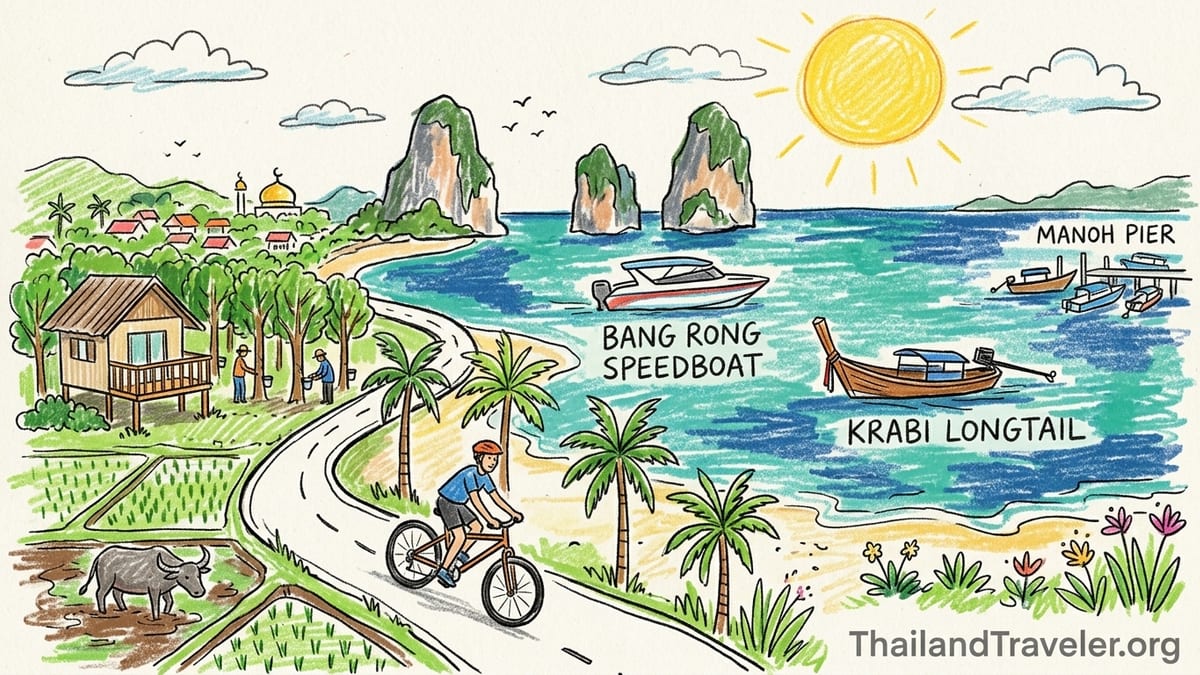
Crossing the Andaman: From Bang Rong and Krabi to Manoh Pier
Reaching Koh Yao Noi is part of understanding it. From Phuket, the main departure point is Bang Rong Pier on the island’s northeast, about 30 minutes by taxi from the airport and closer to an hour from Patong in normal traffic. At the pier, speedboats run several times a day to Manoh Pier on Koh Yao Noi. As of late 2026, the Koh Yao Noi Boat Club lists foreign adult fares at around 400 baht for the speedboat and 300 baht for the slower wooden longtail, with a crossing time of about 30 minutes for the speedboat and close to an hour for the longtail.
I chose an early morning speedboat from Bang Rong to avoid the midday heat on arrival. The ticket office took cash, issued a simple paper stub, and directed passengers to wait under a rusting tin roof where vendors sold iced coffee and plastic bags of sticky rice and grilled chicken. The boat itself was a covered fiberglass speedboat with three rows of bench seating and lifejackets hung overhead. Departing sharply on time, it skimmed past mangrove channels before opening out into Phang Nga Bay, limestone towers rising ahead as the sea shifted from muddy green to a clearer pearl.
For travelers coming from Krabi instead, the usual route is by road to Tha Len (also spelled Thalane) Pier north of Ao Nang, then by longtail or speedboat to Koh Yao Noi. Recent traveler reports and local information boards still list shared longtail fares from Tha Len to Koh Yao Noi in the range of a few hundred baht per person, with journey times around 40 to 50 minutes depending on tide and sea conditions. Schedules are more limited than from Phuket, so it is worth asking your accommodation to confirm the current first and last departures before you commit to a flight time.
Arrival at Manoh Pier underlined that this is a working island first and a tourist escape second. Instead of resort vans lined in formation, I found a loose row of shared songthaews, a couple of shaded tuk tuks and a handful of private taxis, many driven by local residents who also fish or farm. A shared transfer to midrange accommodation on the east coast cost around 100 to 150 baht per person; a private pick up in an air conditioned car or covered pickup was quoted at 300 to 500 baht depending on distance. The ride from pier to the main village took barely ten minutes along a single looping road.
Staying on Koh Yao Noi: Realistic Costs and a Base for Exploration
Sitting roughly between the upmarket villa-world of Six Senses and simple bungalows along village lanes, Koh Yao Noi’s midrange options give an honest picture of what a two or three night stay actually costs. Recent booking platforms put simple fan or air conditioned bungalows and guesthouses at around 700 to 1,500 baht per night, with midrange beach-facing hotels between 2,000 and 4,000 baht, depending on season and how close you are to the coveted Phang Nga Bay views. Well known properties like Cape Kudu Hotel or Koh Yao Island Resort often climb higher into the 4,000 to 7,000 baht range and beyond in peak months, especially around Christmas and New Year, while homestays tucked behind the main road can be found from under 1,000 baht if you book directly and outside major holidays.
For this trip, I chose a locally owned bungalow set a short walk from the east coast, paying the local equivalent of about 1,800 baht per night in October for an air conditioned wooden room with a balcony, hot shower, small fridge and breakfast of rice soup or eggs and toast. The owner’s family lived in the house next door, chickens wandered under the stilts, and the shared lobby doubled as a small cafe used by locals and guests. Being slightly inland meant I could roll straight out to the island’s main circular road without crossing private resort grounds, an advantage if you want to explore independently by bicycle.
Food costs on Koh Yao Noi remain relatively modest if you eat where residents do. Local rice and noodle restaurants in the main village and along the coastal road served substantial plates of pad krapao or fried noodles from about 70 to 120 baht, with fish curries, whole fried fish and shared dishes from 150 to 300 baht depending on size and catch. Fresh coconuts ranged from 40 to 80 baht, iced coffee from 40 to 70 baht, and simple bakery snacks or roti from 20 to 40 baht. Only at higher end resorts did prices approach those of Phuket’s west coast beaches.
For a two night, bicycle based visit, a realistic daily budget for a midrange traveler who is not staying in a luxury resort might sit around 2,500 to 3,500 baht per person. That covers accommodation in a comfortable guesthouse or small hotel, local meals, bicycle rental, boat transfers and some extra for ice cream, a short boat outing and an evening mocktail or beer at a bar looking out onto the bay.
Pedaling the Island: Bicycles, Heat and Road Conditions
Koh Yao Noi is small enough that you can loop much of the island by bicycle in a long morning, but the heat and short, sometimes steep hills mean it rewards an unhurried approach. Several guesthouses and independent shops rent bicycles in and around the main village. Recent local operators’ price boards advertise standard mountain bikes from about 200 to 300 baht per day, with better maintained or newer models and delivery to your accommodation nudging that closer to 350 or 400 baht. Helmets are not always included, so bringing one or asking ahead is worthwhile.
I collected a mid range mountain bike from a small rental business just off the main road, paying 250 baht for 24 hours. The owner checked the brakes and gears in front of me, adjusted the saddle and pointed out a simple loop: east coast viewpoints in the morning, rice fields and rubber plantations inland as the day grew hotter, then back to the quiet west coast by late afternoon. The main ring road around the island is paved and in fair condition, with only a few potholes and a narrow shoulder, while many smaller lanes leading into plantations or to lesser known beaches turn to compacted dirt or concrete strips.
Cycling conditions changed quickly with the time of day. By 8:30 in the morning, stretches that cut through rubber trees still sat in deep shade, the air cooler and scented with earth and latex as workers in boots and long sleeves emptied cups of sap into larger buckets. By late morning, climbs up to modest headlands or through more open sections grew intense, with heat radiating from the asphalt and almost no breeze. Over two full days of riding, I covered roughly 20 to 30 kilometers daily, broken into segments with long breaks for food, cold drinks and swims.
Traffic remained light away from school closing times and the short commuter peaks at dawn and dusk. Most vehicles were scooters, small trucks or tuk tuks moving at moderate speeds, and drivers generally gave ample space to bicycles. Still, there are no dedicated bike lanes and occasional blind corners and dogs suddenly crossing mean riders should be confident on the road. If you are not comfortable in the heat or with small ascents, arranging a local driver with a pickup truck for part of the day is a widely used alternative, with full day rates often quoted around 1,000 to 1,500 baht for a private island tour for two or more people, depending on negotiation and stops.
Villages, Rice Fields and Rubber Trees: A Route into Everyday Life
From my guesthouse near the east coast, the first morning’s ride followed the main road north along the shoreline, with short detours toward small concrete piers where fishermen were unloading the night’s catch. Boats sat low with squid, small reef fish and occasional larger specimens destined for markets on the mainland. When I stopped to watch, I stayed back from the action, only moving closer when one fisherman, laughing, waved me over to show a basket of glistening fish. With a nod of permission, I took a quick photo of the catch, not of the men themselves, to avoid intruding on their work.
Leaving the water, a narrow lane cut inland across bright green rice paddies, the kind of scene that silently explains why Koh Yao Noi still feels different from Phuket just across the water. Water buffalos grazed in soggy corners, and a wooden shelter offered the only shade along a two kilometer stretch. Here the heat felt more intense because there was no sea breeze, so I rationed my riding to short spurts, hopping from shade to shade, and drained a full liter of water before noon. Local corner shops in nearby villages sold large bottles of drinking water for around 20 to 25 baht and small electrolyte drinks or sodas for 15 to 30 baht, essential for anyone cycling longer distances.
The road then rose gently into rubber plantations, where carefully spaced trees in neat rows gave an almost architectural rhythm to the ride. Many of the small land plots are still family operated, and it is important to remember that these are workplaces and private property, not open tourist attractions. When I saw a woman cleaning rubber sheets near her house, I stopped on the verge of the public road and kept my camera in my bag. Only after a brief exchange in basic Thai and English, and a clear nod that it was acceptable, did I take a single photograph, mindful not to include her face or house number.
Lunch that day was in a simple Muslim owned restaurant near the main village mosque, reached after another five kilometer stretch of mostly flat road. The menu was a blackboard listing fish curry, chicken biryani and stir fried vegetables. I chose fish curry with rice and an iced tea; the bill came to around 130 baht. Other diners were a mix of local families and a few visiting Thai workers from the mainland. Dress here mattered. I had packed a light, loose long sleeved shirt and longer shorts that reached below the knee, which felt like the minimum respectful standard away from the beach in this predominantly Muslim community.
Beaches Beyond the Postcards: Tides, Mudflats and Swimming Reality
Koh Yao Noi’s beaches are not Phuket’s long, wave washed sweeps of sand or Phi Phi’s dramatic coves, and that is precisely part of its charm. On the east coast, much of the shoreline faces shallow water and extensive tidal flats. At low tide, the sea retreats hundreds of meters, leaving rippled sand and patches of mud exposed. It is a beautiful sight in its own right, especially with the backdrop of limestone karsts rising from the bay, but it is not the effortless all day swimming some visitors expect from glossy brochures.
On my first afternoon, arriving at a well known east coast stretch shortly after low tide, the waterline lay far out across glistening mud and ankle deep pools. A narrow channel near a small pier allowed local longtail boats to come and go, but there was little point in wading out to swim. Instead, I watched children scavenging for shellfish and crabs, a reminder that this intertidal zone is a crucial part of local food and income. By late afternoon, as the tide turned, patches of water began to creep back, and a shallow swim became possible in water still warm from the sun.
Anyone whose priority is long, deep swimming directly from the sand at all times of the day may be happier on Phuket’s west coast beaches such as Kata or Kamala, or on beaches around Phi Phi Don that face slightly deeper water. On Koh Yao Noi, better swimming from the main island often coincides with mid and high tide on certain coastal sections or along smaller west coast bays where the seabed shelves a little faster. Local guesthouse owners and restaurant staff were honest about conditions when asked, often advising, for example, that a late morning high tide on a given day would be the best window for a proper swim.
That said, even where the swimming is limited, the views can surpass those from many busier islands. Sitting on the sand at dusk on the east coast, facing a row of jagged limestone peaks glowing orange and pink, I saw only a scattered handful of other visitors. At one small beach bar, a fresh coconut cost 70 baht and a fruit shake 90 baht, with the soundtrack nothing more than soft conversation and the occasional thud of a fishing boat against its mooring.
Culture, Etiquette and Being a Respectful Guest
Koh Yao Noi is part of Phang Nga province’s Muslim majority area, and its mosques, calls to prayer and local dress set a different tone from many of Thailand’s more hedonistic islands. Most local women wear hijab and modest clothing, and men often dress conservatively as well. Visitors are warmly welcomed in shops, cafes and homestays, but there is an unspoken expectation that outsiders will respect community norms, especially away from designated tourist beaches.
In practice, this means packing more than just swimwear and beach shorts. When cycling through villages, visiting markets or eating in local restaurants, light trousers or knee covering shorts and tops that cover shoulders are appropriate for all genders. Swimwear and bare chests belong on the beach or at a resort pool, not on village streets or in front of mosques. Alcohol is available at many tourist oriented restaurants and bars, but some family run places do not serve it, and it is considerate not to bring your own to clearly non alcohol venues.
Photography etiquette is another area where Koh Yao Noi benefits from visitors’ sensitivity. The island’s daily life is visually compelling, from fishermen repairing nets to women sorting rubber sheets, but this is not a living museum. Before taking any identifiable photograph of a person or their home, particularly in villages, I made a point of asking with a smile, a gesture to my camera and a simple “okay?” If there was any hesitation, I lowered the camera and moved on. Children, who often love being photographed, should still be approached via a parent or caregiver rather than directly.
Participation in community based tourism activities works best when it is clearly invited. Several homestay networks and local groups on Koh Yao Noi organise guided bicycle tours, cooking classes or visits to small craft workshops. One hotel on a neighboring island, for example, advertises an eco bike tour in cooperation with local villagers at around 1,000 baht per person, and while that example is resort led, similar experiences on Koh Yao Noi are increasingly run or co run by residents themselves. I joined a short, prearranged visit to a small batik workshop where the owner welcomed guests as part of her income. Only after she explicitly indicated that photographs were fine, and only of the fabrics and our hands at work, did I take any pictures.
Exploring Without a Scooter: Local Transport and a Short Boat Trip
Many visitors assume that renting a scooter is the only practical way to get around a Thai island. On Koh Yao Noi, bicycles combined with local transport are a workable alternative, particularly for a two or three night stay. In addition to day rentals, some bicycle shops will deliver or collect bikes at agreed times, allowing you to use pedal power in the cooler hours and rely on a driver when the sun is highest. Guesthouses commonly help arrange a local driver with a pickup or tuk tuk, with typical half day rates in the 700 to 1,000 baht range for a couple or small group, depending on distance and fuel prices.
Road safety feels more forgiving here than on busy tourist centers like Phuket, primarily because of lower speeds and traffic density. Even so, helmets are advisable, and carrying lights or at least reflective clothing is wise if you plan to cycle at dusk. Dogs can be territorial near houses, so slowing down, giving them space and avoiding eye contact usually keeps encounters uneventful. In heavy rain, the few steeper concrete sections may become slippery, in which case flagging down a passing pickup and negotiating a short ride is a normal and acceptable solution.
Koh Yao Noi’s position in the bay makes it tempting to head straight out on a full day boat tour, but I chose a shorter, locally booked outing that still left time for cycling. At the beach near my guesthouse, a cluster of longtail captains rested in the shade, waiting for passengers. With the help of my host acting as translator, I agreed an afternoon boat trip to two nearby small islands, including time for a swim and a stop at a tiny beach with no facilities, for 1,500 baht in total for two people. The price included snorkeling masks, though the captain was clear that coral in the immediate area had suffered and that visibility would not match classic sites around Phi Phi or the Similans.
We left just after lunch in a wooden longtail, riding low in the water and powered by the characteristic exposed engine and long propeller shaft at the stern. The sea was calm, the journey to the first island took fifteen minutes, and we had the small cove entirely to ourselves between other tours’ schedules. On the second stop, a patch of sand barely wider than the boat, the tide was already advancing, so we waded and floated in shoulder deep water looking back toward Koh Yao Noi’s gentle green hills. Returning before sunset left plenty of light for an easy cycle back to my bungalow.
Evenings on a Quiet Island: What to Expect After Dark
Evenings on Koh Yao Noi are closer to a small town rhythm than a beach party scene. After dusk, locals gather at simple eateries, children play in front yards, and only a handful of bars along the east coast and in the main village stay open late. A beer in a guesthouse bar might cost around 80 to 120 baht, a mocktail 100 to 160 baht, and a plate of fried rice about 90 to 130 baht. Music, where it exists, tends to be low key: acoustic covers, Thai pop at modest volume, or simply recorded playlists in the background.
Without neon or club noise, the most compelling evening activity is often simple: walking or cycling slowly along the coastal road as the air cools. With a headlamp or bicycle light, it is easy to reach a village night market if your stay coincides with one of its operating days. These small markets serve skewers, grilled squid, sweet roti and plastic cups of iced drinks at prices very similar to those at midday, with stalls often closing by 9 or 10 p.m. Late night convenience stores are limited, so stocking up on essentials like drinking water and snacks before dark is prudent.
The absence of big ticket nightlife can feel inconvenient for travelers used to the buzz of Patong or Ao Nang, but it contributes directly to Koh Yao Noi’s appeal as a place where stars are visible and scooter noise fades to a distant hum by bedtime. Back at my bungalow, the loudest sound after 10 p.m. was the occasional slow passing truck and geckos clicking in the rafters. Wi-Fi was strong enough for a video call home, but streaming high definition movies sometimes buffered, a reminder that this is an island where early nights are part of the rhythm.
The Takeaway
After two nights and two full days of cycling, walking and short boat trips, Koh Yao Noi left a distinct impression that contrasted sharply with the high energy gloss of much of the Andaman coast. I appreciated most of all the island’s slower pace: the way morning began with the call to prayer and distant rooster crows, how school traffic thinned into quiet midmornings perfect for gentle rides, and the ease with which a visitor could find themselves alone on a stretch of beach or among rice paddies just a few kilometers from the pier.
That slower rhythm came with practical inconveniences. The combination of heat and hills made mid day cycling hard work, and anyone unaccustomed to tropical sun will need to strictly plan riding for early and late hours and budget for frequent cold drink stops. The relative scarcity of deep swimming at low tide, especially on the east coast, might disappoint travelers expecting the all day turquoise lagoons advertised in some generic island marketing. Moving around without a scooter required more planning, coordination with bicycle rental shops and occasional negotiation with local drivers.
On balance, the beaches did not deliver non stop, picture perfect swimming, but they did exceed expectations in a different way. The interplay of tide, exposed flats, working boats and limestone silhouettes felt more like a lived landscape than a curated resort backdrop. When I did find stretches of deeper water at higher tide, the sense of having timed my day to the sea, rather than to a crowded tour boat schedule, made each swim feel deserved.
Would I recommend Koh Yao Noi for a two night escape or for a longer holiday? For travelers seeking a quick break from Phuket or Krabi, two nights is enough to understand the island’s character: to ride through plantations, eat in local restaurants, catch at least one good high tide swim and perhaps fit in a short boat trip. Those drawn to slow travel, reading on a balcony between rides, learning basic Thai phrases and returning to the same noodle stall each evening could easily stretch that into a week without running out of small discoveries. Koh Yao Noi is not a resort fantasy; it is a working island that still feels like home for its residents first. Approached with respect, a bicycle and realistic expectations about beaches and comfort, it becomes one of the most rewarding detours in the Andaman Sea.
FAQ
Q1. How long does the boat from Phuket to Koh Yao Noi take, and how much does it cost?
The speedboat from Bang Rong Pier in Phuket to Manoh Pier on Koh Yao Noi usually takes about 30 minutes. As of mid 2026, foreign adult fares are widely quoted at around 400 to 500 baht one way, depending on the operator and whether you buy directly at the pier or through an agency. Slower wooden longtail boats, where available, often cost a little less but take closer to an hour.
Q2. Is it realistic to explore Koh Yao Noi without renting a scooter?
Yes. For a stay of two or three nights, combining bicycle rental with local transport works well. You can rent a basic mountain bike from around 200 to 300 baht per day and then hire local drivers in pickup trucks or tuk tuks for hotter hours or longer stretches, with half day private tours often in the 700 to 1,000 baht range for two or more people. This approach is comfortable if you plan your route and avoid cycling in the midday heat.
Q3. What kind of accommodation budget should I plan for on Koh Yao Noi?
Simple guesthouses and bungalows start at roughly 700 to 1,500 baht per night, midrange beachfront or sea view hotels from about 2,000 to 4,000 baht, and upscale or luxury resorts can run from 4,000 baht into the tens of thousands per night in peak season. A midrange traveler who eats mainly at local restaurants and rents a bicycle can expect to spend roughly 2,500 to 3,500 baht per person per day, including accommodation and transport, excluding high end resorts.
Q4. Are the beaches on Koh Yao Noi good for swimming?
Swimming is possible, but it depends on the tide and location. Many east coast beaches have very shallow water and wide mudflats at low tide, which are scenic but not ideal for deep swimming. Better swimming tends to occur at mid or high tide and on certain small bays where the seabed drops more quickly. If constant deep water swimming is a priority, islands like Phi Phi or west coast Phuket beaches may suit you better, but Koh Yao Noi offers quieter, more local feeling shores.
Q5. What should I wear to respect local culture on Koh Yao Noi?
The island is predominantly Muslim, so modest dress is appreciated away from swimming areas. Light trousers or knee length shorts and tops covering the shoulders are suitable for both men and women when in villages, markets and local restaurants. Swimwear is fine on the beach or at resort pools, but going shirtless or wearing bikinis through village streets is considered disrespectful.
Q6. How challenging is cycling on Koh Yao Noi in terms of hills and heat?
The island’s main roads are mostly gently rolling with a few short, steeper sections. For reasonably fit riders, distances of 20 to 30 kilometers per day are manageable, but the real challenge is the heat and humidity, especially from late morning to mid afternoon. Planning rides for early morning and late afternoon, drinking plenty of water and taking regular shade breaks are essential for a comfortable experience.
Q7. Can I find local food and not just resort restaurants?
Yes. Koh Yao Noi has a good number of local restaurants and simple eateries where residents eat daily. Dishes like stir fried basil with rice, curries, fried noodles and grilled fish often cost between 70 and 300 baht depending on the dish and portion size. These places give a more authentic sense of the island than eating exclusively at resort dining rooms, and they are generally welcoming to visitors who dress respectfully.
Q8. Is Koh Yao Noi suitable for families with children?
For families who enjoy quiet settings, nature and simple activities like cycling, short boat trips and beachcombing at low tide, Koh Yao Noi can be very rewarding. However, there are limited formal kids’ clubs, playgrounds or entertainment options compared with larger resorts in Phuket. Parents should also account for road safety when cycling with children and for strong sun, planning shorter rides and ample rest time.
Q9. What kind of evening activities can I expect on the island?
Evenings are generally low key. You will find a few bars and guesthouse restaurants where you can have a drink and a meal, occasional live music or acoustic sets, and small markets on some nights. There are no big clubs or late night party strips. Most visitors spend evenings watching sunset, having relaxed dinners, reading or socialising quietly at their accommodation, and nights are usually peaceful by around 10 or 11 p.m.
Q10. How many nights should I stay on Koh Yao Noi?
Two nights is enough to get a feel for the island, fit in a couple of bicycle excursions, eat at local restaurants and take a short boat trip. If you like slow travel, enjoy reading in hammocks and do not need constant entertainment, extending to four or five nights allows you to explore more corners of the island, adjust to the tides for better swimming windows and settle into the local rhythm without rushing.