


By the time our longtail nosed away from Koh Mook’s village pier and pointed at the limestone wall of the Andaman Sea, the sky over Trang was a hard, bright blue and the tide was already dropping. I had read about Emerald Cave, or Tham Morakot, for years: an 80‑metre sea tunnel that opens abruptly into a hidden beach sealed by cliffs. Experiencing it, I quickly learned, is not just about squeezing through a photogenic archway. It is about timing the tide, trusting a local skipper who reads this coastline like a book, and accepting that for a few minutes you will be swimming in complete darkness with only the echo of voices and the slap of water for company.
Planning the Trip: Pier, Price and Choosing a Base
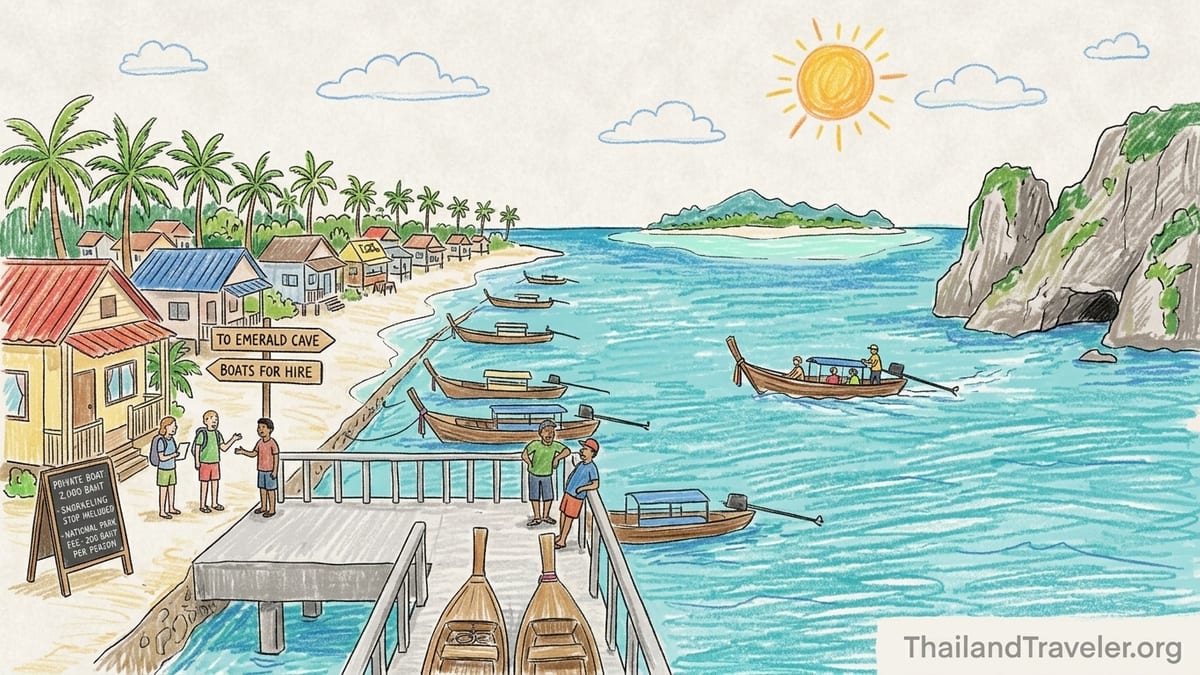
I based this visit on Koh Mook itself, which sits at the heart of the Trang archipelago and functions as the everyday, lived‑in island among more resort‑style neighbours. From the village side, longtail boats line up along the concrete pier and the beach in front of simple guesthouses and small cafes. Here, visiting Emerald Cave is less a luxury excursion and more part of the island’s daily rhythm. Boat owners lean on the pier railings discussing tides, while guesthouse managers make calls to see which skipper is available for the prime cave window that day.
For this trip I booked a private longtail through my guesthouse for two people. In October 2026, the going rate quoted by several operators on Koh Mook for a half‑day charter to Emerald Cave plus a snorkeling stop at a nearby island was between 1,800 and 2,500 baht for the boat, including life jackets and basic masks but not the national park fee. A shared four‑island tour from Koh Mook or the Trang mainland typically cost around 800 to 1,200 baht per person, including lunch and snorkeling gear, with Emerald Cave as the headline stop. Coming from Koh Lanta, island‑hopping day trips that include Emerald Cave, Koh Ngai and Koh Kradan were generally advertised around 1,800 to 2,500 baht per person depending on group size and boat type.
The other fixed cost is the Hat Chao Mai National Park fee, which covers Emerald Cave and most of the Trang islands often visited on these trips. In late 2026, foreign adults were paying around 200 baht per person, usually collected on board by rangers or settled at the pier before departure. Operators from Koh Lanta that cross into Trang’s national‑park waters normally include this fee in their package price; from Koh Mook and the Trang mainland it was more often itemised separately, so it is worth asking in advance how and when you will pay.
Total cost for our two‑person private charter from Koh Mook, including park fees and a simple packed lunch from our guesthouse, came to just under 3,000 baht. In practice, this meant a quieter experience at the cave, the ability to stay longer at our chosen snorkeling spot, and the flexibility to adjust departure to match the day’s best tide for Emerald Cave.
Departure from Koh Mook: Weather, Timing and the Run Out
We left Koh Mook’s village pier in the late morning on a day of gentle northeast breeze, at the tail end of the monsoon period when tours were just beginning to pick up for the dry season. The sea state matters at Emerald Cave; even a modest swell can make the low rock arch at the tunnel entrance an uncomfortable squeeze. My skipper had checked that low tide would fall just after midday and timed our departure so we would arrive at the cave with enough water to swim but a roof high enough to feel safe.
The journey from Koh Mook’s village side to the west‑facing cliff where the cave lies took about 20 minutes by longtail. We motored first along the island’s mangrove‑lined northern shore, then around to the sheer limestone walls that define the western coastline. Against the engine’s rhythmic chug, the guide used the time to explain the plan: we would anchor just outside the cave mouth, put on life jackets, and swim in together holding onto a rope, with him at the front with a waterproof torch and another assistant bringing up the rear.
Arriving from Koh Lanta or the Trang mainland takes longer and shapes the whole day. Boats from Koh Lanta often spend 90 minutes to two hours reaching the Trang islands, so departures can be as early as 8:00 to 8:30 in the morning to match a mid‑day tide at the cave. Mainland boats from Pak Meng or Khuan Tung Ku piers usually take 45 to 60 minutes, again leaving at varying times because every operator is working backwards from the tide chart pinned to their office wall. If the sea is too rough on the west side of Koh Mook, skippers will skip the cave entirely or wait off the cliffs to see if conditions improve. No reputable guide wants their name attached to a risky transit.
On this particular day, the sea was calm and the visibility above water excellent, with high clouds softening the sun. That matters more than it seems: inside the hidden lagoon, the iconic emerald glow appears only when sunlight enters at a certain angle. Guides tend to aim for late morning to early afternoon so that, tide and weather permitting, visitors see the water at its brightest once they have already completed the dark swim.
Entering the Tunnel: Darkness, Effort and Safety Inside Tham Morakot
From a distance, the entrance to Emerald Cave is surprisingly discreet: a low, jagged arch at the base of a sheer cliff. At high tide, locals reminded me, that same opening disappears beneath the waves, and at extreme low tide there can be too little water to swim comfortably. When we arrived, small waves lapped just below the limestone lip, leaving perhaps a metre of headroom under the rock. Two other longtails floated nearby, a manageable crowd by high‑season standards when many more boats can line up outside.
Our guide passed out life jackets to everyone, including capable swimmers, and insisted that one person in each couple carry a waterproof bag for phones only if they were fully comfortable in the water. He clipped a rope to a metal ring on the cliff and ran it into the tunnel’s gloom. Guides now almost always use such ropes, both as a control measure for their group and as a psychological safety line for nervous swimmers. With fins discouraged due to the confined space, the swim relies on steady kicking and an occasional pull on the rope to maintain progress.
The first stretch inside the cave remained faintly lit by the rectangle of daylight behind us. Within a few strokes, though, the tunnel bent and the outside world vanished. The darkness was not figurative; with no artificial lights installed and only the guide’s headlamp and a few scattered torches among the group, visibility dropped to the immediate circle of water at chest level. The rock ceiling felt low but not oppressively so, and I never had to duck fully underwater. Still, the acoustics magnified everything: splashes, nervous laughter, short instructions barked in several languages.
Physically, the swim was moderate rather than strenuous. At mid‑tide, the water level reached my chest to shoulders, allowing a relaxed breaststroke or back‑float while holding the rope. Those who were less confident simply held onto the life jackets of the people in front. There was a very gentle surge inside the tunnel as small swells compressed against the walls, enough to feel the water breathing around you but not strong enough to knock anyone off course. The guide checked repeatedly that everyone was moving comfortably and reminded us to keep voices low so instructions could be heard.
More than once I reminded myself that this darkness, while briefly unsettling, is precisely the point. Swimming the tunnel is an exercise in trusting local expertise and basic safety gear rather than an adrenaline stunt. Our guide emphasised that he would not have entered if the tide had been higher or the swell stronger, and that under those conditions the park and boat operators routinely close the cave. The same warning was repeated several times: never attempt the passage independently without checking the tide and talking to someone who knows the local sea conditions on that specific day.
The Hidden Beach: Light, Crowds and Photography in the Lagoon
After what felt longer than it was, a faint greenish light appeared ahead. Within moments, the darkness opened into a circular bowl of sky and cliffs. The hidden beach inside Emerald Cave is a collapsed sinkhole surrounded by near‑vertical limestone walls draped in jungle, with a strip of pale sand and clear, waist‑deep water. Having just spent several minutes in blackness, the sudden brightness was almost shocking. As the sun bounced off the sandy bottom and through the narrow tunnel behind us, the water took on the promised emerald cast that gives Tham Morakot its name.
Crowding is highly dependent on season and tide. On my visit, in shoulder‑season conditions, there were around 30 people on the sand at peak. In high season, guides described far busier periods, with groups arriving one after another in lines of orange life jackets. To control the numbers, boat crews often wait outside the entrance until the previous group has exited, or they stagger arrivals so that swimmers do not clog the narrowest section of the tunnel. Once inside, many guides set a loose time limit, usually between 20 and 30 minutes, to ensure all their guests can enjoy the lagoon and still exit before the tide shifts.
Photography is possible but not effortless. Any camera that comes through the tunnel must be in a waterproof housing or dry bag, and handling it while swimming in the dark is awkward. Most people simply used waterproof phones or compact cameras, snapping quickly once they reached the sand. The light bounces steeply inside the bowl, meaning that around midday the beach can be very bright with deep shadows along the cliff base. I found the best photographs came from standing knee‑deep in the water facing the tunnel, capturing both emerald reflections and the curve of the cliffs, although moments without anyone else in the frame were rare.
Inside the lagoon, there is not much to do beyond soak in the improbability of the place. The sand is soft, the water clear but shallow, and there are no services at all. National‑park rules prohibit littering, climbing the fragile slopes or staying past official hours, and guides are quick to call out anyone who tries to scramble up the rocks. After our allocated time, our guide gave a short whistle, lined everyone up along the rope again and led the group back into the tunnel. Emerging into full daylight a second time, with the Andaman stretching out beyond the cliff, felt both relieving and slightly unreal.
Snorkeling Stop: Koh Kradan’s Beaches and Underwater Life
Most Emerald Cave trips, whether from Koh Mook, Trang or Koh Lanta, combine the cave with at least one snorkeling or beach stop on another island. Our itinerary continued to Koh Kradan, about 25 minutes away by longtail from Koh Mook. Koh Kradan has developed a reputation as the quintessential postcard island of Trang, with a long crescent of white sand and consistently clear water. Much of the coastline falls inside Hat Chao Mai National Park, and a marine survey in 2026 reported that coral in the wider area, including sites off Koh Kradan and Koh Mook, was generally in normal condition without significant bleaching at the time of inspection.
We anchored over a shallow reef just off Koh Kradan’s main beach. From the surface, the water was a luminous pale turquoise, and visibility once I slipped off the ladder was around 10 to 15 metres horizontally. The coral itself showed some of the wear and tear common across heavily visited parts of the Andaman Sea, with broken patches near the shallowest areas, but also plenty of live hard coral heads and soft corals swaying in the gentle current. Over the course of 45 minutes in the water I saw darting schools of fusiliers, several parrotfish, a curious cuttlefish hovering above the sand and, on the edge of the drop‑off, a small reef shark sweeping past without interest in the gawking humans above.
Snorkeling comfort was generally high. Surface chop remained light, and most swimmers stayed within a few metres of the boat, using life jackets as floatation when needed. Our longtail carried a basic set of masks and snorkels included in the charter price, with fins available in only a few sizes and not offered as standard. The masks were functional but clearly well used, and I was glad I had brought my own. On group excursions from Koh Lanta, equipment is usually similar mid‑range quality, suitable for casual snorkelers rather than dedicated free‑divers. Those with prescription needs or particular fit preferences should consider packing their own gear.
Lunch arrangements varied by operator. In our case, the guesthouse on Koh Mook had packed simple fried‑rice boxes and fruit, which we ate in the shade of casuarina trees just behind Koh Kradan’s sand, supplementing them with cold drinks from a small beach bar. Large day‑trip boats from Koh Lanta or the Trang mainland tend to provide buffet‑style curries and stir‑fries served from the boat or set up picnic‑style on one of the beaches. In all cases, national‑park regulations require rubbish be taken off the islands, and crews are generally good at collecting plates and cups before moving on.
Private Longtail vs Group Excursion: Crowds, Tides and Value
Having experienced Emerald Cave as a private charter and spoken with travellers who visited on larger group boats, the differences are less about raw comfort and more about control over timing and atmosphere. On a private longtail from Koh Mook, our skipper could shift departure at short notice to match a better tide, wait offshore if another group was already in the tunnel, or extend our stay at Koh Kradan when the visibility proved particularly good. The cost worked out slightly lower per person than many group tours would have for a couple, especially once we accounted for park fees negotiated directly with rangers.
Group excursions from Koh Lanta or the Trang mainland, on the other hand, package logistics into a single decision. Operators collect guests from hotels, provide a guide in multiple languages, include lunch and drinking water, and ensure park fees are handled. The trade‑off comes in flexibility; with 20 to 40 people on a speedboat or large longtail, the schedule is tighter. Arrivals at Emerald Cave are often timed to a specific mid‑tide slot, which can mean sharing the lagoon with several other groups and feeling more rushed inside. Photography can also be more challenging when lines of swimmers fill the tunnel and the hidden beach.
One of the most consistent pieces of advice from both guides and repeat visitors was to prioritise tide over clock time. A private charter from Koh Mook gives the clearest path to doing that. By choosing a departure that aligned with a mid‑tide early in the day, we found the entrance relatively quiet and the water deep enough for a comfortable swim but not so high that the roof felt oppressive. In contrast, some travellers reported visiting with group boats that arrived when the tide was already rising sharply, cutting their time inside and making the swim back more hurried as crews urged guests along.
From a value perspective, I found the extra expense of a private longtail from Koh Mook justified for anyone who strongly dislikes crowds or wants more time in the water at a chosen snorkeling site. For solo travellers or budget‑focused visitors already staying on Koh Lanta, the all‑inclusive nature of a shared four‑island tour will likely outweigh the downsides, provided expectations are set for busier conditions at the cave and shorter stops overall.
Season, Safety and When Not to Go
Emerald Cave sits on Koh Mook’s exposed west coast, fully open to the Andaman Sea, so conditions change dramatically with season. The main visiting period for the Trang islands runs roughly from November to April, the drier months when winds are lighter and seas calmer. During the southwest monsoon, typically May to October, the Andaman can see stronger winds, larger swells and frequent closures of exposed sites. In these months, local authorities and operators often suspend cave visits entirely for days or weeks at a time when the tunnel becomes unsafe.
Even in high season, safety is governed by tide tables and immediate weather rather than fixed opening hours. Official information boards at piers in Trang and on Koh Mook emphasise that Emerald Cave is subject to park announcements and sea‑condition assessments on the day. Reputable guides will cancel or adjust timings if they see whitecaps building on the approach to the cave or if the tide window shortens due to an unexpectedly strong swell. Visitors who pre‑book through online agencies should be prepared for last‑minute schedule changes or substitutions such as visiting more sheltered snorkeling sites instead.
The consistent message from locals is clear: do not attempt to swim into Emerald Cave independently without checking both the tidal level and local safety advice. The tunnel can fill almost entirely at high tide, and there have been documented incidents in past years of visitors caught inside as the water rose faster than expected. While the passage feels more claustrophobic than dangerous in calm, well‑timed conditions, that changes quickly if the sea picks up. Simple safeguards such as wearing a life jacket, staying with a qualified guide, and resisting the temptation to linger after they call time make the experience both safer and more enjoyable.
Families with children or older travellers should choose operators that demonstrate clear safety standards: sufficient life jackets for all sizes, attentive guides who enter the water with the group, and a willingness to say no when conditions are marginal. Several Koh Mook and Trang operators now offer sea‑kayak access to the tunnel under the right tide, which provides a more controlled way for less confident swimmers to experience the darkness, but even these trips rely on careful timing and still require short swims at the entrance and exit.
The Takeaway: Was It Worth It and What I Would Do Differently
What surprised me most about Emerald Cave was not the postcard view inside the hidden lagoon but the sensory contrast of the journey. Moving from bright Andaman sun into full blackness, feeling the cave narrow around the sound of splashing feet, then bursting into a circular amphitheatre of light is an experience that photographs can only hint at. The physical effort of the swim was manageable for anyone of average fitness who is comfortable in open water and wearing a life jacket, but the emotional impact of surrendering control to the darkness for a few minutes lingered far longer.
Among the surrounding islands, Koh Kradan provided the most memorable beach time on this itinerary. Its main east‑facing beach still feels unhurried compared to more commercialised islands elsewhere in the Andaman, and the combination of soft sand, clear water and accessible reef made it easy to spend an unstructured afternoon drifting between shade and snorkel. Koh Ngai, which I visited on a separate day, offered quieter resorts and a gentler family atmosphere, though with slightly less impressive coral straight off the shore. Koh Mook itself, with its village life and smaller local beaches, felt like the natural place to base an Emerald Cave trip even if its sands are less immediately postcard‑perfect.
Was the physical experience of the cave worthwhile compared with other Andaman excursions? For me, yes, primarily because it offered something structurally different from standard beach and snorkeling days. The combination of underground swim, enclosed lagoon and the knowledge that access is dictated by forces larger than a departure schedule made it feel more earned. That said, anyone who is intensely claustrophobic, panics in darkness, or cannot relax wearing a life jacket in moving water may not enjoy the central element of the trip, regardless of the beauty waiting at the end.
If I were returning to Trang, I would make only a few adjustments. I would plan at least two full days on Koh Mook itself to build flexibility around the best tide and weather window for Emerald Cave rather than locking into a single date. I would also bring my own well‑fitting mask and snorkel again, and consider a very early or very late‑window visit arranged privately in peak season to reduce crowding inside the lagoon. Most importantly, I would treat the cave as one highlight within a wider stay that includes unhurried time on Koh Kradan or Koh Ngai, rather than my sole reason for coming to these quieter, deeply rewarding islands of Trang.
FAQ
Q1. How long does the swim through Emerald Cave actually take?
The tunnel itself is about 80 metres long. In calm conditions with a guide rope and life jackets, most groups take around 5 to 10 minutes to swim from the sea entrance to the hidden beach, depending on confidence levels and how closely the guide spaces the group.
Q2. Do I need to be a strong swimmer to visit Emerald Cave?
You do not need to be an athlete, but you should be comfortable in open water while wearing a life jacket. The swim is at chest to shoulder depth for most adults and is done at a steady, unhurried pace. Non‑swimmers are strongly advised to go only with attentive guides and stay close to them or hold the rope throughout.
Q3. Is it better to visit Emerald Cave from Koh Mook, Koh Lanta or the Trang mainland?
Koh Mook offers the shortest boat ride and the most flexibility to match the day’s best tide window, especially on a private longtail. Koh Lanta and the Trang mainland are ideal if you prefer all‑inclusive group tours with hotel pickup, but you will spend longer on the boat and have less control over exact timing at the cave.
Q4. When is the best time of year to go to Emerald Cave?
The main visiting season for Trang’s islands is roughly November to April, when seas are calmer and skies clearer. Within any given day, late morning to early afternoon at mid‑tide tends to produce the most vivid emerald light in the lagoon, though operators will always prioritise safe tidal levels over light quality.
Q5. Can I bring my camera or phone into the cave?
Yes, but it must be protected in a waterproof case or dry bag, and you will need your hands free during the dark swim. Many people keep devices stowed until they reach the hidden beach, then take them out on the sand. Expect low‑light challenges inside the tunnel and very bright conditions once you emerge.
Q6. Are there age restrictions for entering Emerald Cave?
There is no strict, universally enforced age limit, but local guides and park staff often make case‑by‑case decisions. Young children who cannot swim confidently, or anyone who panics in the dark, may be asked to remain on the boat. Families should talk frankly with their chosen operator about each person’s abilities before committing to the swim.
Q7. How much time do visitors usually get inside the hidden beach?
Most tours allow around 20 to 30 minutes on the sand, enough to walk the small beach, take photographs and float in the shallow water. In quieter periods with private charters and a generous tide window, guides may allow slightly longer, while crowding or a rapidly changing tide can shorten the stay.
Q8. What should I wear and bring for the cave and snorkeling stops?
Wear a secure swimsuit or light rash vest, as you will be swimming and climbing ladders. Bring a towel, reef‑safe sunscreen, a dry bag for valuables, and if possible your own mask and snorkel for better fit. Operators provide life jackets, and many also carry basic masks and snorkels, though quality and sizing can vary.
Q9. Is snorkeling better at Koh Kradan or Koh Ngai after visiting Emerald Cave?
Both islands offer clear water and accessible reefs, but many visitors, including myself, find Koh Kradan’s main beaches provide more impressive underwater life within a short swim of the shore. Koh Ngai tends to feel quieter and more low‑key, which some travellers prefer even if the coral near the main beach is a little less dramatic.
Q10. How much should I budget for an Emerald Cave trip in 2026?
From Koh Mook, a private longtail for two people combining Emerald Cave and one snorkeling stop typically runs around 1,800 to 2,500 baht for the boat, plus about 200 baht per adult for the national‑park fee. Shared day trips from Koh Lanta or the Trang mainland often cost around 1,800 to 2,500 baht per person including lunch, snorkeling gear and park fees.