


Thailand is not a “pick one place and settle in” destination. For first-timers, the biggest money-and-time decision is choosing the right bases so you spend your trip eating street food and swimming, not sitting in traffic or rebooking ferries. This guide compares seven of Thailand’s most useful stay hubs, Bangkok for city travel, Chiang Mai for the north’s culture, Phuket for maximum beach infrastructure, Krabi for scenery and island hopping, Koh Samui for a resort island, Koh Lanta for slower beach days, and Khao Sok for rainforest. You will see how airports and transfers actually work on the ground, what hotel styles dominate each stop, where nightlife is concentrated, which places suit families best, and how many nights each destination realistically deserves.
Start With The Right Question: What Kind Of Thailand Trip Are You Building?
If you are deciding between Bangkok, Chiang Mai, Phuket, Krabi, and Koh Samui, you are already following the same “base-city” logic that dominates first-time accommodation searches: pick one city base for food and culture, then pick one beach base for recovery. The mistake is treating every beach place as interchangeable. Phuket and Koh Samui are both islands, but they behave differently in price, airport access, and how easy it is to explore without renting a scooter.
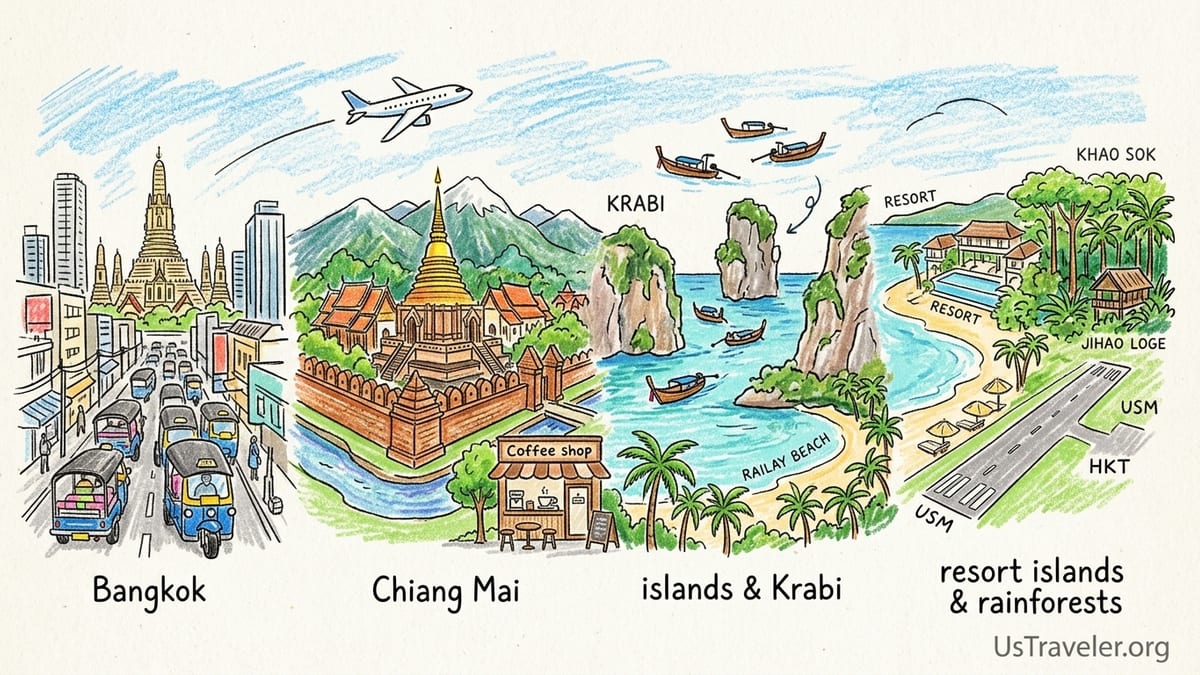
Use this quick mental model before you book: Bangkok is your plug-in city with the most flight connections and the widest range of hotels; Chiang Mai is the relaxed cultural capital of the north with day trips; Phuket is a self-contained tourism machine with the most choice, the most crowds, and the most services; Krabi is the “postcard scenery” base for Ao Nang, Railay, and day trips; Koh Samui is the resort island with a famously convenient airport but typically higher flight costs; Koh Lanta is for slower beach stays and longer sunsets; Khao Sok is for rainforest lodges and lake experiences, not for nightlife.
One practical planning rule helps: if you have 10 to 14 nights total, most travelers are happiest with 2 to 4 bases. More than that can work, but only if you are comfortable with frequent packing and mid-day transfers. If you have 7 to 9 nights, you usually want Bangkok plus one beach base, or Chiang Mai plus one beach base, not both cities plus multiple islands.
Bangkok: Best For City Travel, Food, Shopping, And A Smooth Start
Bangkok is Thailand’s easiest first stop because it has the biggest flight network and the broadest accommodation spectrum, from capsule-style hostels in the Old City to riverfront icons like Mandarin Oriental, Bangkok. If you land at Suvarnabhumi (BKK), you have the Airport Rail Link as a dependable, traffic-proof way into town, plus metered taxis and official limo services. If you land at Don Mueang (DMK), you are closer to parts of northern Bangkok and you have airport bus links, but you should still plan your arrival time carefully because road traffic can turn a short distance into a long ride.
Bangkok’s “where to stay” decision is really a transit decision. A hotel near BTS Skytrain or MRT is the easiest way to protect your time. For a first trip, Sukhumvit (around Asok, Nana, Phrom Phong) is the convenience play: restaurants, malls, and nightlife are dense, and you can ride trains instead of negotiating taxis. Silom and Sathorn are a calmer city base with quick access to Lumphini Park and a mix of office towers and dining streets. The Riverside is the hotel-as-destination choice, great for views and boat access, but less plug-and-play for hopping across town late at night.
Bangkok nightlife is the most varied in the country: rooftop bars in the Sukhumvit and Silom corridors, live music spots, night markets, and club nights that run late. Families generally do well in Bangkok when they prioritize space and pools, which often means mid-range riverside hotels or bigger chain properties near transit. For nights, most first-timers should plan 2 to 4 nights. Two nights can work if you are moving fast, but three nights usually feels better if you want temples, a river day, and one proper food-focused evening without rushing.
Chiang Mai: Best For Culture, Cafes, Night Markets, And Northern Day Trips
Chiang Mai feels like a different country after Bangkok. It is smaller, greener, and built around a walkable Old City grid with a moat, temple clusters, and a thick layer of coffee shops and boutique hotels. Its airport, Chiang Mai International (CNX), makes it easy to pair with Bangkok by air, with frequent daily flights on the route, so you can do a short city-to-city hop without sacrificing an entire day.
Hotel style in Chiang Mai skews toward boutique and design-forward properties, small resorts, and charming guesthouses. For first-timers, the Old City is the most atmospheric place to stay if you want to walk to temples and casual dinners. Nimman (Nimmanhaemin) is the modern cafe-and-bars district, popular with couples and anyone who wants shopping, cowork-friendly spaces, and a more contemporary vibe. Along the Ping River, you will find quieter stays and higher-end hotels that feel like a break from the Old City’s bustle.
Nightlife in Chiang Mai is more about night markets, beer gardens, and live music than mega-clubs. Families often prefer the river area or quieter lanes near the Old City for easier bedtimes, while still being close to daytime sights. Chiang Mai deserves 3 to 5 nights if you want at least one day trip or hands-on activity. Three nights covers the essentials. Four or five gives you room for an early-morning excursion, a slower temple day, and a night market evening without feeling like you are constantly checking the clock.
Phuket: Best For Maximum Beach Infrastructure And Easy, Organized Holiday Logistics
Phuket is the “everything is available” beach destination: the widest choice of hotels, the most developed dining scene outside Bangkok, and a deep bench of operators selling day trips to nearby islands. Phuket International Airport (HKT) is a major advantage for first-timers because you can often fly in directly, then choose your beach zone based on your style rather than on transport limitations.
On-the-ground transport matters here. Phuket has a practical public option that first-timers actually use: the Phuket Smart Bus. It runs from the airport down the west coast corridor and uses a flat fare model, making it a budget-friendly way to reach popular beaches without negotiating taxi prices. That said, many travelers still choose private transfers or taxis for speed, especially if arriving late or traveling as a family.
Where you stay in Phuket is essentially a nightlife and beach-density choice. Patong is the loudest, latest option with the most nightlife, from bar streets to large clubs, and it is also the place where a first-time beach holiday can feel most commercial. Karon and Kata offer a more balanced beach holiday with plenty of hotels, restaurants, and easier sleep. Kamala and Bang Tao lean more resort-oriented, with more space and a calmer tone that works well for families. Phuket deserves 3 to 6 nights depending on how many boat days you want. If you are doing multiple island tours and one or two “do nothing” days, five nights is the sweet spot. If you are using Phuket mainly as a flight-friendly beach base, three nights can work.
Krabi: Best For Dramatic Scenery, Railay, And Island Hopping Without Phuket’s Scale
Krabi is the scenery-first choice. Those limestone cliffs, the water color, and the feeling of being close to multiple iconic day trips are why travelers pick it. Krabi’s airport (KBV) is small and straightforward, and the main stay zones are Krabi Town (more local, cheaper, better for short stays) and Ao Nang (tourist-focused, beach-adjacent, and the most convenient launch point for tours).
Krabi’s hotel style is a mix of mid-range resorts, family-friendly hotels with pools, and budget stays clustered around Ao Nang’s main roads. The appeal is that you can book a room, walk to dozens of tour desks, and be on a longtail boat to Railay or the islands the next morning. Railay itself is a special case: you can stay there for the “no road access” atmosphere, but it is best treated as a short, scenery-centric splurge rather than a long base for most first-timers.
Nightlife in Krabi is lower-key than Phuket. Ao Nang has bars, beachside restaurants, and a steady flow of evening activity, but it is not a party island. Families do well here because logistics are simple: day tours are plentiful, and the resort format is common. Krabi deserves 3 to 5 nights. Three nights covers Railay and an island day. Four to five nights lets you add a second water day or a slower pace, which is when Krabi starts to shine.
Koh Samui Vs Koh Lanta Vs Khao Sok: Resort Island, Slow Island, Or Rainforest Reset
Koh Samui is the resort-island pick when you want convenience, polished stays, and the kind of holiday where the hotel beach club is part of the plan. The big differentiator is the airport: Koh Samui Airport (USM) is famously distinctive and convenient, but it is also known for higher airfares compared with similar domestic routes, so the island often costs more before you have even checked into your room. Once you land, you will see why Samui is easy: transfer counters, abundant hotel shuttles, and a tourism system designed to move people from plane to pool quickly.
Koh Lanta is for travelers who want the opposite rhythm. It is still well-developed enough to be comfortable, but it leans quieter, longer-stay, and less nightlife-driven. Many visitors arrive via Krabi using a shared minivan and ferry combination, and this “one ticket” transfer style is common in the south, especially in high season. Hotel style on Lanta ranges from simple beach bungalows to small resorts, with an emphasis on space, sunsets, and a slower daily routine. If Phuket or Samui can feel like a schedule, Lanta feels like an exhale.
Khao Sok is not a beach alternative. It is a rainforest and lake base that works best as a 1 to 3 night add-on between coasts, or as a dedicated nature stop from Surat Thani. Accommodation tends to be lodge-like: jungle bungalows, river-edge stays, and organized experiences that might include guided walks or lake trips. It is ideal for couples who want a dramatic change of scenery, and for families with older kids who will actually enjoy early starts and nature-focused days. The trade-off is that you are choosing calm nights and early mornings over bars and shopping.
How many nights do these three deserve? Koh Samui typically earns 4 to 6 nights if it is your main beach destination, especially if you are paying more for flights and want to settle in. Koh Lanta works beautifully with 3 to 5 nights because the slower pace is the point. Khao Sok is usually best at 2 nights for first-timers: one full day for the lake or rainforest experience plus a buffer for transfers. One night can feel rushed, and three nights can be wonderful if you want deeper nature time, but only if you are comfortable with limited evening entertainment.
The Takeaway
If you want the simplest, highest-confidence first Thailand itinerary, build it around one city base plus one beach base, then add one “wild card” only if you have the nights. Bangkok is the strongest start for logistics, dining, and flights. Chiang Mai is the best cultural counterpoint if you have time for the north. Phuket is the most convenient beach machine with the biggest hotel range and a real public transport option along the west coast. Krabi is the scenery-first base that rewards you with iconic limestone landscapes and easy longtail-boat days. Koh Samui is a premium-feeling resort island where the airport convenience often comes with higher airfares. Koh Lanta is where you go when you want fewer crowds and longer sunsets. Khao Sok is the rainforest reset that makes a beach-and-city trip feel like a full Thailand story.
For most first-timers with 10 to 14 nights, a smart split is 3 nights Bangkok, 4 nights Chiang Mai or skip it, and 4 to 6 nights at a single southern base. Choose Phuket if you want maximum choice and nightlife, Krabi if you want dramatic scenery and island hopping, Samui if you want a resort island with an easy airport, Lanta if you want slower beach days, and Khao Sok if you want nature and are willing to trade nightlife for jungle mornings.
FAQ
Q1. How many nights should first-timers stay in Bangkok?
Most first-timers are happiest with 2 to 4 nights, enough for temples, food neighborhoods, and at least one unhurried evening.
Q2. Is Chiang Mai worth it if I only have one week in Thailand?
It can be, but it often forces extra flights. With 7 nights total, many travelers choose Bangkok plus one beach base, or Chiang Mai plus one beach base, rather than both cities.
Q3. Which is better for beaches and convenience: Phuket or Krabi?
Phuket wins for sheer convenience and hotel choice. Krabi wins for dramatic scenery and easy access to Railay and nearby islands, with a quieter nightlife scene.
Q4. What is the easiest Phuket airport transfer for budget travelers?
The Phuket Smart Bus is a widely used low-cost option for reaching west-coast beaches, while taxis and private transfers are faster for families or late arrivals.
Q5. Where should I stay in Bangkok if I want the least hassle getting around?
Pick a hotel within a short walk of a BTS or MRT station in Sukhumvit, Silom, or Sathorn so you can avoid traffic and move predictably across the city.
Q6. Is Koh Samui more expensive than other islands?
It often is, partly because flights into Koh Samui Airport are typically pricier than comparable domestic routes, and the island’s hotel scene leans resort-heavy.
Q7. Is Koh Lanta good for families?
Yes, especially for families who want a calmer beach base. It is generally quieter at night than Phuket or Samui and works well for longer, slower stays.
Q8. Can I use Krabi as a base for island hopping?
Yes. Ao Nang is set up for day trips, with plentiful tour desks and quick longtail-boat access to Railay and nearby island routes.
Q9. How do travelers usually get to Khao Sok?
Many visitors arrive by minivan via Surat Thani, then stay 2 nights to fit in a full day of rainforest or lake activities without rushing transfers.
Q10. What is the best “first Thailand” pairing if I want nightlife and beaches?
Bangkok plus Phuket is the most straightforward pairing for nightlife and broad hotel choice, with strong flight access and organized day tours.