


Choosing between Phuket and Koh Samui is less about which island is “better” and more about matching the island to your travel dates and travel style. Phuket runs bigger: more direct flights, a wider hotel spectrum, heavier nightlife, and easy day trips to places like Phi Phi and Phang Nga Bay. Koh Samui feels more compact and resort-forward, with a natural island-hopping circuit to Koh Phangan, Koh Tao, and Ang Thong Marine Park. The twist is that their rainy seasons do not line up perfectly, so the smarter choice can flip depending on whether you’re traveling in, say, July versus November.
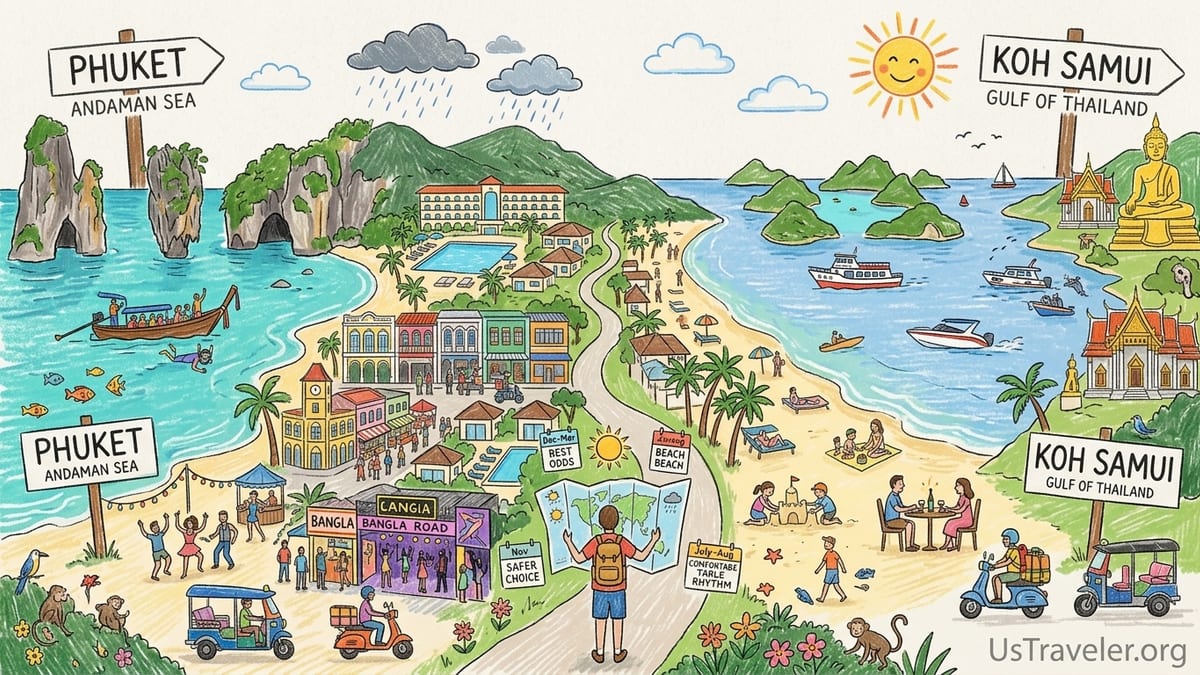
Weather By Month: The Decision-Maker You Can’t Ignore
If you are booking around weather, Phuket’s “best odds” window is typically the dry stretch from roughly December through March, when beach days are most reliable and humidity feels lower. Long-term climate summaries show Phuket’s rainfall bottoming out around February and building steadily into the mid-year months, with September commonly cited as the rain peak.
Koh Samui can be a better bet than Phuket in parts of the northern-hemisphere summer, but it tends to get its most disruptive wet period later in the year. Multiple long-term summaries place Samui’s rain peak around October and November, with November often the wettest month by volume. In practical terms, travelers who insist on a late-October to December beach holiday often find Phuket the safer choice than Samui, while travelers targeting July and August sometimes prefer Samui’s pattern.
Real-world planning example: if you are traveling in mid-July and want island-hopping days on calmer seas, Koh Samui plus Koh Phangan can be a very comfortable rhythm, especially for families or couples who do not need big-city energy. If you are traveling in November and your trip is built around snorkeling, boat days, and beach time, Phuket usually provides more reliable alternatives even when you do get rain, because it has more indoor attractions, more restaurants, and more tour options running daily.
One more detail that matters: when seas are rough, it is not just the rain, it is the swell. In Phuket, rougher Andaman conditions can shut down certain speedboat routes or make them uncomfortable, while in Samui the Gulf can be calmer in months when the Andaman is bouncy. Your “best island” is often simply the island with the friendlier sea state during your exact week.
Beaches: Big Variety vs Compact Convenience
Phuket’s beach scene is about range. You can wake up in the thick of it at Patong, stroll the more family-friendly sands at Kata and Karon, or chase a quieter vibe around the island’s smaller coves. The trade-off is that Phuket is larger and traffic can be a real factor at peak hours, so “just 8 miles away” can still mean a frustratingly long ride.
Koh Samui’s beaches are easier to stitch together in a single trip because distances are shorter and the island’s layout encourages quick hops. Many first-time visitors anchor around Chaweng for the classic wide beach with lots of dining and shopping nearby, then shift to Bophut for a calmer, family-friendly feel. Lamai sits in between: lively enough for nightlife, but generally less intense than Chaweng.
Concrete scenario: if you want to do sunrise beach walks, grab coffee, then be back at your hotel for a 10 a.m. pool session without spending half your day commuting, Samui’s compactness is a win. If you want the option to change the entire tone of your trip by switching beaches and neighborhoods, Phuket’s scale gives you more “reset buttons.”
Another practical difference is the “beach plus town” pairing. Phuket has more distinct hubs, from Old Phuket Town’s café culture to beach strips that feel like mini cities. Samui’s towns feel smaller and more resort-adjacent, which many travelers read as relaxing rather than limiting.
Hotels And Resorts: Inventory, Style, And What You Get For Your Money
Phuket’s biggest advantage for accommodations is sheer inventory. There are more properties across more categories, which tends to create more competition: you can often find sharp value in the mid-range, especially if you are flexible on exact beach location and you book outside the busiest holiday weeks. The selection also makes it easier to solve specific needs, such as multi-bedroom villas for a group trip, larger full-service resorts with kids’ clubs, or boutique hotels in Old Phuket Town for travelers who want food and culture alongside the beach.
Koh Samui leans resort-forward, which makes it feel purpose-built for a beach holiday. If you picture your days as breakfast, beach, pool, massage, sunset cocktails, then a short ride to dinner, Samui’s hotel ecosystem makes that easy. The caveat is that Samui’s limited airport and high-demand resort zones can keep prices firmer during peak season, and “cheap and convenient” is not always as easy as it is in Phuket.
Real-world choice: travelers who want a large selection of international brands and lots of price tiers often feel more comfortable shopping Phuket. Travelers celebrating something, planning a honeymoon, or craving a quieter resort bubble often gravitate to Samui, where the island’s pace supports that style naturally.
If you plan to split time across islands, Samui is also an easy base for combining different hotel moods without relocating far. You can do a few nights near Chaweng for activity, then shift to Bophut or Maenam for a calmer second act, without needing a long transfer day.
Nightlife And Dining: Phuket’s Scale vs Samui’s Beach-Resort Evenings
Phuket is the obvious pick if nightlife is a major pillar of your trip. The island’s entertainment infrastructure is bigger, more varied, and more international. Patong’s Bangla Road remains one of Thailand’s best-known late-night strips, and beyond Patong you can still find stylish beach clubs, live music venues, and a broader range of late-night dining.
Samui’s nightlife exists, but it is more “holiday nightlife” than “party destination” unless you purposely build your itinerary around it. Chaweng offers the busiest scene on Samui itself, while the island’s real party wildcard is the ability to connect to Koh Phangan, which can turn a relaxed Samui stay into a night-out or festival-style side trip.
Food-wise, both islands can be excellent. Phuket’s dining feels more cosmopolitan and spread across multiple districts: you might do a night market run, a seafood meal on the coast, and a café hop in Old Phuket Town in the same weekend. Samui’s food experience is often anchored around beach-town strips, where it is easy to fall into a satisfying routine of Thai staples, fresh seafood, and resort dining without much logistical effort.
Concrete example: if your perfect evening is “walk from hotel to dinner to a low-key bar and be in bed by 11,” Samui is usually easier. If your perfect evening is “choose between five different nightlife zones and keep options open until 2 a.m.,” Phuket is built for that.
Families, Couples, And First-Timers: Who Each Island Fits Best
For families, both islands can work, but they work differently. Phuket’s advantage is choice: more family-sized rooms, more attractions beyond the beach, and more backup plans when weather turns. If you are traveling with kids who need variety, Phuket’s scale can be a relief. It is also easier to find day tours that match different ages and attention spans, from short boat rides to wildlife and cultural stops.
Samui’s advantage for families is reduced friction. Transfers are shorter, the island feels more manageable, and it is easy to do “beach morning, pool afternoon, early dinner” without a lot of travel time. Many parents also like that the island can feel calmer at night outside the busiest pockets of Chaweng.
For couples, the decision often comes down to atmosphere. Phuket can be romantic in the right pocket, but it is a busier island with a more urbanized feel in many areas. Samui more naturally supports quiet, resort-centered romance, especially if you plan to add an island-hopping layer like Ang Thong or a few days on Koh Tao.
For first-timers to Thailand who want an easy, classic beach holiday with maximum services and minimal surprises, Phuket’s international connectivity and huge tourism infrastructure often make the arrival and “figuring it out” phase simpler. For travelers who have already done Bangkok and want a slightly more self-contained island week, Samui can feel like the cleaner beach-holiday edit.
Island Tours, Boat Days, And Diving: Phi Phi And Phang Nga vs Ang Thong And Koh Tao
Phuket’s signature day-trip portfolio is hard to beat for variety. It is a natural launch point for Phang Nga Bay, where limestone karsts and sea caves create a “Thailand postcard” landscape. Recent tour pricing guidance places many Phang Nga Bay day tours roughly in the ฿1,400 to ฿3,950 per person range depending on boat style and inclusions, making it a very accessible add-on for most Phuket itineraries.
Koh Samui’s strongest day trip is Ang Thong National Marine Park, a scenery-heavy outing of limestone islands, viewpoint climbs, and lagoon stops. A Samui-based operator’s 2026 pricing example lists a join-in big-boat day trip from about ฿1,200 per adult and a VIP speedboat from about ฿1,850 per adult, with private speedboat charter pricing starting around ฿32,850 for up to 10 guests. That same source notes a key scheduling detail many travelers miss: Ang Thong is typically closed from 1 November to 23 December each year, so your dates can instantly eliminate the park from your plan.
Diving is where the Samui side of the map can dominate. If “learn to dive” or “rack up fun dives” is a core goal, many travelers plan a Samui arrival then shift to Koh Tao, which has a dense concentration of dive schools and a reputation for competitive pricing. Current published price lists from Koh Tao operators show examples like fun diving rates around ฿550 per dive in packages and pro-level course pricing that can climb into the tens of thousands of baht, depending on the certification track and what is included.
Concrete itinerary examples: Phuket travelers often do a Phang Nga Bay day (karsts, caves, canoeing) plus one beach-focused boat day like Phi Phi, then spend evenings in a dining and nightlife hub. Samui travelers often do an Ang Thong day for scenery, then allocate two to four nights to Koh Tao for diving and clear-water snorkeling, with Koh Phangan as an optional nightlife or beach add-on in between.
Flights, Getting There, And Getting Around: Connectivity vs Convenience
Phuket is one of Thailand’s most connected resort gateways, with a large international airport and a long list of direct routes. That matters in real terms: if you can fly in nonstop from a regional hub, you avoid the “land, transfer, connect, ferry” chain that can turn a beach week into two travel days. Phuket also makes it easier to build a multi-stop itinerary, such as landing in Phuket, then flying out from Bangkok later, without backtracking.
Koh Samui’s airport experience is famously convenient once you are there, but routing can be more limiting. Bangkok Airways is the defining player, and Samui is often approached via Bangkok, sometimes via a same-day connection from an international arrival. This structure can push up flight costs in peak season and can limit flexibility if you want to change plans last-minute.
Getting around on Phuket often means accepting the island’s size: you may want to choose a base carefully to avoid spending a lot of time in the car. On Samui, distances are shorter and “let’s try dinner on the other side of the island” feels more realistic on a weeklong trip. If you are a traveler who likes to explore without overplanning, Samui’s scale can feel friendlier.
If you plan to connect to nearby islands, Samui makes the Gulf circuit feel natural. Phuket makes the Andaman circuit feel natural. In both cases, your best “ease” comes from choosing the island whose nearby day trips match your wish list, so you are not forcing a complicated cross-country transfer mid-vacation.
Cost And Overall Atmosphere: What Your Trip Will Actually Feel Like
Phuket can be cheaper or more expensive than Samui depending on what you buy, but its huge supply often creates more price competition, especially in the mid-range hotel category and in everyday dining. It is also easier to find budget-friendly accommodation in a wide range of areas, which is why Phuket works for both backpacker-style trips and luxury breaks in the same week. The atmosphere, however, is undeniably busier: more traffic, more development, more nightlife signage, and a more “international resort city” energy in certain zones.
Koh Samui often feels more curated. Even when it is busy, the island’s pace tends to stay “holiday” rather than “city,” and many travelers describe it as easier to settle into. Costs can feel higher for certain items tied to limited supply, especially if you prioritize beachfront resort zones in peak months and you value easy walkability to restaurants and the beach.
Concrete spending example: if you are planning multiple paid boat days, Phuket’s menu is so wide that you can usually choose between a lower-cost group boat and a more premium speedboat product for the same destination, depending on your comfort level and time budget. On Samui, the day-trip menu is excellent but narrower, and your “big ticket” experiences often focus on Ang Thong or the Koh Tao day, both of which have more fixed price bands.
The best way to choose is to picture your daily rhythm. If you want maximal options, big energy, and an island that feels like it can keep producing new plans, Phuket is the stronger bet. If you want a more compact island week with natural add-ons to Koh Phangan, Koh Tao, and Ang Thong, Samui is often the better match.
The Takeaway
Pick Phuket if your dates land in late-year wet weeks for Samui, if direct international flights matter, or if you want the biggest choice of hotels, dining, nightlife, and Andaman Sea day trips like Phang Nga Bay and Phi Phi. Phuket is also the more forgiving island for first-timers who want “everything available all the time,” including backup plans when weather shifts.
Pick Koh Samui if you want a compact, resort-forward island with easy movement, a calmer overall feel outside the busiest hubs, and a built-in island-hopping circuit to Koh Phangan, Koh Tao, and Ang Thong. Samui shines when your trip is designed around a beach-and-resort routine with one or two standout sea days, especially if diving or snorkeling in the Koh Tao orbit is on your list.
If you are torn, let the calendar decide. Weather patterns and sea conditions are the most practical tie-breakers, and the “better” island is often simply the one with the better odds of boat days during your exact travel week.
FAQ
Q1. Which island is better for first-time visitors to Thailand, Phuket or Koh Samui?
Phuket is usually easier for first-timers because of broader flight connectivity, larger hotel inventory, and more non-beach activities if weather turns.
Q2. Which island has better weather in July and August?
Koh Samui often has more favorable beach conditions in parts of July and August than the Andaman side, but week-to-week conditions can still vary.
Q3. Which island is better in November?
Phuket is often the safer pick for a beach-first trip in November because Samui commonly sees its heaviest rain around October and November.
Q4. Is Phuket or Koh Samui better for families with kids?
Phuket offers more family-focused hotels and more rainy-day alternatives, while Samui can feel easier day-to-day because it is smaller and more manageable.
Q5. Which island is better for nightlife?
Phuket, especially around Patong, has the larger and more varied nightlife scene. Samui’s nightlife is smaller, with Chaweng as the main hub and Koh Phangan as an add-on.
Q6. Which island is better for island-hopping?
Phuket connects naturally to Phi Phi and Phang Nga Bay on the Andaman side. Samui connects naturally to Koh Phangan, Koh Tao, and Ang Thong in the Gulf.
Q7. Can you do Ang Thong Marine Park from Koh Samui year-round?
Not always. Ang Thong is typically closed from 1 November to 23 December each year, so you need to check your dates before building your plan around it.
Q8. Which is better for diving, Phuket or Koh Samui?
Many travelers choose the Samui side because it is easy to add Koh Tao, a major diving hub with lots of dive schools and competitive course pricing.
Q9. Is Koh Samui more expensive than Phuket?
It can be, especially for flights and some resort zones, because Samui has more limited access and supply. Phuket’s size can create more price competition.
Q10. If I only have 4 to 5 nights, which island should I choose?
For short trips, Koh Samui can feel more efficient because you spend less time crossing the island. Phuket can still work well if you choose one base and keep day trips selective.