


Thailand’s “best island” depends less on which beach looks bluest on your feed and more on a simple geographic fact: the country has two island coasts with different rainy peaks. The Andaman Sea (Phuket, Krabi area, Koh Phi Phi, Koh Lanta, Koh Lipe) shines in the Northern Hemisphere winter, while the Gulf of Thailand (Koh Samui, Koh Phangan, Koh Tao) often holds better beach weather in mid-year, and the far eastern Gulf (Koh Kood) plays by its own wetter Trat-province pattern. This guide compares eight of Thailand’s most booked islands and explains Krabi as the mainland gateway that stitches the Andaman side together, so you can choose with confidence based on your dates, travel style, and tolerance for sea crossings.
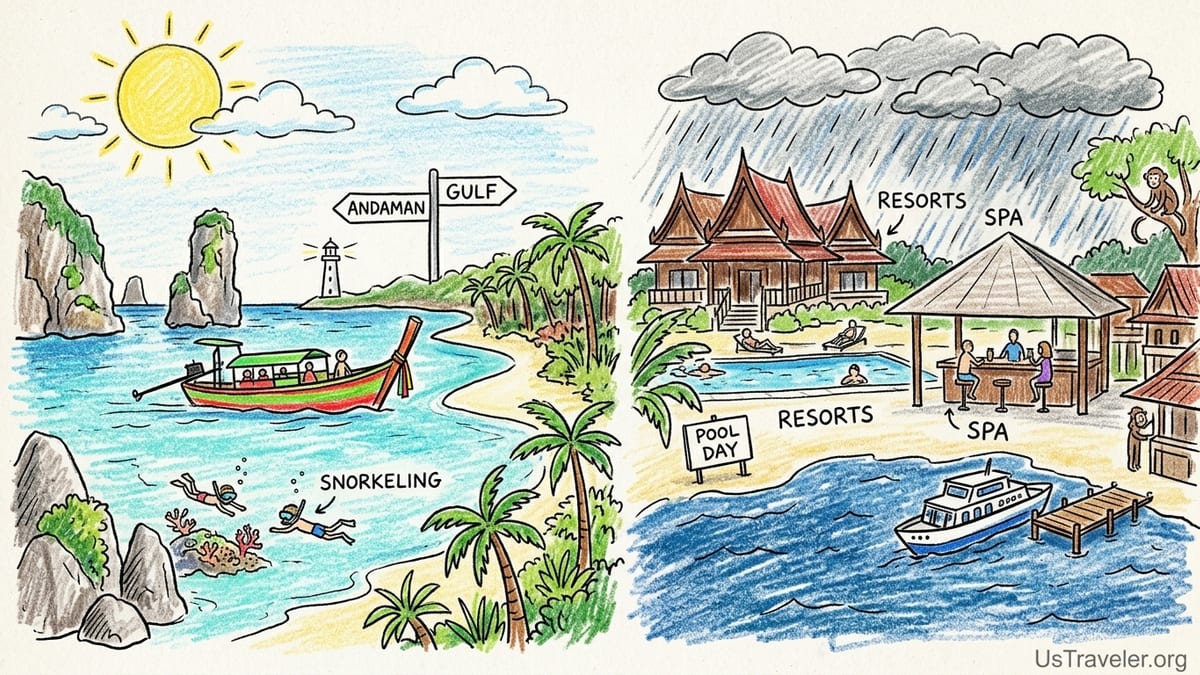
Start With Seasonality: Andaman vs Gulf (And Why It Changes Everything)
If you only remember one planning rule, make it this: Phuket, Krabi, Koh Phi Phi, Koh Lanta, and Koh Lipe are on the Andaman coast, where the calmer, drier stretch is typically around November to April. By contrast, Koh Samui, Koh Phangan, and Koh Tao sit in the Gulf of Thailand, which often stays comparatively drier during parts of the Andaman’s wetter mid-year window but then sees its heaviest rain later, often around October to December.
In real-world terms, this is why a July family trip can feel frustrating in Phuket if you’ve pinned everything on boat days, while the same dates can be a sweet spot for Koh Tao diving or Koh Samui resort time. Then the script flips: a November honeymoon that’s glorious in Phuket or Koh Lanta can land in Koh Samui during its rainier period, when seas can be choppy and “island-hopping day” becomes “pool day.”
For travelers who can choose dates, aim Andaman islands for December to March if you want the most reliable beach weeks and smoother crossings. If you are traveling in June to August and your priority is sun-on-the-sand hours, seriously consider building your trip around the Gulf trio (Samui, Phangan, Tao) instead of forcing the Andaman coast. If you are locked into late October or November, choose carefully: it can be transitional, with the Andaman improving while the Gulf side can still be in its wetter phase.
Phuket: Convenience, Variety, And The Biggest Range Of Resort Styles
Phuket is Thailand’s easiest island to “do like a city” with beaches attached. You can land at a major international airport, check into a large-brand resort, and still have options if the sea turns rough. That convenience is why Phuket works for mixed groups: one couple wants beach clubs, another wants day tours, and someone else wants shopping, spas, and room service without thinking about ferry timetables.
Beach-wise, Phuket’s strength is choice, not seclusion. Patong is built for action and late nights, while Kata and Karon lean more classic beach-holiday. If you want a calmer base that still feels polished, many travelers choose areas like Kamala or Bang Tao, where you can realistically spend a week without needing to “win the island-hopping lottery” every morning.
For water activities, Phuket is a strong launch pad rather than the most intimate snorkeling-from-the-beach destination. A typical “real trip” day looks like arranging a speedboat tour that starts early from a pier on Phuket, spends time at multiple stops, and gets you back before dark. When seas are calm in peak season, those days can feel effortless. In rougher months, it’s common to see operators adjust routes or cancel smaller-boat departures for safety, which is another reason Phuket’s on-land alternatives matter.
Krabi (Mainland Gateway): The Base That Unlocks Railay, Phi Phi, Lanta, And Beyond
Krabi is not an island, but it is one of the smartest “hub decisions” on the Andaman coast because it connects so many island areas with shorter transfers. Staying around Ao Nang or Krabi Town lets you split your trip between limestone scenery, beach time, and island days without packing up every morning like you are racing a schedule.
The classic Krabi experience is combining a mainland stay with day access to Railay. Railay feels like an island because the easiest way in is by boat, and it’s where first-timers get that cinematic mix of cliffs and turquoise water without committing to a full island relocation. It also makes Krabi a practical choice for families: if a child is tired, you can dial back the day plan and still have plenty to do.
Krabi also simplifies the logic of “Andaman island hopping.” It is common to route via Krabi for connections toward Koh Phi Phi and Koh Lanta, then continue farther south in the dry season toward Koh Lipe. If you are traveling outside the Andaman’s calmer months, Krabi’s role becomes even more useful because you can stay grounded and flexible while watching sea conditions before committing to long speedboat legs.
Koh Phi Phi: Iconic Scenery, Big-Day-Tour Energy, And Strict Maya Bay Rules
Koh Phi Phi is Thailand’s most recognizable island name for a reason: the karst cliffs and bright bays really do look unreal in good light. The trade-off is intensity. Phi Phi can feel like a place where you are always sharing the view, especially around peak hours when day-trip boats arrive and the village nightlife ramps up.
If your goal is to see Maya Bay, plan around the reality that access rules are strict and conservation closures can affect your itinerary. In 2026, Maya Bay has been operating with regulated access, and it is closed annually from August 1 to September 30 for conservation. Even when it is open, boats do not enter the bay and time ashore is controlled, so expect the “Maya Bay moment” to be a managed visit rather than a linger-all-afternoon beach day.
Phi Phi is best when you treat it like a short, high-impact stop: one to two nights for viewpoints, sunrise and sunset, and a boat day that strings together multiple locations such as lagoons and snorkeling stops. If you are a light sleeper or traveling with small kids who need quiet, choose your hotel location carefully, because parts of the main village can run late.
Koh Lanta: Family-Friendly Space, Long Beaches, And A Calm Base For Andaman Exploring
Koh Lanta is often the “I wish we’d stayed here longer” island for travelers who want Andaman beauty without the constant party pulse. Its beaches are long and spread out, and the general vibe is lower-volume: fewer “rush hour” crowds, more sunset dinners, and an easier time finding space for kids to run without feeling like you are navigating a beach club scene.
Logistics are also part of Lanta’s appeal. You can arrive via Krabi connections and then settle into a week that mixes beach days with shorter excursions. Many families like Lanta because you can do practical routines: breakfast, beach, nap, repeat, without needing to coordinate a daily boat departure. It’s also a good island for travelers who want to rent a scooter or car and explore multiple stretches of sand in one day.
Koh Lanta becomes a key stepping stone if you are going farther south. In the Andaman high season, speedboats run between Koh Lanta and Koh Lipe, with published options around late morning and early afternoon, and typical fares around 1,600 THB per person on common operator routes. That makes it possible to pair Lanta’s relaxed base with a “grand finale” week on Koh Lipe, but you should still treat the crossing as weather-dependent and avoid tight same-day flight connections.
Koh Lipe: Tiny, Walkable, Snorkel-Forward, And More Effort To Reach
Koh Lipe is the island you choose when you want the trip to feel like you left the world behind. It’s small enough that your real vacation rhythm can be “walk to breakfast, walk to beach, swim, repeat,” and many travelers come specifically because the water can be clear enough for easy snorkeling right off the beach in good conditions.
The price of that paradise is transit complexity. Most travelers route via the mainland at Pak Bara Pier in Satun province, then take a speedboat. In 2026, major names on the Pak Bara to Koh Lipe route include Bundhaya Speed Boat and Satun Pakbara Speed Boat Club. You should also be prepared for the Koh Lipe arrival experience: depending on conditions and boat type, you may transfer via a floating pier and a short longtail ride to shore, which adds time and a small extra fee in some setups.
If you are island-hopping southbound, Koh Lipe also connects by seasonal speedboat chains that can link it back toward Koh Lanta and Phuket in the dry season, but these are long days on the water. A realistic example is Koh Lipe to Phuket via Koh Lanta, which can take most of a day depending on the connection. If you get seasick easily, build in a buffer night on Koh Lanta rather than forcing a single-day marathon crossing.
Koh Samui, Koh Phangan, Koh Tao, And Koh Kood: Gulf Choices For Resorts, Parties, Diving, And Quiet
Koh Samui is the Gulf coast’s most convenient resort island because it has its own airport and a deep inventory of upscale stays. In practice, this is the island for travelers who want “land, check in, pool, beach, spa, repeat” with minimal friction, and for families who value short transfers and reliable infrastructure. One small detail that surprises first-timers: Samui Airport is privately operated, and passenger service charges apply at the airport, so keep a little cash buffer when you travel domestically.
Koh Phangan is the middle sibling with two distinct personalities. It can be the Full Moon Party island, but it can also be a quiet beach-and-yoga island if you base away from the party zones and travel outside major event nights. Many travelers use Phangan as the bridge between Samui comfort and Koh Tao water time: arrive via Samui, then ferry onward for a few nights when you want more space and a more local feel.
Koh Tao is the Gulf’s standout for diving and dive culture. You’ll find a dense concentration of dive shops, training courses, and travelers structuring their week around boat dives and certification schedules. If you want to turn a beach trip into a “learn to dive” trip, Tao is often where people do it because the whole island ecosystem supports that routine: morning classroom time, afternoon dives, and easy social life afterward.
Koh Kood is the outlier and the quietest choice in this guide. It sits in the far eastern Gulf near Trat and is known for wide, calm-looking beaches and a slower, less commercial pace. Think hammock afternoons on beaches like Klong Chao and Bang Bao, short jungle drives to waterfalls, and evenings that end early. Getting there is more of a project than Samui: common routing is Bangkok to Trat area, then Laem Sok Pier and a ferry. Boonsiri has published 2026 Laem Sok to Koh Kood departures at 10:45 AM, 1:15 PM, and 3:00 PM, with Koh Kood to Laem Sok returns at 9:00 AM, 11:45 AM, and 1:00 PM, and published one-way fares around 600 THB on the mainland ferry leg.
For weather strategy, the Gulf trio (Samui, Phangan, Tao) is often the better bet when the Andaman is rough in mid-year, while Koh Kood can be wetter at times because the Trat coast is one of Thailand’s rainier pockets. That makes Koh Kood most satisfying when you plan it as a deliberate “quiet beach retreat” and build flexibility, not a tight schedule of long boat tours.
The Takeaway
Pick your coast first, then your island. If you are traveling roughly November to April and want classic Thailand island weather with easy Andaman hopping, build around Krabi plus either Koh Lanta for calm or Koh Phi Phi for iconic scenery, then go south to Koh Lipe if you want a small-island finale and you can handle the extra transit. If you are traveling in June to August and want the best odds of sunny beach days, the Gulf side is often the smarter call: Samui for resorts and convenience, Phangan for a mix of chill and nightlife, and Tao for diving-forward trips.
Use Phuket when you want maximum flight access and the widest menu of hotels and activities, including good options when the sea is not cooperating. Use Krabi when you want a mainland base that unlocks multiple Andaman experiences without changing hotels every two nights. Use Koh Kood when your priority is quiet, beach time, and a slower pace, and you are willing to plan transfers carefully rather than improvising on the fly.
Finally, treat sea travel as part of the decision, not an afterthought. Speedboats and ferries are amazing when conditions are calm, but in shoulder months and stormier periods, schedules can shift. If your trip includes a fixed-time event like an international flight home, build in a buffer night on the mainland or on a larger hub island so weather does not turn into a last-minute scramble.
FAQ
Q1. Which Thailand islands are best in July and August?
In many years, the Gulf islands (Koh Samui, Koh Phangan, Koh Tao) have better odds of beach weather in July and August than the Andaman islands, which are often in a rougher monsoon phase mid-year.
Q2. Which Thailand islands are best in December to March?
December to March is typically prime time for the Andaman coast: Phuket, Krabi area, Koh Phi Phi, Koh Lanta, and Koh Lipe often see calmer seas and more reliable beach days.
Q3. Is Krabi an island, and should I stay there or Phuket?
Krabi is mainland. Stay in Krabi if you want a gateway to Railay and multiple island areas with shorter transfers; stay in Phuket if you want the biggest range of hotels, shopping, and nightlife plus a major airport.
Q4. Is Koh Phi Phi worth it if I dislike crowds?
It can be, but treat it as a short stop. Go early in the day for viewpoints and plan one boat day, then base longer stays on calmer islands like Koh Lanta or Koh Kood.
Q5. What are the Maya Bay closure dates in 2026?
Maya Bay is closed annually from August 1 to September 30 in 2026 for conservation, and visits are regulated when it is open.
Q6. Which island is best for families with small kids?
Koh Lanta is often the easiest family fit for space and a calmer pace on the Andaman side, while Koh Samui is the easiest in the Gulf for short transfers and resort infrastructure.
Q7. Which island is best for learning to scuba dive?
Koh Tao is the most dive-centric choice in this list, with many training-focused dive shops and an island routine built around certification schedules.
Q8. How do I get to Koh Kood in 2026?
A common route is via Trat province and Laem Sok Pier, then ferry to Koh Kood. Boonsiri publishes 2026 Laem Sok departures at 10:45 AM, 1:15 PM, and 3:00 PM, with fares around 600 THB for the mainland ferry leg.
Q9. How much is the Koh Lanta to Koh Lipe speedboat in 2026?
Published 2026 options commonly show around 1,600 THB per person for Koh Lanta to Koh Lipe speedboat routes in the dry season, with departures typically around late morning to early afternoon depending on operator and date.
Q10. Can I island-hop between Phuket and Koh Samui in one trip?
You can, but it is usually inefficient because they are on opposite coasts. It works best when you have a longer trip and a clear reason to switch coasts, such as chasing better weather mid-year.