


Thailand’s best beach resorts are not just about the room key and the infinity pool. The surrounding beach matters as much as the hotel itself, especially on big, varied islands like Phuket where one “Phuket vacation” can mean anything from a nightlife-forward Patong base to a quiet, swim-friendly bay near the airport. In this commercial guide, we compare Phuket, Khao Lak, Krabi, Koh Lanta, Koh Samui, Koh Phangan, Hua Hin, and a handful of quieter islands to help you pick both the right coast and the right resort zone for beachfront access, swimming conditions, scenery, snorkeling, restaurants, and transfer logistics.
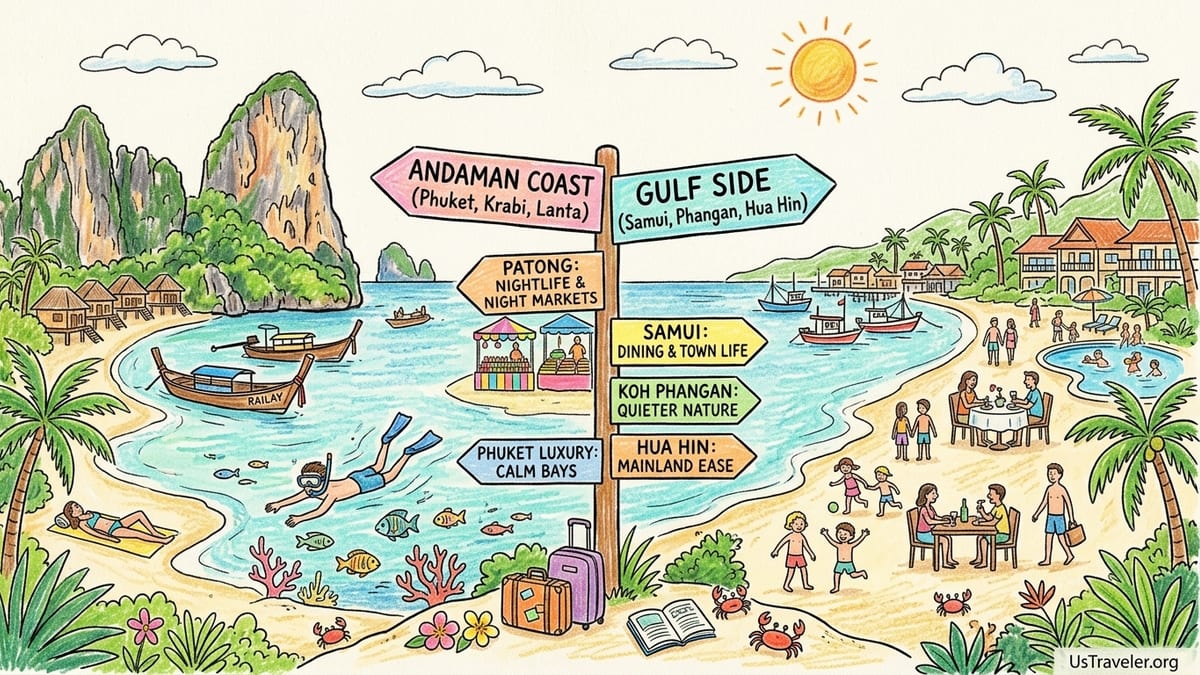
Thailand’s Beach Puzzle: Coast, Bay, And Beach Type Matter
Thailand’s two main beach coasts deliver different “default” vacations. The Andaman side (Phuket, Khao Lak, Krabi, Koh Lanta, plus smaller islands like Koh Yao and Phi Phi) is the postcard coast: dramatic limestone scenery, island-hopping, and standout snorkeling and diving access. The Gulf side (Koh Samui, Koh Phangan, and Hua Hin nearby on the mainland) tends to be easier for repeat dining-out, family convenience, and mixing beaches with a bit of town life.
But the most important choice is often not the island, it is the specific beach zone. A resort on a long, open coastline can feel completely different from a resort tucked into a protected bay. That impacts real, day-to-day things: whether you can comfortably swim at low tide, whether the sea turns rough during a monsoon swell, how noisy the beach road is at night, and whether you can walk out for dinner or you will be relying on hotel transport.
Concrete example: on Phuket, a resort near Bang Tao and Layan can feel private and upscale with beach clubs and more space. Meanwhile, staying in Patong puts you close to nightlife and late-night street food but you may trade away the relaxed, “read a book on a quiet shore” rhythm. Same island, completely different vacation.
Phuket: The Most Choice, The Most Risk Of Choosing Wrong
Phuket is Thailand’s easiest place to match a very specific travel style because it has so many resort zones, price points, and restaurant scenes. It is also the place where the surrounding beach can make or break the trip. Think of Phuket as multiple destinations on one island: Patong for nightlife and convenience, Kata and Karon for a more classic holiday-beach feel, Kamala for a calmer pocket with upscale options, and the Bang Tao and Layan area for larger resorts, beach clubs, and a more polished, low-stress vibe.
Transfer logistics are a major Phuket advantage. You fly into Phuket International Airport and then choose your coast. If you are comparing zones, the airport-to-hotel ride is a meaningful line item, especially for families booking a larger vehicle. In 2026, official fixed-price limousine style transfers sold at Phuket airport counters typically run during the day and evening hours (often listed as 06:00 to midnight), which can shape what you do if you land after midnight. If you arrive late, travelers commonly rely on a prebooked resort transfer or an app-based ride if available and permitted at the time you arrive.
For resort examples, Phuket has headline luxury that is destination-worthy on its own. Amanpuri on Pansea Beach is a classic splurge property, and it has had a publicly stated temporary closure window in 2026 (mid-May to mid-September) for enhancements, so it is the kind of resort where you should confirm your exact travel dates before building an itinerary around it. If you want a luxury base near the airport side with a calmer atmosphere, Anantara Layan Phuket is a recognizable pick in the Bang Tao Layan area, and its own offers have been published with validity through late 2026 for certain rate types and benefits.
Phuket is also where “I’ll just stay beachfront and do day trips” can be either brilliant or frustrating depending on your beach zone. If island-hopping is the priority, being closer to piers and boat departures reduces friction. If you are more focused on dining variety, choose a zone with walkable restaurant density or short, predictable transport to places like Boat Avenue (Bang Tao area) or Kamala’s dining strip, rather than committing to a remote peninsula where every meal becomes a car ride.
Khao Lak: Quieter, Longer Beaches And A Straight Shot To The Similans
Khao Lak sits north of Phuket on the Andaman coast and is a smart choice for travelers who want a calmer beachfront stay without giving up access to iconic marine experiences. The beaches are long and generally less congested than Phuket’s headline zones, and the resort vibe leans toward couples, families, and travelers who want their beach time to feel spacious.
In real-world planning terms, Khao Lak is often chosen by travelers who want to organize snorkeling or diving trips to the Similan Islands and nearby protected areas without staying on a small island. Many operators route day trips from the Khao Lak area, and it can feel more relaxed to base here if you do not care about Phuket’s nightlife or dense shopping.
A well-known luxury example is The Sarojin in Khao Lak, a boutique-style property frequently cited by travelers looking for a quieter, high-service beach resort. It is the type of resort where the “no chaos” appeal is part of the product: you are paying not only for the room but for the atmosphere of the area around you. If your travel group wants nightlife, Khao Lak can feel too quiet. If your group wants early nights, beach walks, and day trips that return you to calm evenings, it can be exactly right.
Transfers matter here, too. Khao Lak is not on an island, but it is not a quick pop-in from the airport either. Many travelers fly into Phuket and then do a longer road transfer north. In practice, this is where prebooking transport through a reputable hotel desk or a licensed transfer service can be worth it, especially if you are arriving with kids, surfboards, or a lot of luggage.
Krabi (Ao Nang, Railay, And The Island-Outpost Resorts)
Krabi Province is the scenery pick: limestone cliffs, dramatic headlands, and a feeling that you are staying in the middle of the Thailand postcards. The trade-off is that some of the most spectacular settings are not “walk out of the lobby onto a perfect swimming beach” situations. In parts of Krabi, the beach can be tidal, boat traffic can be heavy, or the best sand might be a short longtail ride away.
Ao Nang is Krabi’s convenience base: lots of casual restaurants, tour desks, pharmacies, and easy booking for longtail boats to Railay and nearby islands. If you are the kind of traveler who wants to finish a beach day and then choose between Thai seafood, pizza, and a smoothie bowl within a few minutes’ walk, Ao Nang makes daily life easy. It is also practical for transfers because you can fly into Krabi International Airport and drive to the Ao Nang area without needing a boat connection.
Railay is the iconic “you can’t drive here” experience. Resorts here can feel like an island stay even though you are still in Krabi. A recognizable high-end example is Rayavadee, a bucket-list property in the Railay area that has publicly communicated a refurbishment project scheduled for 2026 and also publishes certain seasonal offers with included join-in airport transfers for defined 2026 stay windows. That kind of detail matters because Railay logistics are different from Ao Nang: you are not just booking a room, you are committing to the water-transfer rhythm of your stay.
When choosing Krabi, make a decision upfront about how much you want “destination resort seclusion” versus “I want to explore and eat out every night.” If you want the big scenery and fewer moving parts, a resort that organizes transfers and excursions in one bundle can be the calmest way to do Krabi. If you want flexibility and an easy evening scene, Ao Nang or a nearby mainland base with quick boat access can fit better.
Koh Lanta: A Calmer Andaman Island With Real Beach Time
Koh Lanta is often the Andaman choice for travelers who want more actual beach living and less constant transit. Compared with Phuket, it is quieter and less urban. Compared with Phi Phi, it is larger and easier to settle into. It also has a practical advantage: you can build a trip that is about long beach days and unhurried dinners rather than rushing from pier to pier.
One reason travelers love Lanta is that it can deliver that “barefoot Thailand” feeling without sacrificing comfort. A recognizable luxury anchor is Pimalai Resort & Spa, set above and on the sand at Kan Tiang Beach. It is the kind of property chosen by honeymooners and families who want the service level of a high-end resort while still being on an island that feels mellow and human-scale.
For snorkeling and day trips, Lanta is also a good base for boat excursions to smaller islands. Travelers frequently plan days that look like: breakfast, a half-day boat trip, back in time for a late lunch, and then a simple sunset dinner. That rhythm is harder to achieve if you are staying somewhere where every excursion starts with a long road transfer or a complicated pier connection.
Where Lanta can be less convenient is airport access. Most travelers arrive via Krabi (airport plus road plus ferry depending on the season and route) or via Phuket with a longer overland journey. This is not a dealbreaker, but it should influence how long you stay. Koh Lanta tends to shine when you are staying long enough to “pay back” the transfer effort with multiple days of calm.
Koh Samui And Koh Phangan: Gulf Islands For Ease, Dining, And Mixed-Style Trips
Koh Samui is the Gulf’s classic resort island: a lot of accommodation depth, a strong restaurant scene, and the convenience of having an airport on the island. That last point changes everything for short trips. If you have five nights total, flying into Samui can mean you spend more of your holiday on a beach chair and less of it checking ferry tickets and timing pier transfers.
Samui’s beach experience varies by area. Chaweng is the busiest, with a large range of hotels and nightlife. Fisherman’s Village in Bophut is a popular pick for travelers who care about dining and an evening stroll scene more than they care about the emptiest beach. The north coast and pockets of the west or northeast can feel calmer depending on the specific beach and hotel positioning. For luxury resort examples, Four Seasons Resort Koh Samui is an internationally recognized splurge option, and Six Senses Samui is another well-known high-end stay, often chosen for privacy and views.
Koh Phangan is Samui’s neighbor and is often misunderstood. Yes, it is famous for the Full Moon Party, but outside of party dates it can feel markedly quieter, greener, and more “small island.” It is a strong option if you want a beach-forward trip with fewer big resorts and a more laid-back pace. Logistically, you can move between Samui and Phangan by ferry. Major operators publish schedules, and in practice travelers plan around daylight connections and pier locations rather than assuming they can hop over at any hour. If you are timing a Samui to Phangan transfer on a big arrival day, picking a resort that helps coordinate pier-to-hotel transport can reduce stress.
If you want a two-island itinerary, a practical model is to split the trip by purpose. Example: start on Samui for easy arrival and restaurant variety, then switch to Phangan for a quieter end to the trip when you want fewer decisions and more beach time. Or reverse it if you want to finish with Samui’s airport convenience for your departure day.
Hua Hin And Quieter Islands: When You Want Beach Access Without The Island Shuffle
Hua Hin is the beach escape that behaves more like a city break. It is on the mainland Gulf coast and is popular for travelers who want a resort beach with easy access to cafes, night markets, golf, and a more “weekend in Thailand” vibe. It is also a smart choice if your trip includes Bangkok and you do not want to add flights and ferries to the plan.
The resort scene in Hua Hin is deep and recognizable, including international brands. Hua Hin Marriott Resort & Spa is a mainstream, family-friendly example right on the beach, and it is the kind of property where travelers often choose it because it removes friction: you can do pool time, beach time, kids’ club time, and then walk into town for dinner without needing a boat schedule.
If your priority is quieter beaches and a sense of being away from crowds, it is worth considering smaller Andaman islands that still have good resort infrastructure. Koh Yao Yai and Koh Yao Noi, for example, are often used as calm bases between Phuket and Krabi, delivering sea views and downtime while still letting you do day trips. Phi Phi is famous and can be crowded, but if you choose a resort set away from the party center, it can feel much calmer. SAii Phi Phi Island Village is a recognizable example of a resort positioned for a more self-contained stay rather than the late-night scene.
These quieter islands are where “the surrounding beach” is truly the deciding factor. If you book a gorgeous villa but the beach in front is not swimmable at low tide, you will spend your days shuttling to other beaches or staying poolside. If you book an island with a protected, sandy bay and easy snorkeling right off the shore, you can have a more beach-first holiday even without leaving the property.
The Takeaway
The best beach resort in Thailand is the one that matches your coast, your beach type, and your daily rhythm. Phuket wins for choice, convenience, and variety, but you must choose the right beach zone because Patong, Kata, Kamala, and Bang Tao Layan can deliver completely different vacations. Khao Lak is a quieter Andaman base for travelers who want long beaches and a calmer pace. Krabi is for scenery and wow-factor, but you need to decide whether you want Ao Nang convenience or Railay’s resort-outpost feel. Koh Lanta is the mellow island pick for travelers who want real beach time. Koh Samui and Koh Phangan are the Gulf duo for easy flights, dining, and flexible two-island itineraries. Hua Hin is the mainland answer for travelers who want a resort beach without the island logistics.
If you take only one planning rule from this guide, make it this: treat the beach around the resort as a core feature of the booking, not a background detail. In Thailand, the same brand-level hotel can feel wildly different depending on whether it sits on a protected swimming bay, a tidal flat, a party beach, or a quiet stretch with nothing but sunset and sand.
FAQ
Q1. Which Thailand beach destination is best for first-timers who want everything in one place?
Phuket is usually the easiest first pick because it has the biggest range of beaches, resorts, restaurants, and day trips, plus a major international airport.
Q2. Where should I stay if I want a quieter alternative to Phuket but still on the Andaman coast?
Khao Lak is a strong alternative with long beaches and a calmer pace, while still being reachable by road transfer from Phuket airport.
Q3. Is Krabi better than Phuket for scenery?
Many travelers find Krabi more dramatic for scenery because of limestone cliffs and coastal formations, but Phuket can be more convenient for dining and transport depending on where you stay.
Q4. What’s the most relaxing island for a low-key beach vacation with minimal nightlife?
Koh Lanta is often chosen for a mellow, beach-forward trip where you can settle in and keep daily logistics simple.
Q5. Should I choose Koh Samui or Koh Phangan if I care most about restaurants?
Koh Samui generally offers more restaurant density and variety, especially around Fisherman’s Village and the main beach zones, while Koh Phangan can feel quieter and more nature-led.
Q6. Is Koh Phangan only a party island?
No. Outside Full Moon Party dates and the immediate party area, much of Koh Phangan feels relaxed and scenic, making it a good choice for a quieter island stay.
Q7. Which place is best for snorkeling right from the beach?
It depends on the specific bay and season, but smaller islands and protected coves often provide the easiest shore access. Some resorts on islands like Phi Phi are positioned for more immediate marine experiences.
Q8. What’s the most important “hidden” factor when booking a beachfront resort in Thailand?
Swimming conditions at the specific beach: tides, seasonal waves, and how protected the bay is can matter more than the star rating of the hotel.
Q9. Where should I stay if I want a beach resort that also works for a Bangkok add-on?
Hua Hin is the most straightforward pairing with Bangkok because it’s on the mainland and can be done without flights or ferries.
Q10. How do I avoid spending my vacation stuck in transfers and logistics?
For short trips, favor destinations with direct airport access (Phuket or Koh Samui) or pick one base and do day trips rather than changing islands every couple of nights.