


Thailand looks compact on a map, but first-time itineraries fall apart for one reason: travel days don’t stay small once you stack flights, traffic, pier transfers, and check-in times. The fix is simple: divide the country into a few realistic travel regions, then build a trip around one region plus one nearby add-on, instead of trying to “do it all” in 10 days. This guide breaks Thailand into Bangkok and Central Thailand, Northern Thailand around Chiang Mai, the Andaman Coast (Phuket and Krabi), and the Gulf islands (Koh Samui), with smart secondary stops like Ayutthaya, Hua Hin, and Khao Sok that actually fit without burning your schedule.
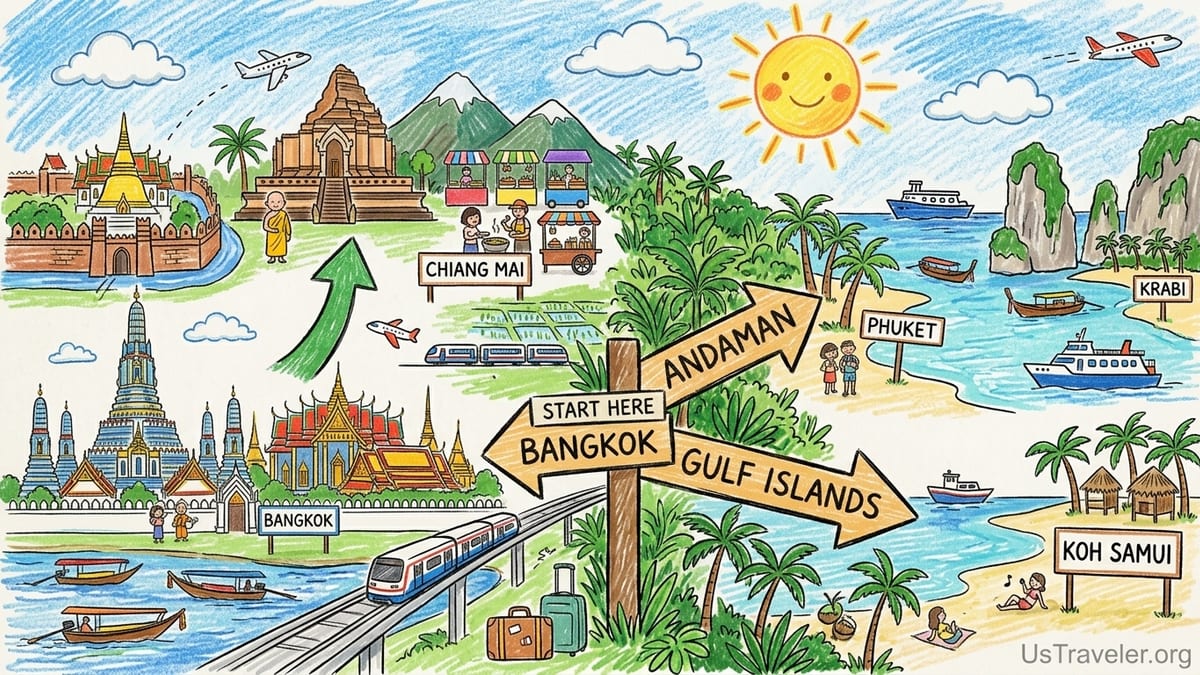
How To Think About Thailand: Build One “Core” Region, Then Add One Nearby
For first-time visitors, Thailand is best planned like a set of connected mini-trips. Bangkok and Central Thailand are the natural hub, because most international flights arrive there and it links efficiently to day trips (Ayutthaya), beach escapes (Hua Hin), and domestic flights north or south. The mistake is treating “Bangkok + Chiang Mai + Phuket + Koh Samui” as four quick add-ons when each one demands its own airport, drive, and hotel change.
A practical rule is to choose one primary region for your trip’s identity and pace, then add one adjacent region that shares the same transport logic. Examples that work: Bangkok plus Chiang Mai (city and culture), Bangkok plus Krabi or Phuket (city and beaches), or Bangkok plus the Gulf islands (city and laid-back island time). Examples that usually waste time: Chiang Mai plus Koh Samui plus Krabi in under two weeks, because you’ll zigzag across the country and stack flight connections and sea schedules.
If you want a grounded reality check, count transfers, not destinations. A “simple” Phuket to Krabi move can be a half-day once you add hotel checkout, pier check-in, weather, and the van ride at the other end. A Bangkok to Chiang Mai move can be quick by plane, but still consumes a prime sightseeing window when you include airport travel and buffers. Planning fewer regions gives you the most valuable Thailand experiences: slow evenings in street-food areas, early temple visits before the heat, and beach days that are not interrupted by constant packing.
Bangkok And Central Thailand: Temples, Food, River Life, And Easy Side Trips
Bangkok is where most first-timers should start, even if beaches are the goal. It has the country’s most concentrated mix of headline temples, street food, markets, and modern neighborhoods, and it’s also the easiest place to recover from jet lag because you can do a lot without long drives. Classic temple anchors include the Grand Palace and Wat Phra Kaew area for first impressions, Wat Pho for traditional Thai aesthetics, and Wat Arun for river views across the Chao Phraya. If you only have one “temple outfit,” plan for respectful coverage: shoulders and knees, with something you can put on quickly if you’re in casual Bangkok heatwear.
Bangkok transport is also where you can immediately make your trip smoother. The MRT Blue Line fare range was adjusted to 17–44 baht starting July 3, 2026, which helps keep city hops predictable when you’re moving between areas like Sukhumvit, Silom, and the old city. From Suvarnabhumi Airport, the Airport Rail Link City Line is widely posted in the 15–45 baht range depending on distance, a useful benchmark when deciding whether to take rail into town or pay for a taxi in peak traffic.
Central Thailand shines with day trips that feel “big” without being logistically heavy. Ayutthaya is the standout for first-time visitors who want a UNESCO-listed historical city without flying. The key detail: Ayutthaya is not a single gated park with one entry, it’s a spread-out island city of ruins where many major sites are ticketed individually. The Fine Arts Department’s posted ticketing includes a combined ticket for six key sites at 220 baht for foreign visitors, and individual site tickets are commonly 50 baht each, which is exactly why first-timers who show up without a plan sometimes overpay by buying single tickets all day.
For a beach break that still pairs naturally with Bangkok, Hua Hin is the classic “easy mode” option: you get seaside hotels, night markets, and a calmer pace than the islands, without needing pier schedules. It’s also a strong choice in months when you want sand time but don’t want to gamble on monsoon seas and boat cancellations. If your group includes older travelers or anyone anxious about island transfers, Bangkok plus Hua Hin is one of Thailand’s most comfortable first-timer combinations.
Northern Thailand And Chiang Mai: Culture, Mountains, Night Markets, And National Parks
Chiang Mai is the most common “second region” for first-time visitors because it feels distinct from Bangkok without requiring complicated logistics. It’s a city of moats, temple-lined lanes, and food markets where evenings are as memorable as the big daytime attractions. Many travelers build days around a simple rhythm: morning temples, late afternoon cafés or crafts, then a night market for dinner. It’s also the gateway to mountain scenery and cooler evenings in the right season.
Getting there is typically either a quick flight or an overnight train. Thai Airways regularly publishes Bangkok to Chiang Mai options, and a non-stop flight time around 1 hour 20 minutes is a realistic planning figure for the air portion of the journey, although the total door-to-door time will be longer once you include airport travel and check-in. The train is slower but can be an experience in itself; the State Railway route is a classic for travelers who prefer to wake up in the north rather than spend another day in transit.
In the north, your “don’t overplan” moment usually comes from trying to add too many mountain detours. If you want Chiang Mai plus a scenic side trip, choose one: a day in the mountains for viewpoints and nature, or a second city like Chiang Rai with a very different temple aesthetic. If you try to do Chiang Mai, Chiang Rai, Pai, and a national park on a short schedule, you’ll spend more time on winding roads than on the experiences you came for.
Season matters more in the north than many first-timers expect. The Thai Meteorological Department describes the southwest monsoon rainy season as roughly mid-May to mid-October for most of the country, and the north can see heavy rainfall windows in that period. If your goal is clear mountain views and outdoor days, plan with flexibility, start early, and keep indoor alternatives in mind, such as temple circuits, cooking classes, or museum stops for afternoons when rain breaks up the day.
The Andaman Coast (Phuket And Krabi): Beaches, Boats, And Why Transfers Eat Your Schedule
The Andaman Coast is where many first-timers picture Thailand: limestone cliffs, longtail boats, and island-hopping days. Phuket and Krabi are often grouped together in one trip, but you should plan them as one coastal region, not two separate “full bases,” unless you have enough days to justify switching hotels. Krabi’s Ao Nang is a common base for boat trips and cliff scenery, while Phuket has bigger city energy, more varied beaches, and a larger spread of hotels and dining.
Here’s the realism that saves trips: water transfers can be slower than they look. A direct Phuket to Krabi ferry option can run around 7 hours in some schedules, which surprises travelers who expected a quick coastal hop. Other routes combine ferry segments with minivans, often taking most of a day. If you only have a week, it’s usually smarter to pick either Phuket or Krabi as your base and do day trips rather than trying to “collect” multiple coastal bases.
Concrete example: one operator’s published Phuket Town to Ao Nang ferry ticket shows 08:30 to 11:45 with an adult price of 900 baht effective from August 21, 2026. That looks simple, but in practice you still need to factor in getting to the pier, arriving early, and then local transport from the arrival point to your hotel. If the sea is rough, the boat experience can also change dramatically, which is why first-timers should avoid scheduling a flight the same afternoon as a major ferry transfer.
Seasonal planning is non-negotiable on the Andaman side. Phuket and Krabi are affected by the southwest monsoon, and the rainy season typically runs to roughly mid-October in many years. September is often cited as Phuket’s wettest month in travel climate summaries, and the practical impact isn’t just rain: it can be rougher seas, fewer operating days for some dive trips, and boat schedules that feel more fragile. If your dream is calm water and reliable island tours, aim for the drier window, and if you’re traveling in wetter months, plan your highlights so they still work on a stormy day (old-town Phuket, food scenes, spas, cooking classes) instead of relying only on boats.
The Gulf Islands (Koh Samui And Neighbors): A Different Monsoon Clock Than Phuket
Koh Samui and the Gulf islands are often treated as interchangeable with Phuket, but the weather patterns are not the same. The Gulf side is influenced by the northeast monsoon later in the year, and many month-by-month guides flag October through December as the riskier wet window, with November frequently described as the peak rainy month. This creates a planning opportunity: there are periods when Phuket and Krabi are enjoying better beach weather while Samui is taking heavy rain, and other periods when Samui feels comparatively calmer than the Andaman side.
For first-time visitors, Samui works best as an “island week” where you slow down, settle into one hotel, and do short-distance experiences: beach mornings, a viewpoint or temple stop, a market dinner, then a day trip if seas cooperate. If your plan depends on hopping to multiple islands on tight dates, you risk losing the exact days you wanted most, because boat conditions can disrupt schedules more than city travel.
A realistic pairing is Bangkok plus Koh Samui, especially for travelers who want nightlife and food in Bangkok first, then beach time without adding another region. If you’re tempted to combine Samui and the Andaman Coast in one short trip, pause and consider what you’re really chasing. If it’s just “a beautiful beach,” you don’t need both coasts. If it’s “two different island styles,” plan a longer trip and accept that you’ll spend meaningful time on flights, airport transfers, and pier runs.
Hotels on Samui range from simple beach bungalows to recognizable international brands and high-end resorts. The practical advice is to choose a location that matches your pace: if you want walkability and lots of restaurants, you’ll typically prefer a busy beach zone; if you want quiet, pick a calmer stretch and accept that you’ll be using taxis more often. First-timers are happiest when they optimize for fewer daily logistics, not for the most “perfect” beach photo.
Secondary Stops That Actually Fit: Khao Sok, Ayutthaya, And Smart Add-Ons
Khao Sok is the secondary destination that can feel like a different country entirely: rainforest scenery and lake landscapes that contrast sharply with Bangkok’s heat and the beaches’ salt-and-sand routine. The problem is not whether Khao Sok is worth it, but whether it fits your route. Khao Sok is most naturally combined with southern itineraries, especially when you’re already moving between beach areas and southern airports, rather than being bolted onto a Bangkok-only short trip.
If you do go, use real fees and rules to plan your day. As of June 2026, one widely referenced national parks resource lists Khao Sok National Park headquarters entrance at 200 baht for adults and 100 baht for children (ages 3 to 14), with camping listed at 30 baht per person and tent rental from about 225 baht per night. Those numbers help you sanity-check tour packages: if you’re quoted a “park fee” that’s wildly higher, ask what’s actually included (transport, guide, lake boat, accommodation, meals) rather than assuming it’s just a gate ticket.
Ayutthaya is the opposite kind of add-on: it’s close enough to be a day trip from Bangkok, and it’s one of the best ways to add deep Thai history without losing a day to airports. The Fine Arts Department’s published fee structure is also unusually clear for travelers: foreign visitors commonly see 50 baht per major site, with a combined 220 baht ticket covering six prominent ruins. That makes it easy to build a value-based day plan instead of wandering randomly and paying repeatedly.
The main point of secondary areas is to protect your trip from “destination overload.” If you’re already doing Bangkok plus an island region, choose just one secondary add-on that supports your theme: Ayutthaya for history, Hua Hin for an easy beach break, or Khao Sok for nature. Trying to cram in all three usually creates the exact problem first-timers want to avoid: spending Thailand in vans, airports, and lobbies instead of in markets, temples, and water.
The Takeaway
Thailand rewards first-time visitors who commit to fewer regions and travel slower within them. Bangkok and Central Thailand are the best foundation because you can stack temples, food, markets, and day trips without constantly repacking, then you can add either the north for culture and mountains, the Andaman Coast for dramatic scenery and island hopping, or the Gulf islands for a different beach rhythm. The goal is not to “see everything,” but to build a trip that feels like Thailand: early mornings at landmark temples, long meals in night markets, and beach days that are not sacrificed to transfer chaos.
If you’re stuck between coasts, use the monsoon clocks as your tie-breaker, not just the photos. And if you’re tempted to add one more region because it’s “only a short flight,” remember the door-to-door reality: airports, traffic, weather, and check-in time. Pick one core region, add one nearby complement, and your first Thailand trip will feel expansive without feeling rushed.
FAQ
Q1. How many regions can I realistically combine on a 10-day first trip to Thailand?
Two main regions is the sweet spot, such as Bangkok plus Chiang Mai, or Bangkok plus Krabi or Phuket, with at most one short side trip like Ayutthaya.
Q2. Should I visit both Phuket and Krabi on my first visit?
Only if you have enough time to justify a hotel change. Many first-timers do better choosing one as a base and using day trips instead of moving every few nights.
Q3. Is Ayutthaya a single “park ticket” destination?
No. Ayutthaya is a spread-out historic city where major ruins are often ticketed per site, with a commonly sold combined ticket that covers several key temples.
Q4. What’s the biggest transport mistake first-time visitors make in Thailand?
Underestimating transfer days, especially when combining flights with boat schedules and long drives, then trying to sightsee fully on the same day.
Q5. Is the Gulf side (Koh Samui) the same weather as Phuket?
No. Koh Samui’s rainiest period is typically later in the year with the northeast monsoon, while Phuket and Krabi are more affected by the southwest monsoon.
Q6. How long is the flight from Bangkok to Chiang Mai?
Non-stop flight times are commonly around 1 hour 20 minutes, but total travel time will be longer once you include airport transfers and check-in.
Q7. Is Khao Sok doable as a quick add-on from Bangkok?
It’s usually better as a southern add-on when you’re already traveling between southern beach areas and airports, rather than as a rushed detour from a Bangkok-only plan.
Q8. What should I budget for Bangkok rail rides?
For the MRT Blue Line, a typical published range is 17–44 baht depending on distance, which makes short hops relatively affordable compared with taxis in heavy traffic.
Q9. If I only want one beach region, how do I choose between Andaman and Gulf islands?
Choose based on season and transfer tolerance. If you want dramatic cliffs and classic island-hopping, the Andaman side is a natural pick. If you want a simpler island week, the Gulf side can be a better fit at certain times of year.
Q10. What’s the simplest first-timer itinerary that still feels diverse?
Bangkok for food and temples, one day trip to Ayutthaya for history, then one beach base (either Krabi area, Phuket, or Koh Samui) for a slower finish.