


Thailand is one of those rare destinations where a single trip can feel like three: a big-city gateway in Bangkok, culture and mountains in Chiang Mai, and a choice of beaches that range from Phuket’s resort sprawl to Koh Samui’s laid-back Gulf vibe. If you’re ready to book (not just dream), bundling a Thailand vacation package can simplify the logistics and sometimes cut your total cost, especially when you’re combining flights plus hotels, adding a resort stay, or building a multi-destination itinerary. Expedia’s current package inventory actively markets Thailand hotel plus flight and hotel plus car bundles, with Bangkok, Phuket, Pattaya, Koh Samui, Krabi, and Chiang Mai among the most prominently featured destinations.
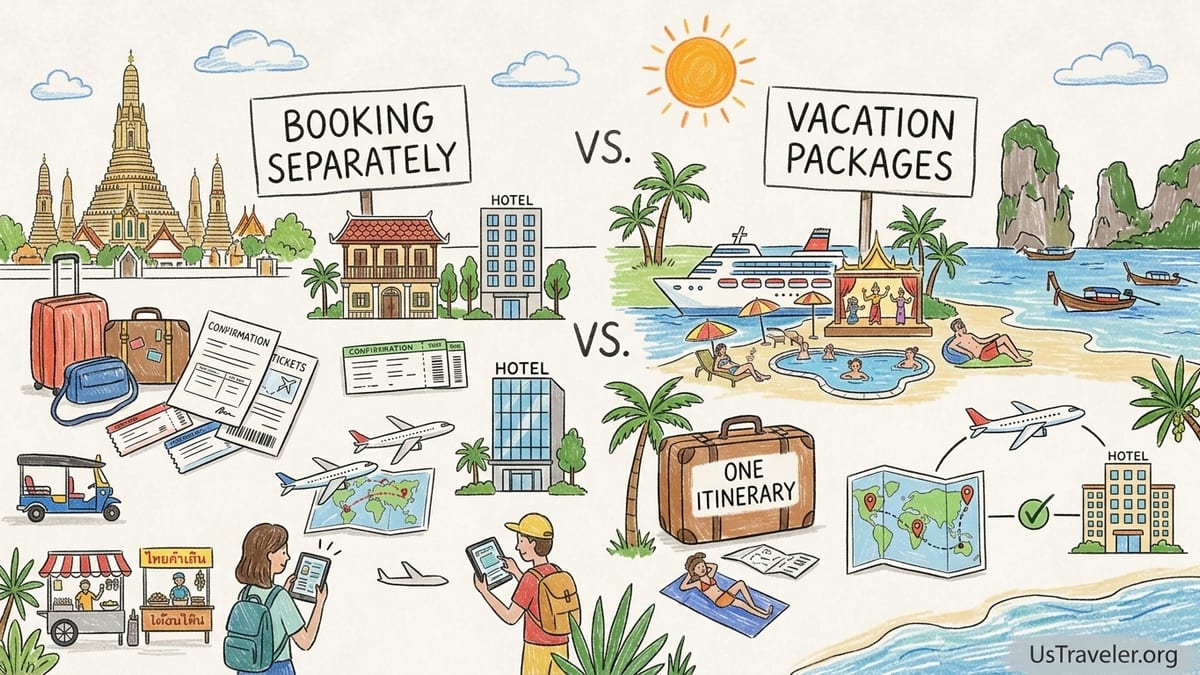
Packages vs. booking separately: what you gain, what you give up
A Thailand “vacation package” usually means you’re bundling at least two components under one checkout, most commonly flight plus hotel, sometimes adding car rental. The big advantage is one itinerary and one payment flow, plus the possibility of a built-in discount on either the flight, the hotel, or both. Expedia continues to market “Bundle and Save” style packages, and it also ties package pricing to its One Key loyalty ecosystem, which can unlock additional member savings on some bookings.
The tradeoff is flexibility. When you book a flight and hotel as one package, changing dates can be more complicated than adjusting a hotel-only reservation. You’ll often see a mix of refundable and nonrefundable options, but the bundled fare rules may be stricter than if you booked the same flight directly with an airline and the same hotel as a standalone reservation. In real life, that matters when a domestic flight time shifts, you decide to add an extra night in Chiang Mai, or you want to switch from Patong to Kamala Beach after reading reviews.
Separate booking tends to win when you want maximum control: picking flights with ideal departure times, mixing different hotel brands, using points (Hilton, Marriott, IHG, Hyatt), or staying in small boutique properties that may not show up in every package search. Packages tend to win when your goal is speed and predictability: you want Bangkok plus a beach, you like the convenience of “one cart,” and you’re price-checking multiple date combinations quickly.
Thailand’s domestic flight reality: easy routes, two Bangkok airports, and the Samui exception
Most first-time visitors underestimate how flight-centric Thailand can be once you start combining regions. Bangkok is served by two main airports: Suvarnabhumi (BKK) and Don Mueang (DMK). In practice, full-service and many long-haul arrivals funnel into BKK, while DMK is a major low-cost hub. That split matters for packages because you may arrive internationally into BKK, but your cheapest domestic hop to Chiang Mai or Phuket might depart DMK, which can add a cross-city transfer and extra buffer time.
Bangkok to Chiang Mai (CNX) and Bangkok to Phuket (HKT) are among the country’s easiest domestic flights to work into an itinerary. Multiple carriers operate nonstop services on those routes, and seats can be inexpensive, especially if you’re traveling light and booking promo fares. Expedia’s current flight listings show Bangkok to Chiang Mai deals as low as about $37 one-way on certain September 2026 dates, with other round-trip examples under $100 depending on airport pairing and timing.
Koh Samui (USM) is the outlier that changes the math. Samui Airport is privately operated and is strongly associated with Bangkok Airways operations, which can keep fares higher than equivalent distances elsewhere in Thailand. Expedia’s current Bangkok to Koh Samui pricing examples show round-trip fares in the mid-$200 range for select October 2026 dates, which is a very different cost profile than a Bangkok to Chiang Mai hop. If Koh Samui is essential to your trip, a package can still be useful, but you should expect air costs to dominate the “value” calculation more than they would for Phuket or Chiang Mai.
Bangkok + Phuket: the classic first-timer combo (and why packages often work here)
Bangkok plus Phuket remains the most straightforward “two Thailand trips in one” pairing: you can do temples, food, shopping, and rooftop bars in Bangkok, then pivot to beach days, island-hopping tours, and resort downtime in Phuket. The biggest practical advantage is frequency. Bangkok to Phuket is heavily served, and you can usually find flight times that fit common patterns like “Bangkok for 3 nights, Phuket for 5 nights,” without awkward overnight connections.
This is also where bundling tends to be genuinely useful. Many travelers want a recognizable resort zone (Patong, Karon, Kata, Kamala, Bang Tao) and don’t need a car. If you’re the type of traveler who will happily accept a well-rated 4-star hotel and focus on location, Expedia-style flight plus hotel packaging can reduce decision fatigue while still letting you compare multiple properties quickly. For example, you might price a Bangkok hotel in Sukhumvit near BTS plus a Phuket beachfront resort and see whether packaging drops your total by enough to justify slightly stricter change rules.
A real-world way to sanity-check value is to do a quick “three-tab test” before you commit: price the Bangkok hotel alone, the Phuket hotel alone, and the domestic flights separately, then compare to the package total. If the package discount is meaningful, it will usually show up as a lower combined total rather than an obvious line-item reduction. If the difference is small, separate booking may be safer, especially if you anticipate changing dates or switching hotels mid-stream.
Bangkok + Chiang Mai: the culture-forward pairing (often cheaper to build yourself)
Bangkok plus Chiang Mai is Thailand’s easiest “city plus heritage” itinerary. Chiang Mai is compact, walkable in the Old City, and surrounded by day-trip options that don’t require a car: Doi Suthep, ethical elephant sanctuaries, craft villages, and café culture in Nimmanhaemin. Because the Bangkok to Chiang Mai route is competitive and often inexpensive, you don’t always need a package to make the numbers work.
Expedia’s current flight examples underline that point: Bangkok to Chiang Mai can be remarkably affordable on certain dates, including low-cost options from DMK and BKK that can bring one-way pricing down to the tens of dollars. When flights are that cheap, bundling doesn’t have as much “room” to create savings, so the real question becomes flexibility. Many travelers prefer to choose a Chiang Mai hotel with a specific vibe, like a boutique in the Old City for evening street-food walks, or a modern stay in Nimman for cafes and co-working friendly spaces.
This combo is also a good candidate for a “soft package” approach: book your international flight to Bangkok and your first Bangkok hotel night, then book Chiang Mai separately once your dates are locked. That way, if you realize you want to shift Chiang Mai by a day or two to match a weekend night market, you can do it without reworking a single bundled reservation.
Bangkok + Koh Samui: best for resort downtime, but watch the flight pricing and timing
Bangkok plus Koh Samui is one of Thailand’s most relaxing pairings when you want a true resort second act: beach clubs, wellness programs, and a slower pace than Phuket’s busiest areas. It’s also one of the easiest places to overspend accidentally, simply because the flight into USM can be pricey compared with other domestic routes and schedules may push you toward less-than-ideal connection times.
Expedia’s current examples for Bangkok to Koh Samui show round-trip fares in the mid-$200 range for select October 2026 dates, which is a realistic reminder to budget accordingly. In a package scenario, that can still work well if your Samui hotel is a higher-end resort where bundling meaningfully reduces the lodging cost, or if you’re booking during a popular travel window and want the “one checkout” convenience more than maximum flexibility.
If you’re a traveler who hates wasting vacation hours, build your Samui segment around flight timing, not the other way around. A common frustration is arriving into Bangkok late at night and realizing the Samui flights you want are gone, forcing an overnight in Bangkok you didn’t plan. A practical workaround is to deliberately plan one Bangkok buffer night on arrival, then fly to Samui the next morning, and save your “Bangkok city time” for the end of the trip when jet lag is gone and you’ll appreciate a great final meal and last-minute shopping.
Bangkok + Chiang Mai + beach: how to build a multi-destination trip that doesn’t feel rushed
Three-stop Thailand trips are where packaging can shine or backfire, depending on how you structure them. The appeal is obvious: Bangkok for energy, Chiang Mai for culture, then a beach destination to decompress. The risk is losing too many days to airport transfers, check-in windows, and “travel day fatigue.” If you’re doing three destinations, the itinerary needs to be deliberately paced, with enough nights in each place to justify the move.
A smart rhythm for many travelers is 3 nights Bangkok, 3 or 4 nights Chiang Mai, then 4 to 6 nights at the beach. Phuket and Krabi typically give you the most flight flexibility for the beach segment, while Koh Samui can be the most “resort-perfect” but may limit your flight choices and raise costs. If you’re using a package, pay extra attention to hotel flexibility: some bundled deals make it tempting to accept whatever property is cheapest, but on a three-stop itinerary, hotel location matters more because you have fewer total nights to “make up” for an inconvenient base.
If you’re choosing between Phuket and a Krabi-area stay for the beach finale, think in terms of trip style. Phuket is better for a wide range of resort infrastructure, nightlife options, and tour variety. Krabi is often chosen for dramatic scenery and easy access to Ao Nang, Railay, and island trips. In either case, multi-destination packaging can reduce the planning workload, but you should still price-check domestic flights separately to ensure you’re not locking into awkward connections or expensive timings just to keep everything under one reservation.
The Takeaway
Thailand packages are most useful when they solve real logistics: combining Bangkok with a beach stay, bundling a higher-priced Koh Samui flight with a resort where the hotel discount offsets the airfare, or simplifying a multi-destination itinerary into one workflow. Booking separately often wins when domestic flights are already cheap (like many Bangkok to Chiang Mai options), when you want maximum date-change flexibility, or when you’re mixing loyalty points and specific hotel brands.
If you do one thing before clicking “Book,” do this: run a quick comparison of packaged total vs. separate totals for the same dates and similar hotels, then decide based on your personal risk tolerance for changes. For Bangkok plus Phuket, bundling often makes sense. For Bangkok plus Chiang Mai, separate booking can be just as economical and more flexible. For Bangkok plus Koh Samui, plan around flight costs and schedules first, then use packaging strategically if it improves the overall value or reduces hassle.
FAQ
Q1. Is it usually cheaper to book a Thailand vacation package than booking separately?
Sometimes. Packages can lower the combined total, but you should compare the package total against the same flights and hotels booked separately because flexibility and fare rules can differ.
Q2. Which combo is easiest for first-time visitors: Bangkok + Phuket or Bangkok + Chiang Mai?
Bangkok + Phuket is the simplest “city plus beach” pairing, while Bangkok + Chiang Mai is an easy “city plus culture” pairing with typically inexpensive domestic flights.
Q3. Why are flights to Koh Samui often more expensive than flights to Phuket or Chiang Mai?
Koh Samui’s airport has unique operational constraints and is closely associated with Bangkok Airways service, which can keep fares higher than other domestic routes with multiple low-cost competitors.
Q4. Do I need to rent a car in Thailand if I book a flight + hotel + car package?
Not for Bangkok, and not for most Phuket or Chiang Mai itineraries. A car can be useful for quieter parts of Phuket or exploring beyond Chiang Mai, but many travelers prefer rideshares, taxis, and tours.
Q5. What’s the biggest flexibility risk with packages?
Date changes and cancellations can be more complex when flight and hotel are bundled. Always read the change and refund terms for both components before booking.
Q6. Which Bangkok airport should I use for domestic flights?
Bangkok uses both BKK and DMK. Your domestic flight may depart from a different airport than your international arrival, so plan transfer time if you’re switching airports.
Q7. How many nights should I allocate per destination on a Bangkok + Chiang Mai + beach trip?
A common pacing is at least 3 nights in Bangkok, 3 to 4 nights in Chiang Mai, and 4 or more nights at the beach to avoid the trip feeling like constant transit.
Q8. Is it better to start in Bangkok or end in Bangkok?
Many travelers like ending in Bangkok for shopping and a great final meal, but starting in Bangkok can help you recover from jet lag before moving on. Either works if you plan flights logically.
Q9. Are domestic flights in Thailand reliable enough for tight same-day connections?
They’re frequent, but delays happen. If you’re connecting from an international arrival to a domestic flight, leaving a buffer or planning an overnight in Bangkok reduces stress.
Q10. What should I prioritize when choosing hotels in a package?
Location and cancellation terms. On multi-destination itineraries, a well-located hotel saves time every day, and flexible terms protect you if your flight schedule changes.