


Thailand’s trains are one of the most satisfying ways to travel the country, but buying the right ticket on the right system is where many trips go sideways. In 2026, most visitors booking Bangkok to Chiang Mai, Bangkok to Ayutthaya, or Bangkok to Surat Thani (for Koh Samui, Koh Phangan, and Koh Tao connections) will use the State Railway of Thailand’s own D-Ticket platform to search services, pick a specific carriage and seat or berth, pay online, and travel with a QR-coded ticket on their phone. This guide focuses on the routes you’re most likely to book, what “first class” and “second class” actually mean on Thai trains, and the real decision points that matter: overnight vs daytime, station changes in Bangkok, how far ahead to book, and when flying simply makes more sense.
Start Here: Bangkok Stations, Names On Tickets, And Why It Matters
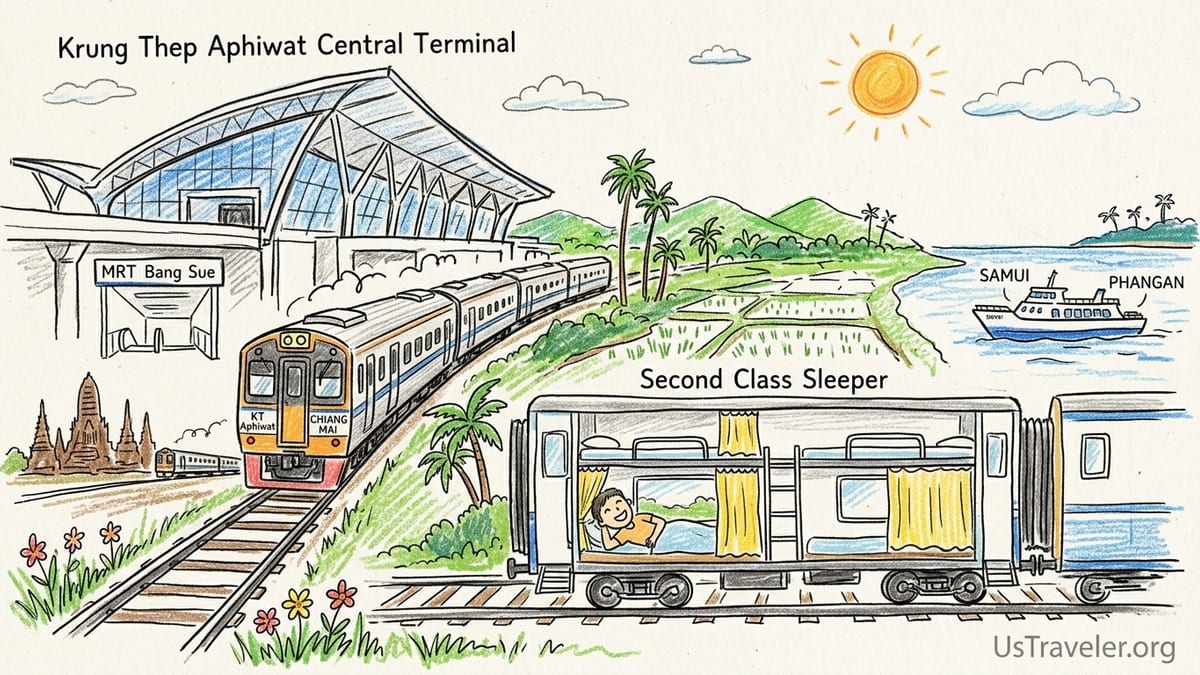
For most long-distance trains today, “Bangkok” on your itinerary usually means Krung Thep Aphiwat Central Terminal (often still called Bang Sue by locals). Since January 19, 2023, the bulk of long-distance special express, express, and rapid services shifted away from the historic Hua Lamphong station to Krung Thep Aphiwat, which is now the primary hub for the Northern and Southern lines used in this guide.
This matters in a very practical way: a taxi to Hua Lamphong because you saw it on an old blog can easily make you miss a sleeper to Chiang Mai. Always check the origin printed on your ticket before you set off. If you’re staying around Sukhumvit or the old city, budget extra time for traffic and the size of the new terminal. Krung Thep Aphiwat is also linked to the MRT at Bang Sue via a connected walkway, which can be a calmer way to arrive than crossing Bangkok by car during rush hours.
Ayutthaya is the one route in this article where station confusion still catches people. There are still some ordinary, non-reserved services that operate in the old pattern, and some departures may still be shown from Hua Lamphong in certain timetables. The fix is simple: don’t assume. When you book, read the station line carefully and treat “Krung Thep Aphiwat Central Terminal” as the default for anything reserved or long-distance.
How D-Ticket Works In Real Life (And What You Actually Receive)
D-Ticket is the State Railway of Thailand’s official online booking system. The workflow is built around choosing exactly what you’ll ride: you search by origin and destination, choose a train, then pick from available carriages and seat or berth positions. This is especially important on sleepers, where you may want a lower berth, a specific cabin, or simply a spot away from the toilets.
In practice, a typical booking looks like this: you search “Krung Thep Aphiwat” to “Chiang Mai,” select an overnight special express, choose “2nd class sleeper air-con,” then the system shows which sleeping cars still have space. You can tap into a carriage map, pick an upper or lower berth, enter passenger details, and pay by card. After payment, you can save the ticket on your phone and present it for scanning on board via its QR code.
Two real-world tips: first, create your account and log in before you start shopping for popular dates, because you don’t want to lose the last lower berth while you’re still wrestling with registration screens. Second, if you’re booking for a family, do your seat selection deliberately. On a second-class sleeper, it’s common to book two lower berths across the aisle from each other so parents can keep an eye on kids without being stuck in separate bays.
Classes Explained: First Vs Second, And What “Sleeper” Really Means
Thai train classes are not just about comfort, they change the entire experience of the trip. For most visitors, the decision is between first-class sleepers (private cabin) and second-class sleepers (open-plan berths with curtains). On the big overnight routes, both are typically air-conditioned when sold as “air-con sleeper,” but the privacy, noise level, and social feel are very different.
First class is usually a two-berth cabin with a door. Think of it like a compact hotel room on rails: two bunks, washbasin in the room on many cars, and a more contained environment. If you’re traveling as a couple and want a quieter space, it can be worth paying more. A concrete example from Bangkok to Chiang Mai on a popular special express: a first-class two-berth cabin can price around ฿1,446 for an upper berth and around ฿1,646 for a lower berth on certain departures, with the option to buy the whole cabin for yourself on some services if you don’t want to share.
Second class sleeper is the classic Thailand rail experience most travelers picture. It’s an open carriage where seats convert into bunks. At night, staff come through to make the beds, curtains give you privacy, and the aisle stays open. On Bangkok to Chiang Mai, a common real-world fare level on a flagship sleeper can be around ฿938 for an upper berth and ฿1,038 for a lower berth, which helps explain why lower berths disappear first. Lower berths are wider and feel more stable. Upper berths can be great if you’re light sleeper who prefers being away from foot traffic, but you’ll climb a ladder and you’ll have less “sit-up” space.
Daytime seats are a separate choice. If you take a day train to Chiang Mai, you’re trading the romance of waking up in the north for a very long sit. If you take a daytime run to Surat Thani, you’ll arrive late afternoon but still need to connect to the pier towns. For many people, the sleeper isn’t about luxury at all, it’s about making the clock work in your favor and saving a hotel night.
Bangkok To Chiang Mai: Picking The Right Train, Time, And Berth
Bangkok to Chiang Mai is the sleeper route most visitors plan their trip around, and it’s also the one most likely to sell out in the classes tourists actually want. The sweet spot for many travelers is an overnight special express that leaves Bangkok in the evening and arrives in Chiang Mai around breakfast time. That timing lets you check out of your Bangkok hotel, have dinner, board, sleep, and start your Chiang Mai day without losing daylight to transit.
Here’s what “real planning” looks like: if you want a lower berth in second class on a popular overnight, don’t wait until you’re already in Thailand during peak dates. Lower berths can be the first inventory to vanish on weekends and holiday periods, and first-class cabins can go even faster because there are fewer of them. If you’re flexible, you can often find space by shifting your departure by one day or choosing an alternative overnight service rather than the single most famous train.
Comfort differences matter on this long run. Second class is usually the best value for most visitors: you get a proper bed, a social carriage feel, and the ability to move around. First class can be a better fit if you’re traveling with a light sleeper, you need to work quietly, or you’re trying to maximize rest before a packed Chiang Mai itinerary like an early morning Doi Suthep visit or a day trip out to Doi Inthanon.
When daytime can win: if you’re the kind of traveler who wants scenery and doesn’t sleep well on trains, a day train plus a Chiang Mai hotel can be more satisfying than a restless night. When flying wins: if your Chiang Mai plan is short, like a two-night weekend, flights often make more sense because the train’s overnight time still consumes an evening and a morning, even if you “save” a hotel night.
Bangkok To Ayutthaya: The Easy Train Day Trip (And The New Commuter Option)
Bangkok to Ayutthaya is one of the most forgiving train rides in Thailand, which is why it’s perfect for visitors who want a low-stress rail day without sleeper logistics. Traditional ordinary trains can be extremely cheap and require no reservation. A classic example repeated by many travelers is buying a third-class ticket on the day for around ฿20 and riding north with open windows and ceiling fans. It’s not luxurious, but it’s an experience, and it’s hard to beat for value.
What’s new and very relevant in 2026 is a dedicated air-conditioned commuter-style service between Krung Thep Aphiwat Central Terminal and Ayutthaya that began operating on August 1, 2026. During its promotional period running through October 31, 2026, the fare to Ayutthaya is capped at 50 baht, with lower promotional fares for intermediate stops. The practical implication is simple: if you’re visiting during this window and you want a cooler, more commuter-style ride without the heat of older fan cars, that 50-baht option is an unusually strong deal.
Ayutthaya ticket strategy is straightforward. If you’re taking a non-reserved local train, you can usually just turn up and buy a ticket at the station. If you’re using a reserved service (or you simply prefer a guaranteed seat on a specific departure time), then use D-Ticket and confirm your origin station carefully. Either way, plan your return: it’s easy to spend longer than expected at Wat Mahathat or along the river near Wat Chaiwatthanaram, and the “just one more temple” habit is how people end up scrambling for the last train back.
Bangkok To Surat Thani: The Gulf-Island Rail Connection That Actually Works
Surat Thani is the rail gateway for Koh Samui, Koh Phangan, and Koh Tao, but the best ticket choice depends on what you want the next day to look like. Many travelers choose the overnight train because it lines up neatly with morning or midday onward transfers. Arrive, grab breakfast, and continue toward the piers rather than spending a whole day traveling south.
There are also daytime services that get you to Surat Thani in the afternoon, which can be ideal if you don’t like sleeping on trains and you’re aiming for an evening in Surat Thani town or you’re connecting onward by road. One concrete example travelers commonly plan around is Train 43, which departs Bangkok (Krung Thep Aphiwat) at 07:30 and arrives Surat Thani at 16:20, putting you in the region before dinner. The tradeoff is what happens next: you still need ground transport to your pier town, and that can feel like a second leg of travel right when you’d rather be done.
On sleeper-equipped southern services, the same class logic applies as Chiang Mai: first class is private and quieter, second class is open-plan with curtains and tends to be the best balance of price and comfort. If you’re booking for an onward island connection the next day, prioritize reliability over perfection. A slightly less popular departure that still gets you to Surat Thani at a sensible hour can be a smarter choice than obsessing over a single “best” train that sells out.
The key “island planning” mindset is to treat Surat Thani as a connection point, not the final destination. Book your train first, then plan your onward transfer window with slack. If your trip is tight, for example you must catch a specific ferry because you’ve pre-booked a diving course on Koh Tao, flying to Surat Thani or directly to Koh Samui may be the calmer option. But if your schedule is flexible, the overnight train is one of the most budget-friendly ways to turn Bangkok into a beach day without paying for an extra hotel night.
The Takeaway
If you want the simplest, most controllable way to buy Thai train tickets in 2026, use the State Railway of Thailand’s D-Ticket system and treat it like an airline-style booking tool: choose your train, then choose your exact carriage and seat or berth. For Bangkok to Chiang Mai, the overnight sleeper is usually the best blend of comfort and time savings, with second class being the most popular value pick and first class best for travelers who prioritize privacy. For Bangkok to Ayutthaya, keep it simple: you can still do a classic cheap local train day trip, and there’s also a new air-conditioned commuter option with promotional fares through October 31, 2026. For Bangkok to Surat Thani, decide whether you want to arrive ready to connect onward to the Gulf islands, and pick your departure time accordingly.
The most common mistake is not picking the wrong class, it’s booking the right class on the wrong day or departing from the wrong Bangkok station. Check your origin station on the ticket, book earlier for sleepers during busy periods, and be honest about your sleep style. If you can’t sleep on trains or your trip is short, that’s when flying wins. If you can sleep even moderately well, Thailand’s sleepers can turn long distances into a surprisingly efficient part of the journey.
FAQ
Q1. What is the official website to book Thailand train tickets online?
D-Ticket is the State Railway of Thailand’s official online booking system, where you can search trains, select carriages and seats, pay, and receive a QR-coded ticket.
Q2. Do Bangkok to Chiang Mai sleeper trains sell out, and how far ahead should I book?
Yes, sleepers can sell out, especially lower berths in second class and first-class cabins. Book as early as you can once your travel date is fixed, particularly for weekends and holiday periods.
Q3. What’s the difference between first-class and second-class sleepers in Thailand?
First class is a private cabin, typically with two berths and a door. Second class is an open-plan sleeping carriage with berths and curtains for privacy.
Q4. Is a lower berth worth paying extra for?
Often, yes. Lower berths are wider, easier to access, and feel more stable, which is why they usually sell out before upper berths.
Q5. Which Bangkok station do trains to Chiang Mai and Surat Thani depart from?
Most long-distance trains to Chiang Mai and Surat Thani depart from Krung Thep Aphiwat Central Terminal, Bangkok’s main long-distance hub.
Q6. Can I do Bangkok to Ayutthaya by train without reserving a seat?
Yes. Many ordinary local trains do not require reservations, and you can typically buy a ticket at the station shortly before departure.
Q7. What is the new Bangkok to Ayutthaya commuter train in 2026?
A daily air-conditioned commuter-style service began on August 1, 2026, with a promotional fare structure through October 31, 2026, including a capped fare to Ayutthaya.
Q8. Should I take a day train or an overnight train to Surat Thani for the islands?
An overnight train can line up well for next-day island transfers and can save a hotel night. A day train can be more comfortable if you don’t sleep well on trains, but you’ll still need onward transport after arrival.
Q9. When does flying make more sense than taking the train in Thailand?
Flying can make more sense if your trip is short, you need to arrive at a precise time, or you struggle to sleep on trains. The train often wins when you value the journey and can use overnight time efficiently.
Q10. What should I double-check before leaving for the station?
Confirm the departure station printed on your ticket, arrive early for large terminals, and verify your carriage and seat or berth details so boarding is stress-free.