


Thailand planning in 2026 still starts with the same proven trio that dominates first-time itineraries: Bangkok for big-city energy and food, Chiang Mai for northern culture and mountains, and one southern beach base for island days. The trick is choosing the right southern base for your priorities, then adding a couple of smart side trips instead of trying to “do it all” and spending half your vacation in vans, ferries, and domestic airports. Below is a selective, comparison-first guide to Bangkok, Chiang Mai, Phuket, Krabi, Koh Samui, Ayutthaya, Khao Sok, Koh Lanta, Koh Tao, Hua Hin, and a handful of northern standouts, with real-world examples to help you pick what belongs on your main route and what’s better as a day trip.
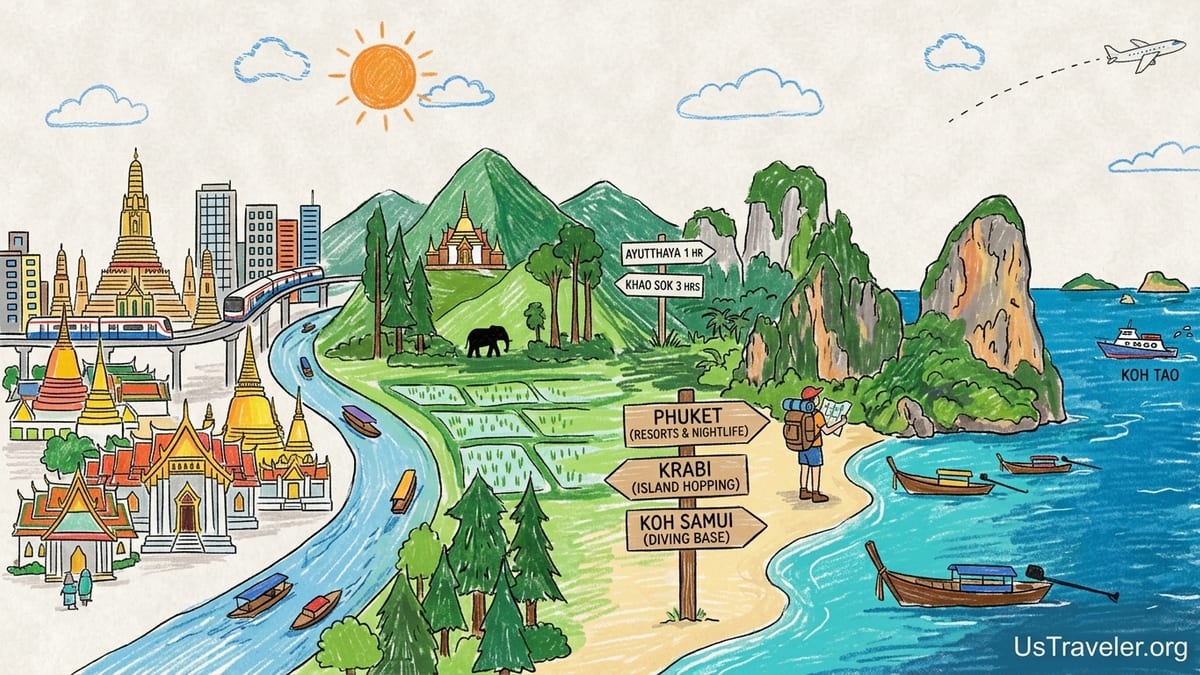
Thailand’s Best Bases vs Side Trips (How To Build A First-Timer Route)
Think of Thailand as a country of “bases” and “add-ons.” Bases are places where you can land, sleep well, move around easily, and do multiple day trips without repacking every night. In this guide, the strongest bases are Bangkok, Chiang Mai, Phuket, Krabi (Ao Nang or Railay area), and Koh Samui. Add-ons are destinations that are amazing but usually work best as side trips or short add-on stays: Ayutthaya (from Bangkok), Khao Sok (between coasts or as a dedicated nature stop), Koh Tao (as a diving-focused island), Koh Lanta (as a quieter beach reset), and most northern mountain towns.
A classic first-time itinerary that still works in 2026 is 3 to 5 nights in Bangkok, 3 to 5 nights in Chiang Mai, and 4 to 7 nights in the south. The main decision is which “south” fits you: Phuket for resort choice and nightlife range, Krabi for dramatic scenery and easier island-hopping, or Koh Samui for a gentler Gulf-of-Thailand island rhythm (plus direct access to Koh Tao diving).
For practical expectations, Bangkok sightseeing is not free: a single high-impact cultural morning at the Grand Palace is a 500 baht foreigner ticket. In exchange you get Wat Phra Kaew, the palace grounds, and the textiles museum in one visit. Bangkok’s public transport is also priced for short hops: MRT Blue Line fares in 2026 are published at 17 to 44 baht depending on distance, so the “quick ride” budget is real, even if you stack multiple rides in one day.
Side trips become worth it when they solve a specific goal. Ayutthaya answers “I want ancient ruins without changing hotels,” and Khao Sok answers “I want rainforest and limestone karsts that feel like nowhere else in Thailand.” If your itinerary starts looking like Bangkok to Ayutthaya to Bangkok to Chiang Mai to Pai to Chiang Mai to Phuket to Krabi to Phuket to Koh Lanta to Phuket, simplify. You’ll see more by moving less.
Bangkok: Best For Food, Nightlife, First-Timers, And Easy Day Trips
Bangkok is the country’s most useful starting point because it combines first-timer landmarks, modern transit, and the widest range of food on one map. You can go from canal-side old town to sleek malls in one day, and it is easy to “choose your own intensity.” If you want to do the core cultural circuit, plan an early morning at the Grand Palace (500 baht for foreigners), then walk or short-taxi to Wat Pho for the reclining Buddha and traditional massage, and end with a river-cross to Wat Arun at sunset when the light hits the porcelain mosaics.
Food is Bangkok’s signature advantage because you can mix serious dining and street staples without over-planning. A very real, very Bangkok evening looks like this: queue for Chinatown snacks in Yaowarat after 6 p.m., jump on the MRT at Wat Mangkon, and finish with a late-night sit-down near the old city. If you want a recognizable “Bangkok food pilgrimage,” Jay Fai is the famous Michelin-star street-food name people chase, and nearby Thipsamai is the pad thai institution many travelers pair with a self-guided crawl. The point is not to collect hype stops, but to use Bangkok’s density to sample widely without burning transit time.
Bangkok is also a nightlife city with multiple “flavors” rather than a single party strip. Khao San Road still does the backpacker thing, Sukhumvit has cocktail bars and clubs, and riverside hotels lean loungey rather than loud. If you want a simple, concrete plan, book a river dinner cruise only if you truly enjoy that format, because the city’s best value is often eating one great dish at a time across neighborhoods instead of paying for a packaged experience.
As a base, Bangkok makes day trips painless. If you only add one, make it Ayutthaya for history. If you add a second, choose between a floating market day (more about atmosphere than shopping) or a day of contemporary Bangkok neighborhoods like Talad Noi and Song Wat for cafés, galleries, and street photography. Bangkok’s superpower is optionality; use it to tailor your first days in Thailand to your exact travel mood.
Chiang Mai And Northern Thailand: Culture, Mountains, Night Markets, And Cool-Season Escapes
Chiang Mai is Thailand’s most beginner-friendly northern base because it pairs “easy city” logistics with real cultural depth. The old city’s moats and temple clusters make it walkable, and the day-trip menu is huge: mountain temples, craft villages, elephant sanctuaries that focus on observation rather than riding, and national-park scenery. If Bangkok is sensory overload, Chiang Mai is the reset button that still feels lively at night thanks to its markets and café culture.
For culture and viewpoints, Doi Suthep is the classic half-day. For a full day in nature, Doi Inthanon is the headline national park: it’s Thailand’s highest mountain and a cool-weather contrast to the coast. Budget for a proper park ticket day because the entrance fee for Doi Inthanon is commonly cited at 300 baht for adults and 150 baht for children, with extra fees at certain specific sites inside the park. In practice, that means you might pay once at the gate, then again for a special landmark, so carrying cash in smaller bills is genuinely useful.
If you want “selected northern destinations” beyond Chiang Mai, think of three tiers. Tier one is the easy add-on: Chiang Rai as a day trip or one-night stop for the White Temple and other contemporary temple art. Tier two is the short-stay add-on: Pai for mountain scenery and a youth-oriented vibe, best if you are comfortable with winding roads. Tier three is for travelers who want trekking and local villages: Mae Hong Son province circuits, which are rewarding but transit-heavy, so they work best when you have at least a week in the north.
Chiang Mai is also a strong family destination in the right season because days can be structured and calm: morning temple visit, afternoon pool time, evening market for easy dinner. It is less “instant beach vacation” than the south, but it is often where travelers feel they got closest to the rhythm of Thai life, especially if you spend time outside the old city in local neighborhoods instead of only doing the postcard loop.
Choosing Your Southern Beach Base: Phuket vs Krabi vs Koh Samui
In 2026, most first-timer searches still funnel toward one southern beach hub after Bangkok and Chiang Mai, and your best choice depends on what you value more: variety (Phuket), scenery and island-hopping (Krabi), or a calmer island base with easy access to Koh Tao diving (Koh Samui). All three can deliver great beaches, but they feel different on the ground, and that matters as much as the photos.
Phuket is the strongest “choose anything” base. If you want high-energy nightlife, Patong is still the most obvious zone, with bars, clubs, and late-night food. If you want a more resort-forward trip with easier evenings, areas like Kata and Karon are more conventional beach towns. Phuket also has the broadest hotel range, from budget guesthouses to international resort brands, and the most developed day-trip infrastructure to islands like Phi Phi and Phang Nga Bay.
Krabi is the better pick if you want your beach days framed by limestone cliffs and quick boat access to famous landscapes. Ao Nang works as a practical base for island tours and Railay beach time. The vibe is more “nature postcard” than “big-resort city,” and many travelers find Krabi easier to balance between active days and quiet nights. It is also a strong choice if you want to split your time between beaches and Khao Sok, because you are already oriented toward the Andaman-side nature corridor.
Koh Samui is the Gulf alternative that often wins for families and travelers who want an island feel without committing to multiple ferry hops. It can be busy in its core beach strips, but the overall rhythm is less chaotic than Phuket’s main nightlife zones. The real strategic advantage is that Koh Samui is a staging point for Koh Tao if diving is central to your trip, and it can also pair well with another nearby island like Koh Phangan if you are timing a specific event.
Islands And Beach Add-Ons: Krabi Coast, Koh Lanta, Koh Tao, And Phi Phi Reality Checks
Thailand’s island list is endless, so this section focuses on the add-ons that most often improve a first-time itinerary rather than complicate it. Start with a simple principle: if you are already based in Phuket or Krabi, you do not need to sleep on every famous island to “count” it. A well-run day trip can cover the scenery, while your base gives you predictable evenings and less packing.
Koh Lanta is the best antidote to a crowded itinerary. It is not the flashiest island, but it excels at long, low-key beach days, casual beachfront dinners, and a slower pace that couples and families often prefer after a few high-energy stops. In real terms, that means you can book a place where the day’s plan is genuinely just “breakfast, swim, nap, sunset,” without feeling like you are missing the main attraction because the main attraction is the calm.
Koh Tao is the specialist island. It is best for diving and snorkeling, and it rewards travelers who are willing to commit time for training rather than treating it as a quick photo stop. Dive-shop pricing is competitive and easy to compare in advance: several Koh Tao operators publicly post course prices, and as a ballpark, many Open Water packages you will see advertised cluster around roughly 9,900 to 13,000 baht for a multi-day course that includes training and boat dives. If you are picking a school, prioritize small group sizes, clear safety standards, and a schedule that does not feel rushed over the tiniest price difference.
Phi Phi is the classic day-trip dilemma. Yes, it is stunning, and yes, it can be crowded. The most useful “reality check” for 2026 planning is Maya Bay’s seasonal closure pattern. Operators and local guides commonly flag an annual conservation closure from August 1 to September 30, which changes what your day trip looks like in late rainy season. If your travel dates land in that window, you can still do a Phi Phi day, but you should expect the tour to substitute other stops and views rather than a beach landing. Plan for this up front so you do not build your entire beach dream around one specific stop that may be restricted at the time you visit.
Khao Sok National Park: Best For Nature, Cheow Lan Lake, And A Mid-Trip Reset
Khao Sok is the strongest “nature contrast” you can add to a Thailand route that is otherwise cities and beaches. The rainforest is dense and dramatic, and the signature experience is Cheow Lan Lake, where limestone towers rise straight out of the water. This is the destination that can make Thailand feel wild again, especially if you have already done Bangkok, temples, and a couple of busy beach areas.
Budgeting here benefits from being specific because Khao Sok has zone-based fees that can surprise travelers. The headquarters area is commonly priced at 200 baht for foreign adults and 100 baht for children. The Cheow Lan Lake zone is often treated as a separate special-fee area, with foreigner pricing commonly listed at 300 baht for adults and 150 baht for children, and you may pay each zone separately depending on your itinerary. It is a small detail with big impact when you are multiplying fees across a couple of days and multiple people.
Transport examples help set expectations. If you arrive by air, Khao Sok is usually approached via Surat Thani, Phuket, or Krabi depending on your route. For travelers pricing a private ride, some current park and travel guides cite a taxi from Surat Thani Airport at roughly 1,600 baht to the Cheow Lan Lake area or about 1,900 baht to Khao Sok village, which can be cost-effective if you are splitting with friends or a family group. If you are solo, shared minivans are typically the more budget-friendly move, but they run on fixed schedules.
Khao Sok is best as a 2-night stop if you want both jungle trails and the lake experience. One night can work, but it often becomes a blur of transfers. If your trip is packed, consider Khao Sok as the one place worth “making space” for because it offers something Bangkok, Chiang Mai, and the beaches cannot: a true inland wilderness feel with water-and-cliff scenery that looks like a movie set, except it’s real.
The Takeaway
If you are planning Thailand for the first time in 2026, start with the proven structure: Bangkok plus Chiang Mai plus one southern beach base. Bangkok is the best all-around entry point for food, culture, and nightlife variety. Chiang Mai is the easiest northern base for temples, mountains, markets, and a slower pace. Your southern choice should be intentional: pick Phuket for maximum choice and nightlife range, Krabi for scenery-driven island-hopping, or Koh Samui for an island base that pairs naturally with Koh Tao diving.
Then add selectively. Ayutthaya is the simplest history side trip from Bangkok, and Khao Sok is the most rewarding nature add-on if you want rainforest and Cheow Lan Lake. Koh Lanta is the quiet-beach upgrade when you need calm, and Koh Tao is worth it when diving is the main goal rather than an afterthought. The best Thailand itineraries are not the longest lists. They are the ones that match the right base to the right traveler, with side trips chosen for a clear reason.
FAQ
Q1. What is the best Thailand itinerary for first-time visitors?
Bangkok for 3 to 5 nights, Chiang Mai for 3 to 5 nights, then 4 to 7 nights in one southern beach base such as Phuket, Krabi, or Koh Samui.
Q2. Which Thai destination is best for beaches: Phuket, Krabi, or Koh Samui?
Phuket is best for variety and resort choice, Krabi is best for dramatic limestone scenery and island-hopping, and Koh Samui is best for a calmer island base in the Gulf.
Q3. Which place is best for Thai culture and temples beyond Bangkok?
Chiang Mai is the best all-around northern base for temples, markets, and day trips into the mountains, with easy add-ons like Chiang Rai if you have extra time.
Q4. Is Ayutthaya better as a day trip or an overnight?
For most travelers, Ayutthaya works best as a day trip from Bangkok. Stay overnight only if you want early-morning or sunset temple photography with fewer day-trippers.
Q5. Is Khao Sok worth it, and how long should you stay?
Yes, if you want rainforest and Cheow Lan Lake scenery. Two nights is the sweet spot for combining jungle time and a lake tour without rushing transfers.
Q6. Where is the best nightlife in Thailand for first-timers?
Bangkok offers the widest range of nightlife styles, while Phuket’s Patong area is the most concentrated beach-nightlife zone in the south.
Q7. Where should families base themselves in Thailand?
Bangkok and Chiang Mai both work well with shorter sightseeing days and easy food options. For the beach, Koh Samui and quieter Phuket or Krabi areas are often easier than party-centric zones.
Q8. What is the best place in Thailand to learn scuba diving?
Koh Tao is the most common training island, with many dive schools offering multi-day Open Water courses and frequent departures, making it easier to match your schedule.
Q9. Is Koh Lanta a good alternative to Phuket and Krabi crowds?
Yes. Koh Lanta is usually chosen for a slower pace, long beaches, and relaxed evenings, especially after busier stops like Bangkok or Phuket.
Q10. How do I avoid overpacking my Thailand trip with too many stops?
Choose three bases that match your goals, then add only one or two side trips with a clear purpose, such as Ayutthaya for history or Khao Sok for nature.