


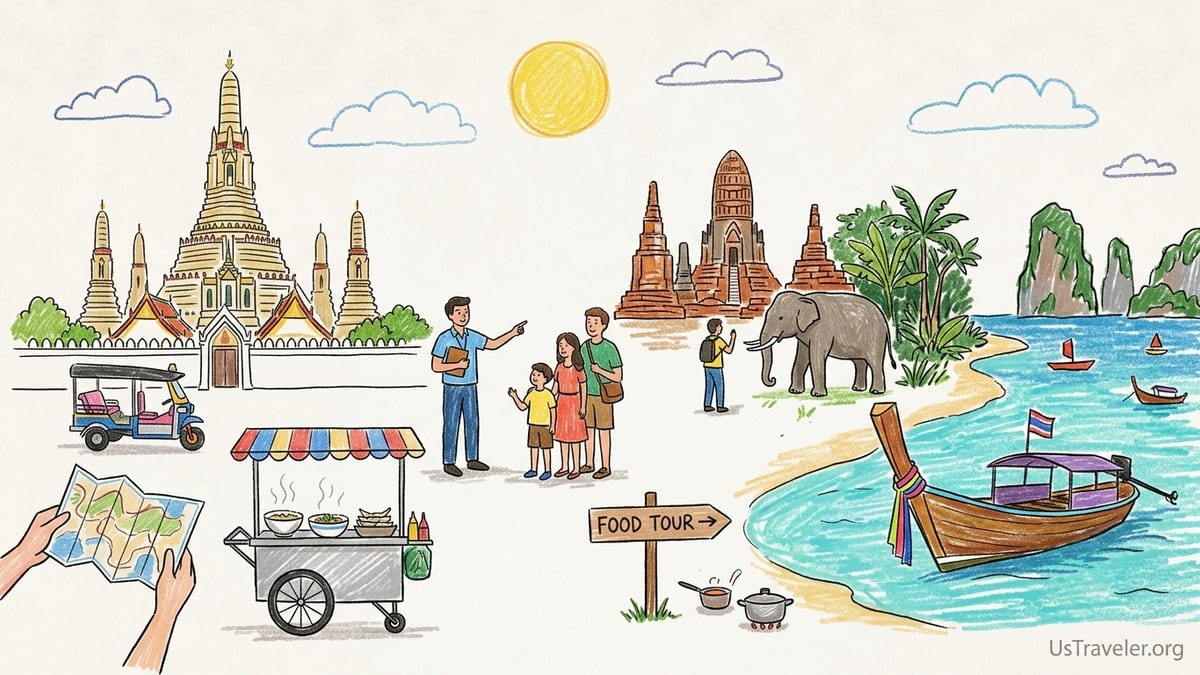
Thailand’s tour scene is not one market, but several: Bangkok’s temple-and-food circuits run on timing and crowd control; Ayutthaya day trips hinge on transport and heat; Chiang Mai sells skills and animal ethics; and the south is a moving puzzle of tides, park rangers, and speedboat seat limits. This guide compares the experiences travelers most commonly book across the country and explains what you gain and lose by going guided versus independent, how hotel pickup and park fees really work, where private tours are worth the premium, and which activities genuinely benefit from advance booking.
Bangkok temple and food tours: when a guide adds value (and when it doesn’t)
Bangkok’s “classic three” usually means the Grand Palace, Wat Pho, and Wat Arun, often bundled into a half-day or full-day guided itinerary. The advantage of a guided day here is not access; it is sequencing, cultural context, and friction reduction around dress code, entry points, and timing. As of recent official pricing, the Grand Palace ticket for foreign visitors is 500 baht, and it includes access to Wat Phra Kaew and the Queen Sirikit Museum of Textiles inside the complex. Wat Arun is commonly priced at 200 baht for foreign visitors, and Wat Pho’s official site currently lists foreigner admission at 300 baht.
If you are comfortable with transit and are traveling outside peak holiday periods, independent temple-hopping is straightforward: you can take the MRT to Sanam Chai for the Grand Palace and Wat Pho, then cross the river by local ferry for Wat Arun. What you give up without a guide is the on-the-ground interpretation that helps these sites feel distinct rather than repetitive: the symbolism of the Emerald Buddha’s seasonal costumes, why Wat Pho is historically framed as Thailand’s “first university,” and the details embedded in murals, chedis, and courtyard layouts that are easy to walk past.
Food tours are where Bangkok’s guided experiences often justify the price most clearly. A good operator compresses what would otherwise be a full day of trial-and-error into three or four hours with a coherent storyline: neighborhood history, the difference between central-Thai and Teochew-Thai dishes, how to order at a counter where no one speaks English, and what “normal” spice levels mean at a shop that caters to locals. Independent street eating can be brilliant, but the tourist penalty is real: you can spend half your evening getting from a famous market to a “recommended” stall only to find it sold out, relocated, or closed for a religious holiday.
Booking strategy for Bangkok: last-minute is usually fine for temple tours, but not always for top-rated evening food walks that cap group size. If you are trying to match a specific neighborhood and time window, book a few days ahead. Private tours are worth considering for families or groups of four who want hotel pickup, air-conditioned transport between sites, and a pace that allows rest stops, coffee breaks, or a longer visit at Wat Pho’s massage school without feeling rushed.
Ayutthaya day trips: the real cost of DIY versus small-group tours
Ayutthaya is the most common “first excursion” out of Bangkok because it’s close enough for a day trip and visually different from the capital. The catch is that the ruins are spread out. A guide does not unlock the temples, but a vehicle and a plan can. Ticketing in Ayutthaya also confuses first-timers because there is no single “park gate” experience. Instead, you pay per site or buy the combined pass.
As of 2026 pricing reported across multiple current guides, Ayutthaya sells a combined pass covering six major sites for 220 baht for foreign visitors, valid for 30 days. The covered temples are commonly listed as Wat Mahathat, Wat Ratchaburana, Wat Phra Si Sanphet, Wat Phra Ram, Wat Chaiwatthanaram, and Wat Maheyong. If you are planning to see several headline ruins, this pass is usually the best-value way to pay admissions because individual tickets add up quickly when you hop between multiple complexes in the heat.
Independent travel works best for confident travelers who can handle a two-step logistics day: get to Ayutthaya early, then rent a bicycle or hire a tuk-tuk driver for a negotiated route and time. The tradeoff is that DIY days often end up compressed: travelers arrive late, spend too long negotiating transport, and then race through ruins during the hottest hours. Small-group tours from Bangkok typically win on efficiency: early departure, a fixed loop, and a guide who can explain the Khmer, Sukhothai, and later Thai elements that blend together if you’re seeing your first set of temple ruins.
Booking strategy for Ayutthaya: if you want a sunrise-style early start from Bangkok or you’re traveling over a weekend, book ahead. If you’re flexible and comfortable negotiating locally, you can often arrange a driver in Ayutthaya on the day. Private tours are worth it when you want to add less-visited stops or when mobility and heat management matter, since having a dedicated air-conditioned vehicle changes the day dramatically.
Chiang Mai: cooking classes versus “responsible” elephant experiences
Chiang Mai’s best-known bookable experiences fall into two very different categories: skill-based classes and wildlife encounters. Cooking classes are comparatively low risk and easy to plan independent of season. Elephant visits are the opposite: high demand, ethics confusion, and wide variation in what the same marketing words actually mean.
For cooking classes, the guided-versus-independent debate is almost moot because the product is the class itself. What matters is the style: a market-to-wok class that begins with a local market visit; a farm-based class with herb gardens; or a technique-driven class focused on curry paste, knife work, and heat control rather than photo moments. Most classes include transfers from Chiang Mai’s core hotel areas and run half a day, which makes them easy to fit between temple visits and night markets. These are good candidates for booking a day or two ahead, mostly to secure your preferred time slot and menu focus rather than because they “sell out months in advance.”
Elephant tourism requires a stricter filter. A major 2026 welfare assessment by World Animal Protection documented that captive elephant tourism in Thailand still includes widespread poor welfare outcomes, even as some venues shift marketing away from rides and toward close-contact activities such as bathing and “hands-on” interactions. World Animal Protection has also explicitly warned that “washing” or bathing elephants can be harmful and should not be assumed ethical just because it looks gentler than riding.
Practically, that means travelers should treat certain inclusions as red flags rather than perks: riding, shows, forced tricks, and high-contact bathing sessions designed for photos. A more cautious approach is to prioritize venues that emphasize observation, distance, and elephant choice: elephants moving freely, visitors not crowding faces and trunks, and interactions that do not depend on keeping an animal compliant for constant touch. If you are traveling with kids, this becomes even more important, because many “family friendly” packages are actually high-contact experiences in disguise.
Booking strategy for Chiang Mai: cooking classes can be booked close to arrival. Elephant visits are the type of activity that genuinely benefits from advance booking, especially in peak season, because reputable programs often cap daily numbers and build their schedule around transport logistics from the city. Expect hotel pickup to be standard for elephant programs, with early starts and a long round-trip drive even for a “half-day” visit. Private bookings are most useful when you have a mixed-ability group and need a slower pace, or when you want to minimize crowding and keep the experience quieter.
Phi Phi and Phang Nga boat trips: park fees, closures, and why the cheapest tour can cost more
The Andaman Sea’s headline day trips are sold as simple “island hopping,” but they are regulated, weather-dependent, and fee-heavy. Two rules matter for planning: national-park fees are frequently collected separately in cash, and certain sites can close seasonally even when tours continue to operate.
For Phi Phi, Hat Noppharat Thara–Mu Ko Phi Phi National Park is widely cited as charging 400 baht for foreign adults and 200 baht for children to enter the park zone. Many tours advertise an attractive headline price, then add “national park fee not included,” meaning you pay it at check-in or onboard. If you do not bring cash in baht, you can end up scrambling on the pier, or paying a poor exchange rate, or wasting time while the group waits.
Maya Bay is the biggest calendar trap. Multiple operators and travel advisories have published that Maya Bay’s official seasonal closure in 2026 is set from August 1 to September 30, 2026, reopening on October 1, 2026. The practical impact is simple: boats still run Phi Phi itineraries during the closure, but they cannot land visitors on Maya Bay beach. If Maya Bay is your must-do, you should plan your trip dates accordingly and confirm what “Maya Bay included” means on your specific tour date.
Phang Nga Bay (often sold as “James Bond Island”) is commonly offered from Phuket and from Krabi, and the experience varies dramatically by boat type. Speedboats reduce time on the water and can help you beat crowds to the photogenic stops, but they can be rough in choppy seas. Larger boats are steadier and more social, but your day becomes a convoy experience. Private longtail arrangements can be excellent for photographers, couples, and travelers who want to linger in mangrove channels and avoid the loudspeaker-tour rhythm, but you must be more careful about what is included: national-park fees, lunch, insurance, and kayak guides are not automatically part of a private hire.
Krabi island hopping: group speedboats, private longtails, and the national-park fee reality
Krabi’s most-booked day trips tend to cluster around the “4 Islands” style itinerary and the Hong Islands. The reason these tours are so heavily booked is that the independent alternative is not a simple bus-and-ticket situation. You need a boat, you need a captain, and you need to be comfortable with sea and weather variables.
Current operator and destination guides in 2026 repeatedly warn of shifting or confusing park-fee messaging, but the figures travelers most often encounter for the Hong Islands are 300 baht per foreign adult and 150 baht per foreign child, collected in cash as the Than Bok Khorani National Park fee. Many Hong Island day-trip products also include hotel pickup and drop-off from the Ao Nang area, which is a meaningful convenience if you are staying on the beach strip and do not want to coordinate pier transfers.
The big decision is private versus group. A group speedboat is usually the best-value way to cover multiple stops in one day with lunch and basic snorkeling gear included. The downsides are predictable: fixed timing, crowded photo stops, and the feeling of being herded through viewpoints. A private longtail can be a better experience when you want to leave earlier, avoid mid-day crowding, or spend more time snorkeling in calmer water. It is also better for families with kids who need shade breaks and snacks on your own schedule. The catch is that private does not always mean “all-inclusive”: you may still pay park fees separately, and you should confirm whether the quote includes masks, fins, life jackets, and insurance.
Booking strategy for Krabi: in calm-season months, you can often book a day ahead from Ao Nang. In busier periods, advance booking is most important if you want a specific boat type, a specific pickup zone (Ao Nang versus Klong Muang, for example), or a private longtail at a preferred departure time. Do not assume park fees are included just because the tour is “premium” or “VIP.” Ask how and when they’re collected and whether you need cash.
Ang Thong from Samui and Khao Sok: the trips that most reward planning ahead
If you only pre-book two categories in Thailand, make them national-park sea days from the islands and overnight-style nature trips inland. Ang Thong National Marine Park from Koh Samui is a prime example: it is a logistics stack of hotel pickup, pier check-in, boat capacity, sea conditions, and ranger-controlled access points. Many tours also bundle kayaking and viewpoint hikes, and your actual day depends on whether sea conditions allow stops at the most scenic lagoons and beaches.
Ang Thong’s admission fee is commonly collected separately if it is not already bundled into the tour price, and crews often request it in cash during check-in or onboard because you should not expect card payment facilities at ranger stations. This is one of those tours where travelers regularly show up under-prepared: no cash for the park fee, no dry bag for phones, and no idea that the best viewpoints involve steep climbs that can be slippery after rain.
Khao Sok is the other high-planning destination because it is split between the park headquarters area and the Cheow Lan Lake zone, and many “Khao Sok tours” are actually multi-operator packages with transfers stitched together. As of June 2026, one widely used national-park reference lists Khao Sok National Park entrance fees at 200 baht for adults and 100 baht for children (ages commonly stated as 3 to 14). On top of that, certain lake and dam-area trips may involve special-fee zones and additional logistics costs that day trippers do not anticipate.
Guided versus independent in Khao Sok is not about independence in the abstract; it is about your tolerance for coordination. Independent travelers can book accommodation in Khlong Sok village and then purchase activities locally, but the best-value lake experiences often depend on fixed boat departures, shared transfers, and the availability of licensed guides. If you want an overnight raft-house style experience, a sunrise wildlife boat ride, or a specific cave or jungle trek requiring a park guide, booking ahead reduces the chance you arrive to find that the “good” departures are full for the next day.
The Takeaway
Thailand rewards independent travel in cities and rewards guided travel in nature. In Bangkok and Chiang Mai, you can DIY most sightseeing and selectively pay for a guide when interpretation or local access is the point, such as a serious food tour or a technique-focused cooking class. In Ayutthaya, a tour primarily buys you transport efficiency and a coherent route, while the 220 baht six-temple pass keeps DIY costs low if you have a plan.
In the south, the economics flip. Boat days and national parks hide the real cost in add-ons: marine-park fees paid in cash, weather-driven itinerary changes, and the difference between a “cheap” tour that excludes everything and a mid-priced tour that includes transfers, equipment, and a safer schedule. Phi Phi is also a calendar game: if Maya Bay is your priority, remember the 2026 closure window from August 1 to September 30, reopening on October 1, 2026.
As a rule of thumb, advance booking matters most for elephant experiences you’ve carefully vetted, for popular small-group food tours, for private boats in Krabi and Phang Nga when you care about timing, and for Khao Sok and Ang Thong where capacity and logistics can make last-minute planning stressful. For everything else, Thailand remains one of the easiest countries in the region to arrange on the ground, as long as you know which fees are separate, which pickups are included, and which “ethical” labels require real scrutiny.
FAQ
Q1. Should I book Bangkok temple tours in advance?
For most travelers, booking a few days ahead is enough. Book earlier if you want a private guide, a specific start time, or a combined temple-and-canal itinerary with hotel pickup.
Q2. How much is the Grand Palace ticket for foreigners?
The official ticket price shown on the Grand Palace site is 500 baht for foreign visitors, including Wat Phra Kaew and the Queen Sirikit Museum of Textiles.
Q3. Is Wat Pho 200 or 300 baht right now?
Wat Pho’s official site currently lists foreigner admission at 300 baht. Older guides and some third-party pages still quote 200 baht, so expect 300 unless confirmed at the gate.
Q4. What is the Ayutthaya combined ticket and is it worth it?
The combined pass for six major Ayutthaya temples is commonly listed at 220 baht for foreigners and valid for 30 days. It is typically worth it if you plan to visit several headline ruins in one day.
Q5. Are Chiang Mai elephant “bathing” experiences truly ethical?
Not necessarily. World Animal Protection has warned that elephant bathing can still involve harmful control and should not automatically be considered ethical. Prioritize venues that minimize forced contact and allow elephants choice and space.
Q6. Do Phi Phi tours include the national park fee?
Sometimes, but many do not. A commonly cited park fee for the Phi Phi national-park zone is 400 baht per foreign adult and 200 baht per child, often collected in cash on the day.
Q7. When is Maya Bay closed in 2026?
Multiple operators and advisories state Maya Bay is closed from August 1 to September 30, 2026, and reopens on October 1, 2026. Tours may still run but cannot land at the beach during closure.
Q8. What are the Hong Islands national park fees in Krabi?
Travelers commonly report 300 baht per foreign adult and 150 baht per foreign child for the Hong Islands park fee, typically paid in cash and sometimes collected separately from the tour price.
Q9. Do Ang Thong tours from Koh Samui include park fees and transfers?
It depends on the operator. Many tours include hotel pickup, but the Ang Thong park fee is often collected separately in cash if it is not clearly included in your ticket.
Q10. Is it better to book Khao Sok trips on arrival or in advance?
Day activities can sometimes be booked locally, but the trips that most reward advance booking are Cheow Lan Lake overnights, early wildlife boat rides, and guided treks that depend on limited departures and licensed guides.