


Thailand’s island travel runs on two very different ferry ecosystems: the Andaman network around Phuket, Krabi, Phi Phi and Koh Lanta, and the Gulf network linking Koh Samui, Koh Phangan and Koh Tao. Both are easy once you understand the “shape” of the day, which pier you actually need, and when it’s smarter to buy a combined hotel pickup plus ferry ticket instead of trying to stitch everything together yourself. In September 2026, Andaman crossings still run multiple times daily, while Lomprayah has published dedicated 2026 high-speed timetables for Samui, Phangan and Tao, making it realistic to plan same-day hops if you pick the right departures and leave weather slack.
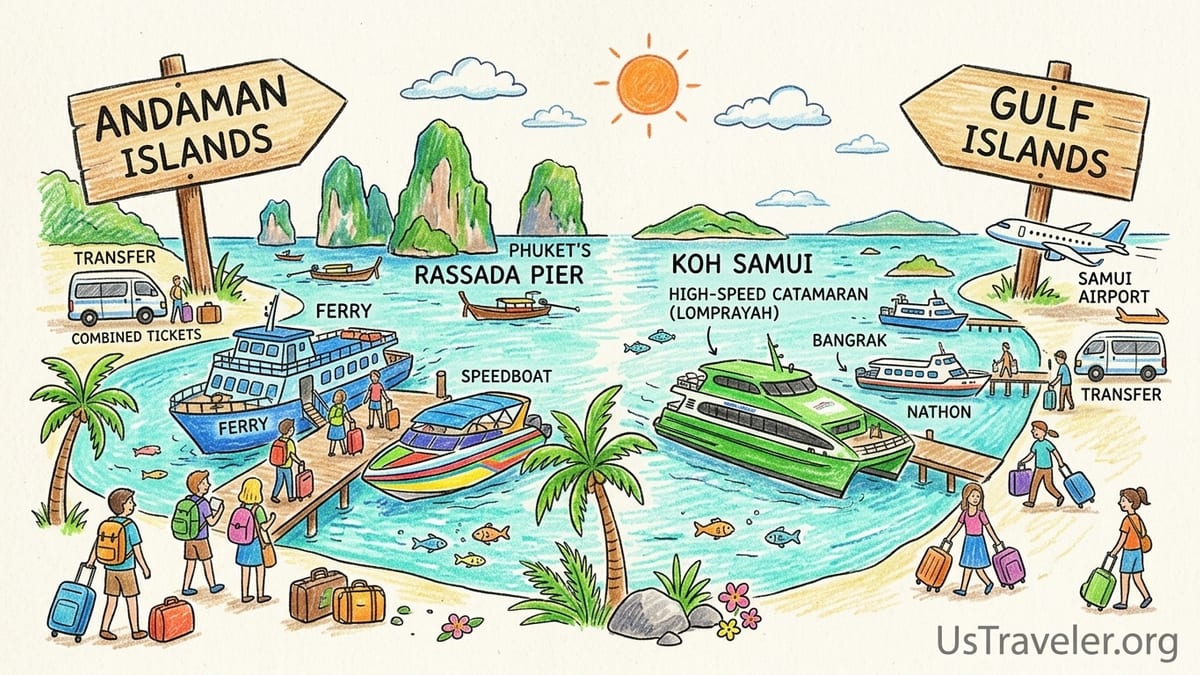
Thailand’s Two Ferry Ecosystems (Andaman vs Gulf) and Why It Matters
Think of the Andaman side (Phuket, Krabi, Phi Phi, Koh Lanta) as a high-volume island-hopping corridor built around Phuket’s Rassada Pier, Krabi’s Ao Nang area, Phi Phi’s Tonsai Pier, and Koh Lanta’s Saladan Pier. In September 2026, this corridor shows multiple daily departures on the core Phuket–Phi Phi run, and regular onward options to Koh Lanta via Phi Phi, which is exactly why travelers can often leave breakfast in Phuket and check in on Lanta by mid-afternoon if they choose the right boat type.
By contrast, the Gulf side (Koh Samui, Koh Phangan, Koh Tao) is a pier-and-operator puzzle: different boats leave from different Samui piers (Bangrak, Nathon, sometimes other points), and the practical detail isn’t just “who runs today,” but “what time is the last boat that actually gets you to Tao.” Lomprayah’s 2026 published timetable is the backbone many travelers plan around, but Seatran Discovery and other operators add additional options, especially on the very short Samui–Phangan crossing.
The biggest planning trap is assuming these two systems behave the same way. In the Andaman, you’re usually choosing between a standard ferry and a speedboat for the same route, often from the same pier. In the Gulf, you’re often choosing between a pier location, a transfer bundle from the airport, and a ferry style, and missing the last Koh Tao onward boat can turn a “simple” hop into an unplanned night on Samui or Phangan.
Andaman Crossings (Phuket, Krabi, Phi Phi, Koh Lanta): What Runs Daily in September 2026
The busiest Andaman route is Phuket (Rassada Pier) to Koh Phi Phi (Tonsai Pier). Current September 2026 schedule snapshots show a dense grid of departures across multiple operators, including options around 08:30, 10:00, 11:00, 12:00, 13:30 and 15:00 depending on company and boat type. That frequency matters because it gives you real flexibility: you can land at Phuket Airport late morning, still make an early afternoon boat, and be on Phi Phi before dinner without paying for a private charter.
For a grounded pricing example you can actually shop against, Chaokoh’s published one-way fares show Phuket to Phi Phi at ฿599 adult, with scheduled departures such as 11:00 and 15:00 from Rassada. On the return, Chaokoh lists Phi Phi to Phuket at ฿599 with departures such as 09:00 and 14:00 from Tonsai. These are the kinds of “planning anchors” that help you decide whether to sleep on Phuket or go straight to Phi Phi the same day.
Koh Lanta sits one step farther down the chain. In September 2026, published schedule windows for Phuket to Koh Lanta show daily departures such as 08:30 with around 4 hours travel time for some services, typically routing via Phi Phi. That time range is important: the quickest-looking option isn’t always the best if you’re prone to seasickness, because some of the faster boats can feel rougher in choppier conditions.
Krabi’s role is partly about access. If you’re staying in Ao Nang, Railay, Klong Muang, or Krabi Town, the most “real life” way people travel is not by assembling pier taxis and separate ferry tickets, but by buying a combined van pickup plus boat ticket that drops you at the correct pier and gets you onto a specific departure. That bundled approach is especially useful when you’re moving with luggage, traveling with kids, or trying to connect after a flight.
Boat Types Compared: Standard Ferries vs High-Speed Catamarans vs Speedboats
Standard ferries in Thailand’s island corridors are the big, stable passenger boats that most travelers picture: indoor seating, bathrooms onboard, predictable boarding, and less drama with luggage. On the Andaman side, these boats commonly take around two hours for Phuket–Phi Phi, and they’re often the calmer choice when the sea is unsettled. If you’re staying on Phi Phi Don near Tonsai, a standard ferry is typically the least stressful “default.”
High-speed catamarans are the signature of the Gulf ecosystem. Lomprayah, in particular, markets itself as a high-speed catamaran network and publishes a dedicated 2026 timetable for routes including Koh Samui, Koh Phangan, and Koh Tao. For many travelers, the real advantage isn’t only speed, but predictability: you can plan your morning around a known sailing and avoid gambling on walk-up availability during busy periods like Full Moon Party weeks.
Speedboats are the fast, punchy option in both ecosystems, but they come with trade-offs: louder rides, more spray, and a higher likelihood of a bumpy crossing if the sea is up. Speedboats can also be stricter about baggage and can charge for excess. They are excellent when you need a specific arrival time or you’re trying to compress your itinerary, but they’re not always the best choice if you’re carrying oversized dive gear, traveling with fragile luggage, or you simply want a smoother ride.
One practical way to choose is to match the boat type to your risk tolerance and your onward plans. If you have a same-day long transfer after arrival, a faster boat can buy you time. If your priority is comfort, or you’re traveling during a week where weather disruptions are more likely, a bigger ferry or catamaran can reduce stress even if it adds an hour.
Combined Tickets (Van/Bus + Ferry): When They’re Worth Paying For
Combined tickets are the most underrated tool in Thailand island logistics. They bundle a timed pickup (often at a hotel, airport, or an operator’s office) with a specific boat departure and, in many cases, a set drop-off point on the destination island. This is especially valuable in places where the pier is not where you are staying. Phuket’s Rassada Pier, for instance, is not in the beach zones most visitors use, and turning up late because you misjudged the drive can cost you the entire day.
On the Gulf side, the strongest real-world use case is Koh Samui Airport. In September 2026, published examples checked against operator booking systems show airport-inclusive transfers at clear price points, such as Seatran from the airport with transfer included around ฿500 for Koh Phangan at certain departure times, and Lomprayah airport-to-Phangan bundles also shown around ฿500 for many departures. In practice, that bundle solves three problems at once: it gets you out of the airport quickly, it eliminates pier negotiation, and it reduces the chance of missing the boat due to traffic or confusion.
Combined tickets can also save you money when you’d otherwise need a private taxi. The taxi from Samui Airport to a pier plus a separate ferry ticket can easily exceed a bundled “airport transfer + ferry” fare, especially if you land at a busy time or you have a group and need a larger vehicle.
The main reason to avoid combined tickets is when you want maximum flexibility on the day. A standalone ferry ticket can let you arrive early at the pier and hop a different departure if space exists, but that’s situational and not something to depend on during peak travel dates.
Luggage, Check-In, and Hotel Transfers: The Details That Actually Break a Transfer Day
Most island crossings are straightforward until you add luggage. One concrete example: Andaman Wave Master’s published FAQ states that for speedboat journeys, the included allowance is 1 piece of luggage up to 18 kg plus 1 handbag per person, and that excess may be charged at the pier. That kind of rule matters if you’re traveling with a heavy suitcase, a large backpack, or extra equipment, because you can end up paying on the spot and losing time during check-in.
Check-in timing is not optional. A common rule across operators is to be checked in well before departure, and Andaman Wave Master explicitly advises checking in 30 minutes before scheduled departure. On popular routes like Phuket–Phi Phi, arriving “just in time” can backfire because the pier area is busy, you may need to find the correct counter, and luggage tagging can take longer than you expect.
Hotel transfers are also not universal, even when a ticket looks like a “transfer.” Some tickets include only a pier transfer (for example, a minivan from a town office to the pier), while others include “any hotel” pickup. The difference is real money in places like Phuket, where getting from a beach area like Kata or Patong to Rassada Pier is not a cheap short hop. When you compare fares, compare the entire door-to-pier cost, not just the boat headline price.
Finally, remember that not every resort is on a public pier. Andaman Wave Master notes that certain private-beach resorts on Phi Phi are not direct stops, and travelers may need to buy a ticket to Phi Phi Tonsai Pier and then arrange an extra longtail or resort boat. In real terms, that means you should confirm your final “last mile” transport before booking, especially if you’re staying at Laem Tong or a secluded bay.
Weather, Sea State, and Seasonal Route Reductions (Andaman and Gulf)
Thailand’s ferry reality is simple: schedules are published, but the sea has veto power. Operators routinely reserve the right to cancel or delay departures due to weather, and even when boats run, rougher conditions can stretch trip times. September sits in the rainy season window for much of Thailand, and while crossings continue, you should plan buffers, especially if you have a flight, a dive trip, or a hotel check-in that requires a fixed arrival.
Seasonal reductions hit the smaller and more “optional” tourist legs first. A very typical pattern in the Andaman is that certain island-to-island links are emphasized in the dry season and can be reduced outside it. Travelers should treat niche routes and direct beach-to-beach speedboat runs as more seasonal than the core trunk lines like Phuket–Phi Phi, which remain frequent because demand is consistently high.
On the Gulf side, the planning risk is the end-of-day cut-off, particularly for Koh Tao. A practical example from September 2026 planning guidance is that if you land after 15:00 and you’re aiming for Koh Tao the same day, you may be out of luck because the last airport-linked departures for Tao can be earlier in the afternoon. In that case, the sensible move is to sleep on Samui and take a morning boat, or go to Koh Phangan first and continue the next day if a late Samui–Phangan option exists.
The safest mindset is to plan like a pilot: pick your primary sailing, identify a realistic same-day fallback, and avoid scheduling “must-not-miss” commitments on the destination island for the first evening unless you’re already there.
The Takeaway
If you’re island-hopping on the Andaman side in September 2026, you can usually travel on the day you want because core routes like Phuket–Phi Phi show multiple daily departures, and onward connections toward Koh Lanta are also available with the right timing. Choose a standard ferry when comfort matters, a speedboat when time matters, and pay attention to whether your ticket includes a hotel pickup or just pier-to-pier transport.
In the Gulf, treat Lomprayah’s 2026 high-speed timetable as your planning backbone, but decide first which Samui pier you’re departing from and whether you need an airport-transfer bundle. The most common itinerary failure is missing the last viable Koh Tao connection, so if your arrival is late, build in an overnight on Samui or Phangan rather than pushing a risky same-day transfer.
Across both ecosystems, the “boring” details are what protect your trip: show up early, confirm your pier, understand baggage limits on speedboats, and keep weather slack in your plan. Do that, and Thailand’s ferry networks become one of the easiest ways to stitch together a multi-island itinerary without renting a car or flying short hops.
FAQ
Q1. Which pier do I use for Phuket to Phi Phi ferries?
Most scheduled ferries and speedboats depart Phuket from Rassada Pier and arrive on Phi Phi at Tonsai Pier, which is the main public arrival point on Phi Phi Don.
Q2. In September 2026, are there multiple daily boats between Phuket and Phi Phi?
Yes. Current September 2026 schedule snapshots show many daily departures across operators, typically spanning morning through mid-afternoon.
Q3. What’s a real example of a Phuket to Phi Phi ferry price in 2026?
Chaokoh publishes one-way adult fares at ฿599 on the Phuket–Phi Phi route on its own timetable listings.
Q4. How strict are luggage rules on speedboats?
They can be stricter than standard ferries. For example, Andaman Wave Master states speedboat tickets include 1 luggage up to 18 kg plus 1 handbag per person, with potential extra charges for excess at check-in.
Q5. How early should I arrive to check in for an island transfer?
A common real-world rule is at least 30 minutes before departure. Andaman Wave Master explicitly advises check-in 30 minutes before the scheduled time.
Q6. Should I buy a combined hotel pickup plus ferry ticket?
Often, yes, especially in Phuket and Krabi where the pier is far from beach areas. Combined tickets reduce the risk of missing the boat and can cost less than taxi plus standalone ferry.
Q7. What’s the fastest way from Koh Samui to Koh Tao?
High-speed services are generally the quickest. Lomprayah publishes a dedicated 2026 high-speed timetable on its official site, and some sailings can be notably faster depending on routing and stops.
Q8. If I land late at Koh Samui Airport, can I still reach Koh Tao the same day?
Not always. September 2026 planning guidance checked against operator systems indicates the last airport-linked departures to Koh Tao can be mid-afternoon, making an overnight on Samui a common solution for late arrivals.
Q9. Do ferries run in rainy season, and do they get canceled?
They run, but cancellations and delays can happen when sea conditions are unsafe. Build time buffers and avoid tight same-day flight connections.
Q10. My resort on Phi Phi isn’t near Tonsai. What should I do?
Buy your main ticket to Phi Phi Tonsai Pier, then arrange the final transfer by longtail or resort boat. Some operators note that private-beach resorts are not direct stops.