


I learned quickly in Southern Thailand that “where to stay” is really “where to base yourself.” I made the classic mistake my first time around: I booked pretty rooms that were technically in the right destination, but in the wrong neighborhood, which meant long waits for rides, missed sunset dinners, and that nagging feeling of being slightly disconnected from the place I came to see. Over multiple trips, I stayed across the Andaman side and the Gulf, bouncing between Phuket, Krabi, Khao Lak, Khao Sok, Koh Lanta, Koh Lipe, Koh Samui, Koh Phangan, and Koh Tao. What follows is how each base actually changed my days: the ease of getting food without planning, whether a scooter was a “nice to have” or mandatory, how frictionless (or not) tour pickups felt, and when I regretted being too far from town or too close to nightlife.
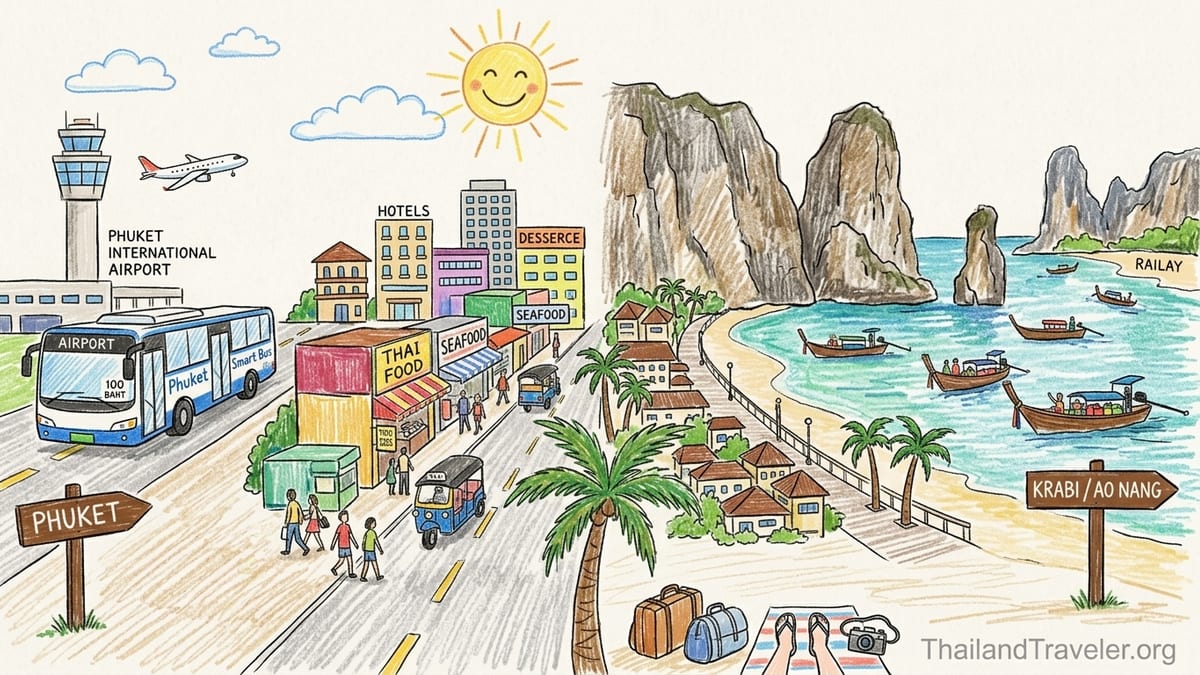
Phuket: Maximum Choice, Easiest Logistics, And The Best “Starter Base”
When I want options, I base in Phuket first. It is the easiest place in this list to land, recover from a long flight, and make decisions later. Phuket International Airport is a major gateway, and the island’s transport ecosystem is simply bigger: more drivers, more day tours, more restaurants, more everything. That matters on real travel days when your energy is finite and you just want dinner without negotiation or a 90-minute transfer for a 20-minute outing.
On my most “efficient” Phuket stay, I deliberately chose to be close enough to the west-coast spine that I could move without a scooter. The Phuket Smart Bus became my sanity saver: it runs between the airport and key beach areas along the west coast, and the published fare structure is refreshingly straightforward, including a 100 baht flat fare on the airport route. The downside is also practical: the Smart Bus stop is at the Domestic Terminal area, and the route does not help if you pick a quiet pocket far off that corridor. I learned that the hard way after booking a gorgeous, isolated stay and realizing I was effectively locked into taxis for every meal.
Evenings in Phuket can be exactly what you want, or exactly what you regret. When I stayed too close to loud nightlife zones, I got the convenience of late-night food and spontaneous drinks, but also the thump of bass that turns “beach holiday” into “earplugs holiday.” When I stayed too far from town, I loved the calm and the empty beach, but dinner became a planned expedition. My sweet spot is a walkable area where I can do an easy dinner loop and still sleep, then use Phuket’s scale for what it does best: transport and choice.
Krabi And Ao Nang: Limestone Scenery, Boat Trips, And Walkable Beach Days
Krabi, especially Ao Nang, is where my days started to feel like a postcard without any effort. I could wake up, walk to the beach, and within minutes be looking at the limestone cliffs that make this coast so distinctive. Ao Nang is also built for day trips: island-hopping tours, Railay runs, and longtail logistics are normal here, so I spent less time “figuring out” how to do things and more time actually doing them.
Ao Nang worked best for me when I stayed centrally enough to walk to dinner and the beachfront without needing a scooter. Once I pushed my stay too far uphill or too far outside the main strip, my daily rhythm changed: breakfast became “where can I reach,” not “what do I feel like.” The practical difference is huge when the air is humid and you have been in the sun all day. On a central Ao Nang stay, I could finish a boat trip, shower, and still be out at a casual restaurant on foot.
Tour pickup friction was noticeably lower here than in some island bases. Many operators are set up for hotel pickup across Ao Nang and nearby areas, which meant fewer early-morning taxi negotiations. The only time I felt friction was when I tried to base somewhere “quiet” but not truly remote: it was far enough that pickups became vague, yet close enough that I still heard traffic. It is a good reminder that in Krabi, choosing the right pocket matters as much as choosing the province.
Khao Lak: Quieter Resorts, Long Beaches, And A Town That Shifts With The Season
Khao Lak is where I go when I want my Thailand days to slow down. Compared with Phuket and Ao Nang, it felt calmer, more resort-oriented, and more linear: you tend to move up and down the main road and the long beaches rather than hop between dense neighborhoods. The trade-off is that “just popping out” for variety is harder unless you are placed well. When I stayed too far from the central clusters, I ended up eating at my resort more than I wanted to, not because the food was bad, but because casual choice was not right outside my door.
This is also where live-season reality matters. Khao Lak’s most famous “base advantage” is access to the Similan Islands, but those trips are not year-round. The Similan and Surin island parks follow an annual closure pattern, and for the 2026–27 season, widely published guidance points to reopening around mid-October, with closures spanning mid-May to mid-October. If you show up in that closure window, you can still have a great Khao Lak stay, but you need to want the quiet beaches and the low-key pace, not a guaranteed Similan snorkeling day.
In my own planning, Khao Lak became a “choose-your-vibe” fork. In peak season, I liked being close to where day-trip logistics are easiest, because early pickups and returns felt smoother. In the greener, wetter shoulder months, I preferred to base where I could still walk to a few restaurants, because once the marine parks close, parts of town can feel noticeably sleepier. I regretted one stay where my resort was stunning but isolated: the beach was perfect, but my evenings became too quiet, too early, too repetitive.
Khao Sok: Rainforest Nights, Early Mornings, And The Joy Of Being Slightly Remote
Khao Sok changed my trip tempo in the best way. After beaches and busy promenades, the rainforest felt like a reset: earlier nights, earlier starts, and days built around nature rather than errands. I treated it as a short, intentional interlude, not a place where I needed endless restaurant choice. For me, it was less about nightlife or shopping and more about the sensation of being surrounded by green, hearing insects after dark, and waking up to misty mornings.
Logistically, this is where “base choice” becomes highly practical. If you are too far from the national park village area, you can lose a lot of time just moving between your room and where tours start. If you are too close to the busiest cluster, you may hear more road noise than you expected for a jungle stay. I found that being near enough to walk to a few simple restaurants was ideal, because it reduced dependence on arranged rides, while still keeping the rainforest feel intact.
Khao Sok is also a reminder that not all “seasonal closures” work the same way. Marine parks like Similan have published closure periods, but Khao Sok itself is a land park, so the travel question becomes less “is it open” and more “what will conditions feel like.” I built my days around the reality that rain can reshape plans, which made flexible scheduling more important than in a beach base. When I planned it this way, Khao Sok became a highlight, not a logistical puzzle.
Koh Lanta And Koh Lipe: Two Different Versions Of “Island Life”
Koh Lanta and Koh Lipe gave me two very different island rhythms. Koh Lanta felt like a place you settle into: longer stays, repeated restaurants, sunsets that become your daily appointment. Koh Lipe felt like a place you orbit on foot: beaches, short strolls, and a compact island energy where your world stays small in a satisfying way. I loved both, but they rewarded different choices in where I slept.
On Koh Lanta, I regretted booking too far from the action once. The island is long, and while there are pockets you can walk, many days still feel scooter-dependent if you want variety. When my hotel was in a beautiful but quieter stretch, I had perfect mornings and empty sand, but I spent too many evenings deciding whether I wanted to ride out for dinner or just stay put. When I based closer to busier beach areas, my nights improved immediately: casual food options, easier meetups, and less “planning fatigue.”
Koh Lipe flipped that experience. Because it is smaller and more walkable, being slightly away from the busiest walking street area felt like a win: I could still reach restaurants quickly, but I did not feel like I was trying to sleep above the island’s main corridor. The biggest practical note is seasonal sea conditions. Speedboat routes to Lipe, including services from the Pak Bara area in Satun, publish seasonal timetables and can reduce or pause depending on monsoon conditions. I now plan Koh Lipe as a high-season or shoulder-season treat, and I build in buffer time because sea travel is less “clockwork” than airport travel.
Transfer friction also differs sharply between the two. Lanta has multiple ways in and out, including minivan plus car-ferry routes via Krabi, which can run when direct sea routes are reduced. Lipe, by contrast, is a commitment: once you choose it, you are agreeing to the pace of boats, piers, and weather. When I embrace that reality, Lipe feels like paradise. When I fight it, it feels inconvenient. The base decision here is really a mindset decision.
Koh Samui, Koh Phangan, And Koh Tao: Polished Resorts, Mixed Scenes, And The Diving Base
Moving to the Gulf side, the mood shifts. Koh Samui felt the most “polished” of the islands on this list: bigger resorts, more developed beach towns, and an easy sense of comfort that can be a relief if you have been bouncing around. My best Samui days came from picking a base where I could walk to food and still escape noise at night. My worst Samui night came from being a little too close to a nightlife pocket: the convenience was real, but so was the late-night soundtrack.
Koh Phangan was the most mixed experience in terms of atmosphere. It can be mellow or chaotic depending on timing and exact location, which is why base selection matters more here than almost anywhere else. I have had peaceful, slow mornings on one beach and then found myself in a very different scene after a short ride. If you want quiet, you have to commit to it and accept the trade-offs: fewer walkable restaurants, more dependence on scooters or taxis, and occasionally longer waits for pickup. If you want social energy, you have to accept the noise and plan your sleep accordingly.
Koh Tao, for me, is the purposeful base: I go when diving is the main goal. That changes everything about the day. Mornings start earlier, schedules revolve around boat departures, and you want to be close enough that gear pickup and meeting points are painless. When I stayed too far from the main hub areas, my “small inconvenience” became a daily tax: extra rides, extra timing anxiety, and less flexibility for spontaneous meals between dives. The upside is that Koh Tao’s identity is so clear that once you align your base with your priorities, it delivers.
Across these three islands, the connective tissue is ferry travel. Operators publish timetables and multiple daily departures on key routes, but in practice, weather and season can affect comfort and punctuality. I now plan Gulf island days with a little slack and avoid stacking a tight flight connection on the same day as a sea crossing. That single habit has prevented most of my past travel-day stress.
The Takeaway
If I could distill Southern Thailand lodging into one rule, it is this: choose your base for your daily life, not your dream photo. Phuket is the best “maximum flexibility” platform when you want choice and transport. Krabi and Ao Nang are the easiest way to build dramatic limestone scenery and boat trips into a normal day. Khao Lak is for quiet resort time, but it is deeply shaped by the marine park season. Khao Sok is the rainforest reset, where your best decision is to be close enough for easy tours but not so close you lose the jungle feel. Koh Lanta rewards longer, slower stays and often a scooter-friendly mindset, while Koh Lipe rewards simplicity and patience with boats. On the Gulf side, Samui is comfort and polish, Phangan is the variable mood island, and Tao is the diving base that works best when you minimize daily friction.
My biggest regrets were always geographic: booking too far from town and turning every dinner into a logistics problem, or booking too close to nightlife and realizing that sleep is also part of the itinerary. When I got the base right, everything else felt easier: pickups were smoother, transfers were less tense, and my days had that effortless flow that makes Southern Thailand feel like the escape it is meant to be.
FAQ
Q1. If I only pick one base in Southern Thailand, which is the easiest?
Phuket is usually the easiest single base for first-timers because it has major airport access, lots of transport options, and the widest spread of tours and restaurants.
Q2. Is Ao Nang a better base than Krabi Town for most travelers?
For beach time and boat trips, Ao Nang is typically easier day-to-day because it is closer to the sea and built around tours, while Krabi Town can feel more local but less beach-forward.
Q3. When do the Similan Islands close, and why does that matter for Khao Lak?
The Similan Islands follow an annual closure during the monsoon months, commonly mid-May to mid-October, which matters because many Khao Lak day trips revolve around Similan departures.
Q4. Is Khao Sok a good add-on if I am doing beaches?
Yes. Khao Sok is a strong contrast to the coast, adding rainforest scenery and a different pace, and it works well as a 2 to 3 night reset between beach stops.
Q5. Do I need a scooter on Koh Lanta?
You can manage without one if you choose a walkable area and do fewer restaurant hops, but many travelers find a scooter or regular taxis helpful because the island is long and spread out.
Q6. Is Koh Lipe easy to reach year-round?
Koh Lipe access depends heavily on sea conditions and seasonal speedboat schedules, so it is easiest in the high season and often involves more planning and buffer time than bigger islands.
Q7. Which Gulf island should I choose: Samui, Phangan, or Tao?
Choose Samui for polished resorts and comfort, Phangan for a mix of quiet beaches and party scenes depending on location and timing, and Tao if diving is your main goal.
Q8. What is the most common “where to stay” mistake in Southern Thailand?
Booking somewhere that looks perfect on a map but is far from restaurants and transport, which turns simple evenings and tour pickups into daily friction.
Q9. How much buffer should I plan for ferry days?
I plan extra time on ferry days and avoid stacking tight connections, because sea conditions and operational delays can affect arrival times more than flights or trains.
Q10. What base gives the best balance of calm nights and easy dinners?
In my experience, a central but not nightlife-adjacent area in Ao Nang or a well-placed Khao Lak resort zone offers calm evenings without making dinner a daily transport problem.