


I’ve stayed in Phuket, Krabi, and Koh Samui on separate trips long enough to get past the first-day honeymoon phase and into the real travel reality: the airport exit scrum, the “why is this taxi so expensive?” moment, the wet swimsuit that never dries, the one dinner that resets your expectations, and the day you realize you picked the right coast for the wrong month. If you’re trying to choose between Phuket vs Krabi vs Koh Samui in 2026, the most honest answer is that none of them is universally “better”, because each one is better at a different kind of trip. Phuket wins on sheer choice and convenience, Krabi on scenery and a calmer base with dramatic day trips, and Koh Samui on being a self-contained Gulf-island resort experience that feels more insulated once you’re there.
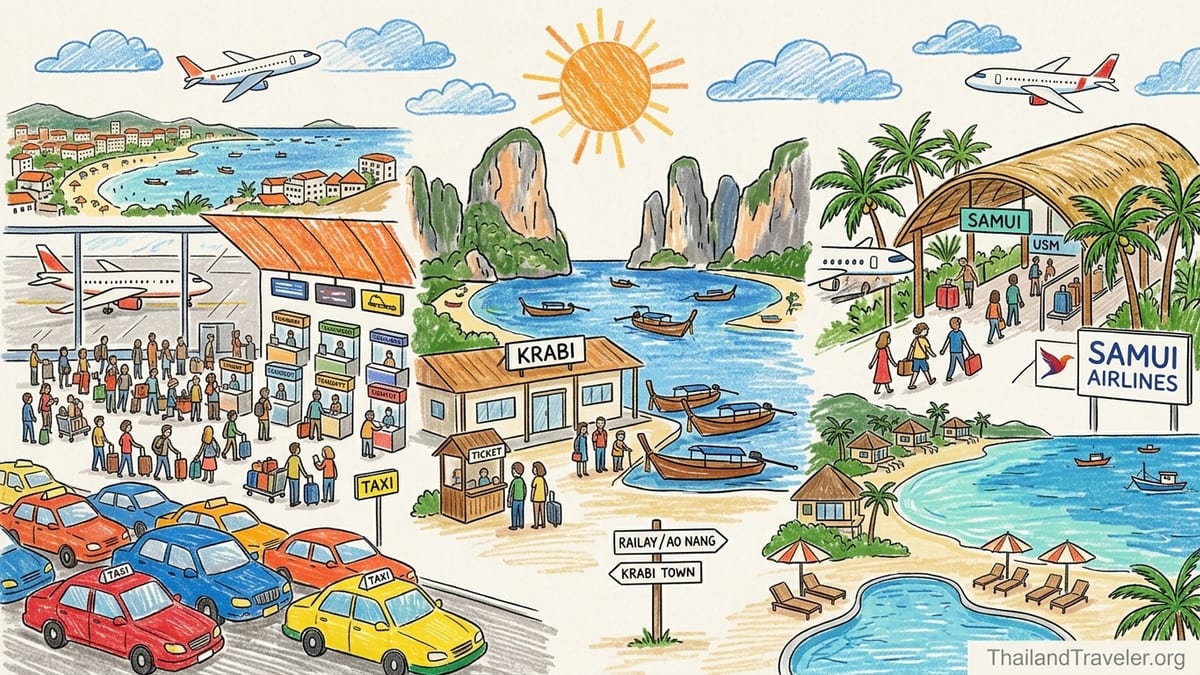
First Impressions: Airport Arrivals And The “Welcome To Thailand” Moment
Phuket’s arrival feels like landing in a fully built tourism machine. Phuket International Airport (HKT) is big, busy, and set up for constant international turnover, and you feel that immediately in the energy of baggage claim, the taxi lines, and the sheer number of transport counters. On my last arrival, it was the kind of airport exit where you can be five minutes from the curb and still feel like you’re negotiating your next two hours: where are you staying, how bad is traffic right now, and are you about to pay for convenience with time, money, or both.
Krabi’s airport experience is smaller and less chaotic, and that sets the tone for the province. Krabi International Airport (KBV) is still an international airport, but the first impression is more “regional gateway” than “global beach hub.” When I walked out into the heat, it was quieter, with fewer simultaneous arrivals, and the whole scene felt like it was designed for people who are heading to Ao Nang, Klong Muang, or a pier rather than a multi-neighborhood island city.
Koh Samui’s airport is the arrival that most feels like the vacation has already started. Samui Airport (USM) is privately owned and operated by Bangkok Airways, and it’s famously open-air and resort-like rather than a typical enclosed terminal. The catch is that the welcome can start earlier than you want: Samui flight prices are often the moment you feel the island’s “curated” nature. I’ve had trips where the Samui leg was the single most expensive piece of transport in the entire itinerary, and that cost shaped how long I stayed and what kind of hotel I justified once I got there.
Where I Stayed And What The Hotel Areas Felt Like After Day Three
In Phuket, I’ve based myself in more than one zone, and the island really is a set of different destinations stitched together by roads. Patong is loud, bright, and relentlessly convenient; it’s also where you can feel the pressure of crowds and traffic most intensely. Kata and Karon have a more family-and-couples feel, with beaches that are still developed but less “all-night.” The surprise for me in Phuket was how quickly “close on the map” stops meaning “easy.” After a few days, you start planning your life around time windows: leave before the traffic builds, commit to one area for the afternoon, and accept that spontaneity costs more here than it does in Krabi.
In Krabi, the most common base for first-timers is Ao Nang, and that’s where I’ve spent several nights using it as a launchpad. Ao Nang is touristy, but it feels like a single strip you can learn fast: beachfront road, longtail boat ticket counters, casual restaurants, and massage shops. Klong Muang feels sleepier and more upscale-quiet, a place you choose when you want the hotel to be the destination. The defining “Krabi feeling” for me was how quickly the scenery quiets you down, even when you’re in the busiest part of town. Limestone cliffs do that. They make even a crowded road feel like it has a backdrop worth slowing for.
In Koh Samui, hotel areas are the whole story. Chaweng is the main hub, and it can be lively to the point of feeling like a small city by island standards. Fisherman’s Village in Bophut feels more curated and evening-friendly, with a strollable strip and a softer nightlife vibe. Lamai can feel like a middle ground. By day three on Samui, I usually settle into an “island loop” mindset: you’re not hopping neighborhoods like Phuket, and you’re not using one town to reach a dozen cliffs-and-islands like Krabi. Samui’s rhythm is more self-contained, more resort-forward, and, for better or worse, more shaped by where you booked your room.
Beaches: The Sand, The Swim Flags, And The Moment Each Place Clicked
Phuket’s best advantage is variety, and you feel it in the beaches. There are busy, serviced beaches with jet skis and parasails and shade you can buy, and there are quieter coves where the mood flips. My “Phuket clicked” moment happened on a day when I abandoned the idea of chasing the perfect beach and instead picked a simple plan: one beach for a long swim, one late lunch, and then staying put. Phuket rewards committing to a zone rather than trying to sample the entire island in a single day.
Krabi’s beaches can be beautiful right in Ao Nang and Klong Muang, but the “I came to Krabi for this” moment often happens when you leave the road. The day I reached Railay by longtail boat, the approach itself changed my expectations. The cliffs rise like a movie set, and even when it’s busy, it feels dramatic in a way Phuket’s flatter bays generally don’t. Railay is also where you feel Krabi’s logistics: beach-to-beach movement can be a boat ride, not a drive, and that creates a sense of separation that’s part of Krabi’s charm.
Koh Samui beaches are less about cliffs and more about comfort and continuity. When the water is calm, Samui can feel like an easy, classic tropical island: long stretches, gentle entries, and a “you could do this every day” kind of swim. What surprised me is how much the beach experience can vary by the exact section of coastline in front of your hotel. On Samui, you can be one bay over and feel like you’ve changed islands, not because the scenery is more dramatic, but because the vibe, waves, and crowds shift quickly.
Traffic, Getting Around, And The Real Cost Of Convenience
Phuket has the most transportation friction of the three, and it’s the single factor that can change your opinion mid-trip. I’ve had a Phuket day that was supposed to be a casual dinner across the island turn into an exhausting crawl of brake lights. That’s the moment many travelers decide they either need a scooter, a driver, or a radically simpler plan. Phuket is not “hard” to get around, but it is easy to underestimate, and the time cost can sneak up on you fast.
Krabi feels simpler. If you’re based in Ao Nang, you can walk a lot, and your “big moves” are often short rides to a pier, a viewpoint, or a night market area. Boats become part of the transit system, not just a tour. That said, Krabi’s convenience is different from Phuket’s: you won’t find the same density of ride options at all hours, and late-night spontaneity can require more planning.
Koh Samui is a loop-road island with a transport culture that feels more personal. Many visitors rent scooters or arrange drivers through hotels. The island isn’t tiny, and the driving can be intimidating if you’re not experienced, but the traffic pressure rarely feels as intense as Phuket’s. The “real cost” of Samui convenience often shows up before you even arrive: the flight. If you choose to avoid high Samui airfares, you may route via Surat Thani on the mainland and then connect by ferry, which can be smooth but turns a short hop into a multi-step travel day.
Restaurants, Nightlife, And The Evening Energy Shift
Phuket has the widest food and nightlife spectrum, from quick street eats to polished international dining, and from beach clubs to packed bar streets. It’s also where you’re most likely to stumble into something that feels like a major-event atmosphere on a random night. The trade-off is that Phuket’s most famous nightlife zones can feel intense, and if you’re not looking for that, you’ll want to base yourself away from the center of it and choose nights out intentionally.
Krabi evenings are more low-key, and I found that refreshing. Ao Nang has plenty of restaurants and bars, but it tends to feel like a place where you wrap the day with a meal and a drink rather than chase an all-night scene. The best Krabi food moments for me were the unflashy ones: a grilled seafood dinner after a boat day, a simple Thai curry that tasted better because I was sun-tired, and the kind of casual beachfront spot where the bill doesn’t feel like it’s paying for hype.
Koh Samui sits in between. Chaweng can be lively, but much of Samui nightlife feels tied to resorts, beach bars, and specific pockets rather than a single overwhelming strip. My Samui nights were the kind you can dial up or down: an early seafood dinner in Fisherman’s Village, a sunset drink with your feet in the sand, then either back to the hotel or onward if you want more energy. It’s a “choose your lane” island, and that’s why it works for mixed groups.
Tours And Day Trips: What Each Destination Does Best
Phuket is the best base if your idea of South Thailand includes sampling a lot of famous stops quickly. The island has the infrastructure, the operators, and the constant flow of departures that make it easy to book last minute. That convenience is real: you can decide over breakfast that you want to be on a boat, and there will be a desk somewhere that can make it happen. The downside is that the most famous tours can feel crowded, especially in peak season, and you may need to pay more or choose timing carefully to keep the day feeling special.
Krabi is where scenery-driven day trips feel most effortless. Railay is the headline for many people, but Krabi’s real strength is how the province sets you up for dramatic landscapes without needing the “big city island” logistics. The day that changed my opinion in Krabi was not a party boat or a beach club moment. It was simply arriving by longtail, stepping onto sand backed by vertical limestone, and realizing that Krabi’s beauty is immediate and structural, not something you have to hunt down across neighborhoods.
Koh Samui is a classic “hub” for Gulf islands. If your plan includes Koh Phangan or Koh Tao, Samui can be a practical base with resorts and services that make the whole trip feel smoother. But Samui tours can also feel more packaged, especially if you book through the most visible channels. My best Samui day trips were the ones that leaned into the island’s strengths: short travel times, easy logistics, and spending more time swimming and eating than sitting in transit.
Family Suitability, Prices, And Pace: Picking By Trip Type (Not A Universal Winner)
For families, Phuket can be the easiest on pure options. There are many hotel styles, many beaches, and lots of services, from international clinics to kid-friendly restaurants. The caution is that Phuket can feel hectic, and families who don’t want constant stimulation often do better choosing calmer areas and treating “big days” as occasional, not daily. Phuket is also where I’ve been most aware of transport time with kids in tow; the day is longer when every move requires a car and a queue.
Krabi is my pick for families who want a calmer base and scenery that does a lot of the work. The pace is gentler, and it’s easier to have days that feel simple: beach time, an early dinner, a short ride back. Krabi is also good for couples who want romance without feeling isolated. The trade-off is that Krabi is not trying to be a mega-hub, and if you want nonstop variety, you may start repeating the same handful of spots.
Koh Samui is what I choose when I want an island resort trip where everything is contained: airport, beaches, hotels, and a set of evening neighborhoods that feel easy to navigate. It’s also the destination where the price logic can flip. Once you’re there, you can find good-value meals and midrange hotels, but the cost of getting there by air can be the biggest line item, especially at peak times. The Samui moment that reshaped my planning was realizing I was building my whole itinerary around flight pricing, and that’s when I started deciding Samui trips by season and by length: it makes more sense when you stay longer and settle in.
Seasonality matters in a way that can trump all the other comparisons. Phuket and Krabi are on the Andaman coast, while Koh Samui is on the Gulf of Thailand, and they follow different monsoon calendars. In practical terms, that means there are months when Phuket and Krabi are having their best stretch while Samui can be in its rainier period, and other months when the Gulf side can be comparatively sheltered while the Andaman side is wetter and rougher at sea. The most “2026” decision you can make is not just picking the destination, but picking the coast that matches your travel month and what you want to do on the water.
The Takeaway
If I’m planning a first South Thailand trip with a group that can’t agree, I lean Phuket because it gives you the most levers to pull: beaches, dining, hotels, tours, and backup plans when the weather or mood changes. If I’m planning a scenery-and-swim trip where I want the landscape to feel unmistakably southern Thailand, I choose Krabi and I build in at least one longtail-boat day to Railay to remind myself why I came. And if I’m planning a resort-forward island break where I want to land, exhale, and stop thinking about logistics, I pick Koh Samui, accepting that the flight cost can be the price of that ease.
The better question in 2026 is not “Which is best?” but “What kind of trip are you actually taking?” Pick Phuket for breadth and nightlife flexibility, Krabi for dramatic coastal scenery and a calmer base, and Koh Samui for a more self-contained Gulf-island resort rhythm that works especially well when you have the right season and enough days to settle in.
FAQ
Q1. Which is better for first-time visitors: Phuket, Krabi, or Koh Samui?
Phuket is usually the easiest first base because it has the widest range of hotels, restaurants, beaches, and transport options, plus strong flight connectivity.
Q2. Which destination feels the least crowded after a few days?
Krabi often feels less intense day to day, especially if you stay outside the busiest Ao Nang strip or choose Klong Muang for a quieter hotel zone.
Q3. Where did traffic affect your trip the most?
Phuket, by far. A short-looking cross-island plan can turn into a long crawl, so it’s best to group activities by area and limit big moves.
Q4. What’s the most memorable arrival experience?
Koh Samui’s airport feels unusually resort-like, but the memorable part can start earlier with the higher airfare compared with other Thailand routes.
Q5. Which has the best “wow” scenery?
Krabi, especially when you reach Railay by longtail boat and see the limestone cliffs rising directly behind the beaches.
Q6. Which is best for nightlife without committing to party mode?
Phuket gives the most choice, but Koh Samui can be a comfortable middle ground with pockets of nightlife rather than one dominant scene.
Q7. Which is best for a relaxing resort vacation?
Koh Samui is the most self-contained for a resort-style trip, especially if you choose a beach area that matches your pace.
Q8. Which is most family-friendly?
All three can work, but Phuket offers the most family-oriented hotel inventory and services; Krabi can feel calmer; Samui can feel easy once you’re settled.
Q9. How should season and monsoon influence the choice?
Phuket and Krabi are on the Andaman coast and Samui is on the Gulf, and their rain and sea conditions peak in different parts of the year, so match the coast to your month.
Q10. If you could only pick one for a short trip, which would it be?
For a short, low-friction trip, I’d usually choose Phuket for flight options and variety, unless I specifically want Krabi’s scenery or Samui’s resort rhythm.