


I love South Thailand’s islands, but I do not love how easy it is to buy the right ticket for the wrong pier, show up confidently to a closed counter, or pick a speedboat that turns your backpack into a soaked, salty sandbag. After enough crossings in the Andaman Sea and the Gulf of Thailand, I’ve learned that ferry travel here is less about “Is there a boat?” and more about “Which pier, which operator, what season, what luggage, and what happens after you land?” This guide is written like the transport notes I keep on my phone: the ferries and speedboats I’ve actually used, the little frictions that cost time and money, and the 2026 realities of schedules, seasonal suspensions, and combined van plus ferry tickets for Phuket, Krabi, Phi Phi, Koh Lanta, Koh Lipe, and the Samui, Phangan, Tao network.
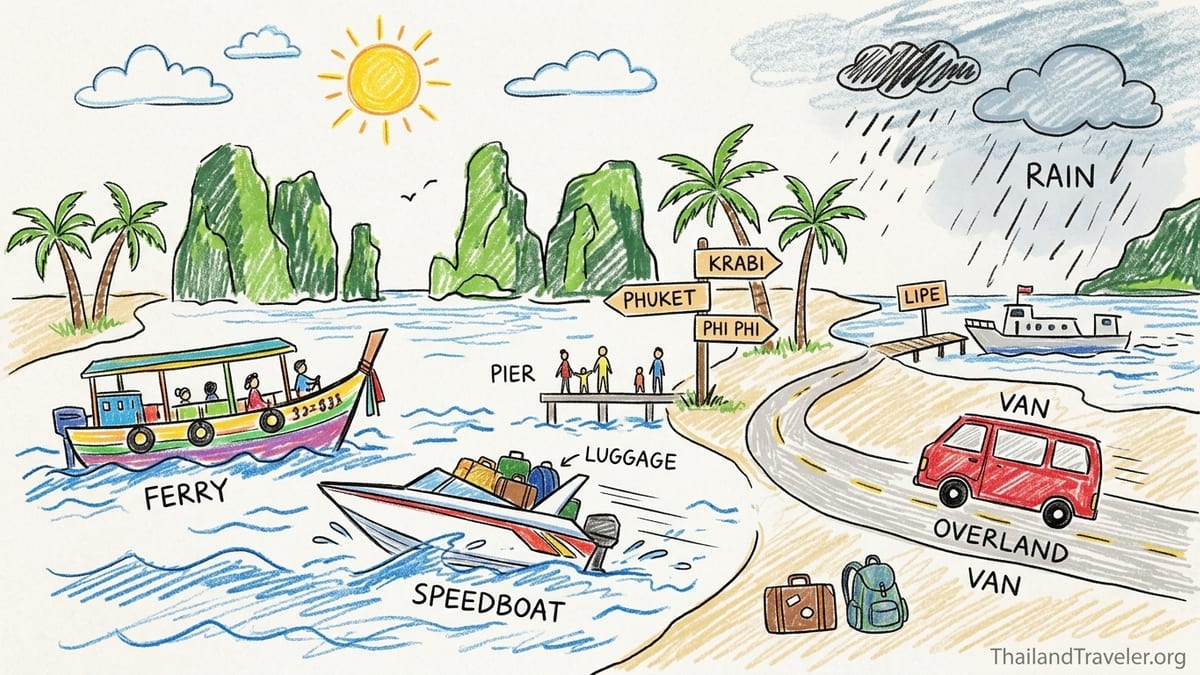
Before You Book: The Three Decisions That Matter (Pier, Season, Boat Type)
The biggest mistake I see travelers make is thinking “Phuket to Phi Phi” is a single product. It is not. It is a bundle of decisions that start with the pier. On Phuket, most scheduled boats to Phi Phi and beyond leave from Rassada Pier in Phuket Town. In Krabi, you’ll hear Ao Nang, Nopparat Thara Pier, Railay, Krabi Town, and Klong Jilad Pier thrown around like they’re interchangeable. They are not. If you book the right company but the wrong pier, you can still miss the boat.
Second, season quietly changes the map. Andaman routes are most reliable in the dry season (roughly late October through April or May), while monsoon months can mean suspensions, reroutes, or a last-minute swap to an overland van plus boat. Koh Lipe is the classic example: in the low season, the dependable access is usually via Pak Bara Pier rather than long island-hopping legs, and even that can be weather dependent. If you are building a multi-island chain, you need a plan that still works when a direct sea route disappears.
Third, boat type is not just a speed versus comfort trade. The “fast” option can be rougher and less forgiving with luggage, especially when the sea picks up. I learned this the hard way on a smaller speedboat with too many hard suitcases stacked high. The boat still left on time, but it was louder, wetter, and the ride felt sharper over chop. When the sea is calm, a speedboat is a joy. When it is not, the extra hour on a larger ferry can feel like a bargain.
Booking Tickets in 2026: Online Versus Counter, and What Your Voucher Really Means
In 2026, I book most legs online when I care about a specific departure time, especially in high season, weekends, or around holidays. The practical reason is not only seat availability. It is pier logistics. An online booking forces you to confront the departure point, check-in window, and whether hotel pickup is included. When I buy at a street agency, the agent often says “same same pier,” then prints a voucher that lists a different pier name than the one I assumed.
At the pier, your “ticket” is often a voucher that must be exchanged at an operator counter for a boarding pass or sticker. On Phuket’s Rassada Pier, some operators use numbered counters and call out boarding by color sticker. I’ve used Bundhaya-style check-in where the instruction is effectively: show your voucher, get a sticker, then wait until someone waves you toward the floating pontoon. On certain tickets, the fine print matters: for example, Lomprayah’s published baggage allowance is commonly stated as 20 kg per person, with excess fees per kilo and disclaimers about liability if bags are handled by staff. That does not mean staff will weigh every bag every time, but it is the rule set you are accepting when you choose a network.
My rule now is simple: if I booked online, I screenshot the booking confirmation, the pier name, and the check-in time, then I keep them available offline. If I booked at a counter, I read the voucher before I hand over money. The number one phrase I look for is the pier. The second is whether the ticket is “direct” or “transfer included.” Those two words change everything about your morning.
Phuket: Rassada Pier Reality, Check-In, and the Phi Phi Problem
Rassada Pier is the Andaman workhorse for Phuket departures. It functions like a small airport: multiple counters, multiple operators, and a mix of ferries and speedboats. The most common Phuket to Phi Phi run departs in the morning window, and 2026 pricing and departure patterns still reflect the classic split: scheduled ferries are generally cheaper and take roughly two hours, while speedboats are faster and priced higher. I’ve done the crossing on a larger ferry where the ride felt stable and social, and on a speedboat where the sensation is more like a fast commute with sea spray.
One mistake I made early on was underestimating road time across Phuket. If you are staying in Kata, Karon, Patong, or up near Bang Tao, traffic can turn “one hour before departure” into a missed boat. Some services selling Phuket to Ao Nang tickets explicitly tell passengers to arrange their own transport to Rassada Pier and arrive well ahead, and in 2026 at least one Krabi-facing seller lists an updated schedule effective late August 2026 for Phuket Town to Ao Nang with a morning sailing and a defined fare. That “find yourself a taxi” language is the reality: pickups exist, but they are not guaranteed on every ticket class.
Phi Phi adds its own twist: you arrive into Tonsai Pier, which is busy, walkable, and chaotic in the best island way. If your onward plan is a same-day connection to Koh Lanta, Krabi, or Phuket, do not assume “arrive at 10:30” means you can catch an 11:00 onward boat without stress. Disembarkation can bottleneck, and the pier area is a swarm of day-trippers. When I do Phi Phi as a transfer island, I treat it like a tight layover: I sit near the exit, keep my bag ready, and I do not wander for coffee unless I have a genuine buffer.
Krabi and Ao Nang: Nopparat Thara, Klong Jilad, and the Transfer-Time Trap
Krabi is the region where pier confusion causes the most missed boats. Ao Nang departures are often associated with Nopparat Thara Pier, while Krabi Town departures commonly use Klong Jilad Pier. Both can get you to Phi Phi, and in 2026 you still see a mix of ferry and speedboat products with different inclusions. I’ve taken Ao Nang area departures where the “hotel pickup” was not a private transfer but a shared songthaew or minivan that collected half the beach strip first. It worked, but it added time I did not plan for.
One of my most teachable mistakes happened here: I booked an Ao Nang to Phi Phi departure thinking I could leave my hotel at the printed pickup time and still grab breakfast. The pickup arrived late, then took a long route, then paused to collect another group. By the time we reached the pier, everyone was rushing. We boarded, but my mood for the rest of the morning was pure stress. Now I treat “pickup time” as the start of a window, not a promise. If you need control, get your own taxi to the pier and arrive early.
For travelers deciding between ferry and speedboat out of Ao Nang, I look at two factors: luggage and sea state. Speedboats can be brilliant when you are traveling light. When you have large suitcases, the loading turns into a game of Tetris, and you lose the ability to keep your gear near you. If you have fragile items, a bigger ferry can be gentler on both you and your bag. In 2026, some route listings still show Ao Nang to Phi Phi departures with fares around the mid-hundreds of baht for ferries and higher for speedboats, with certain operators advertising included transfers and others not. Those inclusions are more important than the headline price if you are not staying right next to the pier.
The Andaman Island Chain in Practice: Phuket, Phi Phi, Koh Lanta, Koh Lipe
This is the route people dream about because it feels like a continuous island-hop. It can be, but it is also where seasonal suspensions and “looks close on the map” thinking cause trouble. My favorite way to do it in high season is to keep legs short: Phuket to Phi Phi, Phi Phi to Koh Lanta, then Koh Lanta onward. That middle leg, Phi Phi to Koh Lanta, is one of the most straightforward transfers I’ve done: it is short, the sea is often manageable, and you arrive into Saladan Pier, which is the northern gateway to Koh Lanta. In September 2026 schedule snapshots from major aggregators still show multiple daily departures on the Phi Phi to Koh Lanta run, with crossing times often around 30 to 35 minutes depending on operator and conditions.
Koh Lanta is where people either feel relaxed or get caught by logistics. Saladan Pier is not where most people stay. If you are based farther south on Long Beach, Klong Nin, or beyond, your “arrival” is only the start. I’ve had tickets where the pier to hotel transfer was included, and others where I negotiated with drivers at the pier. If you are traveling with a lot of luggage, this is the moment where a combined ticket can save hassle, because you avoid the post-arrival scramble for transport in the heat.
Koh Lipe is the endpoint that punishes overconfidence. In high season, island-hopping speedboats can run from Koh Lanta to Koh Lipe via Trang islands like Koh Ngai, Koh Mook, and Koh Kradan. In low season, these direct sea links often stop, and the pragmatic route becomes overland to Pak Bara Pier plus the scheduled speedboat. In September 2026, current route summaries still show high-season island-hopping departures with price bands roughly in the low thousands of baht, and alternative van plus boat products that keep operating when the sea route is not available. The detail that matters is not just cost. It is the type of day you want: a scenic island-hop with multiple stops, or a more controlled road transfer that reduces time on open sea.
Arriving to Koh Lipe itself is also different than a normal pier. Depending on conditions, you may transfer from the speedboat to a floating platform and then into longtail boats to the beach, paying a small fee and getting wet in the shallows. If you have luggage that cannot get splashed, you need a dry bag strategy. I now travel with a simple waterproof liner inside my backpack, because I’ve watched waves hit the boarding step and soak the bottom of bags in seconds.
Onboard Reality: Luggage Handling, Comfort, Seasickness, and Rough-Sea Days
Ferries and speedboats in South Thailand are used by everyone: backpackers, Thai families, dive groups, and resort guests with matching hard-shell suitcases. The luggage handling culture is practical. Bags often go into a pile, sometimes under a tarp, sometimes in an open area. If you have something delicate, keep it in a small daypack with you. On a speedboat, the crew may move bags several times to balance the load, and your bag can end up under someone else’s suitcase. This is why I avoid bringing breakables in checked-style luggage on speedboats.
Comfort varies wildly by operator and boat. Larger ferries tend to have indoor seats and sometimes a small snack counter. Speedboats are usually tighter, louder, and more exposed to spray. My roughest ride in the Andaman was on a smaller speedboat with a full load and a bit of cross swell: the hull slapped, people went quiet, and the crew asked everyone to keep seated. It was safe, but not relaxing. If you get motion sick, the best decision is usually a morning departure when the sea is calmer, plus medicine taken early enough to work. The second-best decision is choosing a larger vessel when available.
On the Gulf side, the high-speed catamaran experience can be smoother than Andaman speedboats, but it is still the ocean. The big difference is systemization. The Samui, Phangan, Tao network is served by well-known operators with defined piers, and in 2026 Lomprayah continues to publish a full 2026 timetable for its routes. Seatran also runs frequent crossings to Koh Phangan from Samui, and current 2026 summaries checked against booking systems show predictable airport-to-pier transfer products with set departure times. The Gulf feels more like a transit network. The Andaman feels more like a collection of routes.
Samui, Phangan, Tao: The Gulf Network That Actually Feels Like Public Transport
If the Andaman is improvisational, the Gulf is structured. On Samui, the piers matter as much as in Phuket, but the experience is often more standardized. You will hear Bangrak Pier and Maenam Pier (often associated with high-speed catamarans) and Nathon (a main town pier) depending on operator and route. In 2026, travel guides that cross-check operator timetables against booking systems still show airport transfer plus ferry options to Koh Phangan with multiple daily departures, and longer combined products onward to Koh Tao. This is one of the few island networks in Thailand where I’m comfortable planning a same-day flight-to-ferry connection, as long as I keep a buffer for baggage claim and road traffic.
Here is what “buffer” means in my real life: if my flight lands at Samui Airport in the late morning, I do not book the earliest possible transfer. I aim for a sailing that leaves at least 90 minutes after scheduled landing, because one delayed bag can wreck your day. When I do book an airport-to-ferry ticket, the convenience is real: you exit into the heat, find the desk or driver, and you get delivered to the right pier without decoding taxi negotiations. The trade-off is control. If you want to stop for food or cash, a packaged transfer is less flexible.
Between Phangan and Tao, the catamaran runs feel like commuter service, but the sea can still decide the mood. I’ve had calm crossings where people nap and scroll, and choppy ones where half the cabin stares at the horizon. Luggage rules matter here too. Lomprayah’s published policies commonly reference a 20 kg allowance with fees for excess. Whether you are actually weighed depends on the day and the staff, but if you are traveling with dive gear and a big suitcase, you should assume you might pay.
The Takeaway
South Thailand’s ferries and speedboats are not hard, but they are specific. The best trip is the one where you match the boat to the season, the pier to your hotel, and the luggage to the vessel. My most common failures were boring ones: booking the wrong pier name, believing a pickup time was a promise, and choosing a speedboat when I was traveling too heavy. In 2026, the best tools are still the same: verify the pier on the ticket, book online when timing matters, travel early in the day when seas are calmer, and keep an overland alternative in mind for Koh Lipe and longer Andaman hops when the monsoon changes the rules.
FAQ
Q1. Which pier do most Phuket ferries to Phi Phi use in 2026?
Most scheduled Phuket to Phi Phi services still depart from Rassada Pier in Phuket Town, so confirm “Rassada” on your voucher and plan road time accordingly.
Q2. Is it better to buy tickets online or at a counter in Phuket and Krabi?
Online is better when you care about a specific departure time or need a combined transfer, while counter purchases work when you have flexibility and can confirm the pier in person.
Q3. How early should I check in for ferries and speedboats in South Thailand?
I aim for at least 45 to 60 minutes at busy piers like Rassada or during high season, because you often need to exchange a voucher for a boarding pass or sticker.
Q4. What is the biggest pier mistake around Krabi?
Assuming Ao Nang, Nopparat Thara Pier, and Krabi Town’s Klong Jilad Pier are interchangeable. They are different departure points, and choosing the wrong one can mean missing the boat.
Q5. Can I island-hop Phuket to Phi Phi to Koh Lanta in one day?
Yes in many cases, but build a buffer on Phi Phi for disembarkation and re-boarding, and avoid ultra-tight connections unless the operator sells it as a protected through-ticket.
Q6. Are there direct boats from Koh Lanta to Koh Lipe year-round?
Direct island-hopping speedboats are typically a high-season product, while the more reliable low-season option is usually an overland transfer to Pak Bara Pier plus the Pak Bara to Koh Lipe speedboat.
Q7. What is the arrival experience like on Koh Lipe?
Depending on conditions, you may transfer from speedboat to a floating platform and then by longtail to the beach, so expect shallow water and protect luggage from splashes.
Q8. How strict are baggage rules on Gulf ferries like Lomprayah?
Rules are published and often reference a 20 kg allowance with excess fees, but enforcement varies. If you are heavy with dive gear, assume you could be charged.
Q9. Is a speedboat always faster door-to-door than a ferry?
Not always. A speedboat can be faster on water but less efficient if it departs from a pier far from you or if loading and transfer logistics add time.
Q10. What is the single best way to avoid missing an island transfer?
Verify the exact pier name on your ticket, then add more buffer than you think you need for hotel pickups, traffic, and check-in lines, especially in high season.