


Northern Thailand is not one destination, it’s a choose-your-own-adventure region where your hotel base shapes your entire trip. Chiang Mai is the all-rounder with the deepest inventory of hotels, restaurants, tours and nightlife. Chiang Rai is the temple-and-far-north specialist with easy day trips to headline sights. Pai is the mountain-town escape where the stay itself can be the point. Mae Hong Son is a quieter road-trip stop that feels a world away from the crowds. And Mae Rim and Chiang Dao deliver the countryside resort version of the north, with rice paddies, mountain views and slow mornings. Here’s how to pick the right base, what each one costs right now, how to get in and around, and how long each place actually deserves.
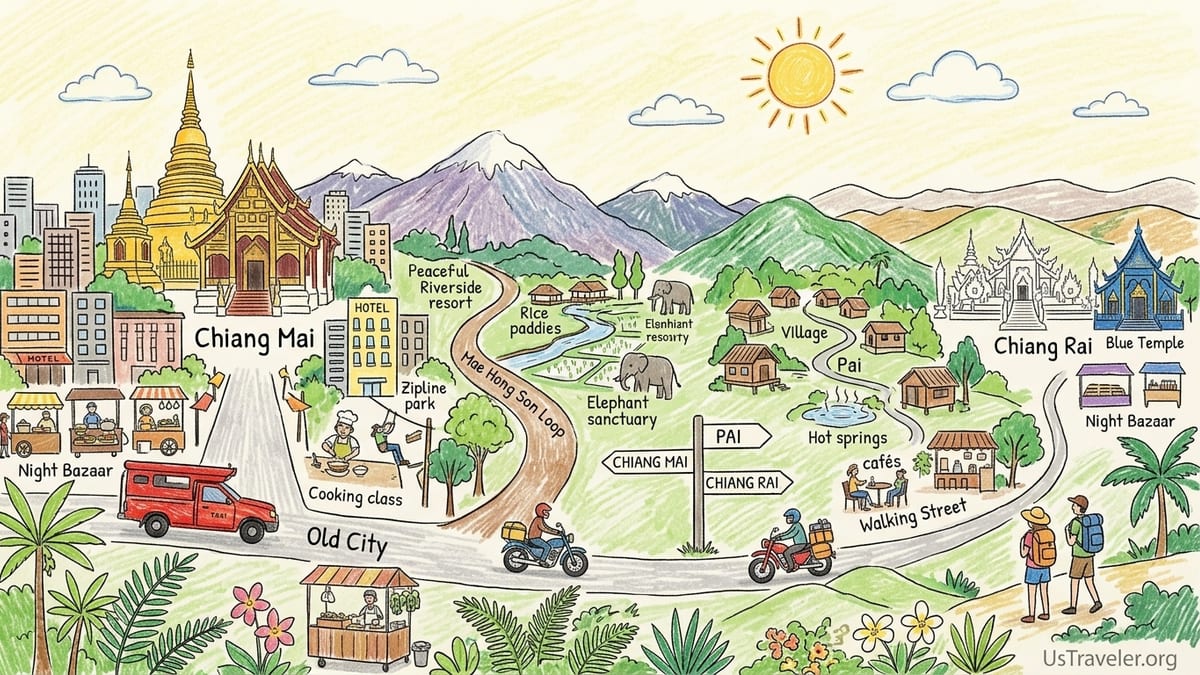
Chiang Mai: The broadest choice for hotels, food, tours and nightlife
If you want the easiest Northern Thailand trip to plan, make Chiang Mai your anchor. It has the region’s widest spread of hotels across every style, from design-forward boutique stays in the Old City to business-class towers near the Night Bazaar to high-end riverfront resorts. It’s also where operators cluster: day trips to Doi Suthep, cooking classes, ethical elephant sanctuaries, zipline parks, temple tours and café-hopping itineraries are all easiest to book here, often with next-day availability.
Nightlife is the clearest reason to choose Chiang Mai over any other northern base. The scene splits into several recognizable pockets: Nimman (Nimmanhaemin) for cocktail bars, late-night dessert cafés and student energy; the Old City and Tha Phae Gate area for backpacker-friendly bars; and the Night Bazaar corridor for tourist-facing venues and easy late dinners. If you’ve heard of Zoe in Yellow, that’s the Old City’s loudest, most recognizable party magnet. For a different feel, the riverside is where many travelers go for live music and a more grown-up night out, especially if you are staying near the Mae Ping River.
Airport access is another Chiang Mai advantage. Chiang Mai International Airport (CNX) has a broad network of domestic and international routes compared with other northern airports, which makes it the easiest place to start or end a multi-stop itinerary. In real terms, that often means you can fly in, be at a hotel in the Old City or Nimman quickly, and start sightseeing the same day without a long transfer.
What it costs right now depends on how specific you are. A recognizable mid-range Old City option like BED Phrasingh (Adults Only) commonly prices around the mid double-digits in USD per night for a standard room when searched close-in, while a splurge riverfront option like Anantara Chiang Mai Resort can price in the low-to-mid hundreds per night depending on date and room type. If you want a classic “Chiang Mai base,” plan 3 to 5 nights so you can do one temple-heavy day, one food or cooking day, one nature day trip, and still leave time for slow café mornings.
Chiang Rai: Best for temples, art landmarks and the far-north feeling
Chiang Rai rewards travelers who want iconic sights with less urban friction than Chiang Mai. This is the natural base for temple and art landmarks that most people recognize from photos: Wat Rong Khun (the White Temple), Wat Rong Suea Ten (the Blue Temple) and the Black House Museum area are all typically approached from Chiang Rai. The city itself is manageable: you can stay near the center, do your sightseeing by day, and still come back for a relaxed dinner without fighting big-city traffic.
Nightlife here is quieter and more market-led. The Chiang Rai Night Bazaar is the dependable evening plan: food stalls, casual seating and a low-stress way to try northern dishes without committing to a long restaurant hunt. Chiang Rai also has weekend walking streets that can feel more local and less scene-y than Chiang Mai’s biggest night market nights. If your priority is bars and late nights, Chiang Rai will feel limited; if your priority is temples and early starts, it’s a feature, not a bug.
Airport access is good, but narrower than Chiang Mai. Chiang Rai International Airport (CEI) is built around domestic connectivity, with frequent links to Bangkok and a smaller route map overall than CNX. For many travelers, that means Chiang Rai works best as a 2 to 3 night add-on after Chiang Mai, especially if you want to see the signature temples and then continue to the Golden Triangle area or return to Chiang Mai.
Hotel pricing tends to be strong value for what you get. Booking platforms commonly show Chiang Rai’s weekend averages around the mid double-digits per night for 3-star stays, and around the high double-digits for 4-star stays, with 5-star averages often landing around the low hundreds depending on date. For a concrete upscale example, The Riverie by Katathani, one of the area’s best-known full-service hotels, is frequently priced around the high double-digits to low hundreds per night in near-term searches, with some dates dipping lower on deals.
Pai: Mountain-town stays for scenery, chill cafés and a social backpacker core
Pai is the stay that changes the pace of your whole trip. It’s a small mountain town that’s built around slow mornings, viewpoint sunsets, hot springs days and café-and-scooter loops. Accommodation is part of the reason people come: you’ll see everything from bamboo bungalows and small hostels near Walking Street to boutique resorts set back in green valleys where the view is the selling point.
Nightlife is concentrated and casual rather than sprawling. If you stay near the center around the Walking Street area, you can walk to night food, bars, reggae spots and the social scene without thinking too hard about transport. If you choose a countryside resort, you trade walkability for quiet, skies full of stars and the kind of morning where breakfast is the main event.
Getting to Pai is straightforward but not “easy.” The road from Chiang Mai is famous for its curves, and shared minivans are the most common option. Typical minivan prices are often quoted in the roughly 150 to 260 baht range per person depending on operator and pickup, and the ride commonly lands around 3 to 4 hours with at least one stop. Private cars and taxis cost more but can be worth it if you’re prone to motion sickness or traveling as a small group.
Prices in Pai can be surprisingly low for the vibe, but they also stretch upward fast in peak season. Budget dorms can run very cheap, budget private rooms often sit in the hundreds of baht, and mid-range stays commonly sit around the high hundreds to low thousands of baht per night. For recognizable real-world examples that travelers actually book, Pai Village Boutique Resort & Farm is a frequently referenced “nice but still Pai” boutique choice, while properties like The Quarter Pai and Yoma Hotel show up repeatedly as practical mid-range picks. Give Pai at least 2 nights; 3 nights is better if you want one full day for exploring beyond town without feeling rushed.
Mae Hong Son: The quieter road-trip stop that feels far from the crowds
Mae Hong Son is for travelers who like the idea of Northern Thailand more than they like the idea of tourist density. It’s a natural overnight on the Mae Hong Son Loop and a place where evenings are slower, mornings are mistier, and the town can feel like it’s running on a different clock. If your mental picture is lakeside temples, calm streets, and a base that encourages early nights and early starts, this is the right stop.
Nightlife is limited, and that’s the point. You can find relaxed places to eat and drink, but you’re not choosing Mae Hong Son for a bar-hopping plan. Instead, it’s the kind of place where travelers often aim for a good dinner, a walk, and a long sleep before the next drive. Scenery is the payoff: mountain backdrops, road-trip viewpoints and a sense that you are in a borderland province rather than a major tourism hub.
Airport access exists but is the most restrictive of the bases in this guide. Mae Hong Son Airport (HGN) is a small airport with limited schedules, so most travelers arrive overland from Pai or Chiang Mai as part of a loop. If you do fly, expect fewer choices and plan your timing carefully so a flight schedule change doesn’t derail your itinerary.
Hotel value can be excellent, especially outside peak holiday windows. Deal aggregators routinely surface very low nightly prices for simple stays, and even mid-range hotels can sit at prices that feel like a throwback compared with bigger Thai cities. If you want Mae Hong Son to feel meaningful rather than just a sleep stop, plan 1 to 2 nights: one night for the classic loop rhythm, two nights if you want a genuinely slow day without packing up again the next morning.
Mae Rim and Chiang Dao: Countryside resorts, rice fields and mountain views
If Chiang Mai is the city base, Mae Rim is the countryside version that still keeps you close to the action. The appeal is waking up to rice paddies and mountain air, then deciding whether you want a spa day, a long lunch, or a short hop into town for temples and night markets. This is where luxury resorts lean into “northern Thailand as an experience,” not just a destination, and it’s ideal for couples, families, and anyone who wants quiet nights after busy sightseeing days.
Mae Rim is also where some of the region’s most famous high-end stays sit. Four Seasons Resort Chiang Mai is a headline example, set in a Mae Rim valley landscape that’s often described in terms of rice fields, mist and a retreat-like atmosphere. The tradeoff is obvious and worth stating plainly: you are paying for the setting and the service, but you are farther from Chiang Mai’s moat, Nimman cafés and late-night options. Plan to use hotel cars, taxis or pre-booked transfers when you want to go into the city.
Chiang Dao, farther north, is the base for travelers who want mountain scenery that feels more dramatic and less curated. Doi Chiang Dao is a major visual draw, and the area suits travelers who want a rural hotel, a slower town, and an outdoors-first itinerary. It’s commonly approached as a short road trip from Chiang Mai, and it pairs well with a “two-speed” trip: a few busy nights in Chiang Mai, then a quiet reset in the countryside.
How long to stay depends on what you’re trying to fix in your schedule. If you’re building a honeymoon-style trip, 2 nights in Mae Rim can be the luxury core between city time and the next destination. If you’re using Chiang Dao for views and a different northern vibe, 1 to 2 nights is usually enough unless you are specifically planning hikes and early morning viewpoints.
How to choose: nightlife, scenery, airport access, transport, price and ideal stay length
If nightlife matters, Chiang Mai wins by a wide margin. Nimman gives you the trendy bar and café scene, the Old City delivers backpacker energy near major temples, and the Night Bazaar area keeps it easy for late dinners and casual drinks. Pai is social but small, more about meeting people than chasing venues. Chiang Rai is market-forward and calm. Mae Hong Son and countryside bases like Mae Rim and Chiang Dao are deliberately quiet, and they feel best when you lean into early dinners and early starts.
If scenery is the deciding factor, Pai and Chiang Dao are the most “mountain town” feeling bases, while Mae Rim is the most resort-polished nature stay. Chiang Rai’s scenery tends to come in day trips and river landscapes, while Chiang Mai’s best scenery is often something you go out to see, then return to the city. Mae Hong Son is scenic in a road-trip way, with the journey and the remoteness as part of the attraction.
For airport access, Chiang Mai is the most flexible. Chiang Rai is convenient for a quick Bangkok connection and the far-north loop, but it has a narrower route map. Mae Hong Son’s airport is useful when it works, but it’s not the place to rely on last-minute flight options. Pai has no practical commercial airport plan for most travelers right now, so you should assume you will arrive by road.
On price, Chiang Mai has the widest spread, which is good and dangerous. You can find great value boutique hotels in the Old City, but luxury riverfront and resort-grade stays can jump quickly into premium pricing. Chiang Rai generally offers strong value per star level, especially if you want a full-service hotel without Chiang Mai’s competition for the same rooms. Pai can be budget-friendly in town and boutique-priced in the valleys, with plenty of travelers paying extra to get a view and quiet. Mae Hong Son tends to be the cheapest feeling stop for simple hotels. A practical trip rhythm many travelers enjoy is 3 to 5 nights Chiang Mai, 2 to 3 nights Pai, 2 to 3 nights Chiang Rai, 1 night Mae Hong Son if doing the loop, and 1 to 2 nights in Mae Rim or Chiang Dao when you want a countryside finish.
The Takeaway
If you want the easiest, most choice-heavy northern base, stay in Chiang Mai. It’s the best place to book tours, chase food, split your days between temples and cafés, and still have a real nightlife menu at night. If temples and far-north landmarks are your priority, Chiang Rai is the smarter base, especially for a tight 2 to 3 night add-on with strong hotel value. If you want a mountain-town stay where days are slower and hotels feel personal, pick Pai and commit to at least 2 nights so the travel time is worth it. If you’re doing the Mae Hong Son Loop and want a quieter, more remote-feeling stop, Mae Hong Son delivers calm evenings and scenic roads. And if your ideal northern Thailand is rice fields, mist and resort mornings, book Mae Rim for luxury countryside comfort or Chiang Dao for mountain views and rural quiet.
FAQ
Q1. Which base has the widest choice of hotels and tours in Northern Thailand?
Chiang Mai, by a wide margin, with the deepest mix of hotels, day tours, food options and nightlife.
Q2. Is Chiang Rai better than Chiang Mai for temples?
For headline contemporary temple and art landmarks like the White Temple and Blue Temple, Chiang Rai is usually the more convenient base, while Chiang Mai is stronger for classic Old City temple wandering plus day trips.
Q3. How many nights should I plan in Chiang Mai?
Plan 3 to 5 nights if Chiang Mai is your main base, especially if you want at least one day trip plus time for markets and café neighborhoods.
Q4. How many nights do I need in Pai to make the trip worth it?
At least 2 nights, with 3 nights ideal if you want one full day exploring viewpoints, hot springs and countryside loops without rushing.
Q5. What’s the typical cost and time for a shared minivan from Chiang Mai to Pai?
Expect roughly 3 to 4 hours, and commonly around 150 to 260 baht per person depending on operator and pickup.
Q6. Where is the best nightlife in Chiang Mai?
Nimman for trendy bars and late cafés, the Old City and Tha Phae Gate area for backpacker-friendly nights, and the Night Bazaar corridor for easy tourist-facing evenings.
Q7. Does Pai have an airport I can use?
Most travelers should assume no practical flight option and plan to reach Pai by road from Chiang Mai.
Q8. Is Mae Hong Son worth staying overnight, or is it only a drive-through stop?
It’s worth at least one night on a loop itinerary, and two nights if you want a genuinely slow day in a quieter, remote-feeling town.
Q9. What’s the best place for a luxury countryside resort experience near Chiang Mai?
Mae Rim is the go-to, with famous rice-field resort settings and easy access back to Chiang Mai by car.
Q10. If I only have one base in the north, which should I pick?
Choose Chiang Mai for the best all-round mix of airport access, hotels, restaurants, activities and flexible day trips.