


The Chiang Mai to Pai ride is short on kilometers but big on logistics. Route 1095 is famously twisty, minivans can sell out in peak season, and what counts as “allowed luggage” depends on the operator and the day’s load. Below is a September 2026, traveler-first guide to shared minivans and private transfers, including current departure windows, real-world fares, pickup points, luggage realities, and a motion-sickness game plan that actually works.
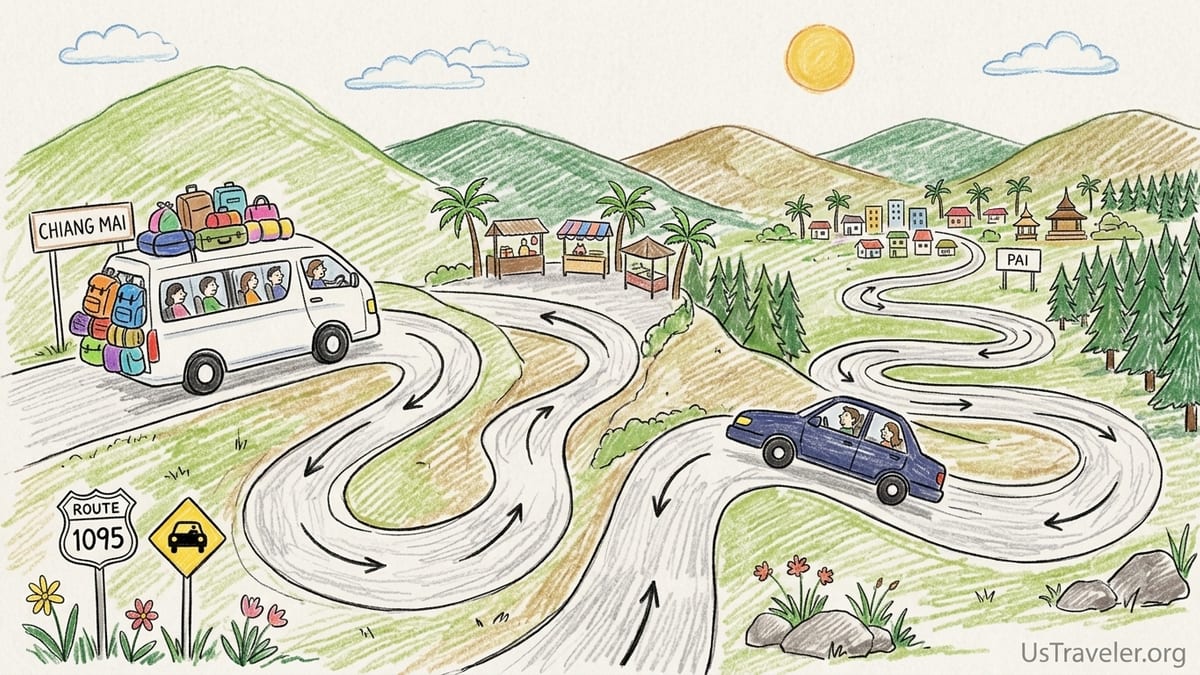
What the trip is really like (and why it feels longer than it looks)
Chiang Mai to Pai is the classic Northern Thailand hop: a mountain road, a few strategic rest stops, and a small town that feels a world away from the Old City. Most travelers do it by shared minivan because it is frequent, straightforward, and usually the cheapest paid option that still gets you there the same day.
The catch is the road. Route 1095 is known for its constant curves, and that is why a trip that is often marketed as “about three hours” can feel like four when you factor in loading, passenger pickup loops around town, a mid-route break, and slower traffic during rain.
If you are choosing between a scheduled terminal-to-terminal service and a “hotel pickup” van, think about what you value. Terminal departures are more predictable. Pickup vans are more convenient on paper, but the pickup loop can add meaningful time before you even leave Chiang Mai, especially if the van is collecting passengers from Nimman, Tha Phae Gate, and the Old City on the same run.
September 2026 minivan schedules and where to board in Chiang Mai
As of September 2026, the most visible schedule pattern for Chiang Mai to Pai is an hourly-style spread across the day. Prempracha Transport publishes a Chiang Mai to Pai timetable with departures starting at 06:30 and continuing through 17:30. That gives you practical options whether you want to leave early for a full afternoon in Pai or depart after breakfast.
On booking platforms in late summer 2026, you will also see Aya Service departures. One commonly shown example is an 08:00 Aya Service van arriving around 12:00. That four-hour block is a realistic expectation once you account for boarding and a rest stop, even if the driving time can be shorter in light traffic.
For boarding, most travelers using the public scheduled service head to Chiang Mai’s Arcade area (often referred to as Bus Terminal 2). Plan to arrive early enough to find the right counter, confirm the gate, and stow luggage without stress. If you are in the Old City or Nimman, give yourself buffer time for traffic and songthaew or taxi pickup.
Aya Service also maintains a Chiang Mai office address at Kham Thiang Plaza, which matters if your booking specifies an operator office check-in rather than a general bus terminal counter. Always read your ticket details carefully, because “Chiang Mai” can mean different pickup points depending on the operator and the product you selected.
Current fares in 2026: what you can expect to pay (with real examples)
For shared minivans, the main price anchors in 2026 sit in the low hundreds of baht. Prempracha lists Chiang Mai to Pai fares such as 220 THB for a van and 260 THB for a minibus on the same corridor, depending on vehicle type. That difference can show up as a slightly larger vehicle or a different seat layout, not a luxury upgrade.
Online booking results in 2026 often show “from around THB260” once fees and distribution markups are included. For example, September 2026 booking results commonly display a Prempracha minivan at about $4.83 USD and an Aya Service van around $5.14 USD, which roughly maps to the mid-200s THB depending on the day’s exchange rate and platform fees.
For private transfers, the fare is per vehicle, not per person, which changes the math for pairs, families, and small groups. Real-world 2026 guide pricing commonly places Chiang Mai to Pai private taxi or car transfers around 2,500 to 4,200 THB per vehicle. Some transfer companies publish fixed rates that can be higher when departing from the airport, with examples in the mid-4,000 THB range for a sedan and above that for a minivan.
A concrete comparison helps: if a shared minivan is about 260 THB per person, four people might spend around 1,040 THB total. A private car at 2,800 THB costs more, but you buy door-to-door pickup, fewer delays, flexible stops, and typically a calmer drive for anyone worried about nausea.
Luggage rules in practice: backpacks, suitcases, and what happens when space runs out
Minivans on the Pai route are not coaches with deep luggage holds. You are usually dealing with a rear storage area plus whatever can fit at your feet or on your lap without blocking aisles. A normal travel backpack is usually fine. A hard-shell suitcase can be fine on an empty van and a problem on a full one.
In real terms, luggage issues tend to show up on busy days: weekends, holiday periods, and the cool-season surge when Pai is packed. If you are traveling with a large suitcase and a daypack, expect the staff to prioritize safe storage first and speed second. That can mean squeezing bags, rearranging cargo at the curb, or asking passengers to keep a smaller item with them.
If you are combining Pai with a scooter plan, you will also see services that move luggage separately. One common pattern travelers use is renting a scooter one-way between Chiang Mai and Pai through an operator with offices in both towns, then paying a separate luggage transfer fee per bag. The practical advantage is obvious: you ride light on the twisty road while your backpack arrives by van.
One more reality check: if you booked online and show up with oversized luggage, the staff may still allow it, but you could be asked to pay a small extra handling fee or wait for a later departure if the cargo space is already full. If you have a flight to catch the same day, that gamble is rarely worth it.
Motion sickness: a prevention plan for the 1095 road that travelers actually use
This is the section most people wish they read before they buy the ticket. The Chiang Mai to Pai road is famous for motion sickness because the curves are relentless and the ride is fast in shared vans. If you are even slightly prone to nausea, treat prevention as part of your ticket, not an optional add-on.
A practical, common approach is to take an over-the-counter anti-nausea medication from a Thai pharmacy, then time it about 30 minutes before departure. Travelers also swear by choosing a front seat when possible, keeping eyes forward, and avoiding reading on a phone. The difference between “I felt fine” and “I was miserable” is often as simple as front row versus back row.
Food strategy matters. Many people do best with a light breakfast and a simple drink, then a snack after the rest stop. Greasy meals right before boarding are a common mistake, especially when the van’s air conditioning is strong and the road is humid or rainy.
If you know you get carsick and you have the budget, a private transfer can be a quality-of-life upgrade. It is not just about comfort. It is about control: slower pace through curves, fewer sudden accelerations, and the option to stop for fresh air at a viewpoint when your stomach starts to turn.
Booking ahead, pickup points, and busy periods: how to avoid the common fails
In low season, many travelers simply walk up and buy a ticket at the terminal. In peak periods, that approach can backfire. Pai gets crowded fast in the cool months, and limited seats on small vehicles mean sellouts happen sooner than people expect. If you are traveling around major holidays or the December and January rush, book ahead and consider booking the return trip at the same time.
Pickup point confusion is another common fail. “Chiang Mai” on a booking page may mean Arcade terminal, a specific operator office, or a pickup service that collects passengers from tourist zones. The simplest way to avoid surprises is to open your ticket details and look for the exact check-in location. If it names an office, plan to arrive there early, even if you are staying five minutes away by foot.
For travelers landing at Chiang Mai International Airport and heading straight to Pai, your cleanest plan is usually either a private transfer from the airport or a taxi to the correct terminal or operator office, then a scheduled minivan. Do not assume there is a direct airport minivan product that runs like an airport bus, because inventory depends on the operator and season.
The Takeaway: if your schedule is flexible, the shared minivan is the best value and the most common choice. If you have a tight timeline, heavy luggage, a group of three or four, or a history of motion sickness, a private transfer can be worth the extra baht because it turns a notorious ride into a controlled, door-to-door trip.
FAQ
Q1. How long does the Chiang Mai to Pai minivan take in 2026?
Most trips are marketed around three to four hours, and a realistic expectation is about four hours once you include boarding, a rest stop, and possible pickup loops.
Q2. What are the current Chiang Mai to Pai departure times?
Prempracha publishes Chiang Mai to Pai departures starting at 06:30 and running through 17:30, with frequent daytime options.
Q3. How much is a Chiang Mai to Pai minivan ticket right now?
In 2026, published fares on the route include examples like 220 THB for a van and 260 THB for a minibus with Prempracha, while online booking results often show totals around the mid-200s THB.
Q4. Where do I catch the minivan in Chiang Mai?
Many services depart from the Arcade bus terminal area, while some Aya Service products require check-in at their Chiang Mai office at Kham Thiang Plaza, so confirm the exact pickup point on your ticket.
Q5. Where do minivans arrive in Pai?
Most services arrive at Pai’s central bus station area near town, which is close enough to reach many guesthouses by a short taxi or scooter ride.
Q6. Can I bring a large suitcase on the minivan?
Usually yes, but space is limited and problems happen on full vans. If you have a big hard-shell suitcase, arrive early and expect it to be stored in the rear cargo area if space allows.
Q7. What is the best seat to avoid motion sickness?
The front row is usually the best. If you can, request a front seat when booking or arrive early to improve your chances.
Q8. Should I take motion-sickness medicine for this route?
If you are even mildly prone to nausea, many travelers take an over-the-counter anti-nausea tablet about 30 minutes before departure and avoid reading on a phone during the ride.
Q9. How much is a private transfer from Chiang Mai to Pai?
In 2026, guides commonly cite roughly 2,500 to 4,200 THB per vehicle for a private taxi or car, while some fixed-rate airport-to-Pai transfers can be higher depending on vehicle type and provider.
Q10. Do I need to book in advance during busy months?
Yes. During the cool-season surge, seats can sell out, so booking ahead and booking the return trip early can save you from last-minute stress.