


The overnight train from Bangkok to Chiang Mai is one of Thailand’s most useful point-to-point journeys because it can double as your hotel night while delivering you into the city by morning. In September 2026, several daily services run between Bangkok’s Krung Thep Aphiwat Central Terminal and Chiang Mai Railway Station, including multiple overnight sleepers and at least one daytime train. This guide breaks down what you actually get in first-class sleeper versus second-class air-conditioned sleeper, what current timetables and price bands look like, how early to book, where to depart from in Bangkok, and when it’s smarter to fly.
September 2026 Bangkok to Chiang Mai train timetable (what’s running)
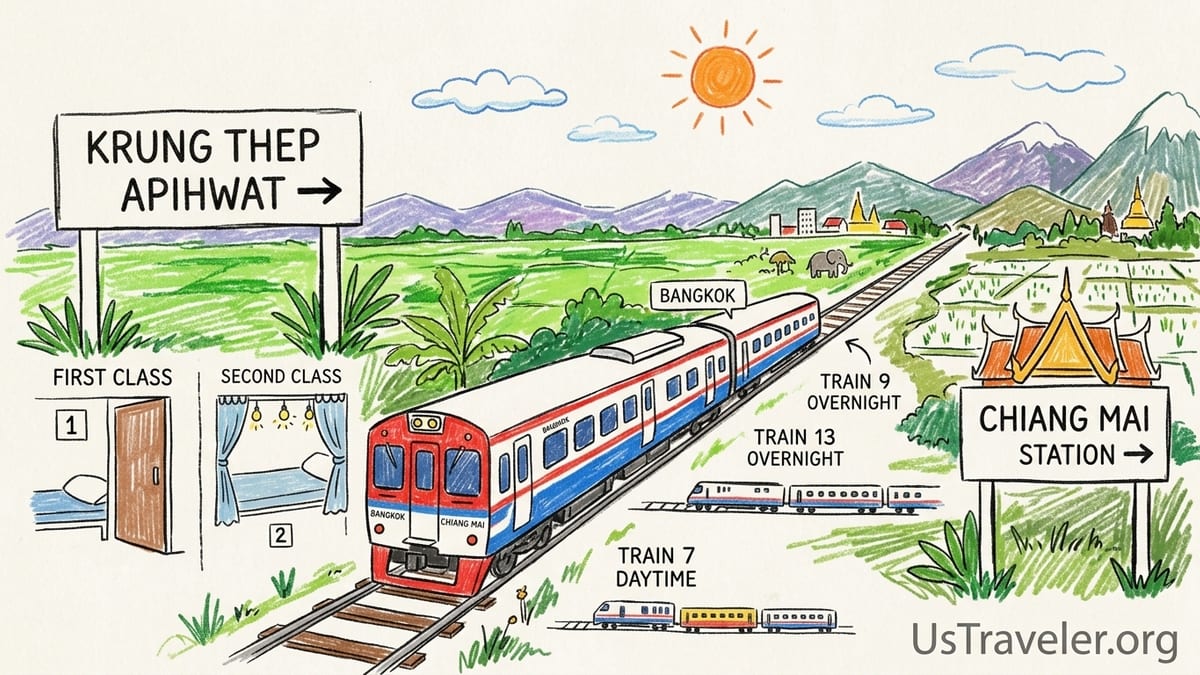
For most travelers, the “right” schedule is the one that lets you check out of a Bangkok hotel, have dinner, board the train, sleep, and then arrive in Chiang Mai with the whole day ahead. In September 2026, the core overnight options typically include Train 9 (Special Express “Utrawithi”), Train 13 (Special Express), and Train 51 (Express). The daytime option many travelers compare against is Train 7, which runs Bangkok to Chiang Mai during daylight hours.
Real-world example: Train 9 is commonly shown departing Krung Thep Aphiwat around 18:40 and arriving Chiang Mai around 07:15 the next morning. Train 13 is commonly shown departing around 20:05 and arriving around 08:40. Train 51 is commonly shown departing around 22:30 and arriving late morning around 11:40 to 12:10, making it the “latest departure” but also the “latest arrival” option.
Daytime example: Train 7 is often treated as the scenic, no-sleep-required alternative if you would rather watch rural Thailand roll by and arrive the same evening. It can also be a fallback when sleeper berths sell out, because seating inventory is often easier to find than berths during busy periods.
Because Thai long-distance trains can run late, it is wise to plan your Chiang Mai arrival as “morning-ish” rather than down to the minute. If you have a tight connection like a noon tour pickup, it is safer to book a slightly later pickup time or choose a flight on a separate day.
First-class sleeper: who should pay for it (and what you get)
First-class sleeper on this route is about privacy first, not luxury in the airline sense. You’re paying for a proper door, a quieter environment, and the ability to sleep without being face-to-face with a stranger across an aisle. Most first-class cabins are two-berth compartments, so couples and friends often choose it to get a private room for the night.
Concrete fare example: in September 2026 listings for Train 9, first-class prices are commonly shown around the mid-THB1,000s per person, depending on upper or lower berth and the specific service. You may also see an option where a whole cabin is sold at a higher price if you want single occupancy, which can be appealing for solo travelers who value privacy more than cost.
What it feels like in practice: you board at Krung Thep Aphiwat, find your carriage, and settle into a compartment that resembles a compact room. Linens are provided, and staff typically convert bedding at night. If you are traveling with a large suitcase and a daypack, the private cabin can reduce the “where do we put our bags?” stress compared with second class.
Who it’s best for: light sleepers, couples on a short schedule who want a more controlled sleep environment, older travelers who prefer less foot traffic at night, and anyone who simply wants the psychological comfort of a door. If first class is sold out, a lower berth in second-class air-conditioned sleeper is the most common “Plan B” that still feels like a proper overnight.
Second-class AC sleeper: the best value for most travelers
Second-class air-conditioned sleeper is the workhorse product on Bangkok to Chiang Mai. It is typically a seat by day that converts into a bunk at night, with a curtain for privacy and linens provided. The experience is social, efficient, and generally comfortable, especially on the newer rolling stock used on the most popular services.
Concrete fare example: September 2026 fare snapshots for Train 9 commonly show second-class air-conditioned sleeper around THB938 for an upper berth and about THB1,038 for a lower berth. Across the broader set of trains and sales channels, you will still see second-class sleeper products starting in the low-THB700s and rising from there depending on train type, berth position, and where you book.
Lower versus upper in real life: the lower berth is typically wider and easier to access, and it turns into seating in the morning. The upper berth can be slightly cheaper and is perfectly workable for many travelers, but if you are tall, traveling with a child, or likely to wake up frequently, the lower berth is usually worth the small premium.
Choose your “train personality” as well as your class. Train 9 is widely viewed as the most comfortable mainstream option because it uses newer sleeper cars, which often means cleaner interiors and traveler-friendly details like individual reading lights and charging points. Train 13 can still be a solid choice if you want the timing or if Train 9 is sold out, but travelers often prioritize Train 9 when the price difference is modest.
Daytime trains: when skipping the sleeper makes sense
The daytime train is the right pick when you do not want to sleep on transport, when you are traveling with someone who struggles to rest in motion, or when you want to see Thailand’s central plains and northern countryside in daylight. The trade-off is simple: you give up a night of accommodation savings, and you arrive later in the day.
A practical scenario: if you plan to check into a boutique hotel inside Chiang Mai’s Old City around 3:00 p.m., the daytime train can turn the travel day into a relaxed “watch the scenery, read a book, arrive, grab dinner” routine. It also avoids the early-morning arrival problem where you reach Chiang Mai at 7:15 a.m. with a suitcase and no check-in until mid-afternoon.
Another scenario is availability. In peak travel weeks, sleeper berths can sell out first, while seated classes on daytime trains may remain available. If you cannot secure a sleeper on your ideal date, a daytime train plus a budget hotel in Chiang Mai may be less stressful than forcing an overnight you do not actually want.
If you are comparing comfort, remember that a daytime seat can feel long on a roughly 12 to 14 hour journey. If you choose daytime, consider whether you can book an air-conditioned class rather than a basic fan-cooled seat, especially if you are traveling with electronics, camera gear, or simply prefer a cooler environment.
How to book Bangkok to Chiang Mai train tickets (official vs agents)
The official booking channel is SRT’s D-Ticket website and app. The big advantage is straightforward: it is typically the lowest price because you are buying at official fare without agent markup. D-Ticket tickets can be saved as a PDF or stored on your phone and are designed for QR code scanning during the journey, so you can generally board with your e-ticket when properly issued.
Booking window and timing: as of September 2026, SRT’s advance sales window is widely shown as up to 90 days. That matters most for high-demand dates like Thai public holidays and the November to February high season, when first-class cabins and second-class lower berths can disappear early. A realistic approach is to set a calendar reminder for the 90-day mark, then book as soon as inventory opens if you care about a specific train and berth.
If D-Ticket rejects your foreign card or you want a simpler purchase flow, a major agent like 12Go is commonly used. The trade-off is that agents may add markup and, depending on ticket type and issuance rules, may require pickup of a physical boarding pass rather than letting you board with a PDF voucher. For example, 12Go maintains pickup points in Bangkok and Chiang Mai for travelers who need printed rail tickets handled through their system.
A grounded recommendation: if you are traveling on a must-make date and you cannot get payment to go through on D-Ticket, use an established agent rather than waiting until the last minute. For popular departures, showing up at Krung Thep Aphiwat one or two days in advance and hoping for a lower berth on Train 9 can be a gamble, especially during busy weeks.
Bangkok departure station, boarding routine, and luggage realities
Bangkok’s long-distance northern trains now depart from Krung Thep Aphiwat Central Terminal, not the old Hua Lamphong station that many older guidebooks still mention. Krung Thep Aphiwat is connected to Bangkok’s rail transit network, including the MRT Blue Line at Bang Sue (BL11), which makes it manageable even if you are staying around Sukhumvit, Silom, or the riverside.
Real-world arrival plan: aim to be at the station well ahead of departure, especially the first time, because Krung Thep Aphiwat is large and the walk from the entrance to the correct gate and platform can take time. Many travelers build in at least 45 to 60 minutes, enough to find the right level, locate your platform area, buy snacks, and still board without rushing.
Luggage on Thai trains is usually more flexible than on budget airlines. In practice, staff rarely weigh bags, but published baggage allowances are generous by class, and oversize items may need special handling. If you are traveling with a full-size suitcase and a carry-on, you can generally manage it in your sleeper carriage by stowing items near your berth and keeping valuables with you.
Two practical packing tips for overnight sleepers: keep an “overnight kit” accessible (toothbrush, wipes, eye mask, charging cable) so you are not digging through a suitcase in a narrow aisle, and bring a light layer because air-conditioned carriages can feel chilly after midnight. Also remember Thailand’s continuing alcohol restrictions on SRT stations and trains, so do not expect the onboard environment to resemble a party train.
Flying vs taking the overnight train: an honest comparison
If your main goal is speed, flying wins. Bangkok to Chiang Mai is routinely a short domestic hop, and you will see frequent service by Thai carriers and low-cost airlines. In pure door-to-door time, even with airport transfers, the flight is usually faster than spending 12 to 14 hours on rails.
But the train can still be the better trip. A second-class sleeper in the roughly THB800 to THB1,100 range can replace a hotel night, and you wake up in Chiang Mai without losing an entire daytime block to travel. In a real itinerary, that can mean dinner in Bangkok, sleep on the train, breakfast near the Ping River, and a full first day exploring the Old City or heading to a café in Nimman.
Consider the “hidden costs” in both directions. Flights can be inexpensive, but baggage fees, airport taxis, and the possibility of needing a hotel night on either end can change the math. Meanwhile, the train’s cheapest advertised berth is not always what you’ll pay if you book late, insist on a lower berth, or rely on an agent with markup.
When flying is smarter: same-day meetings, tight connections to onward flights, travelers who cannot sleep on moving transport, and anyone who wants to maximize comfort and minimize uncertainty. When the train is smarter: travelers who enjoy the journey, travelers who want a more local experience, travelers who plan to sleep anyway, and anyone who prefers arriving in the city rather than navigating airports.
The Takeaway
For most travelers in September 2026, the sweet spot is a second-class air-conditioned sleeper on an overnight service, with Train 9 often the first choice because it is commonly listed as the most modern and traveler-friendly set. Expect second-class sleeper prices to start from the low-THB700s on some services and channels, with common fare points around THB938 to THB1,038 on Train 9 depending on upper versus lower berth.
If privacy is your priority, first-class sleeper is worth paying for, especially for couples who can treat the compartment like a compact hotel room on rails. If your schedule is tight, you are a poor sleeper, or you simply want to arrive without any chance of rail delays affecting your plans, fly and treat the train as a future experience rather than a logistical requirement.
Book as soon as the 90-day window opens when traveling in high season or around holidays, depart from Krung Thep Aphiwat, and plan your station arrival with extra buffer. Done right, the Bangkok to Chiang Mai night train is not just transport, it is one of the most efficient ways to turn a long distance into an easy overnight.
FAQ
Q1. Which Bangkok station do Chiang Mai sleeper trains depart from in 2026?
Most long-distance trains to Chiang Mai depart from Krung Thep Aphiwat Central Terminal in Bangkok.
Q2. What are the typical departure and arrival times for the best-known overnight trains?
A common example is Train 9 departing around 18:40 and arriving around 07:15, with Train 13 around 20:05 to 08:40 and Train 51 around 22:30 to late morning.
Q3. How much is a second-class AC sleeper from Bangkok to Chiang Mai in September 2026?
You will see prices starting in the low-THB700s on some services and channels; a concrete example is Train 9 often listed around THB938 (upper) and THB1,038 (lower).
Q4. How much is first-class sleeper, and is it worth it?
First-class is commonly priced in the mid-THB1,000s per person on popular services, and it is worth it if privacy and quieter sleep matter more than the price difference.
Q5. Should I choose the lower or upper berth in second class?
Lower berths are usually easier to access and feel roomier; upper berths are often slightly cheaper. If you are a light sleeper or tall, the lower berth is typically worth it.
Q6. How far in advance can I book SRT tickets online?
SRT’s advance booking window is commonly shown as up to 90 days, and popular sleeper berths can sell out well before travel day.
Q7. Is SRT D-Ticket the best place to buy Bangkok to Chiang Mai train tickets?
D-Ticket is usually the cheapest because it is the official channel, but some travelers use agents if payment fails or they want a simpler booking process.
Q8. Do I need to print my Bangkok to Chiang Mai e-ticket?
Many travelers board using the saved ticket on their phone, as tickets are designed to be verified by QR code scanning, but printing a backup can reduce stress if your phone battery dies.
Q9. How strict is luggage on the sleeper train?
In practice, luggage is rarely weighed on board, and allowances are generally generous by class, but very large items may need special handling.
Q10. Is it better to fly or take the overnight train?
Fly if speed and schedule certainty matter most; take the overnight train if you want to save a hotel night and arrive in Chiang Mai ready to start the day.