


North Thailand is where Thailand’s mountain geography meets Lanna culture: gilded temples tucked into old city walls, misty ridgelines above coffee villages, and slow river towns shaped by trade routes to Laos and Myanmar. For first-time visitors, the region can feel deceptively big on a map and surprisingly time-consuming on the road, with curving mountain highways that turn short distances into half-day transfers. This guide defines what “North Thailand” covers for travelers, then breaks the region into practical travel zones, from Chiang Mai’s do-it-all base and Mae Rim’s day-trip countryside to Chiang Rai and the Golden Triangle, Pai and Mae Hong Son’s mountain loop, Lampang’s old-world charm, Nan’s quieter Lanna art, and the lower-northern historic corridor anchored by Sukhothai.
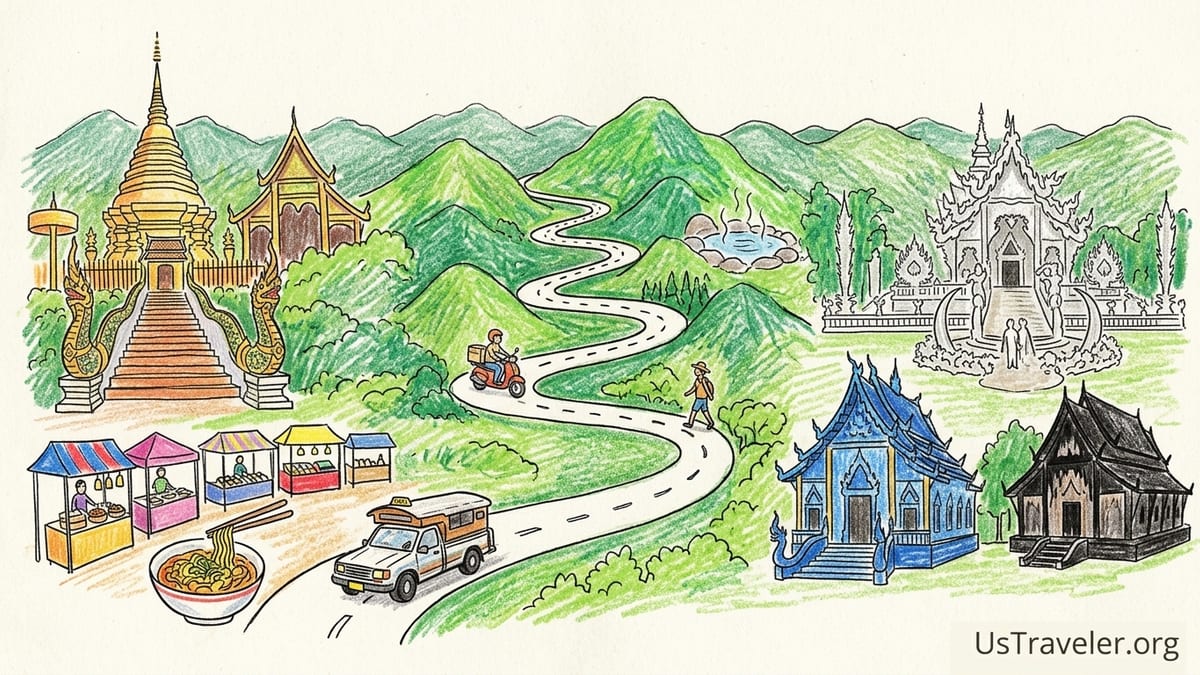
What Counts As North Thailand (And Why The Zones Feel So Different)
For most travelers, “North Thailand” means the upper and lower northern provinces stretching from the Burmese and Lao borders down toward the historic heartland around Sukhothai. In practical trip-planning terms, it includes the Chiang Mai and Chiang Rai basins, the Mae Hong Son mountain frontier, the Lampang and Nan side-valleys, and the lower-north corridor where ancient cities and UNESCO-era heritage sites sit among rice plains and low hills. The unifying thread is Lanna heritage, a distinct northern Thai identity expressed through temple architecture, textiles, markets, and food, paired with a landscape dominated by forests, ridgelines, and cooler-season travel.
The zones differ because of terrain and transport. Chiang Mai is the region’s main air hub and the easiest base for first-timers who want variety without constant hotel changes. Chiang Rai feels more spaced-out and road-trip oriented, with headline temples scattered outside town and day trips that pull you toward border viewpoints. Pai and Mae Hong Son are defined by a single iconic road: a mountain loop of roughly 600 kilometers that is famous for its curves and takes longer than most people expect. Lampang is rail-friendly and slower-paced, with its own identity anchored by old neighborhoods and the city’s iconic horse carriages. Nan is calmer and more local, with standout murals and mountain parks that reward travelers who like quiet roads and fewer crowds. Sukhothai, while geographically lower, is often paired with the north because it fits naturally into overland itineraries linking Bangkok to Chiang Mai and beyond.
If you only remember one planning rule, make it this: in the north, travel times are not just about distance. A 190-kilometer hop can be a comfortable 3 to 3.5 hours on a highway bus, while a shorter mountain segment can still take most of a morning. Build itineraries around no more than one major transfer every two or three days, especially if you want early mornings at temples and sunsets in the hills rather than constant packing and check-ins.
Chiang Mai And Mae Rim: The Lanna Base With Easy Mountains
Chiang Mai is the classic first stop because it combines an old city core of major temples with modern cafés, night markets, and straightforward day trips into mountains and craft villages. Many first-time visitors stay inside or just outside the Old City for walkability, or in the Nimman area for a more contemporary neighborhood feel with boutique hotels and coffee shops. A strong first afternoon is a temple walk that includes Wat Phra Singh and Wat Chedi Luang, then a market dinner where you can try northern staples like khao soi (curried noodle soup) and sai ua (herb-packed northern sausage). If you want a recognizable local ritual, order khao soi at a busy lunchtime spot, then finish with a glass of cha yen (Thai iced tea) at a street-side café where the city’s pace feels distinctly northern, not beach-town Thailand.
For the region’s signature viewpoint temple, Wat Phra That Doi Suthep sits about 15 kilometers from town and is one of Chiang Mai’s defining sights. It’s known for sunrise and evening city views and has set hours that make it easy to plan around: the gate is typically open from 5 a.m. to 9 p.m. daily, with foreign visitors paying a small terrace entry fee and an additional fee if you use the funicular rather than climbing the naga staircase. In real-world terms, that means you can do a pre-breakfast visit to beat tour buses, or go late afternoon and stay until the city lights come on, as long as you’re mindful that funicular operations can end earlier than the temple grounds.
When you want mountains that feel like the north you imagined, aim beyond the city. Doi Inthanon is Thailand’s highest mountain and a full-day trip even though the road is good and the infrastructure is well developed. In practice, many visitors book a small-group day tour with hotel pickup, or they hire a private driver for flexibility to stop at viewpoints, trailheads, and coffee stands. Entrance fees for Doi Inthanon are commonly listed at 300 baht for adults and 150 baht for children, with a small vehicle charge, which is useful to know if you’re comparing tour prices to going independently by rental car.
Mae Rim, just north of Chiang Mai, is the day-trip countryside zone: botanical gardens, short scenic drives, and easy access to green hills without the commitment of a national-park expedition. If your group is mixed-energy, this is where you can combine a relaxed lunch at a farm-style café with a short walk and still be back in Chiang Mai in time for night markets. Mae Kampong, further out in the hills, is another practical example of a nature-and-village day that works well for first-timers who want cool air and forest scenery without multi-day trekking logistics.
Chiang Rai And The Golden Triangle: Contemporary Temples And Borderland Scenery
Chiang Rai is smaller than Chiang Mai and tends to work best as a 2 to 4 night add-on when you want striking modern temples and a sense of the Mekong borderlands. The city itself is manageable, but the biggest sights are spread out, which is why day tours and private drivers are so common here. If you’re coming from Chiang Mai, the most standard transfer is the Green Bus, with frequent departures and a typical road time of about 3 to 3.5 hours for the roughly 190-kilometer route. For a first-timer, that’s an easy travel day: you can depart after breakfast, arrive early afternoon, and still catch an evening market dinner.
The headline attraction is Wat Rong Khun, better known as the White Temple, a contemporary art temple that’s become one of the most photographed sights in the entire north. A key planning detail for 2026 trips is that the foreign visitor fee is widely reported as 200 baht, reflecting a price increase that took effect on January 1, 2026. This matters in a practical way: if you’re comparing day tours, you’ll want to know whether admission is included or if you’re paying it on top. Also plan for dress code expectations and bright mid-day glare, since the white surfaces can be harsh for photos at noon.
Pair it with two other modern stops that contrast sharply. Wat Rong Suea Ten, the Blue Temple, is typically free to enter and is famous for saturated blue-and-gold interiors that feel almost glowing in late afternoon. Then add Baan Dam, often called the Black House Museum, for a darker, more provocative art experience in traditional-style buildings. Together, these three stops make a coherent first-timer day because they’re recognizable, visually distinct, and easy to understand even if you’re not a temple-history specialist.
For the “Golden Triangle,” think of it less as a single must-see monument and more as a half-day borderland circuit from Chiang Rai. The landscape is the draw: river viewpoints and the feeling of standing at a historic crossroads of Thailand, Laos, and Myanmar. If you have extra time, Doi Tung is a strong add-on, especially for travelers who want gardens and cooler air. Tickets for the Doi Tung Royal Villa area, Mae Fah Luang Garden, and the Hall of Inspiration are commonly sold as a combined ticket around 220 baht, making it one of the more straightforward, good-value paid attractions in the wider Chiang Rai day-trip menu.
Pai And Mae Hong Son: The Mountain Loop, Hot Springs, And Realistic Road Time
Pai is the north’s most famous small mountain town: casual, scenic, and built around easy day activities like hot springs, viewpoints, and café hopping. Mae Hong Son is quieter and closer to the Myanmar border, with a slower rhythm and a stronger frontier-town feel. Many first-time visitors connect them via the Mae Hong Son Loop, a roughly 600-kilometer circuit that links Chiang Mai, Pai, Mae Hong Son, and Mae Sariang before returning to Chiang Mai. It’s one of Thailand’s best road trips, but it is not a “quick detour,” and it rewards travelers who build in recovery time after driving days.
The most important transfer for first-timers is Chiang Mai to Pai. This ride is famous for 762 curves and can take roughly 3.5 to 4-plus hours by minivan depending on stops and traffic. Real-world pricing examples for shared minivans are commonly in the 200 to 400 baht range, and services run daily through licensed operators. If you’re prone to motion sickness, a practical approach is to take a travel-sickness tablet from a pharmacy before departure, request a front seat when possible, and avoid reading on the road. The choice between bus and minivan is not just comfort, it’s stability, and some travelers find a larger bus less nauseating even if it is slower.
If you’re planning to ride a scooter or motorbike, treat the loop as a skills and safety decision, not just an itinerary. The road is sealed, but the curves are constant, rain can appear quickly in the mountains, and you may have stretches without services between towns. A common first-timer mistake is to underestimate fatigue: a 135-kilometer segment can still feel like a full day because you’re cornering continuously. If your group includes cautious or inexperienced riders, doing Pai as a there-and-back by van from Chiang Mai can be the safer, simpler way to sample the vibe without committing to long mountain days.
For travelers who do want the loop experience without riding, consider hiring a private car with driver for a few days and treating it as a scenic transfer rather than a self-drive challenge. That can turn the loop into a sequence of photo stops, short hikes, and hot-spring breaks rather than a white-knuckle test. The payoff is real: this is where North Thailand’s landscape becomes the story, with ridge roads, forest viewpoints, and cool-season mornings that feel far removed from Thailand’s beaches.
Lampang: Rail-Friendly Old Streets, Ceramics, And The Horse Carriage City
Lampang is a smart first-timer stop when you want a northern city that’s calmer than Chiang Mai but still easy to access overland. It’s especially appealing if you like old neighborhoods and small rituals that make a place memorable. The city’s signature experience is the horse carriage, still used as a tourist transport in town. For budgeting, it helps to know that prices are often structured in simple tiers, such as about 150 baht for a short city loop, about 200 baht for a longer loop, and around 300 baht per hour for an hourly charter. That means you can treat it like a quick, low-effort orientation ride rather than a major expense.
Beyond the carriage, Lampang’s charm is in unhurried exploring: old shopfronts, cafés, and riverside streets that feel like Thailand a decade ago. It’s also a ceramics center, and you’ll see “chicken bowl” motifs in shops and markets. If your North Thailand itinerary is heavy on temples and mountains, Lampang is a good palate cleanser: an evening walk, a slow dinner, and an early night before your next big transfer.
For temples, Wat Phra That Lampang Luang is a major Lanna-style site outside the core city and a good example of why Lampang belongs on a northern temple itinerary even if you’re not trying to “see every wat.” It’s the kind of place where the architecture and woodwork feel more atmospheric than checklist-famous. Pair it with a local lunch, then return to town for a carriage ride near late afternoon when the light softens and the streets cool down.
Nan: Quiet Lanna Art, Mural Temples, And A Gateway To Doi Phu Kha
Nan is the north for travelers who want less traffic, fewer tour groups, and a feeling that you’ve slipped into a more local province without giving up major cultural sights. The city’s most famous stop is Wat Phumin, known for its interior murals including the iconic “Whispering Lovers” image that appears across Nan’s tourism materials. It’s typically free to enter, and published visitor guidance commonly lists daily opening around 7 a.m. to 8 p.m., making it easy to visit early or late when the light is gentler and the interior is calmer.
Nan also works as a base for mountain nature, particularly Doi Phu Kha National Park in the Luang Prabang Range. It’s the kind of park that rewards travelers who like scenic drives and cooler air more than those seeking a single iconic viewpoint. If you’re comparing it to Chiang Mai’s Doi Inthanon experience, the feel is quieter and more remote, with a stronger “road trip into the mountains” atmosphere. Practical costs can include small add-ons such as a modest camping fee per tent if you plan to sleep in the park, which is useful to know for travelers weighing a lodge night in town versus a simple camping setup.
Because Nan is less connected by fast, frequent transport than Chiang Mai, it’s best for travelers who can commit a few nights and are comfortable moving at a slower pace. A good first-timer rhythm is one culture day in Nan town focused on murals and temples, one day for a mountain drive and short trails, and one flexible day for markets, cafés, and the kind of unplanned wandering that is harder to do in busier northern hubs.
Lower-Northern Historic Corridor And Sukhothai: Temples On The Plains, Not The Peaks
Not every northern highlight is in the mountains. The lower-northern corridor around Sukhothai is where Thailand’s early history becomes tangible through temple ruins and ancient city layouts. Sukhothai Historical Park is one of the most important heritage stops on any first-time Thailand itinerary that goes beyond beaches. It’s also a very different visual experience from Chiang Mai and Chiang Rai: open skies, moats, reflective ponds, and brick-and-laterite stupas spread across a broad landscape where cycling becomes part of the fun.
For practical planning, published visitor information commonly lists Sukhothai Historical Park hours as 6:30 a.m. to 7:30 p.m. daily, with Saturday night illumination extending later to around 9 p.m. if conditions allow. That means a first-timer can do a sunrise ride through the central zone, take a midday break when the heat spikes, and return for late-afternoon golden light without feeling rushed. It’s also a place where you should be honest about weather: the open terrain is beautiful, but it offers less shade than mountain parks, so timing matters.
This corridor is also a logistical bridge. Overland travelers often use it to break up the journey between Bangkok and the northern basins, or to connect northbound and southbound legs without backtracking. If your trip is temple-heavy in Chiang Mai, Sukhothai provides contrast: less “living city,” more archaeological landscape. If your trip is mountain-heavy in Pai or Mae Hong Son, Sukhothai is a reset: flat cycling paths and wide horizons after days of switchbacks.
Seasons, Transport, Hotels, And The Takeaway
North Thailand is most comfortable in the cool season, when mornings can be crisp in the mountains and daytime exploring feels easy. The rainy season can be lush and dramatic, especially for waterfalls and green hills, but it can also disrupt mountain plans with sudden downpours and slower road travel. Late dry-season conditions can bring haze and smoke that affect air quality, which matters if trekking and viewpoints are your main goal. A first-timer strategy is to plan flexible nature days: if visibility is poor, swap in temple interiors, markets, museums, and food-focused exploring, then return to viewpoints on a clearer morning.
Hotels in the north are easiest when you match the neighborhood to your trip style. In Chiang Mai, staying near the Old City is best for walking to temples and markets, while Nimman is a better fit if your days revolve around cafés, boutique shopping, and short rides to restaurants. In Chiang Rai, it’s often more practical to choose a comfortable base and accept that you’ll use a driver, tour, or ride-hail for the major sights because they’re spread out. In Pai, many travelers prioritize a place with easy access to the walking street area, but still quiet enough to sleep, and in Mae Hong Son you’ll often trade nightlife for mountain-town calm. In Lampang and Nan, choosing a central hotel makes evening wandering simple, which is part of why these towns feel restorative between bigger travel zones.
Transport is where first-timers either love the north or get worn down by it. Flights can save time into Chiang Mai, but overland links are the backbone of a multi-stop itinerary. A useful real-world benchmark is that flying between Bangkok and Chiang Mai takes about 1 hour and 25 minutes in the air, while road transfers between northern cities often run 3 to 4 hours even when the distance looks modest. For the Chiang Mai to Chiang Rai hop, frequent highway buses make it one of the easiest moves in the region. For Chiang Mai to Pai, the curvy road makes it feel longer, so build in downtime on arrival and do not schedule a big hike immediately after you land.
The takeaway is simple: North Thailand rewards travelers who choose zones, not checklists. Use Chiang Mai as your Lanna-and-nature base, add Chiang Rai for contemporary temples and borderland scenery, commit properly to Pai and Mae Hong Son if you want mountain roads, and then choose Lampang or Nan when you want a slower, more local northern rhythm. Finish with Sukhothai when you want history under open skies and a different kind of temple day. Plan fewer transfers, start early, eat boldly, and let the mountains and Lanna culture do what they do best: make the north feel like its own country within Thailand.
FAQ
Q1. What provinces are considered North Thailand for first-time visitors?
Most first-time itineraries focus on Chiang Mai, Chiang Rai, Mae Hong Son, Lampang, Nan, and the lower-north historic corridor around Sukhothai.
Q2. How many days do I need for North Thailand for a first trip?
A realistic first-timer range is 7 to 14 days, depending on whether you add the Pai and Mae Hong Son loop and whether you include Sukhothai.
Q3. Is Chiang Mai a good base, or should I move around every night?
Chiang Mai is an excellent base for first-timers. Staying put for 4 to 6 nights reduces packing and lets you day-trip to mountains, temples, and countryside areas like Mae Rim.
Q4. How long is the trip from Chiang Mai to Chiang Rai, and what is the easiest option?
By road it is roughly 3 to 3.5 hours, and the standard option is a highway coach service like the Green Bus with frequent daily departures.
Q5. How difficult is the Chiang Mai to Pai road for motion sickness?
It is famously curvy, with 762 bends, and often takes around 3.5 to 4-plus hours by minivan. If you are sensitive, consider a bus, sit near the front, and avoid reading.
Q6. What is the Mae Hong Son Loop, and how long should I budget for it?
It is a roughly 600-kilometer mountain circuit linking Chiang Mai, Pai, Mae Hong Son, and Mae Sariang. Budget at least 4 to 6 days to enjoy it without rushing.
Q7. What are the must-see temples in Chiang Rai for a first-timer?
Wat Rong Khun (White Temple), Wat Rong Suea Ten (Blue Temple), and Baan Dam (Black House Museum) make a strong first-day trio because they are visually distinct and easy to reach by tour or driver.
Q8. What are typical entrance fees I should expect at major northern sights?
Examples in recent visitor guidance include 200 baht foreigner entry at the White Temple in Chiang Rai, around 220 baht for the combined Doi Tung ticket, and around 300 baht adult entry at Doi Inthanon National Park.
Q9. What is Lampang best known for, and how much is a horse carriage ride?
Lampang is known for its old-town atmosphere and horse carriages. Typical published prices include about 150 baht for a short loop and around 300 baht per hour for an hourly charter.
Q10. When is the best season to visit North Thailand?
The cool season is generally the most comfortable for city walks and mountain viewpoints. Rainy months can be lush but slower for travel, and late dry-season haze can affect visibility.