


Northern Thailand rewards travelers who build a route around a few strong bases instead of trying to “tick off” everything from Chiang Mai in rushed day trips. Chiang Mai is still the easiest hub for temples, cooking classes, and day tours, but the region’s best travel days often happen elsewhere: art-temple Chiang Rai; slow, outdoorsy Pai; the lake-and-mist calm of Mae Hong Son; limestone-and-rice-field Chiang Dao; underrated Lampang for classic Lanna architecture; mural-rich Nan for culture with fewer crowds; and Sukhothai for Thailand’s most approachable ancient-city ruins. This guide focuses on those destinations and explains what each does best, plus how many nights you actually need to do them justice.
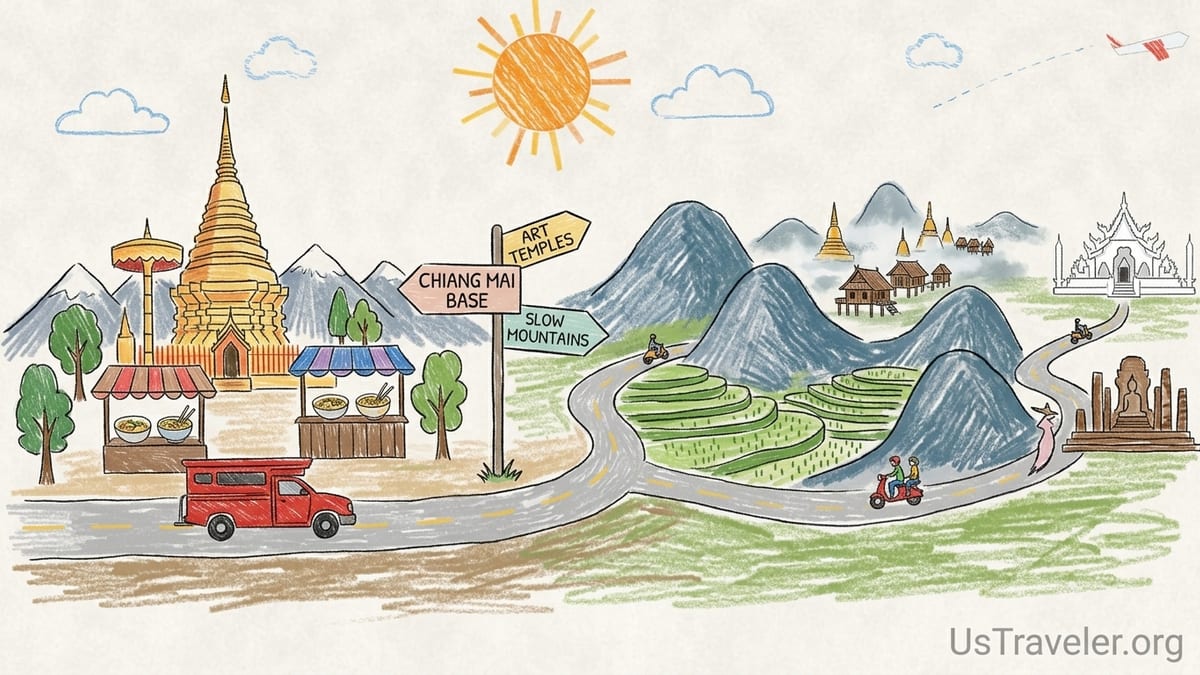
How To Choose Your Northern Thailand Base (And Where You Need Several Nights)
If your goal is temples and food with easy logistics, Chiang Mai is the strongest base and the most flexible starting point. But once you add mountain scenery, trekking, and slower travel days, it pays to treat Pai and Mae Hong Son as genuine destinations with their own rhythms, not as scenic stops you squeeze between minivan rides. The difference shows up in the simplest moments: waking up to fog in a valley, having time for a slow market breakfast, or catching golden-hour viewpoints without racing a return schedule.
For a first-time route, think in “clusters.” Chiang Mai anchors the central cluster (old city temples, Doi Suthep, day trips). Chiang Rai is its own cluster (art-temples and hill-country scenery) and is more satisfying with at least two nights rather than a single long day. Pai and Mae Hong Son form the slow mountain cluster, where the best travel is often unplanned and weather-dependent, and where staying multiple nights prevents the road from becoming the whole story.
Nan is the cultural slow-travel outlier: fewer crowds, striking murals, and a gentle pace that is hard to replicate elsewhere. Sukhothai is the historical anchor, best experienced with time on-site so you can explore the park early and late, when the light is softer and the temperatures are kinder. Lampang and Chiang Dao are “high-value short stays” that can be paired with Chiang Mai or used as stepping-stones if you want to break up overland travel without turning them into box-ticking stops.
Chiang Mai: Best For Food, Classic Temples, Craft Culture, And Easy Day Trips
Chiang Mai’s strength is variety within short distances: Lanna temples inside the old city, mountain viewpoints just outside town, and a dining scene that ranges from street bowls to polished restaurants. For temple-hopping, the old city is the practical starting grid: you can walk between several major wats, then switch to a quick ride when you want to jump to a specific neighborhood for dinner or a night market. If you only have a few days in the North, Chiang Mai gives you the most “range” per day.
For a concrete temple day that doesn’t feel like a checklist, pair a morning in the old city with an afternoon on the mountain. Wat Phra That Doi Suthep is the famous pilgrimage site above the city, and published visitor guidance commonly lists the terrace admission for foreign visitors at 30 baht, with the funicular often quoted at 20 baht. Hours vary by source, but you’ll typically see it described as open daily and accessible from early morning into the evening, which matters if you want to avoid midday tour crowds and heat. If you go late afternoon, aim to arrive with enough time to walk the terrace calmly before sunset traffic builds on the road back down.
Chiang Mai is also the easiest place in this guide to book practical experiences without overplanning. You can build a food day around a cooking class (many include market shopping), then end at the Sunday walking street near Tha Phae Gate, which is widely described as a Sunday evening event. If your travel dates do not line up with Sunday, treat the city as a restaurant destination instead: choose one evening for a serious khao soi hunt, one for grilled northern sausages and sticky rice, and one for a sit-down meal where you can sample nam prik noom and other northern relishes without rushing.
Night-count reality: Chiang Mai can be “done” in two nights if you only want highlights, but it is at its best with three or four nights because it is the easiest place to recover from transit days, do laundry, book a trek, and still have a relaxed temple morning. If you plan to add Chiang Dao, Lampang, or a multi-day trek, Chiang Mai becomes a base you return to rather than a place you race through once.
Chiang Rai: Best For Art-Temples, Contemporary Design, And A Different Kind Of Culture Day
Chiang Rai is the North’s most distinctive destination for temple-style art rather than purely historical architecture. If Chiang Mai is about variety, Chiang Rai is about a few powerful, specific visits that feel unlike anywhere else in Thailand. The city’s headline is Wat Rong Khun, better known as the White Temple, a contemporary, privately created art-temple that uses Buddhist imagery in a modern, sometimes surreal way. Recent travel guides commonly list an entrance fee of 200 baht for foreign visitors, and most sources describe daytime opening hours with last entry in the late afternoon, so plan this visit earlier than you think you need.
For a second major stop that contrasts strongly with the White Temple’s stark palette, Wat Rong Suea Ten, often called the Blue Temple, leans into saturated blues and golds and is widely described as a modern Chiang Rai landmark. Entry fee reporting is inconsistent across publishers, so treat the “price” as something to confirm at the gate rather than a promise in your budget. What is consistent is the best strategy: arrive early in the morning or later in the afternoon, when day tours thin out and you can actually appreciate the interior colors without shoulder-to-shoulder crowds.
Chiang Rai works best when you don’t treat it as a single “temple loop” day trip from Chiang Mai. The distance and the pacing matter. If you do it as a day trip, you’ll spend much of your day in transit and arrive at the most photogenic sites at their busiest. With two nights, you can split your major sites across two mornings, leave afternoons open for coffee, museums, or a riverside walk, and you can time temple visits for light instead of for minivan schedules.
Night-count reality: plan two nights minimum if art and architecture are priorities. Three nights is ideal if you want to add countryside stops, linger over meals, or include slower cultural visits without compressing everything into one rushed loop.
Pai: Best For Slow Travel, Cafes, Easy Nature Days, And A Night Market You’ll Actually Use
Pai is not a “Chiang Mai excursion.” It is its own travel mood: small-town evenings, easy scooter days, hot springs and viewpoints, and a social scene that can be as mellow or as lively as you choose. The road in is famously curvy, and that alone is a reason to give Pai enough nights that the transit day does not swallow the destination. If you arrive in the afternoon, check in, grab a simple dinner, and then decide what you want your first full day to look like.
Pai’s most practical anchor is Pai Walking Street, an evening market area in the center of town that multiple 2026-updated guides describe as operating nightly around 18:00 to 22:00. That matters because it makes Pai easy: you can spend daylight hours out in the valley, then return for an informal dinner built from small bites. Prices at walking streets can change stall by stall and season by season, so instead of promising fixed numbers, budget the way seasoned travelers do: arrive with cash, expect to graze, and treat your first lap as research before you commit to a full meal.
For scenery, Pai is strongest when you travel like you are in a rural area, not a city. That can mean a relaxed loop of short drives and stops rather than one grand attraction. If you rent a scooter, build in extra time and caution, especially if you are not experienced on mountain roads. If you are not comfortable riding, it’s still easy to have a “nature day” by hiring a driver for a half-day, which often ends up being cheaper than you think when split between two or three travelers.
Night-count reality: two nights is the minimum to make Pai feel like a place, not a bus stop. Three nights is the sweet spot for most travelers because it gives you two full days for nature and a buffer for weather. If you want to do nothing but read, wander, and eat, Pai can easily take four nights without feeling repetitive.
Mae Hong Son: Best For Mountain Calm, Viewpoints, And A Slower Northern Thailand You Don’t Get In Chiang Mai
Mae Hong Son has a different kind of appeal than Pai. If Pai is sociable and cafe-driven, Mae Hong Son is quieter, shaped by its valley setting and its pace. This is where you come to slow down and let the landscape do the work. Treat it as a destination where you wake early for fog, move slowly through the day, and plan your most “photogenic” stop for late afternoon or sunset.
Wat Phra That Doi Kong Mu is the signature viewpoint temple above town, known for wide valley views and a strong sunrise and sunset feel. Recent visitor guides describe it as open daily and emphasize that access is straightforward by vehicle, with the option to walk up via a long staircase if you want the exercise. In practice, the best real-world move is simple: go once for late afternoon light, then go again early if the weather looks promising for morning mist.
Mae Hong Son also works well as a base for nearby day trips without feeling like you are constantly packing up. That is exactly why it deserves multiple nights: you can spend one day exploring town and viewpoints, one day doing a countryside loop or cultural visits, and still have an unplanned day for a lake walk, coffee, or a longer dinner. If you arrive and immediately leave the next morning, you will mostly remember the road, not the place.
Night-count reality: plan two or three nights. Two nights gives you one full day plus two golden-hour windows. Three nights makes it feel like a true reset and gives you flexibility if weather turns.
Chiang Dao And Lampang: Best For Limestone Mountains And Old-School Lanna Architecture (Without The Crowds)
Chiang Dao is the easiest “big nature” add-on from Chiang Mai. Its signature is limestone landscape and a more rural, rice-field feel that you can experience quickly, but that is still worth lingering over if you like quiet mornings. Wat Tham Chiang Dao, the cave temple, is a classic northern experience: humid air, incense, dim light, and shrines embedded in natural caverns. Recent local reporting describes it as generally open daily around standard daytime hours, with the practical caveat that hours can shift during temple activity or heavy rain, which is exactly the kind of detail that makes it smart to avoid arriving at the very end of the day.
Chiang Dao is also a strong pick for trekking and mountain scenery, especially if you are the kind of traveler who wants a lodge-style stay, an early breakfast, and a day outdoors rather than a shopping and nightlife schedule. If you want to combine it with Chiang Mai, one night is the minimum that feels worthwhile; two nights turns it into a real countryside break with time for a slow morning and an unrushed cave visit.
Lampang is the sleeper choice in this guide. Many travelers pass through, but if you care about traditional Lanna architecture and a more local-feeling town day, Lampang is one of the most rewarding short stays in the North. Wat Phra That Lampang Luang is the must, a walled temple complex outside town that is widely cited as one of the region’s important Lanna temples. Entry fee reporting differs by publisher, so treat the cost as something to confirm at the gate, but plan your visit around daylight hours, modest dress, and time to walk the compound slowly, because the beauty is in the woodwork, the proportions, and the calm.
Night-count reality: Chiang Dao is best with one to two nights. Lampang can be a strong one-night stop if you time it well, or two nights if you want to add a second temple morning and a slower town day without rushing onward.
Nan And Sukhothai: Best For Artful Culture Days And Thailand’s Most Digestible Ancient History
Nan is one of the North’s best destinations for travelers who want culture without the intensity of Chiang Mai crowds. The star stop is Wat Phumin, famous for its interior murals, including the well-known “Whispering Lovers” image that has become a symbol of Nan. Tourist authority materials and updated guides commonly describe it as open daily from morning into early evening, which makes it easy to visit twice: once quickly to get your bearings, then again at a quieter time to actually study the murals.
Nan’s appeal is not just one temple. It is the feeling of moving through a smaller provincial capital where the old-town core is navigable and the days can be structured around a few meaningful visits, long lunches, and early nights. It is also a strong destination for travelers who want “slower travel” without needing to book multi-day treks. If you are the kind of traveler who buys a local coffee, walks a few blocks, sits down again, and repeats, Nan will feel like a gift.
Sukhothai, meanwhile, is the strongest destination in this guide for historical sites, and it is best done with time on the ground. The Sukhothai Historical Park is operated in zones with separate fees, and official Fine Arts Department information lists 100 baht for foreign visitors per zone, plus separate vehicle entry charges such as 10 baht for a bicycle if you bring one into the area. Official hours are also spelled out by day type, with later Saturday hours and evening lighting, which is a practical detail if you want to see ruins at dusk without guessing whether the park will still be open.
Night-count reality: Nan deserves at least two nights if you want the murals and old-town atmosphere to land. Sukhothai is best with two nights because it lets you visit the park early and late, when the experience is calmer and you can cover more ground without midday heat. One-night Sukhothai is possible, but it often turns into a rushed loop rather than a memorable history day.
The Takeaway
If you want the strongest all-round base, start with Chiang Mai. If you want temples as contemporary art, go to Chiang Rai and stay long enough to time visits for light and crowd levels. If you want slower travel and easy nature days, commit real nights to Pai, then keep going to Mae Hong Son for a quieter, more restorative mountain town that rewards sunrise and sunset pacing. Add Chiang Dao for limestone scenery and cave-temple atmosphere, and Lampang for classic Lanna architecture without the big-city feel. Choose Nan when you want mural-rich culture at a gentler speed, and finish in Sukhothai when you want Thailand’s history in a form you can walk, cycle, and understand without needing a specialist guide.
The best Northern Thailand itineraries are the ones that admit a simple truth: transit days are real days. Treat Pai and Mae Hong Son as destinations, give Chiang Rai more than a rushed day trip, and you will spend more time in temples, markets, mountains, and ruins, and less time staring at road curves and departure boards.
FAQ
Q1. How many nights should I plan for Chiang Mai if it’s my first trip to Northern Thailand?
Three to four nights works well for a first visit, giving you time for old-city temples, Doi Suthep, and at least one day trip without rushing.
Q2. Is Chiang Rai worth staying overnight, or can I do it as a day trip from Chiang Mai?
It is possible as a long day trip, but two nights is a better experience so you can visit Wat Rong Khun and the Blue Temple at calmer times.
Q3. What is the current entrance fee for the White Temple (Wat Rong Khun) in Chiang Rai?
Recent 2026 travel guides commonly list 200 baht for foreign visitors, but you should still confirm at the ticket counter when you arrive.
Q4. What are the typical hours for Pai Walking Street?
Multiple 2026-updated guides describe it as operating nightly roughly from 18:00 to 22:00, with the busiest evenings usually closer to the weekend.
Q5. How many nights do I need in Pai to make it feel worthwhile?
Two nights is the minimum. Three nights is the sweet spot for most travelers because it gives you two full days for nature and a slower pace.
Q6. What’s the must-do viewpoint temple in Mae Hong Son?
Wat Phra That Doi Kong Mu is the classic viewpoint above town, popular for sunrise and sunset valley views.
Q7. Is Chiang Dao a day trip, or should I stay overnight?
You can do a long day trip, but one night makes a big difference, especially if you want a quiet morning and time for the Chiang Dao cave-temple.
Q8. Why should I consider Lampang if I’m already visiting Chiang Mai?
Lampang is excellent for traditional Lanna architecture and a calmer town feel, with Wat Phra That Lampang Luang as a standout temple complex.
Q9. What is Wat Phumin in Nan famous for?
Wat Phumin is known for its interior murals, especially the “Whispering Lovers” image, and for being an essential cultural stop in Nan’s old town.
Q10. How much is entry to Sukhothai Historical Park and how is it ticketed?
Official Fine Arts Department information lists 100 baht for foreign visitors per zone, with separate vehicle fees such as 10 baht for bicycles, so costs depend on which zones you enter.