


Trying to choose one “base” in Northern Thailand can feel impossible because Chiang Mai, Chiang Rai, and Pai are close enough to combine, but different enough that your whole trip can change depending on where you sleep. Chiang Mai is the full-service hub with the easiest logistics and the widest mix of experiences. Chiang Rai is the temple-and-art heavyweight with quick access to the Golden Triangle and tea country. Pai is the smaller mountain town where your days revolve around viewpoints, waterfalls, and unhurried evenings. If you’re deciding where to anchor your itinerary, this comparison breaks down what each place does best in real traveler terms: what you’ll see, what it costs in practice, how you’ll get around, and how long you should stay.
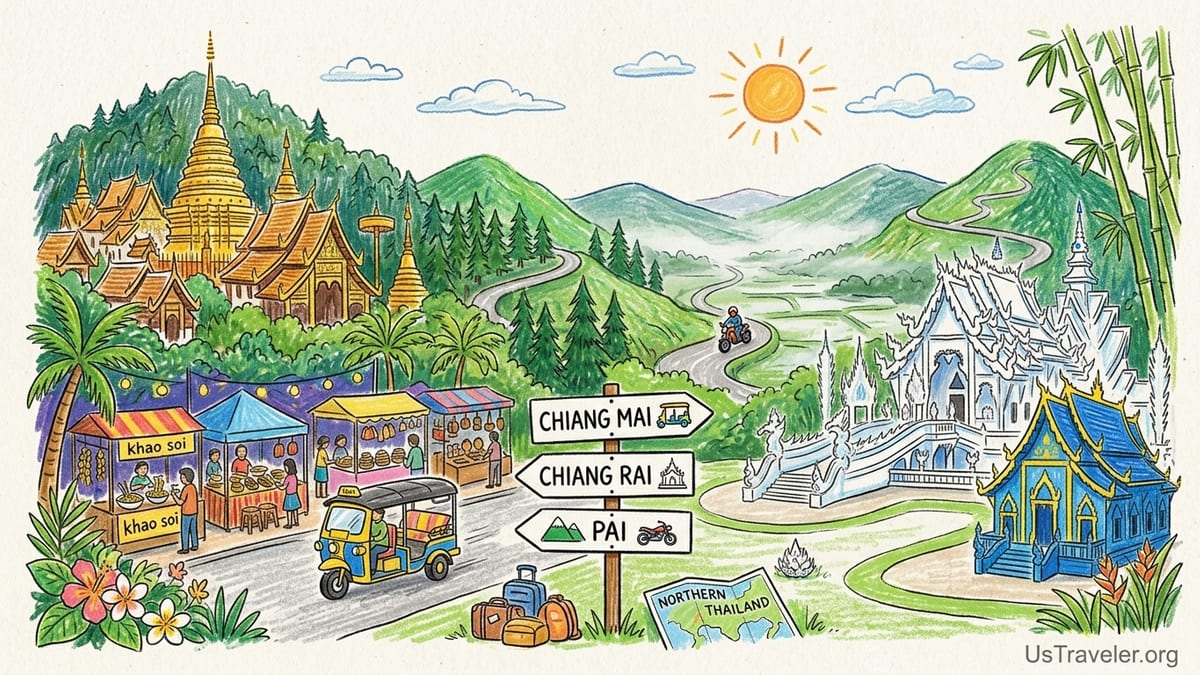
At a glance: who should base where
If you want the easiest Northern Thailand trip to plan, Chiang Mai is the default base. It has the biggest accommodation and restaurant range, the most tour operators, and the most forgiving transport options if you change plans mid-trip. It’s also the place where a “bad” weather day is still salvageable: you can pivot to cafés in Nimman, massage shops, galleries, night markets, or a cooking class without wasting the day.
Chiang Rai makes the most sense when your must-sees are specific: Wat Rong Khun (the White Temple), Wat Rong Suea Ten (the Blue Temple), Baan Dam (the Black House), and day trips that point north and east toward the Golden Triangle and hill-country tea landscapes. It’s quieter at night than Chiang Mai, and it rewards travelers who like early mornings, museums, and scenic drives.
Pai is the right base when your goal is to slow down. It’s not a “checklist” destination; it’s a mood. Travelers base here for the valley scenery, sunrise mist viewpoints, waterfalls, hot springs, and a walkable evening scene that doesn’t demand late nights. The tradeoff is logistics: getting to Pai is a commitment because the road is famously curvy, and day-tripping out to the bigger sights in Chiang Mai or Chiang Rai is rarely practical.
Temples, art, and cultural sights: where the icons are
Chiang Mai wins for breadth and layering. The Old City gives you a dense cluster of historic temples within the moat, plus easy add-ons like Doi Suthep for the classic mountain-top temple view. If you like to wander, Chiang Mai is the kind of place where you can pop into a temple courtyard, then step out into a coffee shop, then drift into a market, all within one afternoon.
Chiang Rai is the concentrated, high-impact option, especially for travelers who prioritize contemporary temple art and bold visuals. The White Temple is the headline act, and in 2026 foreigners typically pay an entrance fee in the range of about 200 THB for the main area. The Blue Temple is usually free to enter and commonly keeps long visiting hours (often around 7:00 a.m. to 8:00 p.m.), so it’s easy to fit in at the edges of the day when tour crowds thin out. Add the Black House for another perspective on northern Thai art, and you can fill a full day with temples that feel completely different from each other.
Pai’s temple scene is not the reason most travelers come. You’ll find small local temples and a more rural, everyday feel, but Pai’s cultural “must-do” is less about monumental architecture and more about experiencing a smaller-town rhythm: sunset at Pai Canyon, an evening wandering the walking street, and slow mornings where the landscape is the main attraction.
Mountains and scenery: the kind of nature you’ll actually see
Chiang Mai is the best base if you want variety in nature without sacrificing comfort. You can have mountain scenery on a day trip and still be back for dinner in the city. This is where travelers often book the big-name day excursions: national park lookouts, waterfalls, and countryside drives that start early and return by evening, with hotel pickup and enough operator choice to suit different budgets.
Chiang Rai’s scenery is cooler in tone and often feels more “edge of Thailand,” especially when you push out of the city center toward borderland views, tea hills, and highland viewpoints. It’s a strong base for travelers who like scenic road days, especially when the plan is to pair temples with landscapes rather than choose one or the other.
Pai is the mountain-town experience, full stop. You’re in a valley, and the scenery is not an “activity” you schedule; it’s what surrounds your entire day. The best moments in Pai tend to be the simplest: an early ride out for misty viewpoints, a waterfall stop after lunch, then cruising back before dark. The atmosphere rewards travelers who rent a scooter and enjoy short, frequent nature breaks rather than one major all-day tour.
Food, coffee culture, and night markets: what your evenings look like
Chiang Mai is the clear winner for food range and convenience. It’s where you can eat northern Thai classics like khao soi and sai ua sausage cheaply, then follow it with third-wave coffee, international restaurants, and dessert cafés without thinking too hard about logistics. If your trip includes a “we’ll decide dinner at 7 p.m.” mindset, Chiang Mai handles that effortlessly.
Chiang Rai’s food scene is smaller but still satisfying, with a strong night market culture and plenty of northern flavors. The difference is choice density: you can absolutely eat well, but you don’t have the same block-by-block variety as Chiang Mai. For many travelers, that’s a plus because it keeps days simpler and quieter.
Pai’s food scene is part of the small-town charm: cafés with mountain views, simple Thai eateries, and a walking street that turns dinner into a casual stroll. It’s not the place you go for endless options; it’s the place where you find two or three favorites, then happily repeat. If you’re the type who wants a new “must-try” restaurant every night, Pai can feel limited after a few days.
One concrete example of how Chiang Mai’s market culture supports a base: the Sunday Walking Street along Ratchadamnoen Road typically runs from late afternoon into late evening, starting near Tha Phae Gate and stretching through the Old City, with temple courtyards functioning as food courts. If your schedule lands you in Chiang Mai on a Sunday, it can replace dinner plans entirely and still feel like sightseeing.
Nightlife and atmosphere: late nights, quiet nights, and everything in between
Chiang Mai has the widest nightlife spectrum. You can do night bazaars and street food, craft beer bars, live music, cocktail lounges, and late-night snacks, especially around the Old City and Nimman. It’s also the easiest place to find your own pace: you can party, or you can keep it low-key, and both choices feel normal.
Chiang Rai is more subdued. Evenings tend to revolve around the night market area and low-key bars rather than big nights out. Travelers who like early starts for temples and road trips often prefer this rhythm because it matches the pace of sightseeing and the quieter, smaller-city feel.
Pai is small but social. The nightlife is more “backpacker-friendly hangout” than big-city bar hopping, and it clusters around the walking street. If you want a place where it’s easy to meet other travelers without committing to a club scene, Pai is strong. If you want a nightlife scene with lots of distinct neighborhoods and venues, Chiang Mai is the better base.
Hotels, budgets, and where to stay: what you get for your money
Chiang Mai has the broadest range of accommodation, from budget guesthouses to high-end resorts, and that range matters in practical ways. If you’re traveling in peak season and want a specific style, like a boutique stay inside the Old City walls or a modern condo-style hotel near the cafés of Nimman, Chiang Mai gives you more real options without overpaying.
Chiang Rai generally feels like better value for quieter stays, especially if you want a calmer hotel environment after a day of temple hopping. Many travelers like basing near the center for easy access to the night market and clock tower area, then using rides or a driver for the White and Blue Temples since they’re not all in one walkable cluster.
Pai’s accommodation is part of the destination: simple bungalows, guesthouses, and small resorts where the view is the selling point. The sweet spot is often a stay close enough to town to walk to the evening walking street, but far enough out that mornings feel rural. If you’re sensitive to noise, ask specifically about distance from the main walking street lanes, because Pai can be lively in a small radius at night.
Day trips, transport, and trip length: how far you can realistically roam
Chiang Mai is the strongest base for day trips because of pure infrastructure. It’s the easiest place to book tours, hire a driver, arrange onward transport, and recover if plans change. It’s also the most flexible for mixed groups where not everyone wants to ride a scooter or handle long road days.
Chiang Mai to Chiang Rai is one of the most common add-on routes, and in 2026 the standard option is a coach service that typically takes around 3 to 3.5 hours in good conditions, with multiple departures daily from Chiang Mai’s Arcade Bus Terminal (Terminal 3). Walk-up express tickets are often in the rough range of the mid-200s THB, while VIP seating can cost more depending on class and booking channel. This makes Chiang Rai a very realistic 2-night side trip from a Chiang Mai base.
Chiang Mai to Pai is shorter in distance but feels longer because of the mountain road. Shared minivans commonly take about 3 to 3.5 hours with a rest stop, and typical prices are often quoted in the rough range of about 150 to 260 THB per seat depending on where and how you book. The road is famous for its 762 curves, which is exactly why Pai feels like a different world, but it’s also why Pai is better as an overnight base than a rushed day trip.
So how long should you stay? If you have 3 to 5 nights total in the north, base in Chiang Mai and do one side trip at most. If you have 7 to 10 nights, you can do the classic split: Chiang Mai as the anchor, plus 2 to 3 nights in Pai or Chiang Rai depending on whether you prefer mountains or temples. If you have two weeks, it becomes less about “which is better” and more about building a rhythm, starting with Chiang Mai logistics, then slowing down in Pai, then finishing with Chiang Rai’s temple circuit and borderland day trips.
The Takeaway
If you want the most reliable base with the widest mix of temples, food, hotels, and day-trip infrastructure, choose Chiang Mai. It’s the place that absorbs last-minute changes, supports every budget, and gives you enough variety that you can fill a week without repeating the same kind of day.
If your priority is temple-and-art sightseeing and you like quieter evenings, choose Chiang Rai. It’s the best base when the White Temple, Blue Temple, and Golden Triangle region are the actual point of the trip, not just an add-on.
If your priority is a smaller mountain-town atmosphere with slow mornings, waterfalls, viewpoints, and easy social evenings, choose Pai. Pai is where you go to feel Northern Thailand rather than “do” it, but you should base there only if you’re comfortable with the winding road and the smaller set of activities.
The most travel-realistic answer is also the simplest: for first-timers, base in Chiang Mai, then add Pai or Chiang Rai when you know what you want more of after a couple of days. Northern Thailand is close enough to combine, but different enough that choosing the right base makes the whole trip feel tailored.
FAQ
Q1. If I can only pick one base, which is the safest choice?
Chiang Mai, because it has the most transport options, tours, restaurants, and accommodation variety, plus easy side trips to both Pai and Chiang Rai.
Q2. Which base is best for temple lovers who want the most iconic photos?
Chiang Rai, thanks to the White Temple and Blue Temple, plus nearby art-focused sights like the Black House.
Q3. Which base feels most like a mountain escape rather than a city?
Pai, because you’re already in the valley landscape, and the daily routine naturally becomes viewpoints, waterfalls, and slow café breaks.
Q4. Can I day-trip to Pai from Chiang Mai?
It’s technically possible but rarely enjoyable. The drive is about 3 to 3.5 hours each way on a very curvy road, so Pai is better as an overnight stay.
Q5. Can I day-trip to Chiang Rai from Chiang Mai?
It’s possible but long. Many travelers prefer 1 to 2 nights in Chiang Rai because the bus ride is typically around 3 to 3.5 hours each way before sightseeing time.
Q6. Which place has the best night markets?
Chiang Mai, especially if you’re there on a Sunday for the large walking street market through the Old City, plus nightly market options on other evenings.
Q7. Which base is best if I don’t want to rent a scooter?
Chiang Mai, because it’s easiest to use ride-hailing and local transport for most activities, while Pai is much more convenient with a scooter.
Q8. Which base is best for digital nomads and work-friendly cafés?
Chiang Mai, because it has the deepest café culture and the most coworking-friendly neighborhoods, particularly around Nimman.
Q9. How many nights should I plan in each place on a 9-night North Thailand trip?
A common split is 4 to 5 nights in Chiang Mai, plus 2 to 3 nights in Pai or Chiang Rai, then 1 to 2 nights in the remaining destination if you want all three.
Q10. What’s the biggest mistake travelers make when choosing a base?
Underestimating logistics: choosing Pai as a base while expecting big day trips, or choosing Chiang Rai expecting Chiang Mai-level nightlife and café variety.