


Northern Thailand rewards travelers who think in routes, not regions. Instead of trying to “do the north” as one giant loop, this guide breaks the self-drive experience into two commercial, real-world road trips that fit actual roads, real driving times, and how people really book hotels: (1) a straightforward Chiang Mai to Chiang Rai drive that works even for first-time Thailand drivers, and (2) the signature Mae Hong Son Loop, the roughly 600-kilometer mountain circuit that dominates 2026 road-trip search results for one reason: it feels like a true adventure, but it is still doable with a sensible plan and the right vehicle.
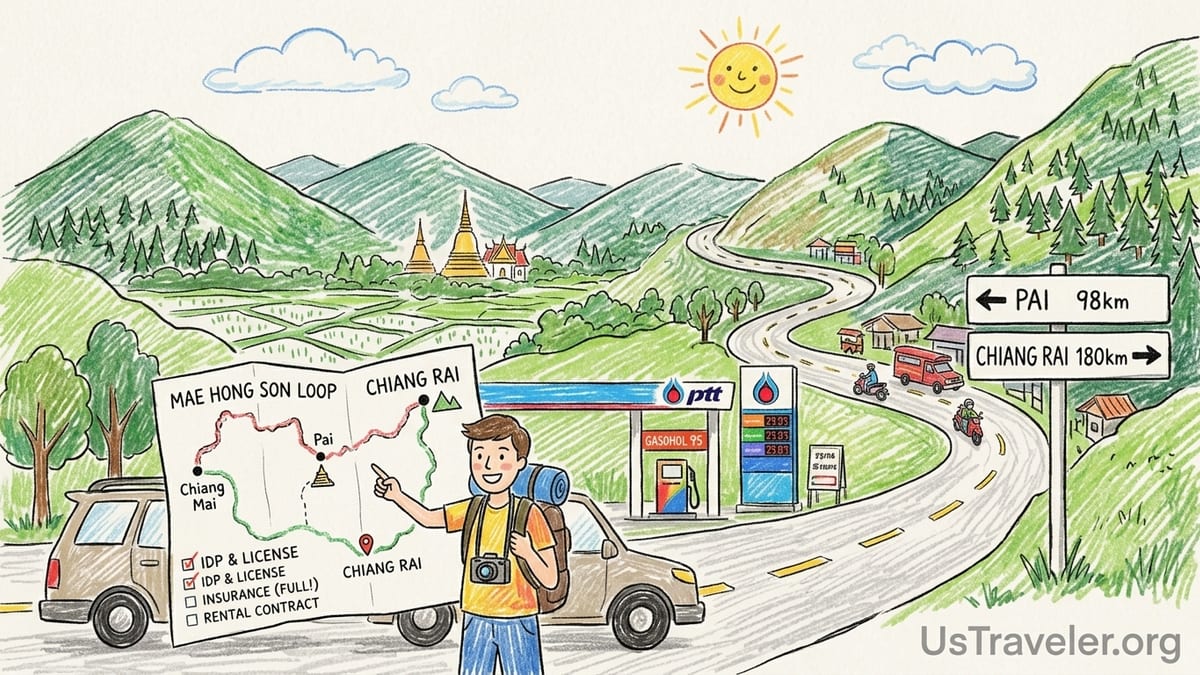
Before You Go: Licenses, rentals, insurance, and what “full coverage” really means
If you plan to drive in Thailand, arrive with a valid International Driving Permit (IDP) issued under the 1949 Geneva Convention, plus your home license and passport. Thailand’s official guidance for foreign tourists emphasizes the IDP route for visitors who want to drive legally, and it remains the simplest option for a short trip because it is designed to match your existing license class.
For car rentals, Chiang Mai International Airport is the most practical pickup point for international travelers because it concentrates major brands and standardized contracts. Big-chain desks at the airport typically spell out liability clearly and offer optional add-ons that reduce your excess. As one concrete example of what “excess” looks like in practice, Avis notes that if you purchase its Collision Damage Waiver and Theft Protection locally, renter liability is reduced to a band that depends on the vehicle group, commonly around 8,000 to 15,000 baht. In the real world, that difference matters on mountain roads where a low-speed scrape on a concrete barrier can become an expensive story.
Do not assume “full insurance” is universal with local street-corner rentals. Travelers regularly report that smaller Old City agencies may not offer windshield and tire coverage or may be unclear about damage exceptions, which is why many cautious drivers choose airport operators for a road trip. If your plan includes the Mae Hong Son Loop, consider insurance and roadside support as part of the route budget, not an optional extra.
Fuel, phone signal, and the daily driving rhythm (with real price examples)
Fuel planning in Northern Thailand is not complicated, but it should be intentional. Thailand’s official Energy Policy and Planning Office publishes daily retail prices, and on September 15, 2026, typical pump-board pricing around Bangkok and major brands showed Gasohol 95 at about 39.09 baht per liter, while premium “Gasoline 95” sat closer to the high-40s baht per liter range (for example, 48.08 baht per liter at some brands). On a route like the Mae Hong Son Loop, that spread can change your total spend enough to matter if you habitually grab premium fuel without needing it.
In practice, most rental sedans and small SUVs in Thailand are happy on Gasohol 95 (E10) or E20 if the manufacturer permits it, but confirm the fuel door sticker and the rental agreement. The safer traveler habit is simple: refuel when your tank drops to roughly half before long mountain stretches, and top up again when you reach your overnight town. In Pai and Mae Hong Son town you will find major stations, but the point of the loop is the in-between, where your best stop might be the next PTT you pass, not the one you hope to find later.
Build your days around daylight. Mountain roads are far less stressful when you can read the curve and see the shoulder condition. A realistic rhythm for these routes is: drive 2 to 3 hours in the morning, stop for a proper lunch and a viewpoint or short walk, then do another 1.5 to 2.5 hours into your hotel before dark. This pacing also reduces motion sickness, because it limits long, uninterrupted twisty sections.
Route 1: Chiang Mai to Chiang Rai (Highway 118), built for freedom without overreach
This is the “easy win” northern road trip: one main highway, plenty of services, and the kind of flexibility that makes renting a car worth it. The core drive runs Chiang Mai to Chiang Rai primarily via Highway 118. It is commonly described as roughly 185 to 190 kilometers and about three hours under normal conditions, with the most demanding portion being a mid-route mountain section of sustained climbs and descents rather than tight hairpins. In other words: it is a mountain drive, but it is not the Mae Hong Son Loop.
A practical way to structure it is as a one-night (or two-night) mini road trip rather than a day dash. Leave Chiang Mai after morning traffic, then make a real stop around the Wiang Pa Pao area for coffee and a leg stretch. This is also where travelers sometimes encounter roadwork, so having time slack keeps the day pleasant. By arriving in Chiang Rai mid-afternoon, you can check in, cool down, and visit a major attraction in the softer light instead of rushing in peak heat.
Overnight strategy in Chiang Rai should match what you want to see: staying near the city center helps if you want night markets and restaurants; staying outside the center can make early starts easier for day trips north toward border areas or quieter countryside temples. If you are traveling with family or anyone sensitive to long car days, Chiang Rai works best as a minimum one-night stop, because the payoff is the ability to do short, comfortable drives to sights rather than stacking everything into one exhausting day.
Chiang Rai day-trip planning by car: how to use the wheels you paid for
Driving in Chiang Rai province is where having a car becomes more than convenience. Instead of negotiating multiple tuk-tuk fares or joining a fixed bus tour, you can build a morning around two or three stops that are geographically close, then return to town for an afternoon break. The main advantage is not speed, it is control: if a viewpoint is crowded, you can move on; if a café is perfect, you can linger.
Real-world example: travelers often want the White Temple area and one additional stop, but tour itineraries commonly compress time at each site. With your own car, you can arrive earlier, park, and leave before the bus wave. You can also plan around weather: in the wet season, short intense rain can pass in 30 to 60 minutes, and having a car lets you sit it out without losing the whole day.
If you do not want to drive this route at all, the Chiang Mai to Chiang Rai corridor is one of Northern Thailand’s most developed public-transport links. Current booking platforms and operators typically show frequent coach departures and fares in the low-hundreds of baht range for standard classes. That is a strong indicator for a key decision rule: if your only goal is to get from city to city, a coach is often the better value; rent a car when you want the stops in between and the freedom to roam once you arrive.
Route 2: The Mae Hong Son Loop (Chiang Mai, Pai, Mae Hong Son, Mae Sariang), the signature 600 km circuit
The Mae Hong Son Loop is Northern Thailand’s headline road trip because it combines real mountain driving with towns that function as natural overnight breaks. Most travelers treat it as a multi-day circuit from Chiang Mai through Pai, onward to Mae Hong Son, down to Mae Sariang, and back to Chiang Mai. In 2026, search results heavily frame it as the region’s defining self-drive route, and that framing is accurate as long as you respect the road and plan your days realistically.
The drive into Pai is the section that defines the loop’s reputation. The road is famous for relentless curves and a rhythm of climbs and descents that can trigger motion sickness even in travelers who do fine elsewhere. The key is to plan your day around it. Start with a light breakfast, keep water within reach, and avoid reading on your phone. If you know you are sensitive, pack motion-sickness medication you have used before, and sit in the front passenger seat if you are not driving.
Overnight planning is what makes the loop feel effortless. A common, sensible structure is three overnight stops: Pai, then Mae Hong Son town, then Mae Sariang. That breaks the circuit into manageable drives and gives you time to actually experience each place. Two nights is possible, but it tends to turn into long days in the car. Four nights is ideal if you want short days, hot springs, viewpoints, and café time without the feeling of constantly checking out of hotels.
Mountain-road realities: carsick passengers, passing etiquette, and when a driver or minivan is smarter
On the Mae Hong Son Loop, the biggest risk is not a single dramatic hazard, it is cumulative fatigue. Curves demand attention, and some sections have steep drop-offs, narrow shoulders, and local traffic that knows the road far better than visitors. The safest strategy is conservative: do not “chase” faster drivers, let pickups and locals pass when safe, and use pull-offs to reset your focus. If you are used to right-hand driving, remember Thailand is left-hand traffic, which adds mental load on the first day.
Motion sickness deserves special planning because it can ruin the loop for a whole group. In real terms, the Pai road is the kind of route where one unwell passenger can force unplanned stops every 10 to 15 minutes. If you are traveling with kids, pregnant travelers, or anyone with a history of nausea in the mountains, the most comfortable choice is often to hire a driver and travel in a minivan. A skilled local driver smooths braking and acceleration, holds a steady line through bends, and reduces the stop-start pattern that makes nausea worse.
Public transport offers a middle option: Prempracha Transport publishes current timetables and fares for key loop towns, with frequent daytime departures between Chiang Mai and Pai (for example, multiple departures from morning through late afternoon, with an advertised journey time of about three hours), plus services continuing to Mae Hong Son and Mae Sariang. This is the practical alternative for travelers who want to see the loop towns but do not want to personally drive the curviest segments. You can also mix modes: drive the Chiang Mai to Chiang Rai route yourself, then use minivans or buses for Pai and Mae Hong Son if your group’s comfort demands it.
The Takeaway
The best North Thailand road trip is the one that matches the road. Use the Chiang Mai to Chiang Rai drive for an easy, flexible self-drive experience with one main highway and comfortable services. Treat the Mae Hong Son Loop as a separate, purpose-built mountain circuit where your success comes from pacing, insurance clarity, and choosing the right setup for your group, whether that is a rental car, a hired driver, or a scheduled minivan. In both cases, plan your overnights like anchors, drive in daylight, fuel up early, and remember that Northern Thailand is at its best when you stop often enough to actually see it.
FAQ
Q1. How many days do I need for the Mae Hong Son Loop by car?
Most travelers enjoy it most with 3 nights (Pai, Mae Hong Son, Mae Sariang). Four nights is even more relaxed if you want shorter driving days.
Q2. Is the Chiang Mai to Chiang Rai drive safe for first-time Thailand drivers?
Yes, it is generally considered one of the simpler northern drives because it mainly uses Highway 118, with a mountain section that has sustained grades but not the tight hairpins of the Pai road.
Q3. Do I need a 4WD or SUV for these routes?
For typical conditions, no. A standard automatic sedan is commonly sufficient for the Chiang Mai to Chiang Rai route and for the main Mae Hong Son Loop highways, assuming you drive cautiously and avoid pushing in heavy rain.
Q4. What fuel should I use in a Chiang Mai rental car?
Use whatever the vehicle label and rental agreement specify. Many cars use Gasohol 95 (E10) in Thailand, but confirm at pickup and avoid guessing at the pump.
Q5. How much should I budget for fuel on these trips?
Fuel costs depend on your car and prices that week, but as a real-world reference, Thailand’s official daily retail pricing in mid-September 2026 showed Gasohol 95 around the high-30s baht per liter and premium Gasoline 95 around the high-40s baht per liter range.
Q6. What is the best direction to drive the Mae Hong Son Loop?
Either direction works, but many travelers choose to overnight in Pai early in the trip to break up the curvy section, then continue onward rather than returning the same way.
Q7. How do I reduce motion sickness on the Pai road?
Start early, avoid heavy meals, keep the cabin cool, take breaks at viewpoints, avoid phone reading, and consider proven motion-sickness medication. If someone is highly sensitive, a professional driver in a minivan is often the most comfortable solution.
Q8. Are there buses or minivans if I do not want to drive the loop?
Yes. Operators such as Prempracha Transport publish scheduled services connecting Chiang Mai with Pai, Mae Hong Son, and Mae Sariang, which is a practical alternative to self-driving the curviest segments.
Q9. What documents do I need to drive legally in Thailand as a tourist?
Carry your passport and a valid International Driving Permit (IDP) under the 1949 Geneva Convention along with your home-country license.
Q10. When is it better to hire a driver instead of renting a car?
Hire a driver if your group has strong motion-sickness concerns, you want to avoid night driving and fatigue on mountain roads, or you prefer a local who knows passing zones, curves, and common roadwork slowdowns.