


North Thailand rewards travelers who like to mix early-morning temple calm with highland viewpoints, market dinners, and days spent on mountain roads. Build your trip around Chiang Mai for classic Lanna culture and easy access to national-park scenery, then fan out to Chiang Rai for headline temples and Mekong panoramas, and to Pai and Mae Hong Son for canyon sunsets, hot springs, and some of the most memorable mountain landscapes in the country.
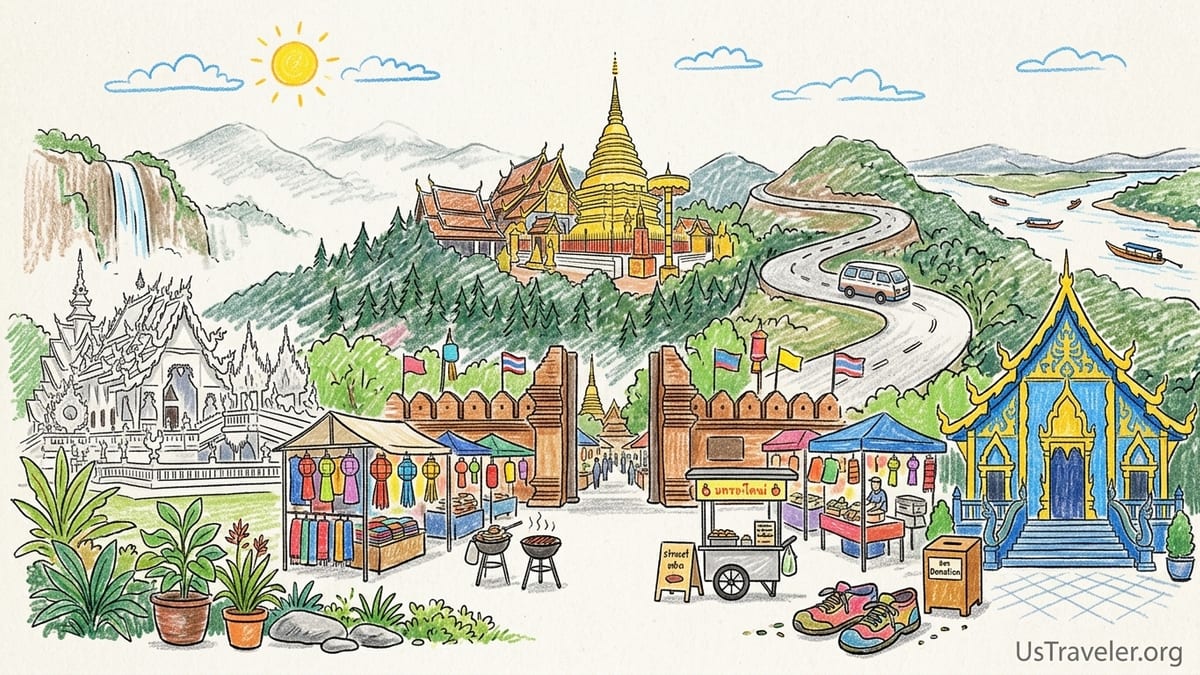
Culture First: Chiang Mai’s Temples, Old City Rituals, And Market Nights
Start in Chiang Mai’s Old City, where temple-hopping is not just sightseeing but a rhythm: quiet courtyards in the morning, shaded museumlike halls at midday, and golden chedis catching the last light before you head to dinner. A practical anchor is Wat Phra That Doi Suthep, the mountain temple about 15 kilometers west of the city. Its gate is open daily from 5 a.m. to 9 p.m., and foreign visitors typically pay 30 baht to access the terrace plus 20 baht for the funicular if you skip the stairs. If you go early, you will likely share the viewpoints with locals making merit rather than tour groups chasing photos.
In the city center, give yourself permission to go slow. It is common to pop into a temple courtyard for five minutes, then emerge onto café streets and small craft shops, then slip back through another temple gate. Dress with respect (covered shoulders and knees) and carry small cash for donation boxes, a real-world detail that keeps the day smooth when you want to enter a hall or take part in small rituals without hunting for an ATM.
Make Chiang Mai’s walking streets your nightly “museum of everyday life.” The best-known is the Sunday Walking Street on Ratchadamnoen Road, running from the Tha Phae Gate area toward Wat Phra Singh. Multiple current visitor guides describe it as operating roughly from late afternoon into late evening, with typical hours around 4 p.m. to 10 to 11 p.m., and many travelers find the most intense crowding hits around 6 to 8 p.m. If your goal is to browse handicrafts and actually stop for snacks, arriving closer to opening time is easier than arriving at peak.
For a slightly different feel, the Saturday Walking Street on Wua Lai Road tends to lean into Chiang Mai’s traditional silversmith identity and feels shorter and more localized. Several up-to-date market guides list typical hours around 4 p.m. to 11 p.m. on Saturdays only. A grounded strategy is to treat Saturday as your “shopping and crafts” night and Sunday as your “street food and people-watching” night, then use weekdays for calmer temple time and day trips.
Mountains And Ecotourism: Doi Inthanon, Cloud Forest Trails, And Waterfalls
Tourism messaging around Chiang Mai consistently highlights its mountain escapes, and Doi Inthanon is the headline day trip for a reason. It is widely presented as Thailand’s highest mountain and one of the most comfortable peaks to visit thanks to paved road access. Plan for a full day if you want to combine viewpoints, short trails, and waterfalls without rushing, and bring a light layer even if Chiang Mai city feels hot, because temperatures can drop noticeably at altitude.
If you want a “real hike” without committing to a multi-day trek, the Kew Mae Pan nature trail inside Doi Inthanon National Park is a strong middle ground. Recent trail guidance notes a defined daily operating window during the open season, with check-in at the trailhead and a first-come approach for guide service, and listed opening times that run from morning into early afternoon. The practical takeaway is to treat this like a timed appointment rather than a casual stroll: arrive earlier in the day, especially in the cool season, and avoid building a late start into your itinerary.
Budgeting matters because national parks in Thailand often have different rates for locals and foreign visitors, and entrance fees are the type of detail that can derail a day if you have the wrong cash expectations. A recent English-language Chiang Mai brochure-style source lists Doi Inthanon entrance fees at 300 baht for adults and 150 baht for children, plus a small vehicle charge. Because fees can change, confirm the exact amount at the gate when you arrive, but plan your cash around that 300-baht baseline so you are not surprised.
Outside the national-park core, Chiang Mai’s mountain culture is also about small villages and viewpoints that feel worlds away from the Old City. Even if you are not doing a full trek, pairing one highland stop with one market night creates the classic North Thailand contrast: mossy forest trails in the day, sizzling skewers and music in the evening.
Chiang Rai’s Iconic Temples, Tea Country Drives, And Mekong Viewpoints
Chiang Rai is where North Thailand’s temple circuit turns contemporary and artistic. The city’s official tourism messaging consistently spotlights major landmarks such as Wat Rong Khun (the White Temple) and Wat Rong Suea Ten (the Blue Temple), which are often paired on the same day by travelers. Treat these as early stops if you want clean photos and less time in lines, then keep a flexible afternoon for tea country and river viewpoints.
The White Temple has had a notable fee change that affects real budgets. Multiple current visitor resources report that the foreign-adult entrance fee is now 200 baht, increased from 100 baht with an effective date widely noted as January 1, 2026. Because this is a privately run attraction rather than a national park gate, it is smart to assume the posted price at the entrance is the only reliable price and to keep small bills ready so you are not stuck breaking a large note.
The Blue Temple, by contrast, is commonly described as free to enter, which makes it easy to pair with other stops without “ticket fatigue.” The experience is less about long explanatory signage and more about soaking up the deep blue and gold interior, then stepping back outside to appreciate the modern temple silhouette against northern skies. It is an ideal late-afternoon stop when the light softens and the colors look especially saturated in photos without feeling over-processed.
Beyond temples, Chiang Rai travel narratives often highlight tea landscapes and high viewpoints. If you are building a day that feels like “temples in the morning, mountains in the afternoon,” you can aim for a tea plantation stop on the way to the Mekong area rather than backtracking, then finish with the river scenery that makes Chiang Rai feel like a borderland province rather than just another northern city.
The Golden Triangle: Borderland Scenery, River Boats, And Museums With Context
The Golden Triangle is best approached as a landscape story rather than a checklist. At Sop Ruak in Chiang Saen district, the Ruak River meets the Mekong, and from the riverside plaza you can look out and see Laos and Myanmar across the water at the same time. The viewpoint area itself is often described as a free public stop, which makes it a useful anchor even if you decide to skip paid museums or boat rides.
A classic add-on is a longtail boat ride that takes you out onto the Mekong for a closer look at the tri-border meeting point. Current guide coverage describes typical tours that may include a brief stop at Don Sao on the Lao side where small stalls sell a mix of goods. Treat this like a short, sightseeing-focused loop rather than a deep cross-border experience, and be mindful that border rules and regional security considerations can change, especially on the Myanmar side.
For travelers who want context beyond the photo-op, the Golden Triangle’s opium museums are frequently recommended as places that explain why the region is famous and how the Mekong trade routes shaped life here. The practical move is to schedule the museums for the hottest part of the day, then return to the riverside for late-afternoon light when haze is lower in the cool season and the view across the water is more cinematic.
If you are choosing between “more temples” and “more river,” the Golden Triangle is the North Thailand experience that feels most geographically distinct. Even travelers who have already done Chiang Mai and Chiang Rai often remember the Mekong confluence scene because it is a rare moment where the map becomes visible in front of you.
Outdoor North Thailand: Pai Canyon Sunsets, Hot Springs Soaks, And The Mae Hong Son Loop
Pai is where North Thailand shifts into a relaxed valley town with big-sky sunsets and quick outdoor hits. The signature viewpoint is Pai Canyon, also known locally as Kong Lan. A current dedicated Pai Canyon guide describes it as a free, community-managed viewpoint, which is a meaningful change if you have old information in your head about paying to enter. The canyon is about 8 kilometers south of Pai town on Route 1095, making it an easy late-afternoon ride or songthaew trip that lines up perfectly with golden hour.
For a recovery day, pair Pai Canyon with a hot-springs soak. Tha Pai Hot Spring is widely treated as the classic option, and recent visitor guidance emphasizes the on-the-ground reality: bring swimwear, a towel, water, and cash for the park fee. One of the most recognizable “real-life” moments here is the small ritual of buying eggs at the entrance and cooking them in the hot channel near the source, an everyday detail that makes the visit feel local rather than purely touristic.
If you want the road trip that ties everything together, the Mae Hong Son Loop is the mountain circuit that starts and ends in Chiang Mai and typically runs through Pai and Mae Hong Son town. Multiple current route guides describe the loop as roughly 600 kilometers, with Route 1095 forming the curvy Chiang Mai to Pai stretch that is famously associated with “762 curves.” This is not a trivial drive on a scooter if you are inexperienced, so the grounded recommendation is to be honest about your riding comfort and choose minivan or private car if the curves would turn your holiday into a white-knuckle endurance test.
Mae Hong Son province delivers the “mountain postcard” version of North Thailand: layered ridgelines, cooler air, and small villages where tea culture and border history blend. A well-known highland stop is Ban Rak Thai, described in recent guides as a Yunnan-influenced tea village by a lake with a history tied to former Kuomintang soldiers who settled in the hills. Even if you do not chase every stop, carving out time for one high-elevation sunrise and one lakeside tea break is the kind of lived-in travel memory that sticks longer than a third temple in a single day.
Food, Cooking Classes, And Cultural Encounters You Can Actually Book Into A Real Trip
North Thailand’s food scene is easiest to understand through markets first, cooking classes second. The walking streets in Chiang Mai are practical “tasting flights” where you can try small portions without committing to full restaurant meals, and you will see how local eating really works: grilled meats, sticky rice, fresh fruit, and desserts sold in grab-and-go portions. If you arrive early and pace yourself, it is realistic to try several small dishes, then still have room for a sit-down dinner afterward.
Cooking classes are the bridge between “I ate something delicious” and “I can recreate the flavor at home.” Chiang Mai is packed with schools offering half-day and full-day experiences, often including a market visit and hands-on cooking stations. Because class prices and inclusions vary by operator and change frequently, the most accurate approach is to book based on what is clearly stated at the time you travel: whether transport is included, whether you choose dishes in advance, and whether the class is hosted at a farm setting or in a city kitchen. If you cannot confirm the exact current price from an official listing, avoid pre-paying far in advance and instead reserve with clear cancellation terms.
Cultural experiences in the North are at their best when they are small and respectful: learning basic temple etiquette, asking before photographing people, and treating hill-tribe crafts as artisan work rather than souvenirs to bargain down to nothing. A simple real-world rule that helps is to set a “fair budget” for handmade items at markets, so you can negotiate lightly without turning every purchase into a tense standoff.
Trekking is the other major way travelers look for cultural immersion, but it is also where quality varies the most. Aim for treks that are clear about route, difficulty, and community benefit, and be wary of vague sales language that promises “authentic villages” without explaining how visits are arranged or how communities are compensated. When in doubt, choose a shorter guided day hike around known nature areas rather than a poorly defined multi-day trek, especially if weather is unstable.
The Takeaway
The best North Thailand itineraries are built like a well-balanced meal: Chiang Mai for temples and walking-street nights, Doi Inthanon for highland ecotourism and forest air, Chiang Rai for iconic White and Blue temple architecture plus tea country, the Golden Triangle for Mekong geography you can see with your own eyes, and Pai and Mae Hong Son for canyon sunsets, hot springs, and mountain road scenery. If you plan your days around light (temples early, viewpoints late), carry cash for the fees you can verify, and leave room for slow market evenings, the region delivers the kind of travel that feels both classic and deeply personal.
FAQ
Q1. How many days do you need for North Thailand’s highlights?
For a first trip that feels unhurried, plan roughly 7 to 10 days so you can base in Chiang Mai, add a Doi Inthanon day, then include Chiang Rai and at least a short Pai or Mae Hong Son stretch.
Q2. What are the best Chiang Mai markets for first-timers?
The Sunday Walking Street on Ratchadamnoen Road is the biggest signature market night, and the Saturday Wua Lai Walking Street is a strong second option with a more crafts-focused feel.
Q3. What time should you arrive at Chiang Mai’s Sunday Walking Street?
Arriving near opening in the late afternoon makes it easier to browse and eat before peak crowds, which many visitors report building heavily around early evening.
Q4. Is Wat Phra That Doi Suthep open early for sunrise visits?
Yes. Recent visitor guidance lists the gate as open daily from 5 a.m. to 9 p.m., which makes sunrise visits possible if you can arrange transport up the mountain.
Q5. How much is the White Temple (Wat Rong Khun) entrance fee now?
Multiple current visitor resources report 200 baht for foreign adults, with the increase widely noted as taking effect on January 1, 2026. Confirm the posted price when you arrive.
Q6. Does the Blue Temple (Wat Rong Suea Ten) charge an entrance fee?
It is commonly described as free to enter, which is one reason travelers pair it with the White Temple on the same day.
Q7. Is Pai Canyon free to visit?
A current Pai Canyon guide describes it as a free, community-managed viewpoint. Plan for sunset, and wear shoes with grip because the red-earth paths can be dusty.
Q8. What is the “762 curves” road in North Thailand?
Route 1095 between Chiang Mai and Pai is widely known for its curves, and many Mae Hong Son Loop itineraries use the same road segment as the first leg.
Q9. What should you bring to Tha Pai Hot Spring?
Bring swimwear, a towel, drinking water, and cash for the park fee. Many visitors also buy eggs at the entrance to cook in the hot channel near the source.
Q10. Is the Golden Triangle worth it if you are not crossing borders?
Yes. Even without any border crossing, the Sop Ruak viewpoint is a distinctive Mekong landscape stop where you can see Laos and Myanmar from Thailand and add a short boat ride for a closer look.