


I arrived in Pai and Mae Hong Son on the same Mae Hong Son Loop trip, slept at least two nights in each town, and tried to ignore both Pai’s reputation as the backpacker darling and Mae Hong Son’s myth as a sleepy frontier backwater. By the time I rolled back into Chiang Mai, my notebook held real prices, room keys from both towns and a very clear favorite for different types of travelers. If you are planning a northern mountain holiday and can only choose one base, the details below come from those nights actually spent on the ground, not from hearsay.
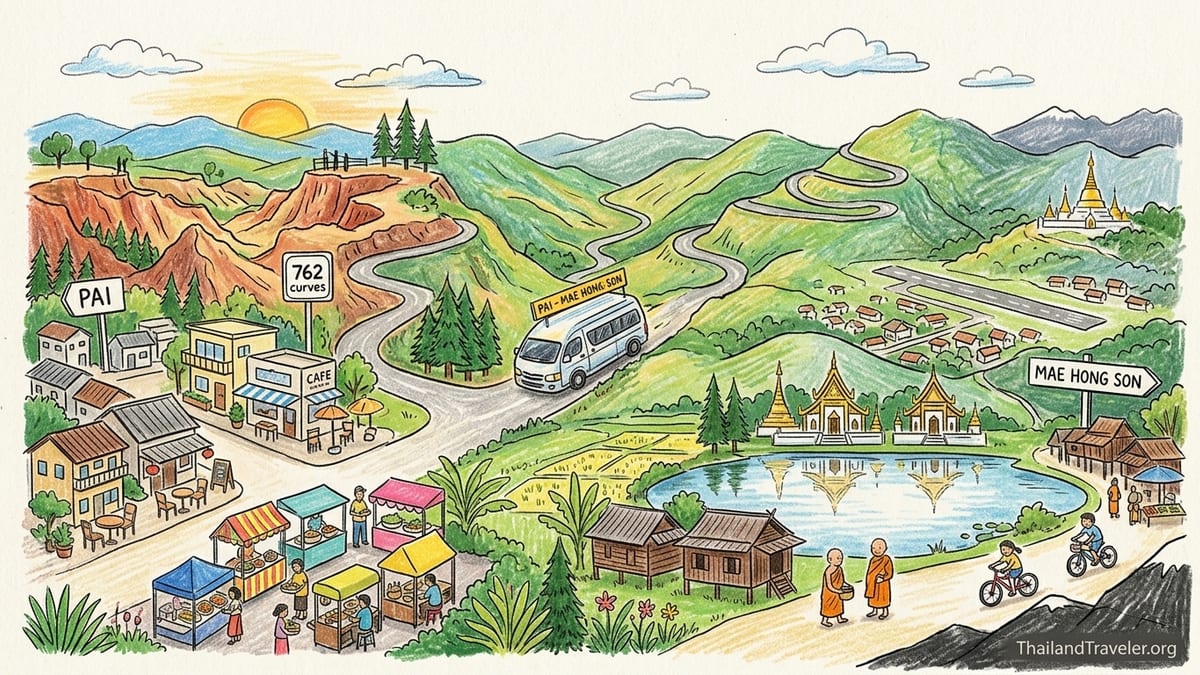
The Journey Between Pai and Mae Hong Son
I traveled between Pai and Mae Hong Son along Highway 1095, the mountain road that links Chiang Mai, Pai, Pang Mapha and Mae Hong Son. It is the same route most travelers use, whether they start in Chiang Mai or are already somewhere on the Mae Hong Son Loop. Minivans remain the most practical option without your own vehicle. From Pai bus station, shared minivans to Mae Hong Son typically take about 2.5 to 3 hours to cover the roughly 110 kilometers, with current fares quoted around 250 to 350 baht per person depending on operator and season. Several local agencies in Pai town sell tickets a day in advance, and my van left close to its scheduled late-morning departure.
The road itself is quieter between Pai and Mae Hong Son than on the Chiang Mai to Pai stretch, but it is still a serious mountain drive with continuous curves. The famous “762 curves” number applies to the full Chiang Mai to Pai itinerary, yet the section onward to Mae Hong Son still packs in many hairpins and long climbs. I found the bends less relentless and traffic lighter than between Chiang Mai and Pai, but passengers prone to motion sickness should still take precautions. I took ginger tablets before boarding, sat in the front row and asked the driver for a short rest stop halfway through, which he agreed to.
Road conditions in late high season were better than the reputation suggests. The surface is mostly paved, with some patched sections where the asphalt has been repaired after rains. There were a few short roadworks where the van slowed to a crawl on gravel, but nothing that felt dangerous. What did stand out was how the forest closes in after Pai; the views shift from farmland and cafes to thick green hills and narrow valleys as you pass Pang Mapha district. We descended into Mae Hong Son with the town, airport runway and Chong Kham lake suddenly visible far below.
On arrival, the van dropped passengers at the Mae Hong Son bus station on the edge of town. From there, I paid a shared songthaew 80 baht to the area around the lake, though fit travelers could walk it in about 15 minutes. Overall, the journey day was tiring but manageable, and for me the extra time spent to reach Mae Hong Son was justified by how different it felt compared with Pai.
First Impressions: Established Pai vs Traditional Mae Hong Son
Arriving in Pai, the shift from Chiang Mai is immediate. The town center is compact, flat and almost entirely dedicated to visitors. Walking Street, the stretch of Chaisongkran Road transformed each evening, is lined with guesthouses, hostels, smoothie stalls, tattoo studios and Western-style cafes. I checked into a midrange guesthouse a few minutes’ walk from the main street and heard live music drifting from bars by late afternoon. Pai feels built around tourism at this point, and while there are Thai families living in town, travelers dominate the center.
Mae Hong Son, by contrast, greeted me with still water and temple spires. The most obvious landmark on arrival is Nong Chong Kham lake, framed by the twin Shan-style temples Wat Chong Kham and Wat Chong Klang. Low-rise wooden houses, a morning market and the modest night market ring its shores. There are guesthouses and small hotels, but they sit alongside local shops, schoolyards and government offices. Walking around my lakeside hotel during the golden hour, I passed monks collecting alms and children cycling along the promenade. English menus existed, yet they did not drown out Thai and Shan on signboards.
The atmosphere difference became clearest after dark. In Pai, Walking Street filled quickly from about 6 pm. Food stalls selling everything from pad thai and khao soi to falafel wraps and vegan brownies lined both sides. Bars pumped out reggae and indie playlists, hostels advertised pub crawls, and tattoo studios stayed busy. Pai after sunset is lively and social, with an unmistakable backpacker energy. In Mae Hong Son, the small walking street along the lake set up its food stalls but never felt crowded. Local families browsed for grilled meats and Shan snacks, and by around 10 pm most stalls were closed and the lake was quiet.
If Pai feels like a mountain resort town fine-tuned for visitors, Mae Hong Son still feels like a small provincial capital that happens to be surrounded by spectacular hills. Neither is inherently better. The choice is between a place where almost every business targets travelers and one where you share the streets with people going about their daily life.
Sleeping in Both Towns: Room-for-Room Comparison
To make a fair comparison, I booked similar midrange double rooms in both towns. In Pai, I stayed in a simple guesthouse on a side street off Walking Street. The air-conditioned room had a queen bed, private bathroom with hot shower, small balcony and reliable Wi-Fi. I paid just under 900 baht per night booked a week ahead in high season. Noise was the main compromise. Even with earplugs I could hear music and motorbikes at night, especially on weekends, although things calmed down after midnight.
In Mae Hong Son, I chose a lakeside hotel directly facing Wat Chong Kham. The room category and facilities were comparable: air conditioning, private bathroom, balcony and Wi-Fi. My nightly rate came to about 1,000 baht booked on short notice, so only slightly more than Pai. The difference was in atmosphere and view. Instead of backing onto another guesthouse courtyard, my balcony looked onto the lake and the illuminated temple chedi reflected in the water. Nights were much quieter, with only the occasional dog barking or motorbike passing the hotel.
Budget travelers will still find cheaper options in both towns. Pai’s outskirts and side streets are full of hostels with dorm beds, shared bathrooms and social common areas, with beds often advertised under 300 baht in shoulder season and higher in the busiest weeks of December and January. Mae Hong Son has fewer hostels but several basic guesthouses and wooden bungalows around the lake and on nearby streets, typically in the 400 to 700 baht range for a fan or simple aircon room. In both towns, prices rise for last-minute bookings in peak season and fall noticeably in the rainy months.
For comfort-loving couples, Pai has more boutique resorts and design-focused stays just out of town, often with pools and rice field views. Mae Hong Son’s higher-end options are more low-key. A few resorts sit near the hills or riverside, but the most atmospheric rooms for my taste were still the midrange lake-facing hotels close to the temples. If I judge purely by room quality and value, both towns delivered similar comfort for similar money. Mae Hong Son edged ahead on serenity and view, Pai on sheer number of options within walking distance of cafes and nightlife.
Eating, Drinking and Nightlife: Variety vs Local Flavor
One of the clearest differences between Pai and Mae Hong Son shows up on the plate. In Pai, cafe culture is well established. Along and around Walking Street, I counted multiple espresso bars, smoothie spots and brunch cafes offering eggs Benedict, smoothie bowls, avocado toast and plant-based menus. Prices reflect the international focus. A flat white or cappuccino commonly runs 60 to 80 baht, a Western-style breakfast 150 to 250 baht, and pizzas or burgers in sit-down restaurants often over 200 baht. There are also cheap Thai food stalls on Walking Street in the evenings where you can still eat pad thai or khao soi for around 50 to 70 baht, but the overall dining scene targets a mix of Thai and international tastes.
Mae Hong Son’s food felt far more regional. The morning market near the lake sells Shan-influenced dishes from early hours, including bowls of rice noodles with tomato-based nam ngiao broth, various curries and salads, and sweet tofu desserts. A filling breakfast of rice porridge or noodles with local tea cost around 40 to 60 baht. Around the lake at night, grill stalls offered skewers, sticky rice and simple noodle dishes in a similar price band, and there were a handful of small restaurants serving Northern and Shan food. I did find several places with English menus and a couple of cafes doing espresso-based coffee for roughly the same 60 to 80 baht you pay in Pai, but there was far less Western comfort food.
In terms of nightlife, Pai easily wins on variety. Bars with live music, backpacker hangouts and a handful of late-night spots cater to people looking to socialize. You can move from a reggae bar to an acoustic guitar venue to a quieter riverside bar over the course of an evening, and still grab pancakes or street snacks after midnight. The downside is noise and a higher chance of late-night revelry near your guesthouse, especially near Walking Street and the river. Mae Hong Son felt more like a town where evenings are for eating, strolling and then sleeping. There are a few bars and simple restaurants where you can have a beer with dinner, and sometimes local events by the lake, but most places closed relatively early and the overall tone stayed subdued.
For travelers who care most about local food traditions, Mae Hong Son’s Shan kitchens and small markets have more distinctive flavors than Pai’s smoothie bars. For those who want choice, vegetarian options, Western dishes and sociable bars, Pai clearly offers more at the cost of a more commercial atmosphere.
Getting Around Without a Motorcycle
One of my priorities was to test how usable each town is without renting a scooter. In Pai, many visitors default to motorbike rental, which remains inexpensive compared to taxis. Daily rental rates for small automatic scooters in late 2026 hovered around 200 to 300 baht, with fuel extra. However, police checkpoints around Pai and on the road to Tham Lod Cave and other viewpoints increasingly check for licenses and helmets, and accidents are not uncommon on the steep, sandy side roads. I chose not to rent and instead relied on my feet, bicycles and organized transfers.
Within Pai town, walking is easy. The center is compact and flat, and you can cross from one side of Walking Street to the other in minutes. Accommodation, cafes and booking agencies cluster together. The challenge appears when you want to reach Pai Canyon, hot springs or sunset viewpoints without your own wheels. Shared songthaews and private taxis exist but are not abundant. To reach Pai Canyon for sunset, I booked a return seat in the back of a pickup arranged through a tour agency, paying around 150 baht for a sunset shuttle shared with other travelers. For hot springs and further-flung waterfalls, most agencies tried to bundle transport into half- or full-day tours. It was possible but took more planning and money than simply hopping on a scooter.
In Mae Hong Son, the dynamic was different. The core of town around the lake, temples and markets is small enough to explore fully on foot. My hotel, the morning market, evening food stalls, Wat Chong Kham and Wat Chong Klang were all a few minutes’ stroll apart. To reach Wat Phra That Doi Kong Mu on the hill above town, I had two options: climb the long stairway from town or hire a songthaew or motorbike taxi for the steep road up. I negotiated a return ride for under 100 baht by asking my hotel to call a local driver. For day trips such as Ban Rak Thai and Pang Ung, however, public transport is minimal. Travelers without scooters usually join group tours sold at local agencies or arrange a private car and driver for a half or full day, which can cost several hundred baht per person depending on how many share the vehicle.
Overall, Pai is slightly better set up for those comfortable on scooters, with many rental shops and a culture of independent exploring, but it can be awkward for travelers who prefer four wheels and public options. Mae Hong Son is very walkable in town but requires more organization and higher per-person costs to reach the more remote viewpoints and villages without your own transport. In both places, asking guesthouses to help book reliable drivers made logistics easier.
What To See: Attractions and Scenery Compared
In Pai, I structured my days around Walking Street, views and water. The town itself becomes an attraction each evening, with Walking Street’s food and craft vendors, buskers and relaxed crowds. During the day I visited Pai Canyon, a narrow red-earth ridge with dramatic drop-offs and views over forested hills. The main viewpoint is a short walk from the road, with more challenging scrambles along the ridges for those with good shoes and a head for heights. Sunset here is deservedly popular, and on my visit dozens of travelers sat quietly watching the sky shift while vendors sold snacks at the entrance.
I also visited one of the hot springs outside town, which required arranged transport. Several options exist, from simple natural pools to more developed facilities with landscaped baths. Entry fees differed between local-style springs and private complexes but were usually in the low hundreds of baht. Closer to town, cafes with rice field or mountain views make for easy half-day outings, often reachable by bicycle or shared shuttle. The scenery around Pai is gentle and pastoral: rice fields, low hills, bamboo groves and the Pai River winding through.
Mae Hong Son’s standout sights sit more squarely in and above town. Wat Chong Kham and Wat Chong Klang on the lake are Shan-style temples with tiered roofs, ornate fretwork and tranquil courtyards. In the early morning I watched their reflections ripple in the water as locals fed fish. At night, the temples are illuminated, their white and gold details glowing above the market stalls along the shore. Climbing or driving up to Wat Phra That Doi Kong Mu, perched on a hill to the west, gave me a panoramic view I never found in Pai. From the terrace you look down onto the entire town, the runway cutting across the valley and folds of hills rolling into the borderlands.
For excursions, Pai’s best-known trips include Tham Lod Cave, a vast cave system near Pang Mapha reachable in roughly an hour or a little more by road, and Huai Nam Dang National Park, a mountainous area known for dawn views above a sea of mist. Many agencies in Pai sell day tours to Tham Lod that cover transport, local guides and bamboo raft fees, making it accessible even without a scooter. Huai Nam Dang visits often require very early starts to catch sunrise and are geared toward those who do not mind cool mountain mornings.
From Mae Hong Son, most popular outings point north towards Ban Rak Thai and Pang Ung. Ban Rak Thai is a hilltop village with Chinese Yunnanese heritage, surrounded by tea plantations near the Myanmar border. Pang Ung is a high-altitude reservoir in pine forest often nicknamed a miniature Switzerland, known for cool air and mist over the water on winter mornings. Both require navigating a steep, winding road, so many travelers opt for organized trips. Together they make a full day that combines mountain scenery, minority culture and cooler temperatures than in town.
Costs on the Ground: Three-Night Stay Comparison
To put numbers on the experience, I tracked expenses for roughly comparable three-night stays in each town as a solo traveler in high season. In Pai, my midrange guesthouse at about 900 baht per night came to 2,700 baht for three nights. I averaged two cafe visits a day, simple street food dinners and occasional snacks on Walking Street. That added up to about 450 to 600 baht per day on food and drinks, or roughly 1,500 to 1,800 baht over three days. Transport, including a shared shuttle to Pai Canyon and a bundled tour that covered hot springs and a viewpoint, cost a further 800 to 1,000 baht. My rough total for three nights in Pai, excluding shopping or alcohol-heavy evenings, landed in the region of 5,000 to 5,500 baht.
In Mae Hong Son, my room cost a little more per night, about 1,000 baht, for a total of 3,000 baht over three nights. Food, however, tended to be cheaper because I ate most meals at local markets or simple Shan restaurants. Breakfast at the morning market and dinner around the lake often totaled 80 to 120 baht per meal, with coffee and drinks bringing my daily food spend to around 300 to 400 baht, or 1,000 to 1,200 baht over three nights. I spent more per excursion because Ban Rak Thai and Pang Ung required either a shared tour or private driver; one full-day trip cost several hundred baht, but spread over three days and a couple of outings, transport still came to only slightly more than in Pai. My total for three nights in Mae Hong Son ended up broadly similar, in the 5,000 to 5,500 baht range.
For budget backpackers sleeping in dorms or basic bungalows, Pai has the edge on low accommodation costs and cheap eats as long as you mostly stick to Thai food stalls. Daily costs under 1,000 baht are realistic with careful choices. Mae Hong Son can also be affordable, but the lack of very cheap hostels and the higher cost of private transport for day trips can nudge costs up unless you are sharing with friends. For midrange travelers and couples, I found the two towns remarkably close in typical daily spend once everything is counted.
One important caveat is seasonality. Room rates, tour prices and even operating schedules shift across the year. Some small businesses in both Pai and Mae Hong Son take breaks in the quiet rainy months, and demand during cool-season holidays can push popular guesthouses to full. Checking recent rates and availability before you set your budget is worthwhile, but my experience suggests that choosing one town over the other will not transform your costs as much as your overall experience.
Best Base for Excursions and Photography
When I looked back at my photos, I noticed a pattern. From Pai, my memory card filled with images of friends made at Walking Street, burnt-orange rock at Pai Canyon, river views from bamboo bridges and patterned latte art at cafes. The scenes were attractive and often beautifully framed, but they also felt familiar, a kind of international backpacker aesthetic set in a gentle mountain valley. The most photogenic landscapes appeared on outings to Tham Lod and Huai Nam Dang, both of which are reasonably accessible and well-covered by tour operators.
From Mae Hong Son, my images were more varied in tone. The lake at different hours, from misty dawn to neon-lit night markets, the twin chedis of Wat Doi Kong Mu against layered hills, and the wooden facades of old shophouses all had a quieter drama. Day trips to Ban Rak Thai and Pang Ung added mountain roads, pine-framed lakes and tea terraces. What felt special was how quickly I could move between town scenes and high viewpoints. Ten minutes of driving or climbing took me from street level to an overlook where the entire valley lay below, something I never quite found around Pai without a longer drive.
For travelers focused on organized excursions, Pai has a wider tour menu, from canyon and waterfall loops to elephant sanctuaries and cooking classes. Long-standing agencies in town are used to independent travelers booking last minute, and it is easy to fill days with new activities. Mae Hong Son has fewer formal tour desks, though hotels and local providers can still arrange full-day trips to nearby villages, viewpoints and even longer explorations of surrounding hill communities. The difference is that in Mae Hong Son the range is narrower and more oriented to quiet nature and culture rather than adrenaline or nightlife.
As a base for photography in particular, Mae Hong Son impressed me more. The combination of distinctive Shan architecture, lake reflections and mountain backdrops offered strong compositions within walking distance of my room, and the soft morning and evening light over the valley rewarded early starts. Pai certainly offers photo-friendly spots, especially at sunrise and sunset over the fields or canyon, but its center feels more like a social stage than a landscape photographer’s playground.
Who Each Town Suits Best and Whether To Split Your Stay
After staying in both towns on the same journey, patterns emerged in who seemed happiest in each place and how I felt in them myself. For a romantic holiday, I would choose Mae Hong Son over Pai. The lakeside setting, soft evening lights on the temples and quieter nights created an atmosphere more suited to couples who want to talk over dinner and wake up to calm views. Boutique resorts outside Pai may look romantic in photos, but the bustle of town and scooter traffic can undercut that mood unless you deliberately stay well away from the center.
For budget backpacking and meeting people, Pai remains the obvious winner. Its hostels, bars and group tours make it simple to connect with fellow travelers, and the sheer number of budget beds keeps dorm prices relatively low outside peak crunch dates. A social solo traveler can arrive in Pai with no plan, find a bed, sign up for a canyon or Tham Lod trip and end the night at an open-mic bar. Mae Hong Son has hostels and guesthouses, yet the backpacker infrastructure and social gravity are far weaker.
Families with children sit somewhere in between. In Pai, family-friendly guesthouses and resorts with gardens and sometimes pools are easier to find, and distances in town are short. But parents need to be comfortable with the motorbike-heavy streets and late-night noise in some areas. Mae Hong Son’s lakefront parks, temples and quieter streets felt easier for relaxed evening strolls with kids, though the steeper prices for private transport on day trips can add up for groups. For photography and cultural travel with a focus on regional food, temple architecture and quieter markets, Mae Hong Son clearly had the edge during my stay.
For a quiet mountain escape, especially for those working remotely or writing, I would again pick Mae Hong Son town or a nearby rural stay over Pai. The caveat is that the town’s restaurant and cafe choices are more limited, so long stays benefit from either a scooter or willingness to repeat favorite spots. Pai’s countryside guesthouses can also feel peaceful, but the town’s constant traffic and commercial focus often cut through that sense of retreat once you head into the center.
Was splitting a four or five night trip between both towns worth the extra journey along Highway 1095? For me, yes, but with conditions. If you only have four nights total and dislike mountain roads, it probably makes more sense to choose a single base and explore its surroundings deeply. If you have five or more nights and want to experience both the sociable, commercial side of the northern mountains and the quieter, more traditional atmosphere further west, then spending two nights in Pai and three in Mae Hong Son is a satisfying balance. The van journey added several hours of fatigue to my itinerary, but the contrast between the two towns made the loop feel far richer than staying in one alone.
The Takeaway
My nights in Pai and Mae Hong Son showed me that the two towns serve very different versions of the same mountains. In Pai, you trade some sense of local daily life for convenience, variety and an easy-going social scene. In Mae Hong Son, you trade some convenience and choice for reflection, lake light and the feeling of being in a small border province capital rather than in a resort. Neither is “better” in absolute terms. The right choice depends on whether your northern holiday is about meeting people and ticking off popular sights, or about slowing down among temples and hills where the pace of life remains mostly local.
If I had to match travelers to towns, I would send romantic couples, photographers, cultural travelers and anyone craving a quiet mountain escape to Mae Hong Son first, and then perhaps suggest a couple of nights in Pai if they also want cafes and a bit of nightlife on the way back to Chiang Mai. Budget backpackers, solo travelers seeking new friends and those who thrive on a buzzy backpacker circuit will likely feel most at ease starting in Pai, with Mae Hong Son as an option if they choose to continue along the loop.
What mattered most for my own trip was seeing both places back to back. The shared mountain air, the twisty road that links them and the consistent kindness of people in both towns tied the journey together. Yet at the end, when I imagine one town to return to for a longer stay, a desk by a window and mornings by the water, I picture the reflection of Wat Chong Kham in Mae Hong Son’s lake rather than the bright lights of Pai’s Walking Street.
FAQ
Q1. Is the road between Pai and Mae Hong Son really dangerous?
The road is very winding with many curves and some steep sections, but it is paved and generally in good condition. Motion sickness is a bigger issue than safety if you travel in daylight with a reputable driver.
Q2. Can I enjoy Pai without renting a scooter?
Yes, you can walk around town easily and book shuttles or tours to Pai Canyon, hot springs and caves, though you will have less flexibility than scooter riders and may pay more per trip.
Q3. Is Mae Hong Son too quiet for solo travelers?
Mae Hong Son is quiet at night but not empty. You can meet people at guesthouses, on day trips and around the lake, though it does not offer the same bar and hostel scene as Pai.
Q4. Which town is better for food lovers?
Pai wins for sheer variety, especially Western and vegetarian options. Mae Hong Son stands out for Shan and Northern Thai food, morning markets and lakefront snack stalls.
Q5. How many nights should I spend in Pai and Mae Hong Son?
If you split a trip, two nights in Pai and three in Mae Hong Son works well. With less time or a dislike of winding roads, choose one town and stay at least three nights there.
Q6. Are day trips like Tham Lod Cave and Ban Rak Thai easy to arrange?
From Pai, tour agencies widely sell Tham Lod Cave and other excursions. In Mae Hong Son, hotels and local operators can arrange trips to Ban Rak Thai and Pang Ung, usually as half or full day tours.
Q7. Which town is better for families with children?
Pai offers more family-friendly accommodation and cafes, but has more traffic and nightlife. Mae Hong Son is calmer and walkable around the lake, though excursions can be pricier for families.
Q8. What is the best season to visit Pai and Mae Hong Son?
The cool, dry months from roughly November to February usually bring the clearest skies and most comfortable temperatures, though they are also the busiest for accommodation and tours.
Q9. Is it easy to find ATMs and basic services in both towns?
Yes, both Pai and Mae Hong Son have ATMs, convenience stores, pharmacies and basic medical facilities, although Mae Hong Son has fewer late-night options.
Q10. If I can only choose one, should I stay in Pai or Mae Hong Son?
Choose Pai if you want a social, backpacker-friendly base with many cafes and bars. Choose Mae Hong Son if you prefer quieter evenings, a lakeside setting and stronger sense of local culture.