


If you only have one free day in Chiang Mai, choosing between Doi Suthep and Doi Inthanon can quietly shape how you remember northern Thailand. On my last visit I was in exactly that position, so I booked both excursions on consecutive days from the same hotel just outside the Old City, kept notes on every step and every baht, and then asked the uncomfortable question travelers rarely answer honestly: which mountain was actually worth my limited time and money?
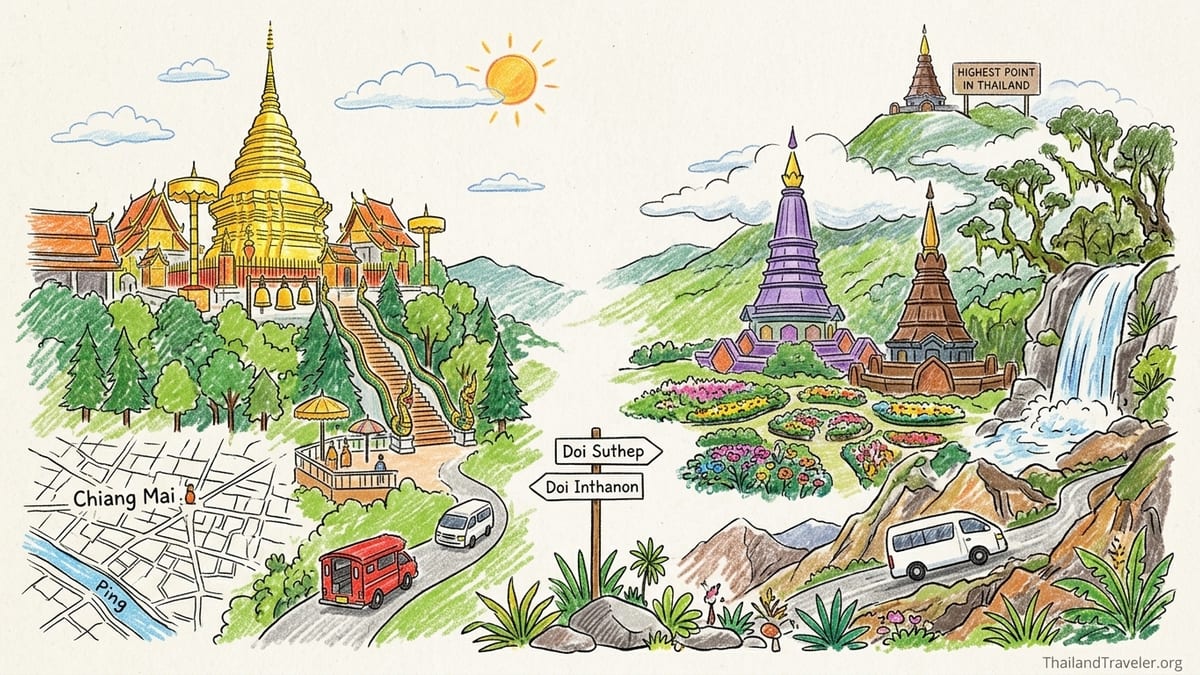
Starting Point: Two Mountains, One Chiang Mai Base
I based myself at a mid-range guesthouse on the west side of Chiang Mai’s Old City moat, a common starting point for both trips because red songthaews and tour vans can reach it easily. From this same hotel lobby, I was picked up one morning for a half-day Doi Suthep temple tour, and the next for a full-day Doi Inthanon national park excursion. Using the same base made the comparison clearer than reading brochures in isolation.
Both trips were booked at small agencies within walking distance of Tha Phae Gate. For Doi Suthep I chose a straightforward shared minivan tour focusing on the temple only, departing around 8:00 and returning by lunchtime. For Doi Inthanon I opted for a classic full-day group tour that promised the summit, the twin royal pagodas, at least one nature trail and two waterfalls, running from roughly 7:30 to 17:30.
By design, I avoided “combo” products that threw elephant shows or zip-lines into the mix. I wanted to compare the mountains themselves. That meant one largely cultural and religious site close to town, and one large protected mountain landscape about two hours away, each experienced as most first-time visitors would: in a shared vehicle with a Thai guide, starting from a central Chiang Mai hotel.
Looking back at my notes, what surprised me was not that the days felt very different, but how often the practical details transport, queues, staircases, clouds and kids in the group shaped how “special” each mountain felt.
Doi Suthep: The Classic Chiang Mai Temple Mountain
My minivan reached the foot of Wat Phra That Doi Suthep in about 30 minutes, climbing a bending mountain road that locals know as one of Chiang Mai’s popular cycling routes. The driver briefly paused at the viewpoint below the temple, where a small terrace looks out over the city and airport. On a clear morning Chiang Mai’s grid of streets and the Ping River are easy to pick out; on hazier days, the view is more about mood than detail, with smog or seasonal smoke softening the horizon.
At the main temple complex, our guide explained that there is no national park fee simply to visit Doi Suthep temple by road. The costs start at the lower plaza. In October 2026, foreigners pay around 50 baht each to enter the upper temple precinct, with Thai nationals exempt, and another 50 baht if they choose the funicular-style tram instead of climbing the long naga staircase. I opted to walk the 300-plus steps, which took me under ten minutes at a steady pace, but some older visitors in the group preferred the tram and were glad to pay to avoid the climb.
Dress rules were enforced quite consistently. At the ticket point and again at the entrance to the inner terrace, staff checked clothing and offered wraps to cover bare shoulders or very short shorts. Knees and shoulders needed to be covered; for anyone in doubt, carrying a light scarf from town solved the problem. Inside, the temple atmosphere was more devotional than many first-timers expect. Local families knelt with lotus buds and incense in front of the golden chedi, and a soft loop of chanting played through speakers, almost drowned out at times by tour groups and camera shutters.
Crowds are the trade-off for easy access. On my midweek morning visit the inner terrace was busy but not unbearable. Later in the day, especially on weekends or holidays, the temple can feel packed, and it becomes harder to find a quiet moment near the chedi or railings. The city view from the upper terrace mirrored what I had seen at the roadside viewpoint, but with more foreground detail temple roofs, bells, umbrellas and the famous golden stupa. Photographically, Doi Suthep delivered classic postcard shots, but almost all of them involved people in the frame.
Wat Pha Lat, Extras and How Doi Suthep Fills Half a Day
Because I wanted to keep the comparison fair, I added one common Doi Suthep add-on to my experience: Wat Pha Lat. We did not hike the full “Monk’s Trail” from town, but stopped at the wooded temple on the way back down by van. As of late 2026, Doi Suthep Pui National Park had begun charging foreigners about 100 baht to access certain trails, including the Monk’s Trail route, but arriving by vehicle we simply parked near the entrance and walked in, with no additional fee collected on my visit.
Wat Pha Lat felt immediately calmer than Doi Suthep itself. Monks moved quietly between simple brick stupas and forest shrines, and the main sounds were cicadas and rushing water from the small stream cutting through the grounds. For a half-day outing, this contrast mattered. After the bright gold surfaces and megaphone tour commentary at Doi Suthep, the mossy stones and shaded prayer platforms of Wat Pha Lat gave the morning a gentler landing. Photographers in the group were especially happy here. The soft light under the canopy suited portraits and detail shots of carvings that would be easily blown out on the exposed upper terrace of Doi Suthep.
Some tours combine Doi Suthep with the Hmong village at Doi Pui or with handicraft stops. My own itinerary did not, and I was glad for that. We arrived back at my hotel around 12:30, before the afternoon heat built up. In practice, my Doi Suthep excursion used about four and a half hours door to door, with no single vehicle segment longer than 30 minutes. For travelers who dislike long drives, that rhythm is far easier than being in a van most of the day.
All in, including my hotel pickup, temple fee, a modest donation at Wat Pha Lat and a coffee at the viewpoint, I had spent just under 500 baht for myself on top of the tour price. Walking difficulty was moderate: the staircase to Doi Suthep is the only real exertion if you skip nature trails, and the tram neatly removes even that.
Doi Inthanon: Thailand’s Highest Peak as a Day Trip
The following morning, the same style of white minivan pulled up at my hotel around 7:20. This time, it was a nearly two-hour drive south-west to reach the gate of Doi Inthanon National Park. The highway section was smooth, but a full-hour stretch of the journey involved climbing into cooler, cloud-prone highlands. Several of my van companions dozed. Anyone prone to motion sickness should plan ahead with medication or front-row seats.
At the main park entrance, our guide collected the national park fee from each of us and paid in one go. Foreign adults were charged 300 baht each, with a separate, smaller fee for the minivan itself. Later in the day, we also paid an additional entrance fee at the twin royal pagodas, a separate attraction within the park with its own pricing, often around 100 baht extra for foreign visitors. The guide explained the structure clearly and handled the tickets, but the cumulative cost was already much higher than Doi Suthep before we had walked a single trail.
Our circuit followed the pattern used by many group tours advertised in Chiang Mai agencies. First, we stopped at Wachirathan waterfall, one of the park’s most dramatic cascades, where a short paved path led to a powerful wall of water throwing spray into the air. It was an easy, flat walk from the parking area suitable even for young children. Then we continued toward the summit, stopping at a hill-tribe market where local farmers sold strawberries, coffee and honey from the surrounding highlands, and a food court handled lunch in simple canteens.
Near the top, we walked the short Ang Ka Luang nature trail, a wooden boardwalk looping through cloud forest close to the summit. At just under 2,600 metres, I felt a noticeable drop in temperature here compared with Chiang Mai, and the air was moist and cool even in late morning. Moss covered almost every branch and trunk, and visibility shifted from a few hundred metres to less than fifty as drifting cloud rolled through the forest.
Summit, Twin Pagodas and The Role of Weather
The actual summit of Doi Inthanon is surprisingly understated if you arrive expecting sweeping views. Our van pulled into a small parking area, we walked a couple of minutes through trees to a modest chedi marking the highest point in Thailand, and then filtered past a radar installation and a small shrine area. The summit is forested and usually shrouded in mist; there is no dramatic cliff-edge panorama. What you feel instead is the humidity of the cloud forest and the way lichen and epiphytes coat every surface.
The most photogenic stop on our Doi Inthanon day was the pair of royal pagodas built to honor King Rama IX and Queen Sirikit. The pagodas stand on separate knolls facing each other, each with landscaped gardens that fall away toward the valley. On clear days, the views from here reach across a wide sweep of northern mountains, and the pagodas make a striking silhouette against the sky. On my visit, conditions shifted between brief clearings and thick cloud. We had about ten minutes of sunshine that lit the purple and brown pagodas beautifully, followed by a fast-moving bank of fog that swallowed the valley view entirely.
This sensitivity to weather is crucial when deciding whether Doi Inthanon is “worth it” for a one-day visitor. In the dry season, especially around December and January, mornings are often crisp and clear, but cold at the top. During the rainy months, low cloud can sit on the upper slopes most of the day. Our guide repeatedly urged us to seize photo opportunities in any clear spell, and his advice proved wise. A couple in our group who had come mainly for landscape photography left feeling they had only half-captured what they imagined from brochures.
On the way down from the pagodas, many tours including mine offer a choice of nature trails. Some include the Kew Mae Pan trail, a paid guided loop known for its ridge-top views, but this requires extra time and sometimes an additional local guide fee collected at the trailhead. My group walked the shorter Ang Ka trail near the summit instead, which focused more on dense forest and moss than on wide vistas. It was flat, damp underfoot and fitted with boardwalks and steps, manageable for most reasonably fit visitors but slippy for anyone without decent shoes.
By the time we returned to the park gate and then to Chiang Mai, it was almost 18:00. Counting hotel pickups, we had spent around nine and a half hours on the excursion, easily five of those in the van. The walking was easy to moderate, but spread across several short segments punctuated by drives and stops.
Real Costs in 2026: What Two Adults Actually Pay
To keep the comparison grounded, I tracked my direct spending and cross-checked it against rates being quoted in Chiang Mai in October 2026. Half-day shared Doi Suthep tours from agencies around the Old City were commonly priced in the 800 to 1,000 baht per person range, including hotel pickup and drop-off but excluding the temple’s own entrance fee. A sunrise Doi Suthep tour with a former monk acting as guide, booked through an international platform, could cost a little more, often around 1,200 baht, in exchange for deeper cultural interpretation.
In my case, the standard morning Doi Suthep tour cost 900 baht per person. The Wat Phra That Doi Suthep upper-terrace fee added 50 baht each, and I chose the stairs instead of paying for the tram. With a modest 40 baht coffee and 60 baht in small donations and snacks, my personal total landed around 1,050 baht. For two adults traveling together, that translates to roughly 2,100 baht in total for a guided half-day from a central Chiang Mai hotel.
For Doi Inthanon, the baseline tour price reflected the longer distance and higher park fees. Standard full-day group tours from Chiang Mai agencies in late 2026 typically sat between 1,500 and 1,800 baht per person. These usually included transport, a basic Thai lunch and bottled water, but not the national park or twin pagoda entrance charges. Private tours and birdwatching trips ran much higher, often several thousand baht per person, in exchange for flexibility and specialist guiding.
My own Doi Inthanon group tour was booked at 1,600 baht per person. At the park gate, the national park fee was 300 baht per foreign adult, collected in cash and included on the ticket stub, while the royal pagodas added another approximate 100 baht per person. I bought a coffee at the summit and fruit at the market, spending an extra 120 baht through the day. All in, my personal expenditure for Doi Inthanon was just over 2,100 baht. For two adults starting from the same Chiang Mai hotel, that came to approximately 4,200 to 4,500 baht, almost exactly double our Doi Suthep morning.
Time, Effort, Scenery and Culture: A Direct Comparison
In raw numbers, Doi Suthep took half a day and cost about half as much as Doi Inthanon. My door-to-door time for Doi Suthep was under five hours, including a short stop at Wat Pha Lat. For Doi Inthanon, the entire day was committed, with the van picking me up before 7:30 and returning after 17:30. That time difference matters if you are in Chiang Mai only for a weekend or juggling work and sightseeing.
Walking difficulty also diverged. Doi Suthep’s toughest segment was the 300-plus-step staircase, which is entirely optional if you pay for the tram. Once at the temple, most of the movement is on level tiles. Wat Pha Lat adds gentle slopes and a few stone steps, but nothing strenuous if you are not hiking the full Monk’s Trail. Doi Inthanon, by contrast, spreads mild exertion across the day: short climbs to waterfall viewpoints, boardwalk sections on Ang Ka trail, staircases at the pagodas and walking between van and ticket booths. None of these were hard on their own, but the cumulative effect was more tiring, especially for older travelers and small children.
Scenery is where the choice becomes philosophical. Doi Suthep delivers urban panoramas framed by temple architecture. Its main visual drama lies in the gleam of the chedi and the sweep of Chiang Mai below. Doi Inthanon offers layered mountains, curtains of water at Wachirathan and Sirithan waterfalls, and damp, lichen-rich forest at altitude. Yet you never quite escape the awareness that you are on a popular tourist circuit; vans line up in the parking areas and groups queue at the most photogenic spots.
Cultural significance, too, takes different forms. Wat Phra That Doi Suthep is one of northern Thailand’s most important pilgrimage sites and a key symbol of Chiang Mai itself. You see locals making merit, lighting candles and walking clockwise around the chedi with flowers in hand. Doi Inthanon’s cultural layer is subtler, expressed in hill-tribe markets and small shrines at the summit, and in the story of the royal projects that encouraged highland communities to grow coffee instead of opium. My Doi Inthanon guide, a soft-spoken man in his forties, took time during the long drive to talk about these changes, and the day would have felt much shallower without his commentary.
Photography differed most in predictability. At Doi Suthep, even on a hazy morning, I could reliably capture sharp images of the chedi, naga staircase and city backdrop. At Doi Inthanon, some of my favorite frames were moody shots of mossy trunks and mist, but anyone arriving with a vision of bright blue sky over the twin pagodas might be disappointed on a cloudy or smoky day.
Who Should Choose Which: Families, Photographers and Short-Stay Visitors
After experiencing both trips back to back, I came to see them not as competitors but as answers to different questions. If your main priority is to avoid spending most of the day in a vehicle, Doi Suthep is the more comfortable choice. The road time is short, the staircase can be bypassed, and you are back at your hotel with energy left for a massage or an afternoon cooking class. For families with younger children, this matters. On my Doi Inthanon day, the youngest child in the group, a six-year-old, slept through much of the return drive and was clearly tired by late afternoon.
For travelers with limited mobility, Doi Suthep also has the edge, provided you budget for the tram. From the drop-off point at the top of the tram, the main temple terraces are relatively flat, with benches and railings. Doi Inthanon’s constant small ascents and uneven paths make it more challenging, even though no individual section is especially steep. Weather at Doi Inthanon can also be a factor, with chilly wind at the summit and wet boardwalks that demand careful footing.
On the other hand, if you are a nature enthusiast or serious landscape photographer, the extra investment in Doi Inthanon is easier to defend. No temple in Chiang Mai replicates the sensation of standing in dripping cloud forest at nearly 2,600 metres or feeling the spray of a powerful highland waterfall. For visitors who live in flat, temperate countries, the sheer change in climate and vegetation between Chiang Mai city and Doi Inthanon can be a highlight of northern Thailand.
Short-stay visitors on a quick city break, especially those in Chiang Mai for just two or three nights, may find that Doi Suthep offers the right balance of icon and efficiency. It gives you a sense of Chiang Mai’s spiritual life, a view over the city grid you have been walking, and an escape from street level without hijacking an entire day. Several travelers I met in my hotel lobby who were juggling work calls and sightseeing chose Doi Suthep for exactly this reason.
Which Trip Felt Worth the Money For Me?
When I added everything up, Doi Inthanon cost me roughly twice as much as Doi Suthep and consumed more than twice the time. Yet when I asked myself which experience I would miss more if I had to delete one from my travel memory, the answer was not as simple as picking the more expensive day. Doi Suthep gave me a very specific sense of place. Stepping onto the terrace at the top of the staircase and seeing Chiang Mai spread below, hearing bells and chants, I felt I had arrived in the city in a deeper way than walking its lanes could provide.
Doi Inthanon, by contrast, widened my understanding of northern Thailand as a region. The highland farms, the cooler air, the way clouds snagged on ridges and forests reminded me that Chiang Mai is not just a city but a gateway to a complex mountain landscape. The cost felt justified partly because my guide invested effort in explaining the park’s ecology and history. Without that, the day could have easily blurred into a sequence of photo stops connected by long drives.
If I had to recommend one excursion for a first-time visitor with only a single free day, staying in a central Chiang Mai hotel and wanting a balanced introduction to the area, I would lean towards Doi Suthep with a stop at Wat Pha Lat. It keeps logistics simple, leaves half a day free for markets or food, and roots you in the cultural heart of northern Thailand. If that same visitor were a dedicated hiker or landscape photographer with a flexible schedule, my recommendation would reverse: book Doi Inthanon, but try to schedule it for a day when the forecast suggests clearer skies.
For a family holiday, I would split the difference. With younger children or older grandparents, start with Doi Suthep, test how everyone tolerates the staircase or tram, and only then consider a full-day Doi Inthanon trip. For a short city break focused on cafes, temples and night markets, Doi Suthep alone is enough. For a photography-focused trip or a longer northern itinerary, visiting both on separate days makes sense and offers two complementary layers of Chiang Mai’s story.
The Takeaway
In the end, choosing between Doi Suthep and Doi Inthanon is less about ranking mountains and more about being honest about your time, energy and expectations. Doi Suthep is primarily a cultural and religious excursion that happens to sit on a forested mountain above the city. It is compact, affordable and forgiving if your jet lag or work schedule only leaves you a morning. Doi Inthanon is a much larger protected landscape, where your experience depends heavily on weather, your tolerance for long drives and how deeply your guide engages with the park’s nature and communities.
If I were planning specific trips, here is how I would decide. For a first Chiang Mai visit on a tight schedule, I would book Doi Suthep again, ideally early in the morning with a guide who can explain the temple’s history, and I would add a calm hour at Wat Pha Lat on the way down. For a family holiday with mixed ages, I would do Doi Suthep first and keep Doi Inthanon as an optional extra on a cooler, clearer day once I had seen how everyone copes with vans and stairs.
For serious nature photography or hiking, I would invest in Doi Inthanon, but avoid promises to myself about picture-perfect blue skies. I would pack a light waterproof layer, accept the likelihood of mist as part of the story, and, if time allowed, consider returning on a second day to walk a longer trail like Kew Mae Pan with a local guide. For a short city break focused on temples, coffee and food, I would skip the long drive entirely and let Doi Suthep be my mountain, buying myself back a day’s worth of wandering in the Old City instead.
And if I had a full week in Chiang Mai and wanted to understand not just what the city looks like from above but where its water and cool breezes come from, I would gladly visit both again on separate days, using the same modest hotel room as a base. One day for the golden chedi above the moat and another for the cloud forest above the plains together they tell a fuller story of northern Thailand than either can alone.
FAQ
Q1. Is Doi Suthep or Doi Inthanon better if I only have one free day in Chiang Mai?
For most first-time visitors with just one free day, Doi Suthep makes more sense. It takes only half a day, costs roughly half as much as Doi Inthanon, and gives a strong introduction to Chiang Mai’s religious life and cityscape without committing you to long hours in a vehicle.
Q2. How much should two adults budget in 2026 for each trip from Chiang Mai?
For Doi Suthep, two adults on a shared guided tour can expect to spend around 2,000 to 2,200 baht in total, including the temple entrance fee and small extras. For Doi Inthanon, the same pair should plan for roughly 4,200 to 4,500 baht, once tour price, national park fee, royal pagoda fee and incidental drinks or snacks are counted.
Q3. Which excursion is easier with young children or older relatives?
Doi Suthep is generally easier with young children or older relatives because the drive is short and the tram removes the need to climb the main staircase. At Doi Inthanon, the day is much longer, with several short walks and stairs spread throughout, which can be tiring even if none of the individual sections is very steep.
Q4. Do I need to be very fit to visit Doi Suthep or Doi Inthanon?
You do not need to be very fit for either trip, but they have different demands. Doi Suthep’s key challenge is the staircase, which you can avoid by paying for the tram. Doi Inthanon involves multiple short walks on sometimes uneven or wet paths, so a basic level of mobility and balance is helpful, and good shoes are strongly recommended.
Q5. How does weather affect the experience and photography on each mountain?
At Doi Suthep, weather mainly influences how clear the view over Chiang Mai is, but you can still enjoy the temple and its details on hazy days. At Doi Inthanon, cloud and fog can dramatically change visibility at the summit and twin pagodas, sometimes hiding long-distance views entirely. Photographers should be prepared for moody forest scenes rather than guaranteed panoramic vistas.
Q6. Is a guide really necessary for these excursions?
You can visit Doi Suthep independently by red songthaew or taxi and still have a rewarding time, though a good guide adds context about the temple’s history and customs. For Doi Inthanon, a guide is more valuable because the park covers a wide area, and their knowledge helps you understand both the natural environment and local hill-tribe communities while managing logistics between waterfalls, trails and pagodas.
Q7. Can I combine Doi Suthep and Doi Inthanon in a single day?
In practical terms, combining both in a single day from Chiang Mai would make for a rushed, exhausting itinerary, with more time in vehicles than at the sites themselves. It is far better to dedicate one day to Doi Inthanon and a half-day to Doi Suthep on a separate morning or evening, so that each experience has space to breathe.
Q8. Which trip offers better value if I am mainly interested in Thai culture?
If your primary interest is Thai culture, Doi Suthep offers better value. The temple is a major pilgrimage site, packed with Lanna architectural details and active worshippers, all within a short drive of the city. Doi Inthanon includes cultural elements, such as hill-tribe markets and summit shrines, but much of its appeal lies in landscapes and cooler climate rather than concentrated religious heritage.
Q9. What should I wear for each destination?
For Doi Suthep, dress modestly with shoulders and knees covered, as you will be entering active temple spaces. Light, breathable clothing with a scarf or sarong works well. For Doi Inthanon, bring layers. It can be significantly cooler and damper at the summit and on forest trails than in Chiang Mai, so a light jacket or fleece, long trousers and good walking shoes make the day more comfortable.
Q10. When does it make sense to visit both mountains on the same trip?
Visiting both makes sense if you have at least four or five full days in Chiang Mai and want to balance cultural and natural experiences. Doing Doi Suthep on one morning and Doi Inthanon on a separate day allows you to see how the city, its sacred mountain and the wider highland landscape fit together, giving a more complete picture of northern Thailand.