


The Mae Hong Son Loop has become northern Thailand’s signature mountain road trip, wrapping nearly 600 kilometers of twisting asphalt through teak forests, misty ridges and small Shan villages west of Chiang Mai. Whether you drive yourself or hire a professional driver, it rewards anyone who respects its gradients, plans realistic days and gives the mountains enough time. This guide focuses on practical, up to date information so you can choose the right 4, 5 or 7 day itinerary, rent a suitable vehicle and stay safe on some of Thailand’s most beautiful but demanding roads.
Understanding the Mae Hong Son Loop and How to Drive It
The classic Mae Hong Son Loop starts and ends in Chiang Mai, running via Highway 1095 from Chiang Mai to Pai and Mae Hong Son, then returning along Highway 108 through Khun Yuam and Mae Sariang before rejoining the main valley road to Chiang Mai. Driven in full, the loop covers roughly 600 kilometers. The famous statistic often quoted is that it contains more than 1,800 curves, although the precise count varies by source. What matters on the ground is that much of the route is narrow, steep and endlessly winding, which makes daily distances feel far longer than their simple number of kilometers.
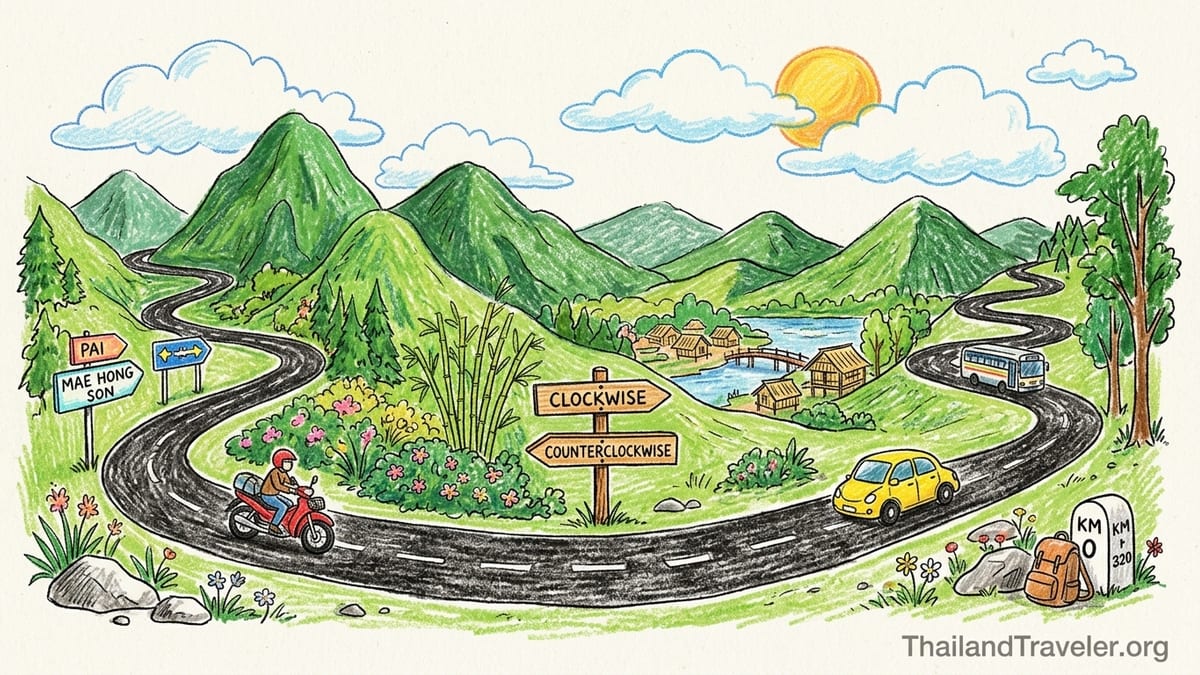
Travelers can drive the loop either clockwise or counterclockwise. Clockwise means heading first to Pai on Highway 1095, then continuing west to Pang Mapha and Mae Hong Son before curving south through Khun Yuam and Mae Sariang along Highway 108. Counterclockwise reverses this order, sending you toward Mae Sariang first. Both directions are fully paved and scenic. The choice largely comes down to how quickly you want to hit the sharpest bends on Highway 1095 and whether you prefer to front load the long Pai section or save it for the end when you may be more tired.
Highway 1095 between Chiang Mai and Pai climbs from valley floor to ridge and back several times, with long sections of 8 to 10 percent gradients, tight hairpins and limited overtaking opportunities. Landslide repairs are common during and just after the rainy season, and surfaces can change from fresh asphalt to patched concrete within one bend. Highway 108 between Mae Hong Son and Mae Sariang is a little less intense but still very curvy, with some fast sweeping sections where drivers can relax slightly before the next set of hills. On both roads, driving times are governed by trucks, buses and cautious local drivers as much as by the absolute distance.
The loop is best treated as an intermediate or advanced mountain drive, not a casual Sunday outing. In a compact car, three to four hours of actual wheel time a day is usually enough to feel pleasantly tired rather than exhausted. On a motorcycle, the same hours can be physically harder because of constant cornering, braking and body movement. This is one of the main reasons experienced riders strongly discourage first time scooter riders from using the Mae Hong Son Loop as a classroom. If you have not spent time on a bike in your home country or in flat Thai cities, this is not the place to start.
Clockwise vs Counterclockwise: Which Direction Is Better?
Clockwise travel, the traditional choice for many visitors, takes you straight into the most famous section on Day 1: Chiang Mai to Pai. This 130 kilometer stretch on Highway 1095 often takes three to four hours of driving in a car with quick rest stops, and longer if you are riding a small scooter two up or stopping frequently for photos. Going clockwise means you discover whether you and your passengers can handle the hairpins and motion early in the trip. If motion sickness is going to be a problem, you will know it by the time you reach Pai, and you can shorten the loop there instead of being committed deep in the mountains.
Counterclockwise itineraries ease you in more gently if you are nervous. Driving Chiang Mai to Mae Sariang first uses the southern approach and avoids the Pai section until late in the route. This day is still long at roughly 190 kilometers, but the curves are more flowing and tend to feel less intense than the compressed hairpins around Pai. Families who are unsure how small children will react to constant bending roads sometimes prefer starting counterclockwise, using Mae Sariang as a test for future days.
From a scenery perspective, both directions offer layered mountain views, lakes, bamboo forests and villages. Clockwise travel gives you early access to the cafes and hot springs around Pai, then gradually increases the sense of remoteness as you approach Mae Hong Son and the Burmese border hills. Counterclockwise itineraries hit the quieter Mae Sariang and Salawin River areas first and then feel busier and more social as you approach Pai near the end, where walking streets and night markets can feel like a return to civilization after days of small towns.
In practical terms, fuel and mobile reception are adequate in both directions as long as you top up regularly. Larger fuel stations with card payment and minimarts operate in Chiang Mai, Pai, Mae Hong Son, Khun Yuam and Mae Sariang. Between these towns, you find small local pumps and hand operated fuel barrels. It is wise to refill when your tank reaches half, especially on a motorcycle with smaller range. Mobile signal is present around almost all towns and on ridges near base stations, but there are regular valleys without data for several kilometers. Download offline maps before departure and share your itinerary with someone in Chiang Mai so they know when you are expected back online.
Road Conditions, Gradients, Vehicles and Safety Considerations
On both Highways 1095 and 108 the surface is officially fully paved, but conditions change quickly with weather and maintenance. After the 2024 and 2025 rainy seasons, Thai media and local travelers reported short unpaved sections and landslide work zones, especially between Pai and Pang Mapha and on remote slopes south of Mae Hong Son. By late 2026 many of these sections have been resurfaced, but you should still expect occasional loose gravel, oil from trucks on inside corners and potholes near drainage channels. During heavy rain, runoff often drags small stones onto the road within minutes, which can be dangerous for motorcycles on lean.
Gradients can reach or exceed 10 percent on both main highways, with stacked hairpins that require first and second gear in a compact car and frequent braking on a motorcycle. Inexperienced drivers sometimes underestimate how long it takes to descend safely. The correct technique is to use engine braking in a lower gear rather than riding the brake pedal continuously, which can overheat pads and cause fading. Many local rental cars are automatic, so practice using the manual shift mode and “L” or “2” settings before you hit the hills, preferably on a smaller rise such as Doi Suthep outside Chiang Mai.
Vehicle choice matters a great deal. For most couples or small groups, a compact automatic car such as a Toyota Yaris, Honda City or similar is the most forgiving option. As of late 2026, Chiang Mai based rental agencies commonly list compact automatics from roughly 900 to 1,300 Thai baht per day for short rentals, with better deals over a full week. Larger SUVs and pickup trucks may feel more stable but are wider on narrow curves and use more fuel. For motorcycles, rental guides and big bike shops in Chiang Mai suggest that a 150 to 160 cc scooter is the realistic minimum for two up riding in the mountains, while 250 to 500 cc adventure motorcycles are more comfortable for experienced riders on multi day trips.
Safety on the loop comes down to speed discipline, weather awareness and honest self assessment. Night driving should be avoided wherever possible, because of unlit curves, occasional livestock, slow farm vehicles and reduced visibility when fog gathers on the ridges. If you leave too late and find yourself still far from your planned stop near dusk, it is safer to cut the day short at an intermediate town or roadside guesthouse than to push on. During the rainy season from roughly May to October, afternoon downpours are common, and wet leaves and diesel spill on the asphalt can be treacherous for scooters. In the burning season, which often peaks between February and early April, smoke from agricultural fires can reduce visibility and air quality. If regional air quality reports show very high PM2.5 readings in Chiang Mai and Mae Hong Son, consider postponing the loop or shortening it.
Renting Cars and Motorcycles: Prices, Insurance and Legalities
Car rental in Chiang Mai for the Mae Hong Son Loop is straightforward if you arrive with the correct documents. Many reputable agencies near the Old City and at Chiang Mai International Airport accept a valid foreign driver’s licence from your home country together with an International Driving Permit, particularly if your licence is not in English. Thai transport authorities and regional tourism manuals specify that foreign self drivers should either hold a Thai licence, an IDP or an ASEAN licence in order to drive legally in Thailand. Rental companies will usually photocopy your passport, visa stamp and licences, take a cash deposit or imprint your credit card and hand over basic insurance documents.
As of late 2026, compact automatic cars in Chiang Mai commonly advertise daily rates around 900 to 1,300 baht for short rentals. For example, several local agencies promote promotions in the 1,000 to 1,200 baht range for a newer Toyota Yaris or Honda City, with weekly and monthly discounts if you book for longer. These base prices nearly always include compulsory government insurance, which only covers third party damage. You can usually pay extra for collision damage waiver with an excess, which reduces your liability if you damage the car. It is important to ask clearly what is covered, what your maximum liability is and whether windscreen and tire damage are included, because mountain roads increase the risk of stone chips.
For motorcycles and scooters, Chiang Mai has a dense rental market, from small local shops to specialist touring companies. Guides that track 2026 prices report that 110 to 125 cc city scooters often rent for about 150 to 350 baht per day, while 150 to 160 cc scooters such as the Honda PCX or Yamaha NMAX usually run between 350 and 500 baht per day on short agreements. Larger 300 to 350 cc touring scooters and mid size manual motorcycles can sit around 800 to 1,200 baht per day, while 500 to 750 cc adventure bikes from specialist shops may cost anywhere from 1,200 to 2,000 baht per day depending on model and season. Monthly rentals reduce the effective daily price significantly, but most visitors driving the loop only for a week pay short term rates.
Legally, you need two things to be properly covered on a motorcycle in Thailand. First, you must hold a valid motorcycle licence for the same class of bike in your home country. A car only licence does not entitle you to ride a scooter in Thailand, even if some shops are willing to rent you one. Second, you should carry an International Driving Permit that includes the motorcycle endorsement, unless your home licence is issued by an ASEAN country or is already valid under the relevant road traffic conventions. Local police checks on the route around Pai and Mae Hong Son occasionally stop tourists to examine licences and will issue fines if they find you riding with only a car licence. More importantly, travel insurance companies frequently refuse to pay medical claims from motorcycle crashes if you did not hold the appropriate licence at the time of the accident.
This combination of legal and insurance risk is the main reason experienced riders urge inexperienced visitors not to learn on the Mae Hong Son Loop. Renting a 125 cc scooter for runs inside Chiang Mai’s Old City is already a serious responsibility. Taking that same scooter loaded with luggage and a passenger into steep mountain hairpins surrounded by buses is several steps higher in difficulty. If you have never ridden before, the safest option is to skip self riding on the loop entirely and either rent a car within your licence category or book a trip with a professional driver or guided motorcycle company, which includes properly licenced riders and support vehicles.
Four, Five and Seven Day Mae Hong Son Loop Itineraries
A realistic four day loop focuses on the core highlights without rushing long detours. One workable clockwise itinerary starts in Chiang Mai and overnights in Pai, Mae Hong Son and Mae Sariang before returning to Chiang Mai. Day 1 runs Chiang Mai to Pai, roughly 130 kilometers and three to four hours’ drive without long stops. Leaving Chiang Mai around 9 a.m. gives time for a lunch break halfway near mountain viewpoints and an early afternoon arrival in Pai. This allows you to settle into accommodation near the walking street, visit Pai Canyon around sunset and dine at the night market.
Day 2 of the four day plan goes from Pai to Mae Hong Son, roughly 110 to 120 kilometers depending on side roads. The raw drive can be around three hours, but this section benefits from a morning detour to Tham Lod Cave near Soppong. To do it properly, you should allocate at least half a day, because visiting the cave involves a short walk with a local guide, bamboo raft segments and optional extra chambers. Many travelers leave Pai by 8 a.m., explore Tham Lod until late morning or midday, then continue to Mae Hong Son for a late afternoon arrival. Overnighting in Mae Hong Son gives access to the hilltop Wat Phra That Doi Kong Mu and relaxed lakeside restaurants around Chong Kham Lake.
Day 3 heads south from Mae Hong Son to Mae Sariang via Khun Yuam, a distance of about 165 kilometers on Highway 108 that typically takes four to five hours with breaks. This is a full driving day, so it is better to treat stops such as the small World War II museum in Khun Yuam or the viewpoints above forests as short leg stretches rather than half day activities. Reaching Mae Sariang before dark matters because the road between Khun Yuam and Mae Sariang passes through isolated hillside. Day 4 then returns from Mae Sariang to Chiang Mai following Highway 108 and 106, a distance close to 190 kilometers. This final stretch includes some curves but also straighter segments. Leaving by mid morning usually brings you back to Chiang Mai in the mid afternoon, with time to return rental vehicles before office closing hours.
A five day itinerary is the minimum that comfortably includes additional scenic stops such as Ban Rak Thai or extra time in Pai. For example, you might keep the first two days similar to the four day plan, but add a third night either in Ban Rak Thai or another night in Mae Hong Son. Ban Rak Thai, the small Yunnan Chinese village near the border north of Mae Hong Son, sits on a photogenic lakeside and deserves at least one full relaxed afternoon and morning. The access road from Mae Hong Son is steep and slow, and the village itself gets busy with domestic tourists on weekends. Squeezing Ban Rak Thai into the same day as Pai to Mae Hong Son or Mae Hong Son to Mae Sariang would leave you driving long hours in the dark or rushing your visit to what many consider the prettiest single stop on the loop. A five day plan solves this by dedicating a near full day to Ban Rak Thai and nearby Pang Ung lake or the Su Tong Pae bamboo bridge.
A seven day itinerary allows you to add even more variety. One popular extended loop includes a night near Huai Nam Dang National Park between Chiang Mai and Pai, two nights split between Pai and Mae Hong Son, a night in Ban Rak Thai, a night in Mae Sariang and a final optional detour to Doi Inthanon National Park before returning to Chiang Mai. This structure turns several previous full driving days into half days, making room for hot springs, coffee plantations and treks. For instance, instead of driving directly from Chiang Mai to Pai on Day 1, you might stop near Huai Nam Dang or stay at a mountain resort along the 1095 ridge, waking to cool temperatures and morning cloud layers. Later days could allocate half a day to visiting Su Tong Pae Bridge just north of Mae Hong Son, where farmers cross rice fields on a raised bamboo walkway to reach a hilltop temple, and another half day to the royal project gardens and lakeside viewpoints around Pang Ung.
Daily Distances, Motion Sickness and Seasonal Hazards
The raw distances on the loop can be misleading. A map might show only 130 kilometers from Chiang Mai to Pai, but those kilometers are dense with bends. For most independent drivers, days that involve more than 200 kilometers on loop roads feel very long, especially with photo stops and meals. As a planning rule of thumb, three to five hours of combined moving time and short breaks is a reasonable maximum if you want to arrive before dusk still feeling able to enjoy your destination town. Trying to cram Ban Rak Thai, Pang Ung, Tham Lod Cave and long transfer stages into four days typically leads to rushed mornings, skipped viewpoints and potentially risky twilight descents.
Motion sickness is a common challenge, even for people who rarely get carsick on straight roads. If one member of your group is sensitive, put them in the front passenger seat or on the more stable part of a back seat, ask them to focus on the horizon and keep a regular supply of water and light snacks. Thai pharmacies in Chiang Mai and Pai sell motion sickness tablets that many domestic travelers use for bus trips along Highway 1095. These can cause drowsiness, which is a good reason the driver should not take them, but they can make the route much easier for passengers. Plan extra stop time around viewpoints where people can get fresh air and reset their stomachs.
Seasonal risks shape when and how you should attempt the loop. From roughly May to October, northern Thailand’s rainy season brings intense but often short lived storms, with the wettest months normally around August and September. On wet days, curves can hide standing water and polished patches of asphalt that reduce grip, especially on scooters with worn tires. Landslides and fallen branches are more likely, and you may encounter temporary one lane closures. Conversely, the cool and dry season from November to January usually offers the clearest blue skies and cooler temperatures, which many consider ideal for driving. You might need a light jacket on morning rides, especially at higher viewpoints.
The burning season, which tends to run from February into early April, brings a different set of issues. Agricultural burning and forest fires around Mae Hong Son and northern Thailand can cause very high pollution levels and thick haze. This both reduces visibility on the road and can make spending days outdoors uncomfortable. Before setting out in these months, check regional air quality reports for Chiang Mai and Mae Hong Son and watch local news. If PM2.5 levels are very high, especially for several days in a row, reconsider your timing or shorten the loop to avoid the worst affected areas. Unlike rain, which you can often wait out for an hour, smoke conditions can persist for weeks.
Five Day Cost Example and Independent vs Guided Travel
To give a concrete sense of budget, consider a couple driving a compact rental car on a five day clockwise loop from Chiang Mai with nights in Pai, Mae Hong Son, Ban Rak Thai, Mae Sariang and then back to Chiang Mai. Vehicle rental might be around 1,100 baht per day for a compact automatic, based on mid range 2026 rates in Chiang Mai, for a total of about 5,500 baht. Fuel for roughly 650 to 700 kilometers of mixed mountain driving in such a car might reach 1,800 to 2,200 baht at prevailing petrol prices, assuming an average of 12 to 14 kilometers per liter in hilly conditions. That puts total vehicle and fuel costs in the ballpark of 7,500 baht for two people.
Accommodation varies hugely, but mid range guesthouses and small hotels in Pai, Mae Hong Son and Mae Sariang often fall into the 800 to 1,500 baht per night bracket for a double room with private bathroom and air conditioning. Ban Rak Thai, which has become a popular domestic getaway, sometimes charges a slight premium, between about 1,200 and 2,000 baht per night at lakeside properties. Using rough midpoints of 1,200 baht per night in most towns and 1,500 baht in Ban Rak Thai, five nights of accommodation could total around 6,300 baht. Together with the vehicle, that brings the shared trip cost to around 13,800 baht before meals and activities.
Food on the loop can be as cheap or as indulgent as you choose. If two people eat simple Thai dishes, noodles and snacks from markets and local restaurants, daily food spending might fall near 800 to 1,200 baht per day, including coffee stops and occasional beer in the evening. Across five days that could amount to roughly 4,000 to 5,000 baht. Entrance fees for attractions such as Tham Lod Cave, Su Tong Pae Bridge donations and small national park gates around viewpoints might collectively reach 600 to 1,200 baht for two over the trip, depending on how many sites you visit. Parking is usually free at most rural stops and guesthouses, with some exceptions near popular canyons or waterfalls where a small parking charge of 20 to 50 baht per vehicle may be collected.
Putting these pieces together, a moderate comfort five day car trip for a couple might fall in the region of 18,000 to 20,000 baht in 2026 prices, excluding flights to Chiang Mai and personal shopping. Independent motorcycle travel can be cheaper in pure rental and fuel costs if you choose small scooters and budget bungalows, but many riders quickly spend similar totals by staying at characterful lodges and enjoying more coffee breaks. In contrast, guided motorcycle tours that include a 500 to 750 cc bike, support truck, fuel, accommodation and some meals can run into several tens of thousands of baht per person for multi day itineraries, which reflects both the cost of premium motorcycles and the presence of professional staff.
Private driver options sit between self drive and full guided tours. Several Chiang Mai based operators offer the Mae Hong Son Loop in a private car or minivan with an English speaking driver, charging a fixed daily rate for the vehicle and driver, plus fuel surcharges and accommodation for the driver. Total trip costs often roughly double those of pure self drive, once you include the driver’s pay and lodging, but in exchange you gain the ability to relax, enjoy views without concentrating on every corner and share the experience with children or nervous relatives who might not feel safe in a self driven vehicle.
The Takeaway
For couples and independent travelers who already hold valid car licences, renting a compact automatic in Chiang Mai and driving a four or five day Mae Hong Son Loop is one of the most rewarding road trips in Southeast Asia. The car provides a safety margin on steep, wet curves and gives you space for luggage, while still being affordable. A five day plan that includes Pai, Mae Hong Son, a relaxed stay in Ban Rak Thai and a final night in Mae Sariang strikes a strong balance between driving and exploring. The key is to keep daily driving times realistic, to arrive at each overnight before dark and to accept that you do not need to tick every detour in a single trip.
Families with younger children or with relatives who suffer badly from motion sickness may prefer to book a private vehicle with a driver or shorten the loop to two or three key bases, such as Pai and Mae Hong Son, reached in separate transfers. Having a professional at the wheel allows everyone else to focus on managing comfort in the back seats and to extend or shorten days based on how people feel. This can be particularly valuable if you are traveling in the peak of rainy season, when conditions can change rapidly along the route.
Experienced motorcyclists with proper licences and recent riding practice can treat the Mae Hong Son Loop as a highlight of a longer northern Thailand tour, especially on mid size adventure bikes that handle both slow hairpins and faster sweepers. For these riders, a seven day version with overnight stops near Huai Nam Dang, Ban Rak Thai and an optional Doi Inthanon detour offers enough time to ride without rush and to enjoy gravel side roads within comfort limits. Even for them, respecting rain, smoke, fatigue and livestock on the road is essential.
Travelers who like the idea of mountain scenery and small towns but feel anxious about driving or riding in Thailand should not feel pressured to self drive. Joining a guided motorcycle convoy as a pillion, booking a private car with a driver or even using combinations of minivans and local taxis can still reveal the charms of Pai, Mae Hong Son, Su Tong Pae Bridge and Ban Rak Thai. However you choose to travel, give the loop enough days, avoid night driving, check licences and insurance carefully and treat Ban Rak Thai as a destination in its own right rather than a quick detour. The Mae Hong Son Loop rewards patience and planning as much as it does a love of hairpin bends.
FAQ
Q1. Do I really need an International Driving Permit to drive the Mae Hong Son Loop?
Most rental companies in Chiang Mai will rent to you if you hold a valid licence from your home country, but Thai authorities and regional tourism manuals state that foreign self drivers should carry either a Thai licence, an International Driving Permit or a valid licence from an ASEAN country. Carrying an IDP that matches your car or motorcycle category reduces the risk of fines at police checkpoints and strengthens your position with travel insurers if you need to make a claim.
Q2. Is the Mae Hong Son Loop suitable for first time scooter riders?
No. The loop involves long, steep gradients, constant curves, changing road surfaces and traffic that sometimes crosses the center line. Experienced riders and rental guides consistently advise that beginners should learn to ride on flat city streets or in low traffic environments first. Using the loop as your first real scooter experience greatly increases your risk of crashes and can also invalidate insurance claims if you do not hold a proper motorcycle licence.
Q3. How many days do I need for a comfortable Mae Hong Son Loop by car?
A four day itinerary is the minimum for the classic Chiang Mai, Pai, Mae Hong Son, Mae Sariang and back to Chiang Mai route if you are willing to treat some days as mostly driving. Five days gives you space to include half day detours such as Tham Lod Cave and a more relaxed pace. Seven days lets you add Ban Rak Thai, Pang Ung, Huai Nam Dang and possibly a Doi Inthanon detour without overloading each day.
Q4. Why does everyone say Ban Rak Thai deserves its own night?
Ban Rak Thai lies on a smaller, steep access road north of Mae Hong Son, and the main pleasure of visiting lies in simply sitting beside the lake, walking among tea shops and experiencing the cool highland atmosphere in the early morning and late afternoon. Trying to squeeze it into a long transfer day often means you arrive hot and tired, spend less than an hour, then face another stretch of winding road in the dark. Staying overnight lets you enjoy sunset and morning mist without rushing.
Q5. What kind of vehicle is best for a couple doing the loop?
For most couples who are not dedicated motorcyclists, a compact automatic car such as a Toyota Yaris or Honda City represents the easiest and safest choice. It offers protection from weather, space for luggage and forgiving handling on steep descents. Experienced riders who hold full motorcycle licences and are comfortable on mountain roads may enjoy the loop more on a 300 to 500 cc scooter or adventure bike, but only if both passenger and rider are happy with long days in the saddle.
Q6. How common are fuel stations and mobile reception on the route?
You will find modern fuel stations with minimarts in major towns such as Chiang Mai, Pai, Mae Hong Son, Khun Yuam and Mae Sariang, and small local pumps or fuel drums in many villages. A safe habit is to refuel whenever your tank drops to half, especially on motorcycles. Mobile signal is generally available in and near towns and on ridges, but expect several stretches of a few kilometers without data. Download offline maps before leaving Chiang Mai.
Q7. What are the main seasonal problems on the Mae Hong Son Loop?
In the rainy season, heavy showers can cause slippery surfaces, sudden fog, small landslides and temporary roadworks, which all require slower speeds and more attention. In the burning season, typically February to early April, agricultural fires and forest burning can produce heavy haze and poor air quality, reducing visibility on curves and making outdoor activities uncomfortable. Checking weather and air quality before and during your trip is essential.
Q8. How expensive is a guided motorcycle tour compared with self driving?
Self driving a compact rental car for five days, including fuel, accommodation and meals for two, might cost in the range of 18,000 to 20,000 baht at 2026 prices, depending on comfort level. Guided motorcycle tours that include a mid size adventure bike, guide, support vehicle, fuel and accommodation can cost several times more per person for the same number of days, reflecting the inclusion of high value motorcycles, staff and logistics. The trade off is convenience, safety support and curated routes.
Q9. Is it safe to drive the Mae Hong Son Loop at night?
It is technically possible but strongly discouraged. Many sections lack street lighting and road markings, fog can form rapidly on high sections, and it is harder to see slow vehicles, animals or debris on the road. The safest approach is to plan conservative daily distances, leave early in the morning and choose overnight stops that you can reach with plenty of daylight to spare.
Q10. Should I book accommodation in advance or find it as I go?
Outside peak Thai holiday periods and long weekends, it is usually possible to find rooms on arrival in Pai, Mae Hong Son and Mae Sariang across a range of budgets. However, booking at least the first night in Pai and any stay in Ban Rak Thai in advance is wise, because these spots are very popular and good value lakeside rooms often sell out, especially on weekends and during the cool season. Having reservations also reduces pressure to drive on in search of vacancies if you arrive later than planned.