


The first time I saw Ban Rak Thai from the road, the village looked almost unreal: terraced tea fields cascading into a small lake, clay-roofed houses reflected in still water and a thin veil of mist hanging above it all. Many travelers treat this Chinese border village as a quick photo stop on the Mae Hong Son Loop, but spending a night beside the lake reveals a slower, more complex place than any drone shot suggests.
Getting to Ban Rak Thai on the Winding Road from Mae Hong Son
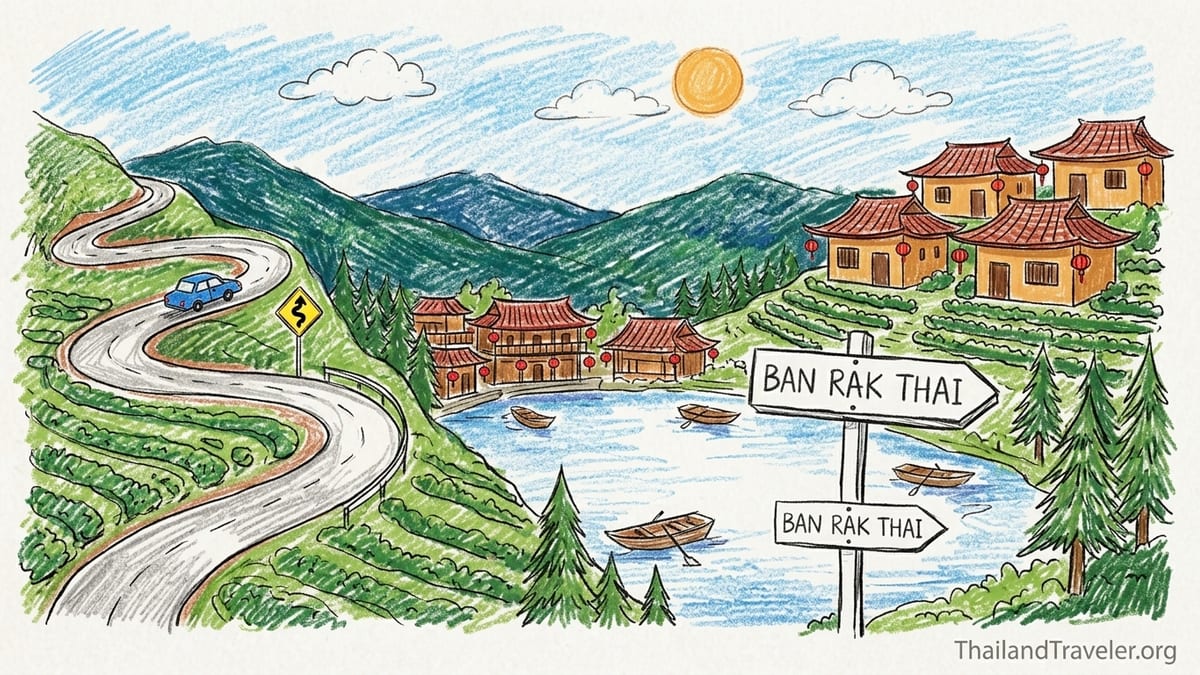
Ban Rak Thai sits close to the Myanmar border, about 44 kilometers northwest of Mae Hong Son town. The distance sounds modest, but the drive is a steady mountain climb that took me just under 1 hour and 20 minutes including a brief viewpoint stop. The first part follows Route 1095 out of Mae Hong Son before branching toward Pha Suea Waterfall and the Pang Tong Royal Project, then snaking up in a series of hairpins to the lake.
I rented a small automatic sedan in Mae Hong Son for 1,200 baht per day with basic insurance, which worked out cheaper than hiring a private driver. Fuel for the return trip, plus a side visit to Pang Ung, cost around 250 baht at current pump prices. Travelers who are not comfortable driving can negotiate a taxi from Mae Hong Son for roughly 550 to 700 baht each way, a figure consistent with local taxi quotes along the loop. Either way, the final 10 kilometers feel slow, with steep grades and tight bends that reward patience more than speed.
The road surface in late 2026 was in good sealed condition, with only a few patched sections where rain had worn the edges away. What made the drive challenging was less the asphalt than the combination of sharp switchbacks, lumber trucks and distracted riders stopping suddenly for photos. I found second gear and engine braking essential on the descents. If you are on a scooter, leave Mae Hong Son with plenty of daylight and be ready for cool air at higher elevation. I passed a handful of riders in shorts and T-shirts visibly shivering by the time we reached the village turnoff.
Arriving in Ban Rak Thai just after 4 p.m., I queued briefly behind minivans unloading day trippers. The lake came into view in a sudden opening of the forest, framed by Chinese-style gate arches and lines of red lanterns. A narrow one-way lane loops around the water, so it is worth confirming with your guesthouse in advance where to park and whether they can meet you near the main lakeside plaza to help with luggage.
Staying Lakeside: Choosing a Room at Lee Wine Ruk Thai and Beyond
For this trip I chose to stay at Lee Wine Ruk Thai Resort, the cluster of ochre-colored clay houses that often dominate photographs of Ban Rak Thai. The resort steps up the hillside among tea bushes, with many rooms facing directly onto the lake. Recent booking platforms list rooms starting around 2,200 to 2,800 baht per night in the cooler season for a double including breakfast, with higher prices for the most coveted front-row terraces. My mid-range room with balcony came to 2,500 baht for one night in October, confirmed directly by phone a week in advance after online bookings showed limited availability.
Officially the resort provides on-site parking near the upper entrance, and staff met me there with a small cart for the luggage. From parking to reception is a short but steep walk along stone steps between tea bushes. The check-in process felt brisk but friendly, with staff switching effortlessly between Thai and simple English to explain breakfast hours, tea-tasting times and the evening quiet policy. A welcome tray of hot village oolong and sesame snacks appeared in my room within ten minutes.
The room itself was more comfortable than the rustic exterior suggests. Thick clay walls kept the interior cool in the afternoon and warm by night, and the simple wooden furniture felt solid rather than decorative. The private balcony looked straight over the lake, framed by a row of low tea shrubs. From here I could see rowboats moored along the far shore and the soft smoke rising from kitchens as cooks began preparing the evening’s braises. While the resort is clearly designed for Instagram, it has enough substance in materials and maintenance that it did not feel like a stage set.
Travelers on tighter budgets can still stay by the water without sacrificing the lakeside experience. Around the shore, smaller guesthouses such as Lungwang Guest House and several family-run homestays advertise rooms typically between 800 and 1,500 baht per night, often within a 30 second walk to the lake. These simpler accommodations tend to offer thin walls and shared terraces instead of private balconies, but they still put you within earshot of roosters, tea sellers and the occasional burst of Mandarin conversation drifting from the restaurants at dusk.
Misty Morning on the Lake: What Sunrise in Ban Rak Thai Really Looks Like
The main reason to sleep in Ban Rak Thai rather than just stopping for lunch is the early morning atmosphere, when the lake belongs more to residents than to tour groups. I set my alarm for 5:45 a.m. and stepped onto the balcony with a sweater and a cup of tea just before first light. The temperature felt close to 14 or 15 degrees Celsius, cool enough that my breath showed faintly, though hardly frigid.
The mist, which is the village’s unofficial calling card, did form but not as a solid blanket. At around 6:15 a light fog began to drift across the water from the far shore, forming low tendrils that curled around the rowboats. In photographs online, the scene often appears as a thick, mysterious shroud, but in person it was more delicate and constantly shifting. By 7:00 the mist was already thinning rapidly wherever the rising sun touched the surface, leaving only patches in the shadows of pine trees.
For photography, the most rewarding period came between 6:20 and 6:45 when the sky turned a muted blue and pink behind the ridgeline and the first orange hints reflected in the water. From the resort balcony I could frame the tea terraces in the foreground and the village houses on the opposite bank without needing a tripod. Down by the shore, about twenty other early risers had already claimed spots along the path. Several lakeside cafés opened their doors at 6:30, serving oolong or drip coffee for 50 to 80 baht a cup to shivering visitors wrapped in borrowed blankets.
As the sun cleared the ridge after 7:15, the quiet began to fray. A bus group in matching jackets funneled through a photography station near the main pier, renting bright Han-style costumes for 150 to 250 baht and posing on decked platforms built specifically for Instagram shots. The waterfront grew noticeably busier by 8:00, with drones humming overhead and shuttle vans arriving from Mae Hong Son and Pai. Staying overnight meant I could simply step away from the crowds after sunrise, retreating uphill for breakfast while most visitors were still queuing for a turn at the lakeside swings.
Tea Fields, Tastings and What the Village Taught Me About Oolong
Tea is the quiet constant that links Ban Rak Thai’s past and present. After breakfast I walked the short footpath through Lee Wine’s tea terraces to their tasting pavilion, where staff pour small cups of different village-grown teas throughout the morning. The complimentary tray for guests included a light green oolong, a darker roasted oolong and a slightly sweetened floral blend. The tasting doubles as a sales pitch, but it is also an accessible way to learn how local growers think about their craft.
Loose-leaf village oolong at the resort’s shop ranged from about 200 baht for a 100 gram bag of basic grade to 400 or 500 baht for more carefully selected leaves, vacuum-sealed with simple but attractive packaging. Next door, an independent tea shop along the main lakefront offered similar prices but with a broader range, including tightly rolled Taiwanese-style oolong labeled with specific altitudes and harvest seasons. The owner poured samples generously, and we spoke in Thai about how the cool nights at roughly 1,700 meters help concentrate aromatics in the leaves.
One detail I appreciated was how the village’s tea culture is still largely built around drinking rather than purely souvenirs. Several older men in thick jackets sat for hours over small clay teapots, refilling them with boiling water from tall kettles. Young workers from nearby plantations came into town on motorbikes, parking under the pines before buying small plastic-wrapped packets of tea for home. Compared to some tea towns in neighboring countries that feel like open-air malls, Ban Rak Thai’s shops retain the blend of wholesale sacks and retail tins that signal an active local trade.
Many travelers arrive expecting hillside plantations open for long walking tours, but Ban Rak Thai’s tea fields are intimate rather than sweeping. Short trails between the resort terraces, and a couple of low ridges behind the village, allow you to walk among bushes and watch pickers in season. There is no formal ticketed plantation tour at the time of writing, but buying tea directly from growers and shop owners, and asking casual questions about harvest timing and processing, gave me a clearer sense of how a remote settlement turned a hillside crop into its economic anchor.
Yunnanese Food by the Lake: Pork Knuckle, Tea Leaf Salad and Breakfast Buns
The other through-line from Ban Rak Thai’s Yunnanese heritage is found on almost every menu along the lake. For dinner I chose a simple Yunnanese restaurant directly opposite the main pier, one of several nearly interchangeable spots with red lanterns and photos of braised pork knuckle in the window. A set meal for two featuring pork knuckle with mantou, stir-fried tea leaves with egg and garlic, a clear herbal chicken soup and rice came to 420 baht, including tea.
The pork knuckle arrived in a clay pot, the meat braised long enough to slide easily off the bone, with a sauce rich in soy, star anise and a hint of cinnamon. The mantou buns, steamed and then lightly fried, soaked up the sauce without becoming soggy, and they carried a faint sweetness that contrasted with the salty richness. It is the signature dish for good reason, and across the village menus list it in the 200 to 280 baht range depending on size.
The stir-fried tea leaves surprised me more. Pickled green tea leaves, rinsed and squeezed, were tossed quickly with scrambled egg, garlic, chilies and tomato. The texture was tender but not mushy, and the flavor sat somewhere between spinach and pickled mustard greens, with a gentle tannic finish. A plate cost 80 baht and paired well with a pot of hot oolong. The herbal chicken soup, slightly bitter from local roots and seeds, rounded out the meal and cost another 120 baht.
Breakfast the next morning showcased Ban Rak Thai’s habit of blending Chinese and Thai preferences. At the resort, the buffet line featured congee with preserved egg, steamed mantou, boiled peanuts and pickled vegetables alongside Thai-style stir-fried noodles and fried eggs. In the village, small stands sold hot soy milk in plastic bags for 15 baht and plump steamed buns filled with minced pork, cabbage or sweet red bean paste for 20 to 25 baht each. It is easy to eat well here for 100 to 200 baht per person per meal, with splurges coming mostly from larger meat dishes and extra tea purchases rather than daily staples.
History and Everyday Life in a Former Kuomintang Outpost
Ban Rak Thai’s story begins long before Instagram discovered its misty mornings. Historically known as Ban Mae Aw, the village was settled by former Chinese Nationalist soldiers and their families who moved across the border into northern Thailand in the mid-twentieth century after conflicts in Yunnan and nearby parts of Myanmar. They brought with them Mandarin and Yunnanese dialects, recipes for braised pork and tea egg, and a long familiarity with cultivating tea on steep hillsides.
For decades the settlement existed in a gray zone, both geographically and politically. Residents cultivated tea and other crops, traded cautiously across the border and slowly integrated into Thai administrative structures as citizenship and land rights evolved. Today, walking through the village you still hear older residents speak a mix of Mandarin and Thai, and house shrines blend Chinese ancestral tablets with local Buddhist imagery.
As tourism has grown, there is always a risk of treating that history as performance. The Chinese lanterns over the lake, the ornamental gates and the costume-rental stalls are relatively recent additions meant as much for visiting Thais as for foreigners. Yet behind the rows of souvenir shops, I saw schoolchildren in simple uniforms racing bicycles, farmers in worn jackets delivering crates of tea to pickup trucks and aunties chatting in a mix of languages while cleaning greens on low stools. The village feels undeniably oriented toward visitors, but its identity is not entirely built for them.
Talking with one guesthouse owner over tea in the late afternoon, she mentioned that her parents arrived as children with the early Kuomintang families and only obtained Thai citizenship many years later. For her, the recent wave of domestic tourism is a mixed blessing. It offers income and new roads but also strains water supply, raises land values and compresses village life into the hours that suit tour buses. Staying overnight, and stepping away from peak visiting times, gives you a better chance of seeing Ban Rak Thai as a living community rather than a fixed exhibit.
Shops, Selfies and How Authentic the Village Feels
By mid-morning the lakeside path becomes a narrow corridor of competing signals. On one hand, there are concrete and brick shops selling vacuum-packed tea, dried mushrooms, local honey and jars of preserved vegetables, their merchandise stacked in the practical, slightly chaotic style of working village stores. On the other hand, new kiosks offer ring lights, selfie platforms and rental qipao or Han-style costumes in bright synthetic fabrics, all designed for a few quick photos before the next minivan departs.
From about 9:30 a.m. to early afternoon, the shoreline can feel more like a small festival than a quiet mountain hamlet. Loudspeakers from some tea stalls play pop songs, and drone pilots angle for the classic overhead shot of clay houses, lake and mist even when the fog has long burned off. It is at these moments that Ban Rak Thai feels most staged, particularly around the main pier where wooden walkways and heart-shaped arches were clearly built as backgrounds rather than community infrastructure.
Step a block away from the water, however, and the tone changes quickly. Dirt lanes lead past simple wooden houses, dogs sleeping in doorways and small vegetable plots behind low fences. Here the shops stock everyday items such as instant noodles, washing powder, motor oil and school supplies, and the only obvious nod to tourism is the occasional handwritten sign advertising homestay rooms. The contrast between the commercial waterfront and the residential backstreets is sharp but not unique to Ban Rak Thai; it mirrors the way many Asian market towns compartmentalize visitors and daily life.
Overall, the village feels like an authentic community that has consciously dressed up its lakeside façade to capture a share of domestic travel trends. Whether that balance appeals to you depends on your expectations. If you arrive imagining an untouched border outpost, the souvenir stalls may disappoint. If you understand that Ban Rak Thai is both a home and a business district for its residents, then the ringing of tills and clicking of camera shutters become part of the modern story rather than a betrayal of the past.
Costs, Itinerary Choices and Combining Ban Rak Thai with Pang Ung
For a single-night stay in Ban Rak Thai, my total costs from Mae Hong Son and back came to roughly 4,200 baht. The largest portion was accommodation at 2,500 baht for a balcony room at Lee Wine Ruk Thai Resort. Transport, counting one day of car rental and fuel for the return trip plus a detour to Pang Ung, added about 1,450 baht. Food and drinks accounted for just under 700 baht across an early dinner, breakfast extras and several pots of tea and coffee by the lake.
Pang Ung, a reservoir ringed by pine forest and sometimes called the “Switzerland of Thailand,” sits about 25 kilometers south of Ban Rak Thai along another twisting mountain road. Combining the two is practical if you have your own vehicle and at least a full day to explore. I left Ban Rak Thai at 10:30 a.m., arrived at Pang Ung just after 11:15 including a brief roadside view stop, and spent about two hours walking the lakeshore and watching campers pack up tents. The road was similarly steep in places but sealed, and the drive back to Mae Hong Son from Pang Ung in late afternoon took around 1 hour and 20 minutes.
Entrance and parking arrangements at Pang Ung vary slightly depending on the season and whether you are camping, but for a simple daytime visit in my case the only cost was a modest parking fee charged at the gate, less than a typical city parking garage. Food options near the reservoir were minimal at midday, so it is wise to bring snacks or plan your main meal back in Ban Rak Thai or Mae Hong Son town. Timewise, it is realistic to sleep in Ban Rak Thai, enjoy sunrise, check out mid-morning, visit Pang Ung and still reach Mae Hong Son with daylight to spare, though it makes for a full, winding day on the road.
Travelers attempting to squeeze both Ban Rak Thai and Pang Ung into a single day trip from Mae Hong Son without staying overnight will find the schedule tight. You would need to leave town very early to catch the lake mist in Ban Rak Thai, continue to Pang Ung, then return along mountain roads in the afternoon or after dark. Having experienced the route in clear daylight, I would be reluctant to drive it in heavy rain or fog, especially on a scooter, and would encourage planning at least one night in the area for safety as much as enjoyment.
The Takeaway: Was an Overnight Stay Worth It and What I Would Do Differently
Spending a night beside Ban Rak Thai’s lake changed the village from a postcard into a place with a rhythm. Watching mist drift across the water at dawn from my balcony, sipping tea grown on the slope just below, and hearing the village wake gradually before the tour buses arrived are experiences that a midday visit simply cannot replicate. The lakefront may be crowded and curated by 10 a.m., but those quiet hours at the bookends of the day justify the winding drive.
The biggest surprise in terms of expense was accommodation. While you can find simple guesthouses under 1,000 baht, the most photogenic lakeside and tea-terrace rooms command prices closer to what you might pay for a boutique hotel in Chiang Mai’s Old City. Tea itself, on the other hand, felt fairly priced considering its role in the village’s livelihood; 200 to 500 baht for 100 grams of carefully produced oolong that can yield many pots at home is hardly extravagant.
If I were to return, I would book two nights instead of one and aim for a weekday visit outside major Thai holidays to reduce crowding. I would also contact the resort or a local shop in advance to ask about the possibility of informally visiting a working tea processing facility during harvest, even if only to observe for an hour. Finally, I would plan my itinerary to arrive earlier in the afternoon, allowing more time to wander the backstreets and talk with residents before the dinner rush.
Ban Rak Thai is no longer a secret, and its lakeside façade wears its Yunnanese nostalgia openly, sometimes theatrically. Yet underneath the lanterns and costume rentals, you still find a community whose modern story is written in tea rows, family kitchens and the daily negotiation between remoteness and opportunity. For travelers willing to slow down, stay the night and look beyond the first row of shops, the village offers a rewarding glimpse of how history, landscape and commerce intertwine on a cool mountain border.
FAQ
Q1. How long does it take to drive from Mae Hong Son to Ban Rak Thai?
Under normal conditions the 44 kilometer drive takes about 1 hour to 1 hour and 20 minutes each way, depending on traffic, weather and how often you stop for views.
Q2. Is the road to Ban Rak Thai dangerous for first-time scooter riders?
The road is fully paved but steep and winding with many sharp bends, so it can feel risky for inexperienced riders. Confident riders who go slowly, avoid riding in the dark and wear proper gear usually manage it without problems.
Q3. How much should I budget for a night in Ban Rak Thai?
A typical mid-range budget for two people is around 3,500 to 4,500 baht including a comfortable lakeside or tea-terrace room, dinner, breakfast, several teas and fuel from Mae Hong Son.
Q4. Do I need to book accommodation in advance?
Yes, in the cool and dry season from roughly November to February, popular resorts and lakeside guesthouses often fill up days or weeks ahead, so advance booking is strongly recommended.
Q5. Is there always mist on the lake in the morning?
There is often mist in the cool season when nights are colder, especially around sunrise, but its thickness and duration vary by day and weather. In warmer months the fog can be patchy or very brief.
Q6. Can I visit Pang Ung and Ban Rak Thai on the same day?
Yes, if you have your own vehicle and start early, you can see sunrise in Ban Rak Thai, visit Pang Ung late morning and still return to Mae Hong Son by late afternoon.
Q7. What kind of tea can I buy in Ban Rak Thai and how much does it cost?
Most shops sell village-grown oolong and green teas, with prices commonly between 200 and 500 baht for a 100 gram bag, depending on grade and packaging.
Q8. Is Ban Rak Thai suitable for families with children?
Yes, families often enjoy the gentle lakeside walks, boat rides and cool temperatures, though parents should supervise children closely near the water and be prepared for limited evening entertainment.
Q9. Are vegetarian options easy to find in Ban Rak Thai?
Simple vegetarian dishes such as stir-fried vegetables, eggs, tofu dishes, rice, noodles and some tea-leaf preparations are usually available, but strict vegans should communicate their needs clearly.
Q10. Is staying overnight better than visiting Ban Rak Thai as a day trip?
For most travelers the overnight stay is more rewarding, as it allows time to experience the calm sunrise, talk with residents and avoid the heaviest mid-morning crowds.