


The mountains around Chiang Rai stretch across a wide northern frontier, from tea-covered ridges above Santikhiri village to dawn viewpoints looking over mist-filled valleys on the Lao border. These highland attractions are not clustered in one place. Reaching Phu Chi Fa, Doi Mae Salong, Doi Tung, Doi Pha Tang, Phu Chi Dao and Doi Chang involves long, winding roads in different directions from Chiang Rai city. This makes a realistic plan, with private drivers, sunrise departures and occasional overnights, the key to enjoying them rather than spending your holiday stuck in a car.
Understanding Chiang Rai’s Widely Scattered Highlands
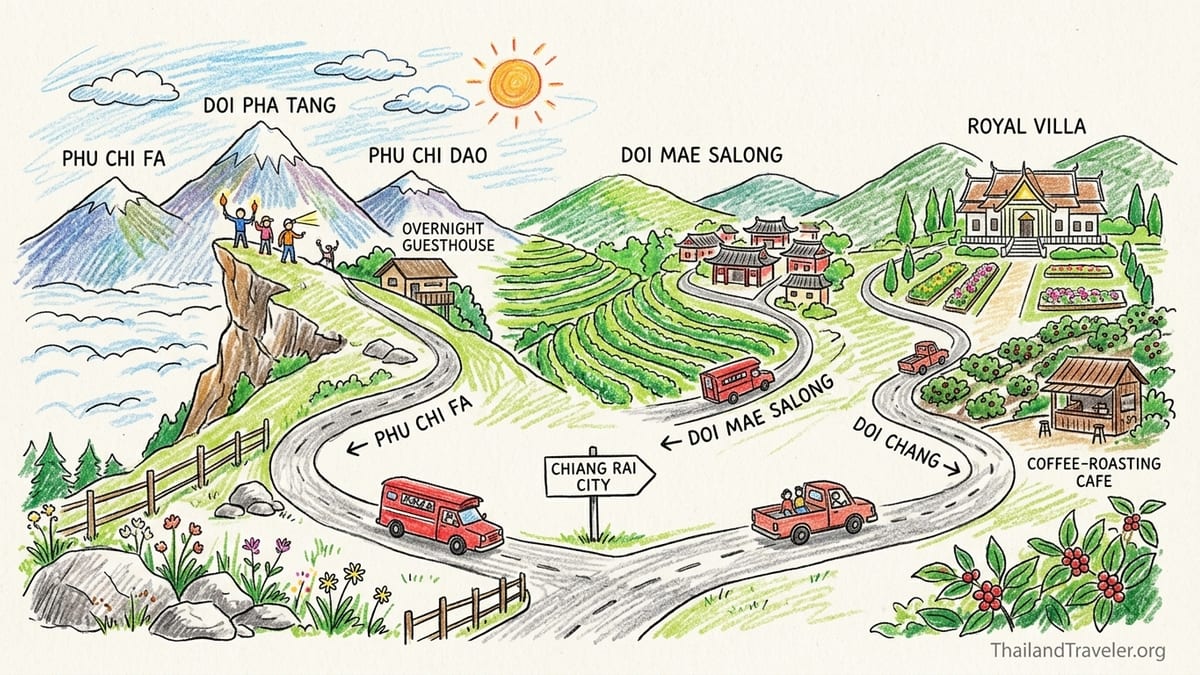
Chiang Rai’s highland sights fall into several distinct pockets. Phu Chi Fa, Doi Pha Tang and Phu Chi Dao lie along the mountainous Thai–Lao border east of the city. Doi Mae Salong, officially Santikhiri, and Doi Tung sit to the northwest in Mae Fa Luang district. Doi Chang is further southwest in Mae Suai district. None of these mountains is very far "as the crow flies", but in practice you will spend a lot of time on narrow, climbing roads that are slower than the highway between Chiang Mai and Chiang Rai.
From central Chiang Rai to Phu Chi Fa, the official tourism listing quotes a distance of about 108 kilometres via Thoeng and Pang Kha, with the last section on smaller roads up to the ridge. Driving to Doi Mae Salong via Mae Chan is roughly 60 to 70 kilometres, while Doi Tung is reached by taking Highway 1 north toward Mae Sai before climbing into the hills on Highway 1149. Doi Chang lies about 70 to 80 kilometres southwest, reached along Highway 118 toward Mae Suai before turning into the mountains. It is technically possible to combine several of these in a single very long day, but most travelers are happier choosing one sector at a time.
This geography matters for planning. A full border-ridge circuit that attempts Phu Chi Fa sunrise, Doi Pha Tang viewpoints and Phu Chi Dao in a single sweep, then continues on to Doi Mae Salong and Doi Tung before returning to Chiang Rai, will involve well over 300 kilometres of mixed roads and many hours in a vehicle. Instead of chasing every peak, think in terms of themed days: one for Doi Tung and Doi Mae Salong, one overnight for Phu Chi Fa and its neighbouring viewpoints, and a separate coffee day around Doi Chang.
Public transport between these mountain villages is limited to infrequent songthaews and local pickups. There are no regular buses up to Phu Chi Fa at 4 a.m., and no direct minivans connecting Doi Mae Salong with Doi Tung or Doi Chang. That is why most visitors either rent a car from Chiang Rai airport or city, or arrange a private driver or tour that understands the road conditions and timing needed for sunrise trips.
Phu Chi Fa, Doi Pha Tang and Phu Chi Dao: Border Ridge Sunrise Routes
Phu Chi Fa is one of Chiang Rai’s best known sunrise spots. The peak forms a rocky spur at roughly 1,628 metres on the Doi Pha Mon range, looking east over Laos. On many cool-season mornings from around November to February, a sea of mist fills the valley below while the sun rises beyond distant ridges. Reaching the main viewpoint involves a walk of around 700 metres from the upper parking area along a dirt and stone path that steepens near the top. Most visitors allow 20 to 30 minutes for the walk in the dark, using phone torches or headlamps.
Official tourism sources report that Phu Chi Fa does not currently charge a national-park style admission fee for the viewpoint itself, although parking and informal village services may collect small charges. The site is usually accessible year-round, but heavy rain and landslide repairs can lead to temporary closures, as travelers discovered during mid-2026. It is sensible to check with your accommodation around Ban Rom Fa Thong or Ban Rom Fa Thai shortly before travelling, especially in the rainy season.
Doi Pha Tang sits on the same border ridge further north along Route 1093. Here, a series of viewpoints look down toward the Mekong River and Laos, with paths and stairways leading to spots such as Chong Pha Bong and signs marking "Viewpoint 103". Recent traveler reports mention a small local entrance or parking fee rather than a formal ticket gate. Walking sections are short but steep, so comfortable shoes and a light jacket are important, especially for dawn visits in December and January when temperatures can drop close to single digits Celsius.
Between Phu Chi Fa and Doi Pha Tang, Phu Chi Dao has become a quieter alternative sunrise summit. Updated local information in 2026 describes Phu Chi Dao as a free-entry viewpoint open daily from 5:00 to 18:00, reached from Ban Rom Fa Luang by a steep 4WD track of about 3 kilometres. Most travelers leave their own cars in the village and pay for a local pickup truck service, typically around 100 baht per person or roughly 500 baht for a chartered truck, then follow a stepped trail and boardwalk of about 400 to 450 metres to the grassy ridge. Compared with Phu Chi Fa’s narrow spur, Phu Chi Dao offers a broader 360-degree panorama and fewer crowds.
Why Phu Chi Fa Works Best as an Overnight Sunrise Excursion
Reaching Phu Chi Fa in time for sunrise from Chiang Rai city requires an extremely early start. Driving the roughly 108 kilometres in a car or van usually takes around two and a half hours in daylight. At night, with slower speeds on the final curving sections, three hours is more realistic. For a December sunrise near 6:40 a.m., you would need to leave the city between 3:00 and 3:30 a.m., then hike up in the dark with no chance to rest or adjust to the cooler temperatures. This is technically possible in a private car, but not especially comfortable.
An overnight stay in villages such as Ban Rom Fa Thong, Ban Rom Fa Thai or Ban Rom Fa Luang makes the experience much more manageable. Simple guesthouses and small resorts line the approach roads, often within a 10 to 15 minute drive of the trailhead. Many properties routinely organise 4:30 or 5:00 a.m. departures, wake-up calls and hot drinks before you set off. In practice, arranging a 4:00 or 4:30 a.m. pickup is as simple as confirming the desired sunrise time at check-in and agreeing on a meeting point in front of the reception or parking area.
Typical room prices in these villages in the 2026 cool season sit in the range of roughly 700 to 1,500 baht per night for a basic double room or simple cabin, rising for weekends and New Year holidays. Some places also offer camping or dome tents, quoted at a few hundred baht per night, for travelers who want a more outdoors experience. The trade-off is limited heating and very cool pre-dawn conditions, so warm layers and socks are important.
If you prefer not to drive at all, private drivers and small local tour operators in Chiang Rai can arrange an overnight Phu Chi Fa trip that includes transport from the city, time for sunset or market browsing in the village, and a sunrise ascent. Recent rate surveys for Chiang Rai drivers show full-day car and driver services around 2,200 to 3,200 baht for a standard vehicle and eight to nine hours. Because Phu Chi Fa involves long distances and early hours, many drivers quote higher figures for this route or treat it as a two-day job. For a couple, it can be more cost-effective to book a packaged overnight tour that shares van and driver costs across several guests, while a family of four or five may find a private van more flexible.
Doi Mae Salong (Santikhiri) and Doi Tung: Tea Estates, Gardens and Culture
Doi Mae Salong, officially the village of Santikhiri, occupies a high ridge in Mae Fa Luang district north of Chiang Rai. Settled by Chinese Nationalist soldiers in the 1960s, it has evolved into one of Thailand’s best-known oolong tea regions, with terraces of bright green tea bushes covering the slopes around the village. Visitors come for mountain scenery, cool air, tea tasting and a glimpse of Yunnanese-influenced culture through food, language and local temples.
Along the access road, plantations such as 101 Tea Plantation and others around Santikhiri welcome visitors to stroll among tea rows, watch basic processing and taste different oolong and green teas. Tea shops in the village typically offer complimentary tasting if you are considering a purchase. Staff may explain oxidation levels, roasting styles and recommended brewing methods, and many sell vacuum-packed bags of tea starting from a few hundred baht depending on grade and weight. This makes Doi Mae Salong an excellent stop for tea enthusiasts who want to compare Thai high-mountain oolong with Taiwanese or Chinese teas they already know.
Doi Tung, further to the north, provides a different kind of highland experience built around a long-running development project. The Mae Fah Luang Foundation under Royal Patronage has worked for decades to replace opium cultivation and forest loss with sustainable livelihoods and reforestation. Visitors today can tour the Doi Tung Royal Villa, former residence of the Princess Mother, and the landscaped Mae Fah Luang Garden below. Official ticket information in 2026 lists a four-site combo ticket covering the Royal Villa, Mae Fah Luang Garden, the Hall of Inspiration museum and the Mae Fah Luang Arboretum at Doi Chang Mub priced at 220 baht for adults and 110 baht for students, seniors and people with disabilities. Each attraction can also be visited separately for 90 baht, but the combo is better value if you plan to see at least three.
The educational aspect at Doi Tung is significant. Exhibitions in the Hall of Inspiration and interpretive signs around the site explain how highland communities shifted from poppy fields and shifting cultivation to coffee, macadamia and handicrafts. The emphasis is on local participation, environmental restoration and long-term income rather than quick tourism profits. For travelers interested in responsible tourism, Doi Tung offers a concrete example, with coffee served under the Doi Tung brand, handicraft shops that promote village-made textiles and ceramics, and forest walks that pass replanted hillsides.
Doi Chang: Coffee Landscapes and Slower Highlands
Doi Chang lies in Mae Suai district southwest of Chiang Rai, and is one of Thailand’s most prominent Arabica-growing regions. The village sits around 1,200 to 1,700 metres above sea level, surrounded by coffee shrubs instead of tea bushes. For years the name Doi Chang has appeared on coffee bags sold across Thailand and overseas, and visiting the mountain allows travelers to connect that brand with real farms, roasting sheds and highland communities.
Driving from Chiang Rai city along Highway 118 and into the hills takes about one and a half hours in a private car. The final climb from Ban Teen Doi involves a paved but narrow and winding road that all standard cars can handle in dry conditions. Once on the ridge, small cafes and roasteries dot the roadside. At some, you can see green beans being sorted, smell roasting coffee in small drum roasters and taste fresh brews overlooking the valley. Prices vary by café, but a pour-over or espresso-based drink often runs in the region of 60 to 100 baht, similar to specialty cafés in Chiang Rai city.
Doi Chang also offers simple guesthouses and homestays for travelers who want to stay a night among the coffee farms, as well as half-day and full-day community visits through local enterprises that explain coffee production, weaving, herbal products and highland agriculture. These are not glossy theme parks. Facilities are basic, and activities depend on the agricultural season. During harvest months, you may see coffee cherry picking and wet processing; at other times, nurseries and pruning take centre stage.
For travelers building a multi-day highland circuit, Doi Chang can be combined with Doi Tung or Chiang Rai city rather than the eastern border viewpoints. The roads between Doi Chang and Phu Chi Fa region are long and indirect, so most itineraries keep coffee and border-ridge sunrises on separate days.
Private Drivers, Guided Tours and Sample Costs
Because Chiang Rai’s mountain attractions are dispersed, most visitors choose between renting a car and hiring a local driver. Recent checks of Chiang Rai driver listings and local travel resources in mid-2026 show typical rates of around 2,200 to 3,200 baht for a standard car with driver for an eight or nine hour day focused on nearby sights. Vans capable of carrying larger families or groups often start around 3,200 to 4,000 baht for a similar day, with higher quotes for demanding mountain routes or extended hours.
For a practical comparison, consider a one-day Doi Tung and Doi Mae Salong circuit from Chiang Rai for two travelers. A private car and driver quoted at 2,800 baht for a nine-hour day, including fuel but excluding attraction tickets and meals, splits to 1,400 baht per person. Add 220 baht per person for the Doi Tung combo ticket, plus perhaps 150 to 250 baht each for tea tasting and snacks in Santikhiri village, and the total approaches around 1,800 to 1,900 baht per person for a full day of mountain touring. A family of four in the same car pays the same 2,800 baht for transport, but spreads it more thinly; the main additional costs are extra attraction tickets and meals, so the per-person price can drop well under 1,500 baht depending on how much everyone spends.
For an overnight Phu Chi Fa sunrise trip, the calculation is different. A private car and driver might quote in the region of 4,000 to 5,000 baht to cover the longer distance, late-night or early-morning hours and waiting time in the village. On top of that, a couple might pay around 1,000 baht for a basic double room near Ban Rom Fa Thong, plus meals and small local transport fees for any onward moves to Doi Pha Tang or Phu Chi Dao. A packaged group tour from Chiang Rai could cost a similar total but bundle van transport, simple accommodation and a guide for several guests. This is why solo travelers often gravitate toward shared tours or public songthaews combined with a guesthouse pickup, while families with children may be happier securing a dedicated vehicle on their own schedule.
Guided tours with licensed English-speaking guides charge more than simple car-and-driver services. Some Chiang Rai agencies publish rates for a guide and vehicle package of 3,500 to 5,000 baht per day, depending on route and vehicle size. The benefit is detailed interpretation at sites such as Doi Tung’s Hall of Inspiration or the KMT history museum around Santikhiri, but budget-conscious travelers who are comfortable reading signage and self-guiding may prefer to save the difference and rely on driver-only arrangements.
Renting a Car vs Hiring a Local Driver
Self-driving in Chiang Rai gives maximum flexibility. Major rental companies and local outfits at the airport and in town offer small cars that are perfectly capable on paved mountain roads to Doi Mae Salong, Doi Tung and Doi Chang. Daily rental rates for compact automatics often fall in the 900 to 1,500 baht range depending on season and insurance, to which you must add fuel and any tolls. For a couple comfortable with left-side driving and mountainous roads, this can work out cheaper than hiring a driver for multiple days, especially on itineraries that include flexible detours or slow exploratory stops.
However, the eastern border mountains deserve caution. Travelers and local drivers alike describe the final stretches toward Phu Chi Fa and Phu Chi Dao as very steep and winding, with tight hairpins and occasional rough patches. In dry conditions a confident driver in a well-maintained car can reach the main Phu Chi Fa parking area, but the unpaved 4WD track to Phu Chi Dao’s upper lot is not realistic for standard rental cars. In practice, many independent travelers drive only as far as Ban Rom Fa Luang, park at their accommodation and pay a local pickup for the steepest section to the trailhead.
Hiring a local driver removes the stress of unfamiliar roads, night-time driving and navigating along unnumbered village lanes. Drivers based in Chiang Rai city or around the highlands know where to stop for fuel, toilets and viewpoints, and can adjust plans due to heavy fog or rain. For families with children, and for travelers unused to mountain driving, the extra cost often buys peace of mind. It also allows everyone in the group to watch the landscape instead of focusing on tight corners.
Another factor is responsibility. When you rent a car, you are personally responsible for any damage, navigation errors and fatigue management. When you hire a driver, they accept the professional duty to manage those details. If your plan involves a 4:00 a.m. start for Phu Chi Fa, followed by more sightseeing later the same day, a driver who regularly keeps such hours may simply be a safer option than trying to do it on your own after a long holiday day.
Single-Day Doi Tung – Mae Salong Tour and Multi-Day Highland Circuits
Many visitors with limited time choose a single-day loop combining Doi Tung and Doi Mae Salong. Leaving Chiang Rai around 8:00 a.m. with a private driver, you can reach Doi Tung in roughly 70 to 90 minutes, spend a morning walking through Mae Fah Luang Garden, touring the Royal Villa and visiting the Hall of Inspiration, then continue along mountain roads toward Mae Salong, arriving mid-afternoon. After a late lunch of Yunnanese noodles or braised pork, you can stroll through Santikhiri village, stop at one or two tea plantations such as 101 Tea Plantation and enjoy sunset views before returning to Chiang Rai by early evening.
A more relaxed version stretches this into two days, staying overnight in Santikhiri. This allows time for early-morning market visits, when local Akha, Lisu and Chinese residents shop for vegetables, tea and spices, plus unrushed tea tastings and short walks into surrounding tea fields. Families often appreciate waking up to cool mountain air and bird calls instead of city traffic. Budget-friendly guesthouses and mid-range boutique stays are both available, with prices varying by view, room size and season.
For travelers who want both border-ridge sunrises and tea or coffee landscapes, a two or three day highland route works best. One common pattern is to leave Chiang Rai for Phu Chi Fa in the afternoon, spend the night near the trailhead, hike up for sunrise, then continue north along Route 1093 to Doi Pha Tang for mid-morning views. From there, you can either return to Chiang Rai city or, on a longer trip, loop back via Thoeng and Mae Chan before heading into the Mae Salong and Doi Tung region on the second or third day.
Another approach is to pair Doi Chang with Doi Tung or Mae Salong. You might dedicate one day to Doi Chang coffee farms, staying the night in a farmstay or homestay, then drive back via Doi Tung the next day for gardens and cultural interpretation. While it is geographically possible to link Doi Chang to Phu Chi Fa, the drive cuts across multiple districts and results in a long, tiring day. In designing your own circuit, always account for the slower pace of mountain highways compared with Google Maps estimates.
Cultural Respect and Highland Community Histories
The highlands around Chiang Rai are home to a mix of ethnic groups, including Akha, Lisu, Lahu and communities with Chinese roots in places like Santikhiri. Some villages, particularly around Doi Tung and Doi Chang, participate in structured development projects that promote coffee, handicrafts and agroforestry. Others continue small-scale farming with limited infrastructure. For responsible travelers, the goal is to appreciate these communities without treating them as exhibits.
In practice, this starts with simple behaviour. Ask before photographing people, especially elders and children. Dress modestly in villages and at temples, covering shoulders and avoiding very short shorts. When buying tea, coffee or handicrafts, prefer shops clearly associated with local producers rather than middlemen selling generic souvenirs. An hour spent tasting tea at a family-run plantation in Doi Mae Salong, or listening to a farmer explain how coffee cherries are processed in Doi Chang, offers far more insight than a quick snapshot from a van window.
Places like Doi Tung illustrate the region’s complex history. Just a few decades ago, much of the mountain was dominated by opium fields and severe deforestation. The Mae Fah Luang Foundation’s long-term programmes encouraged highland families to switch to legal crops, gain citizenship papers and send children to school, while replanting degraded slopes. Exhibitions there emphasise pride and partnership rather than pity. Approaching the site with curiosity and respect, rather than simply treating it as a backdrop for flower photos, helps honour that story.
At Santikhiri, museums and memorial halls remember the Chinese 93rd Division that settled the area after the Chinese Civil War, while local markets sell both Thai and Yunnanese products. Reading a little about that history before arrival, and perhaps visiting the local museum during your stay, will deepen your understanding of how tea replaced earlier trade and security concerns. It also explains why you may hear Mandarin or Yunnanese dialects alongside Thai and Akha languages in the streets.
The Takeaway
Chiang Rai’s mountain attractions offer far more than a single snapshot at dawn. Phu Chi Fa, Doi Pha Tang and Phu Chi Dao reward those willing to rise before dawn and walk short but steep paths to border ridges washed in mist and first light. Doi Mae Salong and Doi Tung combine cool air, scenic vistas and a rich mix of tea estates, gardens and development history. Doi Chang adds a coffee dimension, where cups poured in city cafés connect directly to farms on the hills above.
Because these places are scattered across different corners of the province, the most satisfying trips are those that respect the distances involved. That usually means choosing one sector per day, or building a two or three day circuit that balances driving with time on the ground. Hiring a local driver or joining a well-run tour can simplify logistics, especially for sunrise excursions and steep access roads, while confident drivers may prefer the flexibility of renting a car for tea and coffee routes.
For photographers, the eastern border viewpoints are the main draw. Plan an overnight near Phu Chi Fa or Ban Rom Fa Luang, arrange a pre-dawn pickup and allow time to scout foregrounds on arrival. Carry a tripod for low-light shots, prepare for strong contrast as the sun clears the clouds and remember that side trips to Phu Chi Dao can deliver 360-degree vistas with fewer people in the frame. Afternoon and golden hour at Doi Tung or overlooking tea terraces in Santikhiri also yield compelling compositions.
Tea enthusiasts will want to focus on Doi Mae Salong and Doi Tung, tasting oolong at small family plantations in Santikhiri, learning about processing at places like 101 Tea Plantation, then comparing those flavours with Doi Tung’s socially driven coffee and macadamia projects. Families often gravitate toward the structured, stroller-friendly paths of Mae Fah Luang Garden and the gentle cultural learning at Doi Tung, while mixing in shorter drives to viewpoints that do not require pre-dawn starts. Travelers who care more about mountain scenery than temples or city sightseeing can confidently devote several days to these highland routes, knowing that each ridge offers its own blend of views, history and local flavour.
FAQ
Q1. How much does it cost to visit Doi Tung, including the gardens and Royal Villa?
The main ticket option in 2026 is a four-site combo covering the Doi Tung Royal Villa, Mae Fah Luang Garden, Hall of Inspiration and Mae Fah Luang Arboretum at Doi Chang Mub, priced at about 220 baht for adults and 110 baht for students, seniors and people with disabilities. Each site can also be visited individually for around 90 baht, but most travelers find the combo better value if they plan to see at least three of the attractions.
Q2. Is there an entrance fee for Phu Chi Fa, Doi Pha Tang or Phu Chi Dao?
Current tourism information indicates that Phu Chi Fa and Phu Chi Dao do not charge a formal national-park style entrance fee, though parking or small village contributions may be collected. Doi Pha Tang typically has a modest local entrance or parking charge at the viewpoints. Because fees can change, it is wise to carry small notes and confirm details with your guesthouse or driver shortly before travel.
Q3. How early do I need to leave for a Phu Chi Fa sunrise if I stay in Chiang Rai city?
From central Chiang Rai to the Phu Chi Fa parking area is roughly 108 kilometres, usually taking about two and a half to three hours in the pre-dawn dark. You also need 20 to 30 minutes to walk from the car park to the main viewpoint. For a cool-season sunrise around 6:40 a.m., you would need to depart Chiang Rai no later than 3:00 to 3:30 a.m., which makes for a very short night and a long day. This is why many travelers choose to stay in villages close to the trailhead instead.
Q4. How do I arrange a 4–5 a.m. departure for sunrise at Phu Chi Fa or Phu Chi Dao?
If you stay in Ban Rom Fa Thong, Ban Rom Fa Thai or Ban Rom Fa Luang, most guesthouses regularly organise pre-dawn transfers. When you check in, ask staff about sunrise time and agree on a departure hour, usually between 4:00 and 5:00 a.m. They may drive you directly to the Phu Chi Fa trailhead, or arrange a local pickup truck for the steep 4WD section to Phu Chi Dao. Payment is typically made in cash, either added to your room bill or settled directly with the driver.
Q5. Is it better to rent a car or hire a local driver for Chiang Rai’s mountains?
Renting a car can be cheaper and more flexible for confident drivers, especially on paved routes to Doi Mae Salong, Doi Tung and Doi Chang, where traffic is light and road surfaces are reasonable. Hiring a local driver, at day rates often between 2,200 and 3,200 baht for a standard car, removes the stress of mountain driving, night-time departures and navigation on smaller roads. For sunrise trips to Phu Chi Fa or steep 4WD tracks near Phu Chi Dao, most visitors find a driver plus local pickup service safer and more relaxing.
Q6. What kind of accommodation can I expect around Mae Salong and near Phu Chi Fa?
Around Doi Mae Salong and Santikhiri, choices range from simple guesthouses and small family-run hotels to boutique properties with panoramic terrace views. Rooms can cost from a few hundred baht for basic fan rooms to higher mid-range rates for stylish, view-focused stays with breakfast. Near Phu Chi Fa and along Route 1093, accommodation is simpler: wooden cabins, small resorts and occasional tents or domes. Heating is limited, so pack warm clothing, but locations are convenient for 4:00 or 5:00 a.m. departures.
Q7. How do tea visits at Doi Mae Salong compare with coffee experiences at Doi Chang?
Doi Mae Salong focuses on high-mountain oolong and green teas. Visitors typically join informal tastings in plantation shops, learn about tea oxidation and roasting, and walk past neatly trimmed tea rows. At Doi Chang, the emphasis shifts to Arabica coffee: you might watch roasting in small drum roasters, sample pour-over brews at hilltop cafes and, in some community programmes, see cherry picking and processing. Both offer local products to take home, but the crops, processing and flavour profiles are distinct.
Q8. Are Chiang Rai’s mountain tours suitable for families with children?
Yes, with some planning. Doi Tung’s Mae Fah Luang Garden has paved paths, toilets and cafés, making it very family friendly. Tea villages around Doi Mae Salong offer short walks and easy viewpoints, while Doi Chang provides relaxed café stops with space for children to move around. Border viewpoints like Phu Chi Fa and Phu Chi Dao involve pre-dawn wake-ups, cooler temperatures and short but steep walks, so they suit older children and teenagers more than toddlers. Discuss conditions honestly with your driver or guide before committing.
Q9. What should photographers prioritise in Chiang Rai’s highlands?
Photographers focused on landscapes will want at least one sunrise at Phu Chi Fa or Phu Chi Dao, when seas of mist and layered ridges create classic northern Thailand images. A second dawn or late-afternoon session at Doi Pha Tang can add variety, with views across the Mekong. Tea terraces at Doi Mae Salong and flower beds at Mae Fah Luang Garden offer strong patterns and colours during the day, while Doi Chang’s coffee farms and village scenes lend themselves to documentary-style work. Carry spare batteries, a tripod and protection for gear in fog or drizzle.
Q10. If I am more interested in mountain scenery than temples or city sights, how many days should I allow?
To enjoy Chiang Rai’s highlands at a comfortable pace, consider at least three days. One day can focus on Doi Tung and Doi Mae Salong for gardens, tea and cultural history. A second day or overnight can cover Phu Chi Fa, Doi Pha Tang or Phu Chi Dao for sunrise ridge views. A third day might be devoted to Doi Chang’s coffee landscapes. With four or five days, you can slow down further, add extra sunrise sessions or include rest time between long drives.