


Northern Thailand’s mountains are no longer a niche side trip. Around Chiang Mai, places like Mon Jam, Mae Kampong, Chiang Dao, Doi Ang Khang and Mae Rim have become destination-worthy for travelers who want cool nights, morning mist and cabins or glamping tents with real views. Yet these areas offer very different experiences, from simple streamside homestays to dome tents with bathtubs on the deck, and not every photogenic stay is practical once temperatures drop or the rain sets in.
How Northern Thailand’s Mountain Stays Really Differ
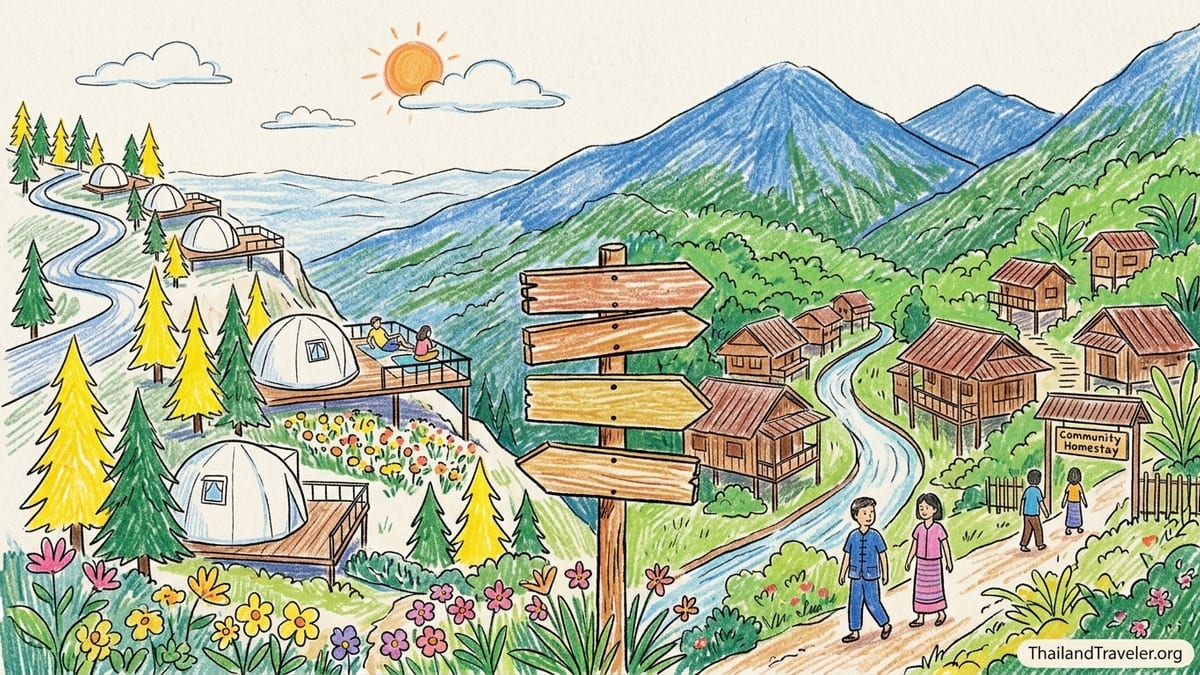
Within a two to four hour drive of Chiang Mai you can sleep in Mon Jam’s ridge-top glamping sites, join a community homestay in Mae Kampong, wake up beneath the cliffs of Doi Chiang Dao, stroll cool-season flower gardens in Doi Ang Khang, or retreat to comfortable hotels around Mae Rim. Although all are marketed with similar images of mist and mountain ridges, the on-the-ground experience varies sharply in terms of comfort, road access, temperature, and how much nature you actually feel once day-trippers go home.
Mon Jam, around 40 kilometers north of Chiang Mai in Mae Rim district, has developed into a dense strip of small resorts and glamping compounds along a high ridge. Many offer canvas or PVC dome tents with private decks, hot tubs and shared or private bathrooms, with entry-level rates in October 2026 generally starting around 900 to 1,500 baht including simple breakfast for a couple in basic non-dome tents, and from roughly 1,800 to 3,500 baht for domes with private bathrooms and better views, based on recent listings and Thai-language booking platforms.
Mae Kampong, about 50 kilometers east of Chiang Mai, is a registered community homestay village at roughly 1,300 meters elevation. Official homestays there usually charge per person rather than per room; academic research and recent village information indicate a typical cooperative rate around 500 to 600 baht per person including three home-cooked meals, basic bedding and hot showers in shared or private bathrooms, which makes it one of the best-value ways to experience cool mountain air if you do not need hotel-style amenities.
Chiang Dao and Doi Ang Khang sit farther from the city but reward that extra travel with quieter mountain lodges and sharply cooler nights in the cool and cold seasons. Around Chiang Dao town and near the base of Doi Luang Chiang Dao, small lodges and glamping sites now commonly price double rooms between about 1,200 and 3,000 baht per night including breakfast, with more rustic bungalows from roughly 800 baht. Doi Ang Khang’s older resort-style accommodation, by contrast, tends to offer conventional hotel rooms with solid walls, hot water and duvets from around 1,200 to 2,500 baht in the shoulder months, rising in peak winter weekends as rooms sell out. Closer to Chiang Mai, Mae Rim’s mid-range resorts provide easier road access and more predictable services at broadly similar price points, often representing better value than the most Instagram-famous dome tents once you factor in heating, bedding quality and backup power.
Mon Jam: Panoramic Glamping and Romantic Dome Tents
Mon Jam’s appeal lies in its panoramic views over Mae Taeng basin and toward the Chiang Dao range, along with relatively short travel time from Chiang Mai. Depending on traffic, private drivers and self-drivers usually reach the area in about 60 to 90 minutes via Mae Rim and winding local roads. The core ridge hosts scores of small accommodations, from very simple tent platforms with shared bathrooms to fully serviced villas. Many of the properties featured on Thai travel portals advertise starting rates between roughly 900 and 1,500 baht for basic tents without air conditioning, and around 2,000 to 3,000 baht or more for dome tents or cabins with private bathrooms, hot water and outdoor soaking tubs.
In practice, the comfort level depends less on the view and more on construction details. Several Mon Jam campgrounds now offer semi-permanent canvas tents or domes on wooden decks, with electricity, lighting, and private or shared bathrooms located a short walk away. Better-reviewed sites note that their bathrooms supply hot showers and that beds come with thick duvets and extra blankets, an important consideration when night temperatures in the cool season can drop below 15 degrees Celsius on exposed ridges, sometimes close to 10 degrees on clear December and January nights. Basic glamping setups that use thin mattresses directly on the deck and only light blankets can feel uncomfortably cold in such conditions, especially when wind drives through gaps in the tent structure.
Cheap Mon Jam tents can also be noisy and damp during rain. Many budget compounds rely on thin PVC or nylon shells which amplify the sound of heavy rain, while condensation builds up inside. In stormy weather, wind can rattle the structure, and because several sites have communal bathrooms located downslope, walking to the toilet at night in wind and drizzle becomes a chore. Travelers who enjoy the idea of outdoor living but are not used to camping may be better served by mid-range Mon Jam stays that combine the glamping aesthetic with more solid insulation, private bathrooms attached directly to the platform, and sheltered outdoor areas where you can still enjoy the view if the weather turns.
Road access at Mon Jam is relatively straightforward for confident drivers, though the final kilometers involve steep, narrow paved roads with sharp curves and occasional potholes. During busy weekends, parking can become tight and some accommodations request that guests park in central lots and use pickup transfers to their platforms. Wi-Fi is now advertised at many properties, but signal strength and reliability vary, especially in wind or storms. Nearby restaurants range from simple noodle stalls and coffee stands to larger cafes and barbecue places that stay open into the evening on weekends. If you plan a romantic overnight escape, booking a property that includes private dinner service or has a good on-site restaurant can make the experience more relaxing than trying to navigate crowded ridge roads after dark.
Mae Kampong: Streamside Homestays and Traditional Village Stays
Mae Kampong offers a very different feel from Mon Jam. Instead of a strip of separate resorts, guests stay inside a living village of wooden houses lining a narrow valley stream. The village is one of Thailand’s longest-running community homestay projects and has been recognized in regional homestay award programs. Most accommodations belong to local families who register with the village cooperative. Rooms tend to be on the upper floors of wooden houses, with shared or simple private bathrooms, foam mattresses or wooden beds, thick blankets, and mosquito nets. Showers typically use small electric water heaters that provide hot but not high-pressure water.
Recent guides from local homestay owners and research focusing on the village’s tourism development describe a standard cooperative rate of about 500 to 600 baht per person, which includes a bed, dinner, breakfast and often lunch if you stay more than one night. That per-person pricing makes Mae Kampong particularly good value for solo travelers or couples who prioritize experience over luxury. Private-bathroom options do exist, often at slightly higher rates per room. For example, some newer guesthouses on the outskirts of the village and nearby holiday homes on booking platforms advertise double rooms or small houses with en suite bathrooms, hot water and Wi-Fi, often starting around 1,200 to 2,000 baht for two people including breakfast, but still within walking or short driving distance of the village center.
The key advantage of staying overnight in Mae Kampong instead of visiting on a day trip is atmosphere. Tour vans periodically stop during the late morning and early afternoon, especially in the dry season, and roadside cafes and viewpoints can feel crowded. By late afternoon, however, most visitors leave and the valley becomes quiet, with only the sound of the stream and sporadic motorbike traffic. Early risers who sleep in the village can walk up to viewpoints above the temple or along nearby trails to see sea-of-cloud conditions on some cool mornings, something that is difficult to time correctly on a rushed day trip from Chiang Mai.
Facilities remain basic despite increased popularity. Wi-Fi coverage exists but can be patchy; power cuts during storms still occur. There are small village shops and coffee houses but no large supermarkets or ATMs, so bringing enough cash is important. Night temperatures in the cool season regularly fall into the low teens, and because many homes are built of wood with gaps in walls and floors, interior temperatures can feel colder than outside. Thick blankets are standard and some homestays now provide electric blankets or hot-water bottles, but heating systems are rare. Travelers who know they get cold easily should request extra blankets and consider packing thermal sleepwear and socks.
Chiang Dao: Quiet Mountain Lodges and Nature Retreats
Chiang Dao district, roughly 70 to 80 kilometers north of Chiang Mai, is dominated by the limestone massif of Doi Luang Chiang Dao, which rises to over 2,100 meters and creates dramatic scenery of sheer cliffs and forested slopes. Accommodation clusters primarily around Chiang Dao town, along rural roads leading toward the base of the mountain, and near natural attractions such as Chiang Dao Cave and local hot springs. Compared with Mon Jam or central Mae Rim, the pace here is slower and the built environment less dense, so many lodges can offer quieter nights and wider views.
Around the foothills, small resorts and guesthouses typically provide solid-walled bungalows or rooms with private bathrooms, hot showers, and often air conditioning or at least fans for the hot season. Recent booking data for October and November dates shows garden-view bungalows and double rooms starting around 900 to 1,200 baht per night including breakfast at simpler properties, while more polished nature resorts with pools, on-site restaurants and mountain-view villas tend to price between about 1,800 and 3,500 baht per night for couples. A growing number of places market themselves as glamping sites, with spacious tents or domes equipped with real beds, private bathrooms and sometimes outdoor tubs, often in the 1,500 to 3,000 baht range depending on view and amenities.
For travelers, the main trade-off in Chiang Dao is distance versus tranquility. Driving from Chiang Mai takes roughly 90 minutes to two hours on mostly good highways followed by smaller local roads. Independent drivers appreciate the straightforward route and easy parking at most lodges, many of which have ample space and direct car access to individual units. Those without a car usually rely on pre-arranged private transfers or scheduled buses or vans to Chiang Dao town combined with local pickups. In return for the extra logistics, you sleep in a landscape where night skies can be dark enough to see stars and mornings are relatively quiet compared with the viewpoints closer to Chiang Mai.
Because accommodation concentrates in small pockets rather than a continuous strip, having on-site dining or a restaurant within walking distance matters. Better-established Chiang Dao resorts commonly include breakfast in the room rate and operate their own restaurants serving Thai dishes all day. Several also promote coffee stands or viewpoints on their grounds, so photographers can capture sunrise and sunset light without driving pre-dawn on mountain roads. Wi-Fi is widely advertised and usually sufficient for messaging and light work, although speeds vary. During the cool season, nights can become significantly colder than in Chiang Mai city, so duvets and extra blankets are standard and some lodges provide room heaters or electric blankets for an additional fee.
Doi Ang Khang: High-Altitude Gardens and Cool-Weather Stays
Doi Ang Khang, located along the border between Thailand and Myanmar, is one of Chiang Mai province’s highest accessible resort areas and has long been known domestically for its agricultural research station and cool-season flower gardens. Travel time from Chiang Mai typically runs three to four hours by private car, involving a mix of highways and steep, winding mountain roads in the final approach. The elevation and exposure bring reliably cooler air than lower mountain valleys, with winter-night temperatures sometimes dropping into single digits Celsius and occasional frost at the coldest times of year.
Accommodation options around Doi Ang Khang include an older but well-situated resort beside the royal agricultural station, several small local hotels and guesthouses in the nearby village, and basic bungalows and tents in national park or research-station grounds when available. Although exact rates fluctuate by season and booking channel, recent publicly listed sample prices for the area indicate that simple double rooms with private bathrooms can often be found from around 1,200 to 1,800 baht per night in the shoulder months, rising on popular winter weekends. Rooms within or near the research-station gardens command higher rates than village guesthouses but offer the advantage of walking access to sunrise viewpoints and ornamental gardens at first light.
Because of the long, steep drive and limited evening facilities, Doi Ang Khang works best as an overnight or two-night base for travelers who are confident in mountain driving or who have arranged private transport. The reward is sunrise and early-morning mist above vegetable plots, orchards and flower fields, plus cool afternoon temperatures suitable for walking, birdwatching and photography. Day-trippers from Chiang Mai face six or more hours of round-trip road time, which leaves little flexibility for bad weather or lingering in the gardens. For families, the area feels more like a conventional highland resort zone than a village homestay, with clear separation between accommodation, garden attractions and small local markets.
Facilities in Doi Ang Khang accommodations are generally more hotel-like than in homestay villages. Solid walls, tiled private bathrooms with water heaters, proper insulation and duvets or thick quilts are the norm at established resorts. Some places offer room heaters or electric blankets on request or for a small supplement, which can make a large difference in comfort on very cold nights. On the other hand, dining options after dark can be limited to in-house restaurants and a few local eateries, with many closing by around 20:00 or earlier in the quiet season. Travelers should not expect wide restaurant choice or nightlife. Given the altitude and remoteness, Wi-Fi can be slower than in Chiang Mai city and mobile signal at times inconsistent, which suits visitors seeking a digital break but frustrates those who need stable connections.
Mae Rim: Comfortable Hotels with Easy Access to Chiang Mai
Mae Rim sits much closer to Chiang Mai than the other destinations in this guide, yet includes foothills and valleys that feel surprisingly green and cool, especially in the late afternoon and at night during the cool season. The district covers a range of accommodation types, from large spa resorts near the main highway to smaller boutique hotels and homestays in side valleys. Importantly for many visitors, Mae Rim allows travelers to sleep in more conventional rooms with full hotel services while still reaching viewpoints, waterfalls and activities in under an hour’s drive from Chiang Mai’s Old City.
Medium-range resorts in Mae Rim typically price standard double rooms between about 1,500 and 3,000 baht per night including breakfast in the cooler months, with higher rates at top-end properties that add pools, spas and extensive landscaped grounds. Rooms almost always feature private bathrooms with hot showers, air conditioning, and decent insulation. While temperatures rarely become as cold as in Doi Ang Khang or the highest parts of Mon Jam, the combination of altitude and valley breezes can still make evenings pleasantly cool. For travelers who value predictable comforts such as firm mattresses, blackout curtains, and consistent water pressure, Mae Rim’s resort strip often delivers better value than similarly priced glamping tents higher on the ridges.
Another advantage is access. Roads from Chiang Mai to Mae Rim are wide and well-maintained, suitable for taxis, private drivers and self-drivers who are not comfortable with very steep mountain sections. Grab and similar ride-hailing services usually operate in this corridor, although availability tapers off later at night and farther into side valleys. Families appreciate that activities such as elephant sanctuaries, zipline parks, botanic gardens and the Mon Jam viewpoints are within day-trip distance, so you can combine relaxed resort time with excursions without changing hotels every night. Photographers who mainly want sunrise and sunset light may still prefer to overnight directly on the ridges, but others will find that returning to a comfortable Mae Rim room in the evening yields a better rest.
Wi-Fi, parking and on-site restaurants are standard features in most Mae Rim hotels, making this the most straightforward base for travelers who need to work remotely or who are nervous about rural driving. For those planning a longer northern Thailand stay that mixes city sightseeing with cooler nights and greenery, basing in Mae Rim for several days and then adding one or two nights in a higher, more rustic mountain area can offer a balanced itinerary.
Smaller Alternatives: Mae Wang, Mae Chaem and Samoeng
Beyond the better-known names, several smaller areas south and west of Chiang Mai offer meaningful mountain stays with verified accommodation. Mae Wang, to the southwest, follows a river valley fringed by hills and is popular for bamboo rafting and day trips, but also has homestays and small lodges. A number of farmstays and homestays with private bathrooms, hot showers and simple breakfast now appear on major booking platforms in the Mae Wang area, with recent sample prices showing double rooms from roughly 900 to 1,500 baht per night. Properties such as small streamside homestays emphasize quiet, greenery and traditional-style houses while still providing basic comforts like Wi-Fi, parking and breakfast.
Farther southwest, Mae Chaem serves as a gateway for those heading toward Doi Inthanon and surrounding highlands. The town itself sits at lower elevation than some destinations in this guide but is still cooler than Chiang Mai city and significantly quieter. Guesthouses and small resorts often feature private bathrooms, hot water, and air conditioning or fans, with room rates for doubles commonly between about 700 and 1,500 baht depending on setting and season. For travelers with a car who want to explore rural roads, rice terraces and viewpoints without the crowds of more famous spots, Mae Chaem can make a rewarding base for two or three nights, especially outside holiday weekends when popular mountain viewpoints closer to Chiang Mai are busiest.
Samoeng district, west of Chiang Mai, is known among local drivers and cyclists for its circular mountain route, with forested ridges and strawberry farms. Accommodation includes homestays, small resorts and farms offering bungalows and cabins. Verified listings show a mix of shared and private bathrooms; travelers who value privacy and hot water should filter specifically for en suite bathrooms and electric water heaters. Night temperatures in the cool season feel crisp but not as cold as the highest points of Doi Ang Khang or Mon Jam, and road access involves winding but mostly paved routes. These smaller alternatives work well for independent travelers and drivers who want to explore without committing to the most remote or most commercialized areas but still sleep to the sound of rivers or forest.
In all three districts, infrastructure is more limited than in Mae Rim or Chiang Mai city. Restaurants close early, many accommodations accept cash only, and English-language signage can be sparse. However, Wi-Fi and mobile data are increasingly available even in small homestays, and verified online reviews provide a useful check on cleanliness and comfort for specific properties. For travelers seeking quieter retreats or longer stays at lower nightly cost, these areas can deliver good value so long as expectations remain realistic about service levels.
Why Cheap Glamping Tents Can Feel Harsh in Cold, Wind and Rain
Photo-led marketing often hides the practical weaknesses of cheap glamping setups in northern Thailand’s mountains. A tent or dome with a private deck and plunge tub might look perfect in dry-season photos, but comfort depends heavily on insulation, wind protection, bedding and bathroom design. At elevations above about 1,000 meters, clear winter nights can be genuinely cold by tropical standards, and the combination of wind and moisture makes thin tent walls a poor barrier. Guests sometimes discover that an attractive dome feels more like a basic camping tent once temperatures drop and the wind picks up.
Lower-priced glamping tents at Mon Jam, Chiang Dao and other ridges frequently use lightweight PVC or nylon shells over simple frames, with perforated or semi-open floors and minimal sound insulation. During strong wind, drafts can enter around zippers and floor seams, creating cold spots around beds. Even when duvets are provided, uncovered floor areas stay cold, so stepping out of bed in the night can be uncomfortable. In heavy rain, the drum-like sound on the tent roof may make sleep difficult, and condensation buildup can leave the interior feeling damp by morning despite no actual leaks.
Bathrooms represent another key difference between budget and better-quality glamping. Some of the cheapest sites still use shared bathrooms located along muddy or slippery paths, which means walking in rain or cold to use the toilet. For travelers unaccustomed to camping, this can make short stays feel longer than planned. Mid-range and premium domes that include attached private bathrooms with hot water heaters and at least partial solid walls offer significantly better comfort, especially when they have small covered porches or enclosed deck areas where you can sit even during light rain. Choosing such features often matters more to sleep quality than an extra decorative outdoor tub or more dramatic Instagram view.
Heating is rarely standard in northern Thai mountain tents. Even some high-end domes do not provide space heaters by default, preferring to offer thick blankets and occasionally electric mattress pads. This can be adequate for many travelers, but those who know they sleep cold should consider properties that explicitly mention heaters or electric blankets, or opt for solid-walled cabins or resort rooms instead. When comparing prices, also check whether breakfast is included and whether there are covered common areas where you can escape cold wind in the evening. A slightly higher nightly rate at a conventional resort often buys a much more forgiving environment during spells of bad weather.
Overnight Stays vs Day-Trip Viewpoints
Many Chiang Mai visitors consider visiting Mon Jam or Mae Kampong as a day trip, reasoning that they can enjoy the view and return to the city’s comforts at night. This works reasonably well in the dry and hot seasons if your main goal is scenery and coffee stops. Shared vans and private tours can reach Mon Jam, Mae Kampong and Mae Rim-based viewpoints in around one to two hours each way, and day tours sometimes bundle multiple stops such as hot springs, waterfalls and zipline parks. However, day trips rarely deliver the full mountain experience because they miss the most atmospheric times of day.
Sunrise and the first few hours of the morning are when mist most often forms in valleys around Mae Kampong, Chiang Dao and Doi Ang Khang. Guests who have slept nearby can step out in warm clothes and watch clouds drift through forested slopes without needing to drive mountain roads in the dark. Evening also changes the feel of mountain villages completely. Cafes close, valley lights flicker on, and temperatures drop noticeably, encouraging slower walks and early nights. Day-trippers generally depart before this transition, leaving overnight guests to enjoy quieter paths and viewpoints.
On the other hand, overnight stays require more attention to practicalities such as road safety, seasonal closures and booking legitimacy. During the rainy season, which typically stretches from around May to October, sudden storms can reduce visibility on mountain roads and trigger small landslides or fallen branches. Self-drivers need to be comfortable with steep gradients, hairpin bends and occasional loose gravel or potholes. In the cool season, dawn and dusk driving may involve patches of fog. Booking licensed accommodations with clear contact details, recent reviews and established operations can help ensure that parking, lighting and local advice on road conditions are available.
Some national park areas near Chiang Dao and Doi Ang Khang, as well as certain summit trails, operate seasonal closures for ecological reasons or due to weather risks. While standard hotels and village homestays remain open most of the year, certain high-level camping areas or summit shelters may not be available during specific months. Travelers whose primary goal is a particular sunrise viewpoint or summit hike should confirm seasonal access before committing to non-refundable rooms or fixed itineraries. For most visitors, staying in lower-elevation lodges and visiting higher viewpoints during the day provides a good balance between scenery and practical comfort.
Choosing Stays for Couples, Families, Photographers, Drivers and Quiet Retreats
The best mountain accommodation near Chiang Mai depends as much on who you are traveling with as on scenery alone. Couples who prioritize romance lean toward Mon Jam domes or Chiang Dao glamping tents that combine privacy with dramatic views, while families often prefer Mae Rim resorts or larger Chiang Dao lodges with solid walls, multiple beds and on-site dining. Photographers might accept simpler rooms if they secure better vantage points and sunrise access, and independent drivers care strongly about parking and road gradients. Travelers seeking quiet above all else often gravitate toward Chiang Dao, Mae Kampong or smaller valleys like Mae Wang and Samoeng.
To highlight these trade-offs, consider a sample cool-season weekend in late November for two adults. A basic but scenic Mon Jam tent with shared bathrooms might show online rates around 1,000 to 1,200 baht including breakfast. Steps up from that, a mid-range dome tent with en suite bathroom and hot water could price around 2,500 to 3,000 baht per night. In Mae Kampong, a cooperative homestay charging per person might total roughly 1,000 to 1,200 baht for two guests including dinner and breakfast, while a nicer private-bathroom guesthouse or holiday home may cost between 1,800 and 2,500 baht, often with breakfast but not always with full board. In Chiang Dao, mid-range lodges around 1,800 to 2,500 baht per night typically offer solid rooms with private bathrooms, hot showers, breakfast and on-site restaurants, which can provide better value for those sensitive to cold or noise.
For families of four in the same period, Mae Rim resorts and some Chiang Dao lodges show double or family rooms around 2,500 to 3,500 baht including breakfast for all, with full private bathrooms, pools or gardens and easy car access. By comparison, placing a family of four in two Mon Jam dome tents or a cluster of glamping units can quickly cost more than a comfortable resort, while still exposing children to colder nights and shared-bathroom logistics. Photographers who travel solo may find Mae Kampong’s per-person pricing attractive, especially when it includes meals and early morning access to village viewpoints on foot without renting a motorcycle.
The following comparison summarizes typical choices based on widely available accommodation features and recent sample rates for cool-season weekend stays for two people. The prices are indicative rather than exact quotes, using publicly referenced price ranges and verified accommodation types to show relative differences between destinations.
Couples: Romantic glamping domes in Mon Jam and Chiang Dao with private bathrooms and bathtubs or hot tubs, often 2,500 to 3,500 baht per night including breakfast, offer memorable views and privacy but require accepting potential cold and noise. For couples who value warmth and quiet more than photos, a 2,000 to 3,000 baht solid-walled room in Chiang Dao, Mae Rim or Doi Ang Khang with thick duvets, good showers and on-site dining usually delivers more sustained comfort.
Families: Mae Rim resorts and Chiang Dao lodges around 2,500 to 3,500 baht for family rooms with private bathrooms, pools or gardens, breakfast and parking tend to be best suited. They provide predictable hot water, heating or thick bedding and shelter from rain, which matters with children. Homestays in Mae Kampong or Mae Wang can also work for families who want cultural immersion and can manage stairs, simple bathrooms and earlier nights.
Photographers: Mae Kampong homestays and Doi Ang Khang hotels place you close to misty dawn scenes and garden viewpoints, often for 1,000 to 2,500 baht with meals or breakfast. Chiang Dao lodges with on-site viewpoints and open land also serve landscape and night-sky photographers well. Glamping tents with high platforms in Mon Jam or Chiang Dao suit those who want sunrise from their deck, but they should budget for mid-range or better units to ensure adequate warmth and privacy.
Independent drivers: Mae Rim and Chiang Dao rank best for drivers who want straightforward highway access, reliable parking and logical routes. Mon Jam’s ridge roads can be narrow and crowded, especially on weekends, and Mae Kampong’s single-lane village street may challenge nervous drivers. Smaller areas such as Mae Wang and Samoeng require comfort with winding mountain roads and occasional gravel or broken pavement.
Travelers seeking quiet retreats: Chiang Dao’s nature-focused lodges and cabins, and homestays or small farms in Mae Wang, Mae Chaem and Samoeng usually provide the calmest nights, with fewer nearby bars or traffic noise. Mae Kampong offers quiet once day visitors leave, but the compact village layout means you still hear neighbors and church or temple bells. Mon Jam can remain lively into the evening due to cafes, music and vehicles along the ridge.
The Takeaway: Itinerary Ideas and When Resorts Beat Dome Tents
For a one-night romantic escape from Chiang Mai, Mon Jam and Chiang Dao are the most practical targets. Couples who enjoy the novelty of glamping can choose a mid-range dome tent at Mon Jam or a Chiang Dao glamping site with a private bathroom, hot water and clear view from the bed. Booking midweek or outside holiday periods increases the sense of seclusion. Those who prefer warmth and quiet over stylized photos should instead look to a well-reviewed Chiang Dao lodge or a Mae Rim boutique resort; they still get cool evening air on the veranda but sleep behind solid walls with steady hot water and less chance of being woken by wind or heavy rain on canvas.
For a two-night mountain weekend, combining Mae Kampong with either Chiang Dao or Mae Rim offers variety. Spending the first night in Mae Kampong lets you experience village life, home-cooked meals and early-morning cloud views, while a second night in a Chiang Dao or Mae Rim resort restores some luxury with larger bathrooms, better mattresses and more dining choices. Independent drivers can design loops that connect these areas through back roads, while travelers reliant on transfers may prefer basing in Mae Rim with a dedicated overnight trip to Mae Kampong or Mon Jam arranged through local tour operators or drivers.
For longer, nature-focused holidays of three to five nights, Chiang Dao remains one of the strongest bases. A sequence such as two nights in Chiang Dao followed by two nights in Doi Ang Khang or Mae Chaem allows time for hiking, cave visits, hot springs, village walks and photography without needing to pack every day. Travelers who want very quiet days to read, write or work on creative projects might instead choose a simple homestay or farmstay in Mae Wang, Mae Chaem or Samoeng after an initial city stay in Chiang Mai and a taster night in Mon Jam or Mae Kampong.
Across all these scenarios, a conventional resort or solid-walled lodge often provides better value than a purely photogenic dome tent once you factor in practical issues. For roughly 2,000 to 3,000 baht per night in many mountain districts, you can secure a private bathroom with reliable hot shower, good bedding, breakfast, parking, and often a restaurant and pool. In contrast, some domes charge similar or higher rates for thinner walls, more noise and weaker weather protection. Dome tents and glamping make most sense if you specifically want that aesthetic and accept the camping-like trade-offs. Otherwise, allocating your budget toward better insulation and services rather than the most dramatic photo backdrop typically leads to warmer, drier and more restful mountain nights.
FAQ
Q1. When is the best time of year to stay in Chiang Mai’s mountain hotels?
The coolest and most comfortable months generally run from about November to February, when daytime temperatures are mild and nights can be crisp, especially in higher areas like Doi Ang Khang and the ridges near Mon Jam and Chiang Dao. March and April are hotter and can be hazy due to regional burning, while the May to October rainy season brings greener hillsides but more frequent storms and reduced views.
Q2. Do I need to rent a car to visit Mon Jam, Mae Kampong or Chiang Dao?
Renting a car is not strictly necessary, but it does add flexibility, especially for Chiang Dao and smaller valleys like Mae Wang and Samoeng. Mon Jam and Mae Kampong can be reached by shared vans, private tours or hired drivers from Chiang Mai, while Chiang Dao has scheduled buses and vans to the town followed by local transfers to lodges. Self-driving requires confidence on steep, winding roads, especially in wet or foggy conditions.
Q3. Are glamping tents in Mon Jam and Chiang Dao warm enough in winter?
Mid-range and higher-end glamping tents usually provide thick duvets, extra blankets and hot showers, which are sufficient for many travelers in the cool season. Budget tents with thin walls, gaps and light bedding can feel cold on clear winter nights, particularly on exposed ridges. If you feel the cold easily, look for properties that mention heaters, electric blankets or solid-walled cabins, and consider packing warm sleepwear and socks.
Q4. How do Mae Kampong homestays compare with hotels in terms of comfort?
Mae Kampong homestays are simpler than conventional hotels. Expect wooden houses, foam mattresses or basic beds, shared or simple private bathrooms with hot showers, and thick blankets instead of heating systems. Noise from neighboring houses and early-morning village life is common. In return, you get home-cooked meals, cultural immersion and cooler air at very reasonable per-person prices, especially for solo travelers and couples who do not require hotel-level privacy.
Q5. Is Wi-Fi reliable in northern Thailand’s mountain areas?
Wi-Fi is now offered at many mountain accommodations in Mon Jam, Mae Kampong, Chiang Dao, Mae Rim and even smaller valleys such as Mae Wang, but speeds and stability vary. Mae Rim and Chiang Mai’s outskirts generally have the most reliable connections, while remote ridges and high-altitude areas may experience slower speeds and occasional outages, particularly during storms. Travelers who must work online should confirm connectivity directly with their chosen property.
Q6. Are there safety concerns when driving to these mountain destinations?
The main concerns are steep gradients, tight curves, wet or muddy patches in the rainy season and occasional fog or low visibility in the cool months. Most main roads are paved, but some final access stretches to lodges or homestays may include potholes or narrow sections. Driving in daylight, avoiding high speeds on descents, and postponing trips during severe storms all reduce risk. If you are uncomfortable with mountain driving, hiring an experienced local driver or joining a private tour is a sensible alternative.
Q7. How far in advance should I book accommodation in places like Doi Ang Khang or Mae Kampong?
For weekends and Thai holiday periods between November and February, booking at least several weeks in advance is wise for popular areas such as Doi Ang Khang, Mon Jam and Mae Kampong, as rooms and homestays can sell out. Midweek nights and non-holiday periods usually offer more flexibility, but specific high-demand properties with strong reputations may still fill early. Last-minute options are easier to find in Mae Rim and Chiang Mai’s outskirts.
Q8. Can families with young children stay comfortably in homestays and glamping tents?
Families can stay in both, but practicalities matter. Homestays in villages like Mae Kampong often involve steep stairs, shared bathrooms and early nights, which may not suit very young children or those who need quiet at set times. Glamping tents can be fun for children, yet cold nights, thin walls and shared bathrooms may challenge families used to hotel comforts. Many families find that Mae Rim resorts or Chiang Dao lodges with family rooms, private bathrooms and gardens offer the best blend of adventure and comfort.
Q9. Are there vegetarian or special-diet options at mountain accommodations?
Increasingly, many mountain cafes and resorts around Chiang Mai can provide simple vegetarian dishes such as fried rice, stir-fried vegetables, tofu curries and salads. In homestays, hosts are often willing to adjust menus if informed in advance, though choice may be limited and ingredients seasonal. Strict vegan, gluten-free or allergy-friendly diets require more planning and sometimes bringing snacks or staples from Chiang Mai city, where supermarkets and specialist restaurants are more common.
Q10. How do I check if a mountain accommodation is legitimate and operating safely?
Look for properties with clear names, addresses and contact details, consistent recent reviews from multiple sources, and photos that match traveler images rather than only promotional shots. Licensed homestays and hotels in areas like Mae Kampong and Chiang Dao are often mentioned in local tourism information or community pages. When in doubt, contacting the property by phone or message to confirm room details, access, parking and payment methods helps verify legitimacy and provides a first impression of how responsive and organized the hosts are.