


The misty mountain domes of Mon Jam in Chiang Mai have taken over Instagram: glowing geodesic tents, private decks, and a sea of clouds at sunrise. On my feed, every photo looked dreamy and secluded, framed by endless green ridges and bubbling moo kratha barbecues. But regulars in Chiang Mai quietly warn that the reality can be crowded, noisy, and surprisingly basic for the price. To find out what is really behind the photos, I booked and paid for two very different glamping stays in Mon Jam in 2026 and spent a night in each: one popular geodesic dome on a hillside, and one more traditional wooden bungalow with mountain views.
What Attracted Me: The Instagram Promise of Mon Jam Domes
The first spark was a set of photos tagged in Mon Jam on a Chiang Mai travel account. In one, a clear dome sat on a wooden deck with a white duvet spilling toward a glass front, looking over layers of blue mountains and a soft sea of mist. A caption claimed it was taken in January at 6.30 in the morning, with temperatures around 12 degrees Celsius. Travel blogs and Thai-language review sites echoed the same promise: cool mountain air, heated domes, hot showers, and private moo kratha dinner on your own balcony, all within a 1.5 hour drive of Chiang Mai city.
Mon Jam itself is a ridge-top viewpoint in Mae Rim district, about 35 to 40 kilometers northwest of Chiang Mai Old City, part of the Nong Hoi Royal Project area. It has become one of the region’s most popular cool-season escapes, known for flower gardens, strawberry plots, simple campsites and an increasing number of private dome tents and glamping resorts. As demand has grown, operators have added artificial photo spots such as bamboo swings, heart-shaped viewing decks, and outdoor bathtubs set up purely for pictures.
What caught my eye were the newer heated domes that promised hotel-like comfort rather than simple tents. Many listings on Thai booking sites in 2025 and 2026 advertise electric blankets, reverse-cycle air conditioning or plug-in heaters, private bathrooms with hot showers, and high-speed Wi-Fi. Prices typically sit between about 2,000 and 5,000 baht per night for two people in the cool season, often including breakfast and the option to add an all-you-can-eat moo kratha barbecue dinner for an extra fee.
Of course, photos rarely show the neighboring domes, parking lot, or the narrow access road. So I decided to test two contrasting stays. For night one I booked a popular mid-range dome site that regularly appears on roundups of “best Mon Jam glamping” and on booking platforms, using a standard two-person dome with private bathroom. For night two I chose a nearby small resort that offers simple wooden bungalows with mountain views but conventional rooms, closer to what you might find in a mountain guesthouse around Mae Kampong or Samoeng.
What I Booked, What I Paid, and How I Got There
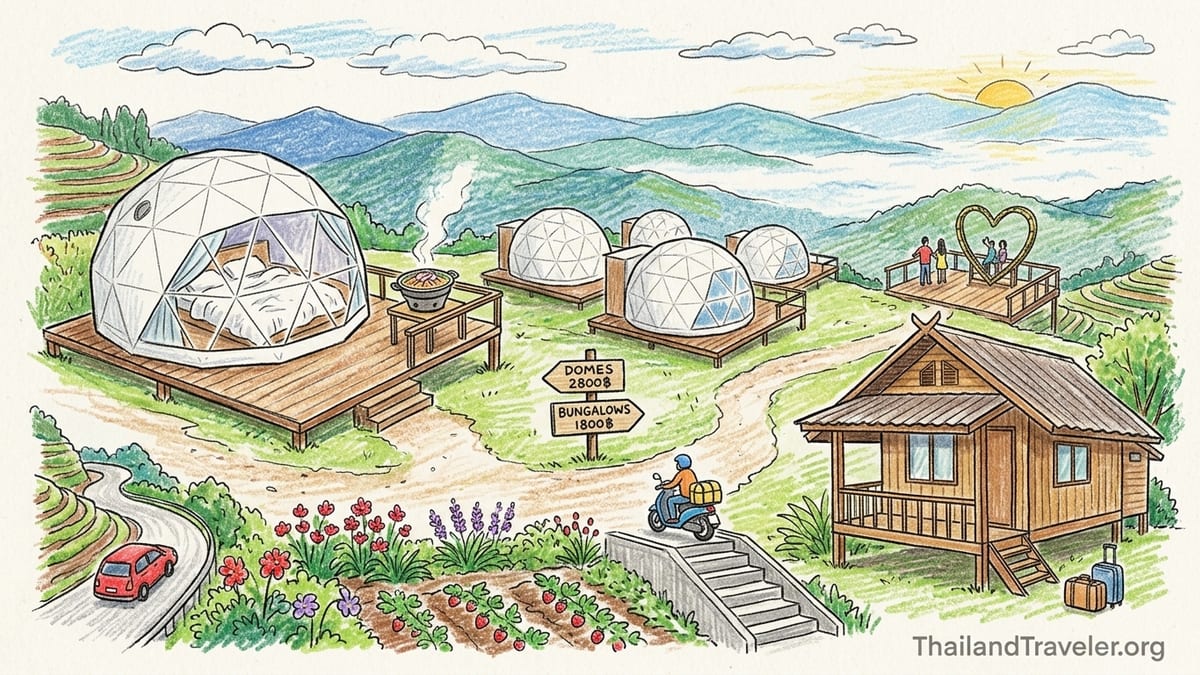
For the dome experience, I booked a hillside glamping site just outside the central Mon Jam viewpoint area. The room category was a “Standard Dome for 2 with Private Bathroom,” advertised at 2,800 baht per night on a weekday in August 2026 during the rainy season shoulder period. After service fees that brought the total to just over 3,000 baht for two people including breakfast, with the option to add moo kratha dinner on the balcony for 699 baht for two. The booking photos showed a white 5-meter dome on a wooden platform facing open hills, a raised queen bed, fairy lights, and a small hot water bathroom behind the bed.
The exact location, which I received after booking, was a cluster of domes west of the main Mon Jam viewpoint, down a side road off the ridge. The property offered free parking on-site and could arrange a private transfer from Chiang Mai for 1,200 to 1,500 baht each way in a pickup truck or SUV. There was no mention of public transport, and when I asked by message whether a songthaew or minivan from Chiang Mai was practical, the staff replied that shared transport would drop me only at Mae Rim town or at the main Mon Jam junction, from where I would need a local pickup or motorcycle taxi.
To keep control over timing and stops, I drove myself from Chiang Mai Old City in a small rental car. Leaving at around 14.30, I followed Route 107 north toward Mae Rim, then turned left onto the mountain road that climbs toward Mon Jam. The journey took about 1 hour 10 minutes in light weekday traffic. The final 7 to 8 kilometers after Mae Rim are steep, with a mix of sharp switchbacks and narrow sections where you share the road with pickup trucks, motorbikes and tour vans. In the wet season some segments are slick with mud washed from roadside farms. This is not a route I would recommend to a nervous driver in heavy rain or on a scooter if you are inexperienced.
Parking at the dome site was a small gravel area on a slope, with space for around ten cars. From there it was a short walk up a steep concrete staircase to reception and the domes terrace. Luggage was carried by staff on motorbike for an extra 50 baht per trip, or you could carry it yourself. None of this logistical reality appears in the promotional photos, which imply that you step straight from your car onto a private deck. Mon Jam’s terrain makes stairs and climbs almost inevitable.
The Dome in Reality: Views, Layout and Comfort
The dome I booked matched the basic shape of the photos, but the setting was less isolated than the marketing suggested. My Standard Dome sat in the second row, one level down from the front row of domes that had completely unobstructed views. From inside my dome, the panoramic view was partially framed by the dome in front, though the ridge and distant hills were still visible. The property did have a shared wooden viewing deck at the top row, which gave the full Instagram perspective, but that was not the angle from my bed.
Inside, the dome was about 5 meters in diameter with a zippered door and a clear front panel. The raised queen bed had a firm mattress, clean white sheets, a duvet, and two medium-thick blankets. At the foot of the bed stood a small coffee table and two low chairs, plus a kettle with instant coffee and tea. Against the back wall was a small hanging rail and a shelf. At one side was a basic but private bathroom, built as a small concrete annex with a sliding door, squat-style toilet, hand shower, sink and an electric water heater. The bathroom floor was tiled but stayed damp after a shower because there was no exhaust fan.
Heating and cooling were limited to a small reverse-cycle air conditioning unit fitted at the back of the dome and a portable fan. The operator marketed the dome as “heated” and “air conditioned,” but the thin PVC shell and gaps around the deck edge meant the temperature inside changed quickly with the outside air. During the afternoon, with sun hitting the dome, the interior became hot and stuffy, exceeding 30 degrees Celsius by about 15.30. The air conditioner could cool it slightly, but because the unit was small and the dome surface radiated heat, it remained uncomfortable until the sun dropped behind the ridge.
At night, conditions reversed. On my stay in late August, the outside temperature dropped to around 19 degrees Celsius before dawn according to the forecast and the property’s small exterior thermometer. Inside the dome, with the air conditioner switched to a gentle heating mode and the duvet plus extra blanket, I remained comfortably warm in light sleepwear. In the cooler months between November and February, when overnight lows in Mon Jam often fall to 10 to 14 degrees Celsius, you would likely want thicker blankets or an electric blanket if provided. Guest reviews across several Mon Jam dome properties frequently mention cold floors and condensation on the PVC inner wall during mid-winter stays, so layering clothes and socks remains a good idea even in so-called heated domes.
Noise, Privacy, Facilities and That Moo Kratha Dinner
Glamping implies a degree of seclusion and nature, but in Mon Jam many dome sites feel more like compact hillside motels. On the property where I stayed, Standard Domes were packed in two rows with barely two meters between decks. Conversations carried easily across the thin dome walls, and when a neighboring couple played music via a portable speaker on their balcony around sunset, every lyric was audible. After quiet hours around 22.00, and with most guests retreating inside, noise dropped significantly, but I could still hear phone notifications from an adjacent dome during the night.
Privacy was moderate at best. From my deck I could see across several other domes and down to the parking area. The clear front of the dome meant that anyone walking along the path above could see directly to the bed if the curtains were open. There were curtains that pulled across the clear panel, which I used from dusk onward. Bathrooms were fully private but basic, with concrete walls and simple fittings. Hot water worked consistently during my evening shower, though water pressure fluctuated as other guests used their showers.
Wi-Fi coverage was better than I expected. The operator had installed a visible router near the reception and another near the second row of domes. Speeds were enough to stream video on a phone and join short work calls, though during peak evening use the bandwidth clearly strained, and streaming occasionally buffered. Electrical outlets inside the dome included two standard Thai sockets near the bed and another near the bathroom, enough for phones and a small camera charger but not much more.
Curious about the food experience that so many photos highlighted, I opted in for the moo kratha barbecue. The advertised price on-site was 699 baht for two people, which included a set tray of pork slices, marinated chicken, sausages, vegetables, instant noodles, eggs, and dipping sauces, plus a jug of drinking water. Staff set up the charcoal grill in the center of my balcony table at around 18.15, just as the sky shifted from pink to deep blue over the hills. The atmosphere was indeed special: cool mountain air around 22 degrees, light breeze, and stars appearing above the dark silhouettes of the ridge.
The food itself was decent rather than exceptional. Meats were pre-marinated but on the thin side, and the broth base was simple. Sauces were flavorful, particularly the spicy nam jim seafood style, which lifted the otherwise plain ingredients. For the price versus a moo kratha buffet in Chiang Mai city, where 200 to 300 baht per person buys far more variety, you are clearly paying for the location, the private balcony, and the novelty of cooking in the open air. During the rainy season, a passing shower cut my dinner short for about twenty minutes, which highlighted one of the trade-offs of outdoor dining in Mon Jam’s unpredictable weather.
Chasing Sunrise, Sea of Mist and Dealing With Crowds
Mon Jam’s marketing leans heavily on its sunrise and “sea of mist” views, particularly from November to February when temperature inversions often leave low clouds pooling in the valleys. My visit in August 2026 fell within the rainy season, when mornings can swing between crystal clear and completely fogged in. The dome site advised guests that sunrise that week was around 06.05 and suggested heading to the shared viewing deck between 05.45 and 06.30 for the best light.
I woke at 05.40 to the sound of roosters and zippers from neighboring domes and stepped onto my deck. Initially, visibility was promising: low bands of cloud in the valley, with the first light outlining distant ridges. By 06.00, however, a thicker bank of clouds rolled up and wrapped the hillside in white. The shared viewing deck, which a dozen guests had already filled, became a grey bubble with visibility reduced to about 20 meters. The sea of mist view that dominates Mon Jam’s advertising never appeared that morning, though the soft light and cool air were still pleasant.
This mixed reality is common in Mon Jam. Even in the cool season, locals often mention that mist views are far from guaranteed and can disappear quickly when the sun warms the air. Conversely, during rainy months you may find dramatic cloudscapes one day and flat grey the next. For photographers, this means flexibility is crucial. If the dome site allows multiple nights, booking at least two improves your odds of a good sunrise. On a one-night stay, you may simply have to accept what the weather delivers.
After sunrise, the area rapidly shifts from tranquil to busy. By around 09.00, day-trippers from Chiang Mai and Mae Rim stream in by van and car to Mon Jam’s central viewpoint, flower gardens, and view cafes. Even around my relatively small dome site, mid-morning brought more traffic noise, motorbikes shuttling supplies, and the hum of drones and phone cameras. While the domes themselves remained a semi-private bubble, the broader atmosphere felt more like a popular tourist hill station than a remote mountain retreat.
Artificial photo installations were everywhere. Within a short walk of my accommodation I counted a swing facing the valley, a bamboo platform framed by heart-shaped branches, and a bathtub placed on a deck purely as a prop. These installations attract lines of visitors taking turns for photos, and they shape the Instagram aesthetic that initially convinced many visitors, including me, to book. Whether they detract from or enhance the experience depends on your tolerance for staged scenery.
Comparing With a Conventional Mountain Stay
To judge whether the Mon Jam dome pricing made sense, I spent my second night at a small mountain resort about twenty minutes’ drive away, in the Mae Rim highlands but off the main Mon Jam ridge. There, I booked a standard wooden bungalow with balcony and mountain view for just under 1,800 baht including breakfast in late August, again for two people. The room had a solid structure with insulated walls, a sliding glass door, tiled floors, and a covered balcony. There was no dome, no Instagram bathtub, and no packaged moo kratha, but the view across terraced hills and forest felt just as wide.
Comfort-wise, the conventional bungalow outperformed the dome in almost every practical way. The afternoon temperature inside stayed cooler, helped by shading from trees and a tiled roof rather than a transparent PVC shell. At night, the room held warmth better and felt less damp, with only minimal condensation on the windows. The private bathroom was larger, with a Western toilet, separate shower area, and better ventilation. Noise from neighbors was lower because units were spaced further apart and built with thicker walls.
Where the dome did win was in the immediacy of the view from the bed. Waking in the glamping dome, I could unzip the curtains and see straight out to the layered hills, even if partially framed by the dome in front. In the bungalow, I had to step onto the balcony to get the same feeling. The dome also created a certain novelty factor. For couples seeking a special occasion stay, that novelty can matter. Yet when comparing the total bills, including dinner, it was hard to ignore the price difference. My dome night with moo kratha and breakfast came to roughly 3,700 baht. The bungalow, with a simpler Thai dinner in the small on-site restaurant and breakfast, came to about 2,300 baht.
For a third comparison point, I cross-checked rates for homestays in Mae Kampong village, another popular mountain escape east of Chiang Mai known for wooden houses, cool air, and waterfalls. Nightly rates in mid-2026 for basic but atmospheric homestays there often ranged between about 1,200 and 2,000 baht per room with shared or private bathrooms, including simple home-cooked meals. These stays lack the dome aesthetics but offer similar or better cool-climate comfort, thick blankets, and strong community atmosphere, often with less traffic than Mon Jam’s ridge.
What Disappointed Me and What Was Genuinely Special
My biggest disappointment with the Mon Jam dome stay was the gap between the marketing and the actual setting. The booking photos carefully cropped out neighboring domes, power lines, and the concrete steps that zigzag between platforms. In reality, the atmosphere felt more like a boutique camping compound than the solitary mountain bubble suggested online. For some travelers this may not matter, but anyone expecting wilderness-level isolation will likely feel misled.
The second disappointment was the thermal comfort. While the dome stayed acceptably warm overnight in late August, it was uncomfortably hot and stuffy on a sunny afternoon, even with air conditioning running. Guests arriving in mid-afternoon will likely spend their first couple of hours sweating, unless they escape to a shaded café or viewpoint. In the cool season that afternoon heat may be less of an issue, but condensation on cold nights is frequently mentioned in other traveler reviews, and you can feel the thinness of the structure compared with a wooden cabin.
Noise was a third drawback. Part of glamping’s appeal is the promise of quiet nights, hearing only the wind and the occasional dog in the distance. At my site I heard cars arriving late, doors slamming, people video calling on balconies, and a few children running along the walkways. Staff did enforce quiet hours, and by around 22.30 it was significantly calmer, but the period just after sunset felt busier than a typical mountain guesthouse.
Still, several aspects of the dome stay were genuinely special. Eating moo kratha on a private balcony in cool air, with the smells of grilled pork and the sound of distant music drifting from a valley-side café, is a memorable way to spend an evening, especially if you arrive with realistic expectations about the menu. The view, even with partial obstructions, was beautiful at golden hour and again after dark when scattered lights marked farms along the slopes. The novelty of unzipping the curtain at dawn to check whether the valley was clear, misty, or totally clouded gave the morning a sense of anticipation that a standard hotel curtain cannot replicate.
Service at the dome site was also warm and practical. Staff offered to help with luggage, explained how to adjust the air conditioner to heating mode, and warned guests in advance about possible morning fog. Breakfast, though simple, was served on the deck at a pre-arranged time and included local fruit, congee, eggs, toast, and coffee, enough to start a day of short walks and café hopping along the ridge.
The Takeaway
After staying in both a Mon Jam dome and a conventional mountain bungalow nearby, I came away with a clearer view of what those glowing dome photos do and do not show. For couples seeking a one-night novelty stay in cool weather, with the budget to pay a premium for design and photos, a hillside dome can be worth the experience, provided you pick a front-row unit with a genuinely unobstructed view and confirm heating details in the cool season. Just be prepared for afternoon heat inside the dome, some noise from neighbors, and the possibility of waking up to grey cloud instead of a dramatic sea of mist.
For families, I would be more cautious. Space inside a standard two-person dome is tight once you add children or extra mattresses, and balconies on steep slopes can be stressful with toddlers. If you travel with kids, consider a larger family dome or a wooden cabin with more solid barriers and a flatter yard area where children can move around more safely. Factor in the steep access roads when planning arrival and departure, and avoid late-night drives in heavy rain.
Photographers who are primarily chasing sunrise and sea-of-mist shots might be better served by staying two nights rather than one, whether in a dome or in a nearby guesthouse, to improve the odds of suitable weather. Domes do provide a direct line of sight from bed to valley in some positions, but many of the best photos are still taken from shared viewpoints or public decks a short walk away, not from individual tents. In that sense, a cheaper stay with access to the same viewpoints can deliver similar images if your budget is tight.
If you value hotel-level comfort more than novelty, a well-reviewed mountain resort or a Mae Kampong homestay may be a better choice than Mon Jam’s domes at the same price point. Solid walls, better insulation, and more generous bathrooms go a long way toward restful sleep, especially in the cool season. You can still visit Mon Jam’s viewpoints and cafés as a day trip from Chiang Mai or from another mountain base, then return to a quieter room at night.
Would I personally pay again for a Mon Jam dome? I would, but selectively. I would choose a weekday in the cool season to avoid the heaviest crowds, book a front-row dome with confirmed heating and thicker bedding, budget for the moo kratha dinner as part of the experience, and treat it as a one-off indulgence rather than a default way to stay in the mountains. The photos that originally attracted me were not entirely dishonest, but they showed a carefully curated slice of Mon Jam. The full picture is more complex, mixing romance and reality on a very steep hillside.
FAQ
Q1. Is Mon Jam glamping suitable for travelers who do not drive in Thailand?
Public transport options to Mon Jam are limited. Shared songthaews can take you as far as Mae Rim or the main junction, but reaching most dome sites still requires a local pickup, motorbike taxi, or pre-arranged transfer. If you do not drive, ask your accommodation to organize a return transfer from Chiang Mai and confirm the price in advance.
Q2. How much should I budget for a heated dome in Mon Jam in 2026?
For a standard two-person dome with private bathroom, current weekday rates in the cool season often fall between about 2,500 and 4,000 baht per night, rising on weekends and holidays. Many include breakfast but not dinner. Front-row domes with the best views and larger family domes are usually more expensive.
Q3. Do the domes actually stay warm on cold nights?
In my late August stay, the dome stayed comfortably warm with a small heater and thick blankets when outside temperatures dropped below 20 degrees Celsius. In the cool season, when lows near Mon Jam can be closer to 10 to 14 degrees, you should confirm that your chosen dome offers adequate heating and extra blankets, and pack warm clothes in case the structure feels colder than a solid-walled room.
Q4. Can I rely on having a private panoramic view from my Mon Jam dome?
Not always. Many properties arrange domes in multiple rows along a slope, and only the front row has a fully unobstructed panorama. Second and third rows may have partial views blocked by other domes or railings. When booking, ask the property directly which row your dome will be in and whether any structures obstruct the view from the bed.
Q5. How likely is it to see the famous sea of mist at sunrise?
The sea of mist is common in the cool dry season from roughly November to February, but it is never guaranteed. Weather, wind, and temperature inversions all affect visibility. Even during peak season you might experience days with clear valleys, light haze, or thick fog that hides the view entirely. For better odds, consider staying two nights instead of one.
Q6. Are Mon Jam domes quiet at night?
Noise levels vary by site and season. Many dome camps are compact, so conversations, music, and footsteps from neighboring decks can carry through the thin walls. Most properties set quiet hours around 22.00, after which things become more peaceful, but it is rarely as silent as a truly remote campsite or a well-insulated hotel room.
Q7. Is moo kratha dinner at the dome worth the extra cost?
Moo kratha sets served at dome sites cost more than most city buffets but include the atmosphere of grilling on your private deck in cool air. The food quality on my stay was acceptable rather than exceptional, with basic cuts of meat and standard sauces. If you value the setting and experience, it can be worth the price. If food variety and value are your priorities, you might prefer to eat elsewhere.
Q8. What should I pack for a Mon Jam glamping stay?
Pack layers, including a light jacket, long trousers, and warm socks, even in the hot season because nights can be cool. Bring a small flashlight for walking on dark paths, any medications you need, and perhaps a portable power bank in case outlets are limited. If you are sensitive to noise, earplugs can help in compact dome sites.
Q9. How does Mon Jam glamping compare with a Mae Kampong homestay?
Mon Jam domes usually cost more and focus on design, views, and private balconies. Mae Kampong homestays typically offer simpler wooden rooms, thicker walls, and a stronger village atmosphere at lower prices, often including home-cooked meals. If your priority is community and comfort, Mae Kampong can be a better fit. If you want a one-night novelty stay with a striking view from bed, a Mon Jam dome may appeal more.
Q10. Who is Mon Jam glamping best suited for?
Mon Jam glamping is best for couples or small groups who want a short, scenic escape, value design and photos, and are comfortable paying extra for atmosphere. Families with young children, light sleepers, and travelers who prioritize hotel-level comfort may be happier in a conventional mountain resort or homestay, using Mon Jam as a day trip instead of an overnight base.